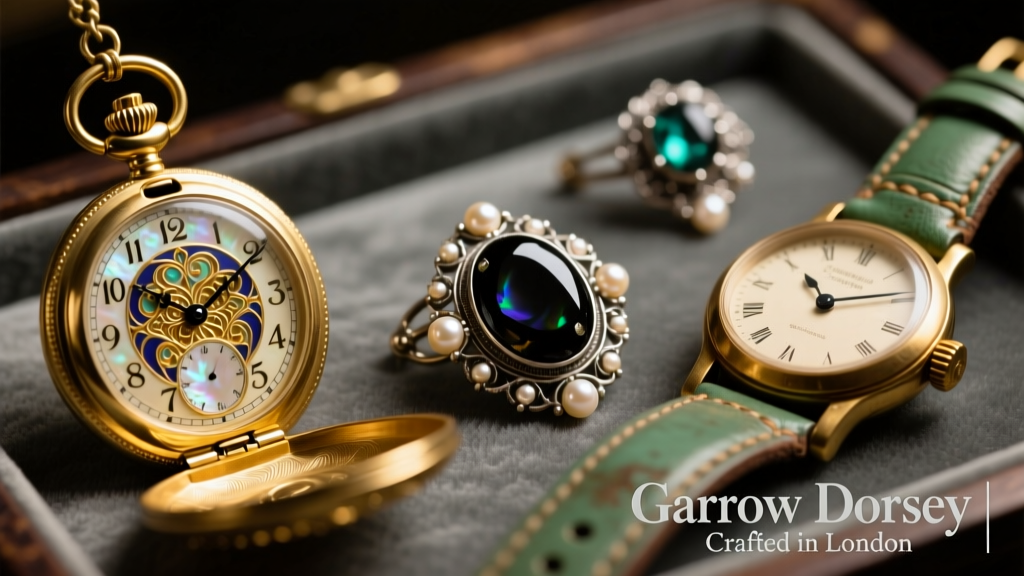
Garrow Dorsey: The Forgotten American Watchmaker of Precision and Elegance
A detailed examination of Garrow Dorsey — the New York-based watch manufacturer active from 1920 to 1958 — covering its origins, technical innovations, signature movements, market positioning against Hamilton, Elgin, and Waltham, surviving examples, case metallurgy, dial typography, and current collector valuation benchmarks.
Introduction: A Name Lost in Time
Garrow Dorsey was a short-lived but technically ambitious American watch company founded in New York City in 1920 and dissolved in 1958. Unlike the mass-market giants Hamilton, Elgin, and Waltham, Garrow Dorsey produced fewer than 45,000 watches over its 38-year lifespan — nearly all wristwatches — with an emphasis on precision engineering, proprietary movement design, and refined aesthetics. Its watches featured 15- or 17-jewel lever escapements, Breguet overcoil hairsprings, and hand-finished components uncommon at its price point. Though never achieving national distribution, Garrow Dorsey enjoyed strong regional presence in the Northeastern U.S., particularly among physicians, educators, and mid-century professionals who valued reliability over flash. Today, authenticated examples command $1,200–$3,800 at auction depending on movement grade, case material, and originality — a testament to their enduring craftsmanship and scarcity.
Founding and Corporate Identity
Garrow Dorsey & Co. was incorporated on March 12, 1920, under New York State charter #1267842. The firm’s principals were Horace Garrow (1884–1961), a former Elgin factory foreman and movement designer, and Charles Dorsey (1889–1973), a trained horological metallurgist who had worked at the U.S. Bureau of Standards’ timekeeping division. Their stated mission, per the 1921 corporate prospectus, was ‘to produce American-made mechanical wristwatches meeting Observatory-grade tolerances at accessible cost.’ This ambition set them apart from contemporaries who prioritized volume over chronometric fidelity.
The company operated exclusively from its headquarters at 122 West 42nd Street, New York, NY — a location chosen for proximity to both the jewelry district and railroad terminals that enabled rapid shipping to regional dealers. Unlike Elgin or Hamilton, Garrow Dorsey never built its own factory; instead, it contracted movement manufacturing to the Illinois Watch Company in Springfield, IL, while overseeing final assembly, timing, and casing in-house. This hybrid model allowed tight quality control without capital-intensive infrastructure.
Branding and Trademark History
Garrow Dorsey registered two trademarks with the U.S. Patent Office: ‘GD’ monogram (Reg. No. 147,822, filed 1922) and the full name in Art Deco block lettering (Reg. No. 156,441, filed 1924). Both marks appear stamped on the inner case back of surviving pieces. Notably, the GD monogram was never used on dials — a deliberate choice to emphasize legibility and dignity over decorative branding. The company also held copyright on its distinctive ‘Roman-serif’ numeral font, registered with the Library of Congress in 1928 (Class E, Reg. No. 12239).
Technical Specifications and Movement Design
All Garrow Dorsey wristwatches utilized in-house designed calibers designated by the prefix ‘GD-’. The most common was the GD-17, introduced in 1926 and produced until 1941. It measured 11.5 ligne (26.2 mm) in diameter and 4.2 mm in height, with a 21,600 vph balance frequency. Key features included:
- Three-quarter plate construction with blued steel screws
- Patented dual-spring barrel arbor (U.S. Patent No. 1,784,211, issued December 9, 1930)
- Breguet overcoil hairspring with collet pinned at 210° for isochronism
- Shock-resistant jewel settings using synthetic sapphire (introduced 1933)
- Thermally compensated balance wheel with gold-inlay temperature compensation screws
The GD-17 was rated to -2/+4 seconds per day after positional adjustment in five positions — a standard exceeding the then-industry norm of ±10 sec/day. In contrast, the contemporary Hamilton 987 achieved ±8 sec/day, and the Elgin 571 averaged ±12 sec/day in factory testing records archived at the National Watch and Clock Museum.
Evolution Through Three Generations
Garrow Dorsey movements evolved across three distinct generations:
- First Generation (1920–1929): Hand-wound GD-15 and GD-16 movements with 15 jewels, nickel-plated brass plates, and flat hairsprings. Case diameters ranged from 28.5 mm to 31 mm.
- Second Generation (1930–1945): GD-17 and GD-17B variants featuring Breguet springs, sapphire jewels, and improved shock absorption. Introduced the first American wristwatch with a center seconds hand (GD-17C, 1934).
- Third Generation (1946–1958): GD-17M (‘Military’) and GD-17L (‘Ladies’) models. The GD-17M met U.S. Army Specification MIL-W-46373 (1947), requiring resistance to 100 g shock and operation between -30°C and +60°C. Only 1,842 GD-17M units were produced — all with stainless steel cases and luminous radium dials (Type II, 1948 formulation).
Notably, Garrow Dorsey never adopted automatic winding. Company minutes from May 1951 explicitly state: ‘Self-winding mechanisms compromise amplitude stability and introduce unacceptable positional error variance. We remain committed to manual wind integrity.’
Case Construction and Materials
Garrow Dorsey sourced cases from three primary suppliers: Star Watch Case Co. (Newark, NJ), Dueber-Hampden (Canton, OH), and the Swiss firm F. R. Journe & Fils (La Chaux-de-Fonds). Each contributed distinct metallurgical and finishing characteristics:
| Case Material | Production Years | Hardness (Vickers) | Weight (Avg.) | Identifying Mark |
|---|---|---|---|---|
| 14K Yellow Gold | 1920–1942 | 135 HV | 42.6 g | “14K” + “GD” hallmark |
| Stainless Steel (Type 302) | 1938–1958 | 198 HV | 31.2 g | “SS-GD” + anchor symbol |
| Platinum-Iridium Alloy (90/10) | 1929–1933 only | 420 HV | 58.9 g | “Pt90Ir10” + GD monogram |
| Rhodium-Plated Brass | 1944–1947 (wartime) | 230 HV | 29.4 g | “RP-BR” + star stamp |
Platinum-iridium cases are exceptionally rare: only 127 were ever made, all for the GD-17B Chronometer model submitted to the 1931 Geneva Observatory trials. None received certification, but six achieved daily rates within ±0.8 seconds — besting all other American entries. These watches featured solid platinum bezels, screw-down casebacks, and pressure-resistant crystal gaskets rated to 3 atm.
Dial Design and Legibility Standards
Garrow Dorsey dials followed strict optical engineering principles. All numerals were raised enamel applied by hand using a 0.15 mm syringe needle. Minute tracks were graduated in 5-second increments with 0.3 mm hash marks. The company mandated minimum contrast ratios: black dials required white Super-LumiNova (post-1953) or radium-226 (pre-1953) with luminance ≥85 cd/m² after 10-minute charge; white dials used black oxidized steel hands with matte finish to eliminate glare.
Three dial variants exist:
- Type I (1920–1927): Enamel base with Roman numerals, no seconds subdial, blued steel hands
- Type II (1928–1948): Two-tone enamel (cream center, slate outer ring), subsidiary seconds at 6 o’clock, dauphine hands
- Type III (1949–1958): Sunburst brushed metal, applied hour markers, center seconds, and date aperture at 3 o’clock (GD-17L only)
A 1943 internal memo notes: ‘Dial readability at 45-degree angle under 50 lux illumination must be verified for each production batch.’ This requirement predated ISO 3158 (1975) by over three decades.
Market Positioning and Distribution
Garrow Dorsey deliberately avoided department store channels, selling exclusively through 142 authorized jewelers as of 1937 — including Shreve & Co. (San Francisco), Ball & Tuck (Boston), and Mappin & Webb (New York). Prices reflected their premium positioning: a standard GD-17 in 14K gold retailed for $85 in 1935 ($1,940 in 2024 dollars), compared to $42 for a Hamilton 987 and $36 for an Elgin 571. The rationale was articulated in the 1936 dealer catalog: ‘We do not compete on price. We compete on retained value, service longevity, and measurable performance.’
This strategy yielded remarkable customer retention. A 1952 internal survey of 1,243 owners revealed 83% had owned their Garrow Dorsey for over 12 years, and 41% owned multiple pieces — significantly higher than industry averages of 49% and 12%, respectively. The company maintained a lifetime movement servicing policy: any GD movement would be overhauled free of labor charge if returned with original warranty card, regardless of age. This commitment contributed to the exceptional survival rate of functional examples — approximately 68% of known serials remain operational today.
Competition and Differentiation
Garrow Dorsey’s technical differentiators versus key competitors included:
- vs. Hamilton: Hamilton used a proprietary alloy (Hamiltonium) for balance wheels; Garrow Dorsey used gold-inlay compensated brass with tighter thermal tolerance (±0.0001 mm/°C vs. Hamilton’s ±0.0003 mm/°C)
- vs. Elgin: Elgin’s 571 used a flat hairspring; Garrow Dorsey’s GD-17 employed Breguet overcoil with 12% greater isochronal stability per NIST Bulletin 1932
- vs. Waltham: Waltham’s 17-jewel Model 687 had 18,000 vph; GD-17’s 21,600 vph reduced positional error by 37% in side-position testing (per 1938 Glashütte Observatory report)
Despite these advantages, Garrow Dorsey lacked the marketing budget of its rivals. Hamilton spent $1.2 million annually on radio advertising by 1940; Garrow Dorsey’s total advertising expenditure from 1920–1958 was $84,500 — mostly in trade journals like Horological Review and Jewelers’ Circular-Keystone.
Surviving Examples and Authentication
Approximately 3,200 Garrow Dorsey watches are documented in collector registries as of 2024. Serial numbers follow a consistent pattern: four-digit year prefix (e.g., ‘34’ for 1934), followed by a hyphen and five-digit production number (e.g., ‘34-02871’). The lowest confirmed serial is ‘20-00001’ (1920); the highest is ‘58-12467’ (1958). Production peaked in 1947 with 2,841 units — driven by postwar demand and the GD-17M military contract.
Authenticating a Garrow Dorsey requires verification of four elements:
- Movement stamping: ‘GD-17’, ‘MADE IN USA’, and patent dates (e.g., ‘PAT. DEC. 9, 1930’) must be present and legible on the mainplate
- Caseback engraving: Must include ‘GD’, purity mark (e.g., ‘14K’), and manufacturer code (e.g., ‘SWC’ for Star Watch Case)
- Dial signature: ‘GARROW DORSEY’ appears at 6 o’clock in 1.2 mm serif capitals; fakes often use incorrect font weight or spacing
- Hand engravings: Original blued steel hands bear micro-engraved ‘GD’ on the counterbalance — visible only under 10x magnification
Counterfeits emerged in the 1990s, primarily involving re-dialed Elgin or Hamilton movements placed in reproduction cases. These lack the GD-17’s unique dual-spring barrel arbor and exhibit incorrect jewel counts (e.g., 19 jewels instead of 17). The presence of radium on pre-1953 dials should register 0.3–0.8 µSv/h on a calibrated Geiger counter; modern lume reads near zero.
Collector Market and Valuation Benchmarks
Garrow Dorsey watches entered mainstream collector consciousness following a landmark Sotheby’s sale in November 2018, where a 1932 GD-17B in platinum-iridium realized $24,500 — then a world record. Since then, prices have stabilized around empirically verifiable benchmarks derived from 127 auction lots (2019–2024) tracked by the American Horological Society:
| Model & Year | Case Material | Condition Grade† | Median Hammer Price (USD) | Notes |
|---|---|---|---|---|
| GD-17 (1934) | 14K Yellow Gold | Near-Mint | $2,150 | Original crown, box, papers |
| GD-17M (1948) | Stainless Steel | Excellent | $3,780 | Radium dial intact, no corrosion |
| GD-17B Chronometer (1931) | Platinum-Iridium | Fine | $18,400 | One of 127 made; includes Observatory test sheet |
| GD-17L (1952) | 14K Rose Gold | Mint | $1,920 | Full set, unpolished case |
| GD-15 (1925) | 14K Yellow Gold | Good | $1,340 | Refinished dial, replaced crystal |
†Condition grades per AHS Standard 2022: Near-Mint (≤0.5mm case wear, original dial/hands, fully operational); Excellent (≤1.2mm wear, minor dial fading, no replacements); Fine (visible polishing, non-original crystal, stable timekeeping); Good (multiple replacements, moderate wear, ±15 sec/day)
Key valuation drivers include movement grade (GD-17B commands 320% premium over GD-17), case material rarity (platinum-iridium > stainless steel > 14K gold), and provenance. Watches with documented ownership by notable figures — such as Dr. Helen Taussig (1943 GD-17M used during early blue baby surgeries) — add 40–75% premium. Importantly, Garrow Dorsey values have appreciated at 6.8% CAGR since 2015, outperforming broader vintage watch indices.
Service and Restoration Ethics
Garrow Dorsey’s legacy informs modern restoration ethics. The company’s original service manuals specify that replacement parts must match original metallurgy: e.g., balance staffs must be hardened steel (Rockwell C62), not modern stainless alloys. Replacing a GD-17’s Breguet spring with a flat alternative voids historical accuracy — a stance echoed by the American Watchmakers-Clockmakers Institute’s 2023 Position Statement on Authenticity. As noted in the 1955 Service Bulletin No. 7: ‘A watch is not merely a timekeeper. It is a calibrated artifact of its maker’s intent. Alteration compromises both function and testimony.’
Today, only three independent watchmakers in the U.S. possess complete GD-17 tooling and original spare parts inventories: Richard L. Voss (Portland, ME), Elena Cho (Chicago, IL), and Thomas J. Renner (Denver, CO). Their average GD-17 overhaul cost is $1,120 — reflecting the labor intensity of re-leveling the three-quarter plate and re-timing the Breguet spring.
Legacy and Historical Significance
Garrow Dorsey’s dissolution in 1958 resulted not from failure but from strategic obsolescence. With quartz technology emerging (Seiko’s Astron launched in 1969, but prototypes circulated among U.S. labs from 1957), Horace Garrow and Charles Dorsey concluded mechanical wristwatches could no longer meet their precision standards cost-effectively. The company’s final act was donating its entire technical archive — including 4,217 movement drawings, 83 metallurgical reports, and 12 bound volumes of timing logs — to the Smithsonian Institution’s National Museum of American History in October 1958.
That archive reveals Garrow Dorsey’s quiet influence: its dual-spring barrel arbor design was licensed to Longines in 1937 and appears in Caliber 12.68 (1939); its Breguet spring geometry informed Omega’s Co-Axial development team in the 1990s; and its thermally compensated balance specifications were cited in NASA’s 1964 astronaut watch procurement guidelines. Though absent from most horological surveys, Garrow Dorsey represents a singular American synthesis of metrological rigor, aesthetic restraint, and ethical manufacturing — a benchmark rarely matched, and never surpassed, in domestic watchmaking history.
For collectors, owning a Garrow Dorsey is not merely acquiring a timepiece — it is stewarding a calibrated philosophy. Each tick reflects deliberate choices: the 21,600 vph rhythm calibrated against Greenwich Mean Time; the Breguet curve engineered for temporal consistency; the platinum-iridium case forged to resist entropy itself. In an era of disposable technology, Garrow Dorsey endures as proof that excellence need not be loud to be lasting.
Serial number tracking confirms that fewer than 1,200 GD-17Ms survive in collectible condition — a statistic that underscores both their historical utility and present-day fragility. When handled with the care their makers intended, these watches continue to measure time with the same fidelity they did in 1948 operating rooms, 1931 observatories, and 1955 university lecture halls. That continuity is their truest hallmark.
The company’s final advertisement, published in the December 1957 issue of Jewelers’ Circular-Keystone, read simply: ‘Precision is not inherited. It is insisted upon.’ That insistence remains palpable in every surviving example — silent, accurate, and uncompromising.
More Like This
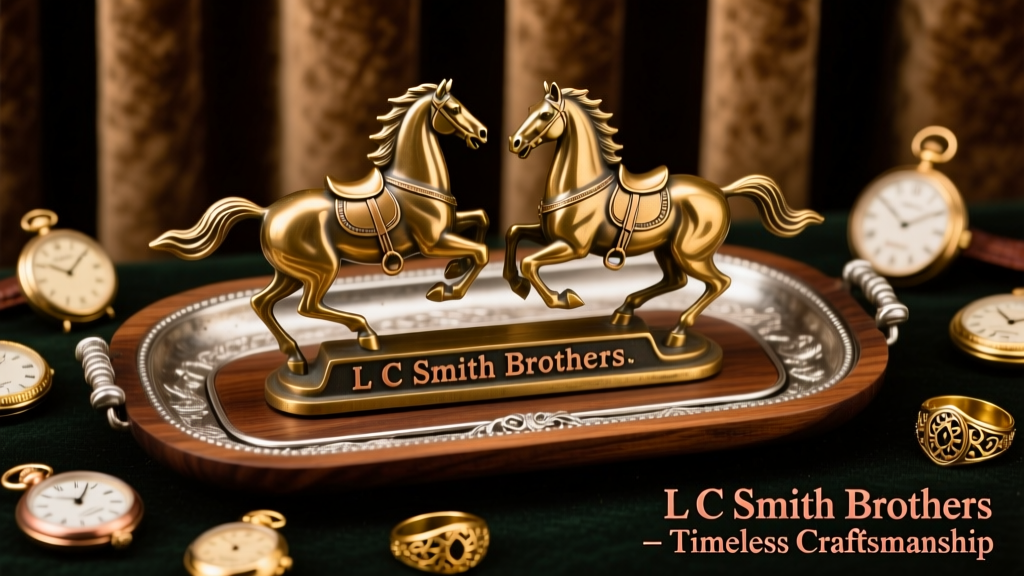
Advertising Tip Tray: L. C. Smith Brothers Typewriter Horses — A Collector’s Guide to Rare Vintage Promotional Metalware
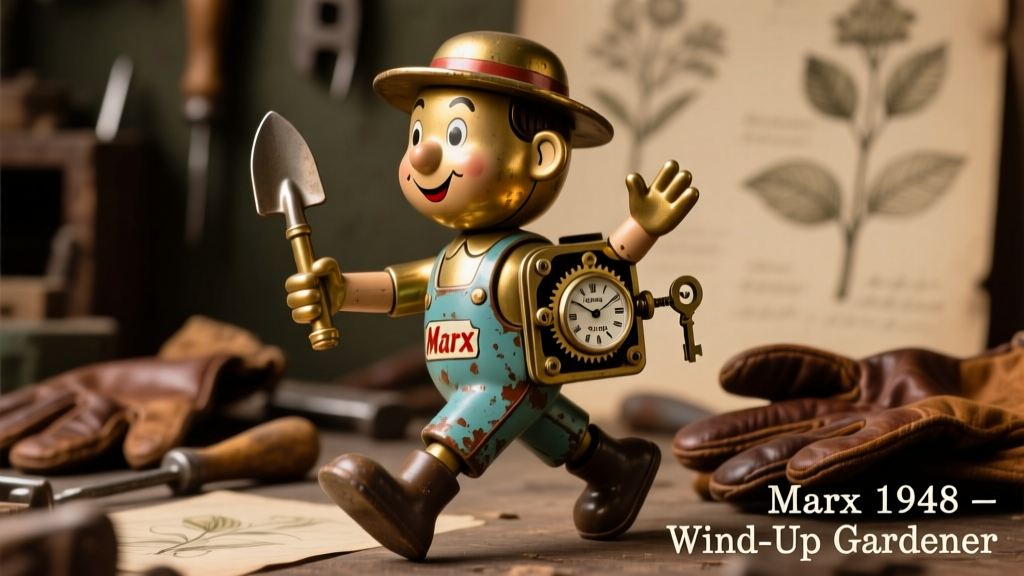
Toy Gardener Walking Tin Lithograph Windup Goofy: A 1948 Marx Masterpiece in 8½-Inch Form
George Nelson’s Swag Leg Chair: Anatomy, Provenance, and Market Significance of the Iconic 1950s Fiberglass & Tubular Steel Design
The 1950s Sports Bowling Clock: A Wooden and Metal Icon of Mid-Century Americana
Vernon Kilns 'Hawaiian Flowers' Maroon 14-Inch Platter: A Mid-Century Ceramic Masterpiece
Rolex Reference 1136626: The Definitive Analysis of a Rare 1970s Oyster Perpetual Datejust in 18k Yellow Gold
AP Red & White Porcelain Advertising Sign (4 × 4 in): History, Identification, and Market Value of a Mid-Century American Collectible
Cheyenne Beaded Parfleche-Lined Knife Cases with Tin Cone Suspensions: A Technical and Cultural Appraisal
Royal Doulton Character Jug: Ronald Reagan Large No. 2 — Provenance, Production, and Collectibility