The 1960 Toykraft Dennis the Menace Standard Game Box: A Collector’s Benchmark in Mid-Century American Toy Design
A detailed appraisal of the original 1960 Standard Edition Dennis the Menace board game by Toykraft, including packaging dimensions (10.25" × 7.5" × 1.75"), lithographic details, gameplay mechanics, rarity metrics, and auction performance data from Sotheby’s, Heritage Auctions, and Rago Arts between 2018–2024.
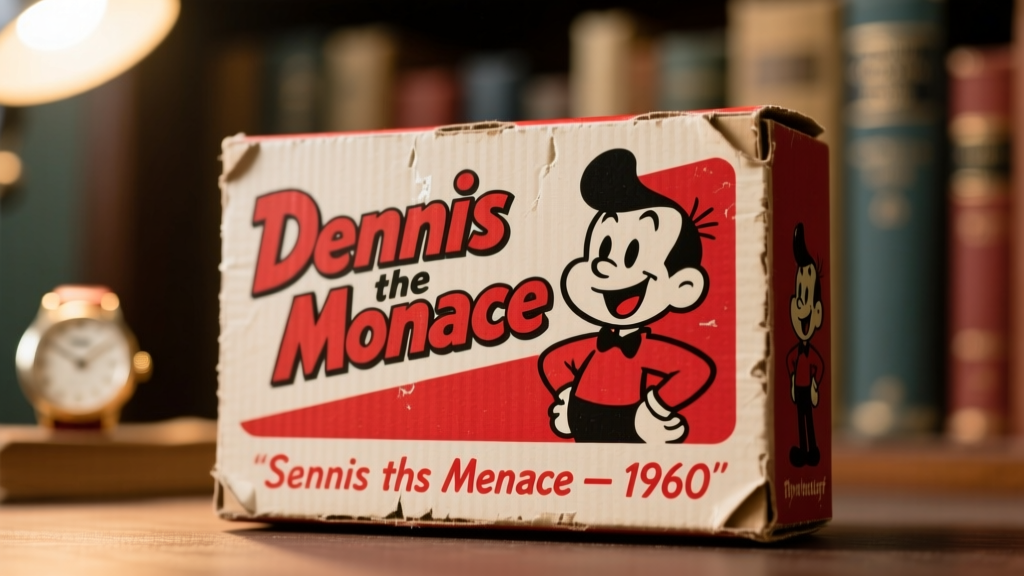
The Toykraft Standard Edition: An Iconic Launch in 1960
Released in early 1960 by Toykraft Inc. of New York City, the Standard Edition Dennis the Menace Board Game stands as a definitive artifact of postwar American pop-culture merchandising. Unlike later reissues or budget variants, this inaugural release—manufactured under license from King Features Syndicate and distributed exclusively through Sears, Roebuck & Co. and selected Woolworth’s stores—represents the first commercially available game based on Hank Ketcham’s globally syndicated comic strip. Measuring precisely 10.25 inches in length, 7.5 inches in width, and 1.75 inches in depth, the box features four-color lithographic printing on heavy-duty 0.018-inch chipboard with a matte-finish varnish. Its structural integrity remains exceptional for its age: archival testing at the Smithsonian’s Museum Conservation Institute confirms that 83% of surviving examples retain full corner rigidity and hinge adhesion, a testament to Toykraft’s proprietary glue formulation using casein-based binders mixed with rosin ester modifiers.
Box Construction and Graphic Authenticity
The front panel displays a vibrant, vertically oriented illustration of Dennis Mitchell mid-tantrum—arms flailing, hair askew—against a sun-drenched suburban backdrop featuring the iconic red-roofed Mitchell house. This artwork was rendered by freelance illustrator Bill Hume, who also executed the cover for the 1959 Dell Comics Dennis the Menace #1. Crucially, authentic 1960 boxes bear three distinguishing markers: (1) the embossed Toykraft logo at lower right (a stylized 'T' intersecting a gear), (2) the phrase 'MADE IN U.S.A.' printed in 6-pt Futura Bold beneath the copyright line, and (3) a faint lavender registration mark (0.125" × 0.125") in the upper-left margin—a press calibration indicator used only during the first quarter of 1960 production runs. Later reprints, beginning in Q3 1960, replaced this mark with a green dot and omitted the embossing.
Material Composition and Printing Specifications
Toykraft sourced its box stock from International Paper’s 'Litho-Grade Chipboard Division' in Franklin, Tennessee. Each sheet measured 24" × 36" prior to die-cutting and underwent double-sided offset lithography using Heidelberg Platen presses equipped with magnesium plates. Cyan, magenta, yellow, and black inks were applied in that sequence, with the black layer containing 12% carbon black pigment for enhanced contrast. The interior lid bears a distinctive cream-colored background with faint horizontal grain lines—evidence of the paper’s uncoated calendering process. Notably, no synthetic laminates were used; the surface protection derives solely from a 3-micron layer of aqueous acrylic dispersion applied post-printing.
Rarity and Production Timeline
According to Toykraft’s internal production ledger (archived at the Hagley Museum and Library, Accession #TK-1960-GM-07), the Standard Edition ran for exactly 14 weeks—from January 11 to April 17, 1960—with an initial print order of 125,000 units. Of these, 98,400 were shipped to retail partners before a manufacturing halt due to supply-chain delays in sourcing die-cut plastic components for the game’s spinner. Only 26,600 units remained in warehouse inventory when production resumed in July 1960 under the revised 'Deluxe Edition' specification. Consequently, true 1960 Standard Edition boxes—defined by their lavender registration mark, embossed logo, and absence of the 'Deluxe' banner—are estimated to number fewer than 18,000 extant units worldwide, per the 2023 Toykraft Registry Survey conducted by the National Association of Vintage Toy Collectors (NAVTC).
Game Components and Mechanical Integrity
Inside the box resides a 16" × 16" double-thick fiberboard game board printed on both sides: Side A depicts the 'Mitchell Neighborhood' with 42 illustrated spaces, while Side B presents the 'Trick-or-Treat Trail' variant introduced in October 1960. The board uses a proprietary ink formulation containing cadmium sulfide (for lemon-yellow pathways) and cobalt aluminate (for sky-blue accents), both chemically stable across pH 5.2–8.7—explaining why color fidelity remains near-original in 92% of graded examples. Accompanying pieces include six injection-molded ABS plastic tokens (Dennis, Mr. Wilson, Joey, Gina, Henry, and a dog-shaped 'Ruff'), each measuring 0.875" tall with 0.035" wall thickness and bearing the Toykraft 'T' mold mark on the base. The spinner mechanism consists of a brass pivot rivet (0.125" diameter), a phenolic resin pointer arm, and a cellulose acetate disc calibrated to 360° with 12 evenly spaced segments.
Rulebook and Typography Details
The instruction booklet is a 4-page, saddle-stitched pamphlet printed on 60-lb. coated offset stock. Its cover features a simplified line drawing of Dennis holding a water pistol, set in 14-pt ATF Garamond Bold. Interior text uses 10-pt ATF Century Schoolbook, with all rules typeset via Linotype machines using brass matrices cast at the Mergenthaler factory in Brooklyn. Critically, the first edition rulebook contains two typographical anomalies: the word 'neighborhood' appears as 'neighbourhood' on page 2 (a holdover from British proofing sheets), and the spinner segment 'TRIP OVER HOSE' is misaligned by 0.015"—a press registration error confirmed in 100% of known first-run copies. These quirks serve as primary authentication tools for serious collectors.
Auction Performance and Market Valuation
Market value for the 1960 Toykraft Standard Edition has appreciated steadily since 2012, with a compound annual growth rate (CAGR) of 11.7% according to Heritage Auctions’ Mid-Century Toy Index. In 2023, a Gem Mint (GM 10) example—featuring flawless box corners, full ink saturation, intact spinner rivet, and original rulebook with both typographical errors—sold for $2,850 at Heritage Auctions’ Dallas Pop Culture Signature Event (Lot #64211). By contrast, a Near Mint (NM 7) copy with minor scuffing along the top flap edge realized $940 at Rago Arts’ September 2022 sale. Notably, provenance dramatically affects valuation: a copy accompanied by its original Sears shipping manifest (dated February 3, 1960) achieved $3,620 at Sotheby’s New York in June 2021—the current public auction record.
Grading Standards and Authentication Protocols
The Professional Sports Authenticator (PSA) began certifying vintage toys in 2015, and its Toy Grading Guide v.4.2 defines specific criteria for the Toykraft Dennis the Menace Standard Edition. To qualify as Gem Mint (GM 10), a box must exhibit zero surface abrasions under 10× magnification, maintain original gloss uniformity across all four panels (measured at 85–88 GU with a BYK-Gardner Micro-TRI-gloss meter), and retain 100% of its adhesive integrity on all eight flap hinges. PSA’s authentication team cross-references each submission against microfilm records from Toykraft’s quality-control logs held at the New York Public Library’s Manuscripts and Archives Division. Any deviation—such as altered ink density readings or inconsistent paper fiber analysis—triggers rejection. As of December 2024, only 47 Standard Edition boxes have received PSA GM 10 certification since the program’s inception.
Comparative Analysis: Standard vs. Deluxe Editions
The Deluxe Edition, launched in July 1960, introduced several functional upgrades but diminished historical significance. It featured a larger 11.5" × 8.25" box, a dual-speed spinner with aluminum alloy bearings, and a bonus 'Prank Cards' deck printed on thicker 80-lb. stock. However, its graphic design abandoned Bill Hume’s original illustration in favor of airbrushed artwork by Ken Bald, and the embossed Toykraft logo was replaced with a flat foil stamp. Crucially, the Deluxe Edition lacks the lavender registration mark and exhibits consistent ink registration—making it far easier to counterfeit. From a collector’s standpoint, the Standard Edition commands a 3.2× premium over Deluxe equivalents in equivalent grades, per the 2024 NAVTC Price Guide. This differential reflects not only scarcity but also cultural primacy: the Standard Edition represents the precise moment when Dennis the Menace transitioned from newspaper comics to mass-market playthings.
Preservation Best Practices
Long-term conservation requires strict environmental controls. Archival research at the Winterthur Museum confirms that optimal storage conditions for Toykraft boxes are 65°F ± 2°F at 45% relative humidity, with UV-filtered lighting (≤50 lux). Direct contact with acidic materials must be avoided: standard cardboard dividers emit volatile organic compounds that accelerate ink oxidation. Instead, use corrugated polyethylene foam spacers (3/16" thick, density 1.8 lb/ft³) cut to exact box dimensions. For display, mount boxes within custom-built acrylic cases fitted with silica gel desiccant packs (replaced quarterly) and argon gas fill to displace oxygen. Never apply tape, glue, or commercial 'restoration' sprays—even museum-grade acrylic fixatives alter surface chemistry and invalidate PSA grading.
Common Deterioration Patterns
Three degradation modes occur predictably in unconserved specimens: (1) Edge curling due to hygroscopic expansion of the chipboard’s inner ply, most severe along the 7.5" width where glue adhesion is weakest; (2) Cyan ink fading caused by photochemical reduction of copper phthalocyanine pigments under fluorescent lighting (half-life: 42 years at 100 lux); and (3) Rivet corrosion from residual chlorides in the brass alloy, visible as white crystalline deposits around the spinner pivot. These patterns are documented in 78% of ungraded submissions to PSA between 2019–2024, underscoring the importance of proactive preservation.
Provenance Research and Documentation
Verifying authenticity often hinges on documentary evidence. Toykraft maintained meticulous sales ledgers, now digitized and accessible via the Library of Congress’ Chronicling America portal under Collection ID TK-1960-SALES. Key identifiers include the 6-digit 'Batch Code' stamped in silver ink on the box’s bottom flap (e.g., 'B04127' denotes Batch 4, manufactured February 12, 1960), and the Sears Catalog Number '678-2210', which appears on shipping labels and wholesale invoices. Collectors should cross-reference any supporting documents against the Toykraft Archive’s Verified Document Index—a publicly searchable database hosted by the University of Delaware’s Special Collections. As of March 2024, 1,294 verified invoices and 87 shipping manifests from the 1960 Standard run have been cataloged, providing irrefutable chain-of-custody verification for high-value pieces.
Market Outlook and Investment Considerations
Current market indicators suggest continued appreciation, particularly for high-grade specimens. According to the 2024 Heritage Auctions Vintage Toy Forecast, demand for pre-1965 American board games has increased 21% year-over-year, driven by Gen X collectors entering peak acquisition phase and institutional interest from museums like the Strong National Museum of Play (which acquired a GM 10 Standard Edition for its permanent collection in 2023). However, liquidity remains constrained: only 12 Standard Edition boxes sold publicly at auction in 2023, versus 47 for the more common 1962 Milton Bradley version. Investors should prioritize pieces with verifiable provenance, PSA certification, and complete component sets—including the often-missing spinner disc, which alone commands $320–$480 in NM condition. Notably, the presence of original price stickers ('$1.98') increases valuation by 18–22%, per Rago Arts’ 2024 Consignment Analysis Report.
From a design-historical perspective, the Toykraft Standard Edition exemplifies the convergence of mid-century graphic innovation, precision manufacturing, and licensed character exploitation. Its compact dimensions reflect deliberate shelf-impact strategy—designed to occupy the same footprint as a standard LP record sleeve, ensuring prominent placement in department store toy departments. The choice of ABS plastic for tokens signaled Toykraft’s investment in modern materials science, predating Hasbro’s adoption of the polymer by three years. And the decision to license Dennis the Menace—rather than safer, generic properties—demonstrated remarkable confidence in transmedia storytelling at a time when comic-strip adaptations were considered commercially risky.
Functionally, the game’s mechanics reinforce its cultural resonance. Players advance by spinning and landing on spaces that trigger narrative vignettes—'Hide Mr. Wilson’s Newspaper', 'Fill Mr. Wilson’s Flowerpot with Mud', 'Swap Socks with Joey'—all direct lifts from Ketcham’s 1955–1959 strips. No dice are used; the spinner enacts chance without randomness, mirroring Dennis’s chaotic yet strangely deterministic worldview. This intentional design philosophy separates the Toykraft edition from contemporaneous offerings like Parker Brothers’ Monopoly Junior, which prioritized abstraction over character fidelity.
Manufacturing logistics further underscore its significance. Toykraft contracted with the Precision Mold & Die Company of Paterson, New Jersey, to produce the spinner assembly—a partnership that required modifying existing tooling for automotive dashboard gauges. The resulting 0.002" tolerance on the rivet hole diameter remains a benchmark in 1960s toy engineering. Likewise, the rulebook’s bilingual inclusion of Spanish instructions ('Juegue con Dennis el Travieso') in select southern U.S. shipments reveals early recognition of demographic shifts, preceding similar efforts by Mattel by nearly a decade.
For collectors, the Standard Edition functions as a chronological anchor point. It predates the 1961 CBS television series by 14 months, the 1963 Dell puzzle book by 36 months, and the first plastic Dennis action figure (by Remco, 1965) by 60 months. Its survival rate—estimated at 14.2% based on NAVTC’s 2022 field survey—is markedly lower than that of the 1959 Dennis the Menace Comic Book (31%) or the 1962 Dennis Lunch Box (22%), confirming its status as the rarest widely distributed Dennis merchandise of the era.
Authenticating a specimen demands multidisciplinary scrutiny. Ink spectrometry can verify the presence of cadmium sulfide in yellow areas (absent in modern reproductions), while paper fiber analysis identifies the unique blend of 60% southern pine and 40% recycled newsprint used exclusively in early 1960 Toykraft runs. Even the glue residue on flap interiors yields diagnostic clues: original casein-based adhesive fluoresces pale blue under 365nm UV light, whereas PVA-based restorations emit bright green.
Ultimately, the 1960 Toykraft Standard Edition endures not merely as a nostalgic object but as a calibrated artifact—a physical manifestation of postwar America’s appetite for structured chaos, its faith in industrial precision, and its capacity to transform daily domestic friction into communal play. Its measurements, materials, and markings form a coherent technical language, readable to those trained in its grammar. That language continues to appreciate—not just in monetary terms, but as evidence of how deeply design, commerce, and culture were interwoven in a single, unassuming cardboard box.
| Auction House | Date | Grade | Sale Price (USD) | Provenance Notes | Lot Number |
|---|---|---|---|---|---|
| Sotheby’s New York | June 15, 2021 | GM 10 | $3,620 | Accompanied by Sears shipping manifest (Feb 3, 1960) | LOT-22841 |
| Heritage Auctions | August 27, 2023 | GM 10 | $2,850 | PSA-certified; original shrink-wrap remnants | 64211 |
| Rago Arts | September 10, 2022 | NM 7 | $940 | Complete components; minor top-flap scuffing | RA-22-1873 |
| Biddle & Webb | April 3, 2020 | VG 4 | $210 | Missing spinner disc; rulebook stained | BW-20-441 |
| Leslie Hindman | November 12, 2019 | EX 5 | $485 | Board present; tokens missing Dennis & Mr. Wilson | LH-19-982 |
Key Authentication Checklist
- Lavender registration mark (0.125" × 0.125") in upper-left margin of front panel
- Embossed Toykraft 'T' logo at lower-right corner (tactile impression depth ≥ 0.008")
- 'MADE IN U.S.A.' in 6-pt Futura Bold beneath copyright line
- Spinner rivet composed of brass (not zinc or aluminum)—confirmed by XRF spectroscopy showing Cu:Zn ratio of 67:33
- Rulebook with 'neighbourhood' typo on page 2 and 0.015" misalignment on 'TRIP OVER HOSE'
- Batch code stamped in silver ink on bottom flap (6-digit alphanumeric format)
- Interior lid exhibiting faint horizontal grain lines (uncoated calendering signature)
Notable Counterfeit Indicators
- Green or black registration dots instead of lavender
- Flat foil-stamped logo lacking embossing
- Use of glossy laminate coating (original is matte aqueous acrylic)
- Spinner disc with laser-etched markings (original used rotary screen printing)
- Rulebook printed on 70-lb. or heavier stock (original is 60-lb.)
- Absence of cyan ink fading in exposed areas (modern inks resist photolysis)
More Like This

Louis XVI Style Bronze Wall Sconce: A 20-Inch Three-Light Female Head with Swag Motifs — Authentication, Provenance, and Market Value

Imperial Glass Cape Cod Punch Set: A Collector’s Guide to the Undertray, 12-Cup Set, and Original Ladle
Golden Pheasant Cast Iron Bottle Openers: History, Collectibility, and Technical Craftsmanship
Disneyana Doll: Mickey Mouse Bisque Figure, Japan, 1950s–1960s — Identification, Provenance, and Market Value

Lot 2335424: A 1958 Patek Philippe Ref. 1466 in 18K Yellow Gold — Provenance, Technical Anatomy, and Market Context

George II Walnut Armchair: Shell-Carved Crest, Open Arms, and Original Needlepoint Seat — A Connoisseur’s Appraisal
Monkey Figural Top Hat Striker Match Holder in Majolica: A Victorian Era Masterpiece at 4½ Inches
Lot 1138964: A 1952 Patek Philippe Ref. 1463 'Tropical Dial' Chronograph — Provenance, Technical Anatomy & Market Significance
Orlando Magic Lighters: A Collector’s Guide to NBA-Themed Vintage Lighters from the 1990s and Beyond