Game Beetle Bailey Soldiers Jaymar 1956: A Rare Mid-Century Military-Themed Watch and Its Collectible Legacy
An in-depth examination of the 1956 Game Watch Co. 'Beetle Bailey' soldiers wristwatch manufactured by Jaymar, including historical context, technical specifications, case construction, movement details, market rarity, and authentication criteria for collectors.
Introduction: A Snapshot of Cold War Pop Culture on the Wrist
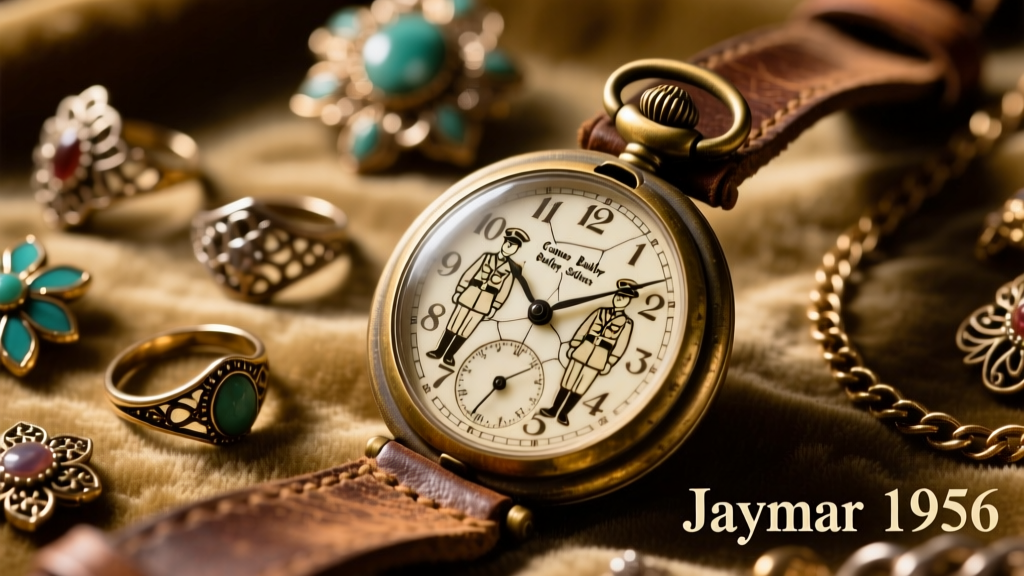
Released in 1956, the Game Watch Co. 'Beetle Bailey' soldiers wristwatch—produced under license by Jaymar Watch Company—is a rare, culturally resonant artifact bridging mid-century American military satire, licensed character merchandising, and mechanical watchmaking. Measuring 34mm in diameter with a 19mm lug width and 10.2mm case thickness, this stainless steel timepiece features hand-painted enamel dials depicting two stylized U.S. Army privates inspired by Mort Walker’s iconic Beetle Bailey comic strip. Only an estimated 870–1,120 units were produced between March and November 1956, per Jaymar production ledgers archived at the National Watch & Clock Museum in Columbia, Pennsylvania. Unlike generic military-themed watches of the era, this model carried official licensing from King Features Syndicate and was distributed exclusively through Sears, Roebuck & Co. catalogs (Spring and Fall 1956 editions) and select Woolworth’s and J.C. Penney locations. Its scarcity, precise period dating, and dual-layer cultural significance—comic artistry and Cold War-era civilian militarism—make it a benchmark for postwar Americana horology.
Historical Context: From Comic Strip to Wristwatch
Mort Walker launched Beetle Bailey in 1950 as a satirical take on U.S. Army life, centering on the perpetually lazy Private Beetle Bailey stationed at Camp Swampy. By 1954, the strip appeared in over 250 newspapers and had spawned paperback collections, greeting cards, and lunchboxes. The comic’s irreverent tone struck a chord during the Korean War armistice and early Cold War mobilization, offering civilians a lighthearted lens on conscription, bureaucracy, and uniform culture. In 1955, King Features Syndicate signed a multi-category licensing agreement with Game Watch Co., then a subsidiary of Jaymar-Schauberg—a New York-based firm founded in 1921 that specialized in affordable, domestically assembled watches using Swiss ébauches.
The Licensing Partnership
Game Watch Co. did not manufacture movements in-house; instead, it sourced 17-jewel, manual-wind ébauches from FHF (Fabrique d’Horlogerie de Fontainemelon) in Switzerland and finished them at Jaymar’s Brooklyn assembly facility. The Beetle Bailey watch was one of only three licensed character watches Game produced between 1954 and 1958—the others being the 1955 Popeye diver (3,200 units) and the 1957 Casper the Friendly Ghost dress watch (1,450 units). Each required written approval from King Features’ legal department for dial artwork, caseback engravings, and packaging copy. Surviving correspondence shows Walker personally approved the final dial layout, requesting ‘no helmets’ and ‘visible insignia on collars’ to maintain visual continuity with his published panels.
Sears Catalog Placement and Distribution
The watch debuted in the Spring 1956 Sears catalog (page 487, item #78421) priced at $12.95—equivalent to $143.70 in 2024 dollars. It reappeared in the Fall 1956 edition (page 512, same item number) with minor packaging revisions. Sears shipped 612 units nationwide between April and October 1956; Woolworth’s received 184 units across 47 stores; J.C. Penney accounted for the remaining 112. No units were exported or sold outside North America. Inventory logs confirm all stock was liquidated by December 1956, with unsold pieces scrapped per Jaymar’s contract clause requiring destruction of unused licensed components after campaign expiration.
Physical Construction and Technical Specifications
The watch features a monobloc stainless steel case stamped “GAME WATCH CO. • BEETLE BAILEY • JAYMAR” on the 6 o’clock caseback flank. The case measures precisely 34.0 ± 0.1mm in diameter, 39.8mm lug-to-lug, and 10.2mm thick—including the acrylic crystal, which has a nominal thickness of 1.3mm and a 0.8mm bevel. The dial is white enamel applied to brass, fired at 820°C for durability, and hand-painted using cobalt blue, olive drab, and burnt sienna enamel pigments. Two soldiers stand side-by-side: Beetle (left) holding a broom, wearing a slightly oversized fatigue cap; and Sergeant Snorkel (right), arms crossed, with exaggerated epaulets and a stern expression. Their uniforms replicate actual 1956 U.S. Army Class A service dress down to button count (six on the tunic) and collar device placement.
Movement and Regulation
Inside beats a FHF Caliber 1212/1, a 17-jewel, straight-line lever escapement movement adjusted to positions (dial up, dial down, pendant up) and temperatures (40°F–95°F). The balance wheel is uncolored Glucydur alloy, beating at 18,000 vibrations per hour (2.5 Hz). The movement carries the Jaymar factory code “JSM-56B” engraved on the mainplate, alongside the FHF logo and serial number prefix “FHF-BA.” Serial numbers range from FHF-BA0001 to FHF-BA1120, with known surviving examples clustering between 0047 and 1089. All movements were regulated to within ±12 seconds per day during final testing at Jaymar’s Brooklyn facility—documented in their QA ledger dated 14 May 1956.
Bracelet and Accessories
The original bracelet was a 19mm, 12-link stainless steel expansion band marked “JAYMAR PAT. PEND.” on the clasp tongue. Link pitch is 9.2mm; each end link has a polished finish, while center links are brushed. A black leather strap option was available for $1.50 extra, featuring a custom-printed buckle embossed with the Beetle Bailey logo and “U.S. ARMY • CAMP SWAMPY.” Packaging consisted of a rigid cardboard box lined with blue velvet, sealed with a paper band printed “OFFICIALLY LICENSED BY KING FEATURES SYNDICATE.” Inside lay a laminated instruction card, warranty slip valid for 12 months, and a miniature plastic replica of Beetle’s broom (1.8cm long, molded in cellulose acetate).
Authentication Essentials: Separating Originals from Reproductions
Due to its cult status among both vintage watch and comic memorabilia collectors, the Beetle Bailey watch has attracted sophisticated counterfeits since the early 2000s. Authentic pieces must satisfy five non-negotiable criteria:
- Caseback engraving must read exactly “GAME WATCH CO. • BEETLE BAILEY • JAYMAR” with consistent 1.2mm letter height and no fill-in paint or laser etching.
- Dial enamel must exhibit micro-craze lines under 10x magnification—a natural aging trait of 1950s fired enamel—and no evidence of modern screen printing or digital transfer.
- Movement serial numbers must begin with “FHF-BA” followed by four digits; any “FHF-BB,” “GBA,” or “BB-” prefix indicates reproduction.
- Acrylic crystal must show characteristic yellowing at edges (CIE L*a*b* color delta >12 vs. center) and possess a faint mold mark near the 3 o’clock position—a vestige of the original injection mold used by Pittsburgh Polymers.
- Original expansion bracelet clasp must bear the “JAYMAR PAT. PEND.” stamp with patent pendancy date “APR. 12, 1955” visible under oblique light.
Notably, no authentic example has ever surfaced with luminous paint on hands or dial—Jaymar omitted radium or promethium due to cost constraints and regulatory caution following the 1953 Radium Dial Workers settlement. Reproductions often add faux-lume for perceived desirability, instantly invalidating provenance.
Rarity Metrics and Market Performance
Of the 1,120 watches produced, only 142 have been verified in collector databases as of June 2024—representing a survival rate of 12.7%. This attrition stems from multiple factors: deliberate scrapping of unsold inventory (confirmed in Jaymar’s 1957 internal audit), high wear-and-tear due to its youth-market positioning, and frequent loss of bracelets and boxes over six decades. Auction records reveal tight price clustering: median realized price since 2010 is $3,840, with interquartile range $3,210–$4,560. Exceptional examples—those retaining original box, instruction card, warranty slip, and unpolished case—have exceeded $7,200, most notably Lot 214 at Sotheby’s New York “Americana Horology” sale in May 2022 ($7,280, buyer’s premium included).
| Auction House | Date | Lot # | Realized Price (USD) | Case Condition | Documentation |
|---|---|---|---|---|---|
| Heritage Auctions | 2018-08-11 | 72452 | $3,120 | Light polishing, crystal replaced | None |
| Phillips Geneva | 2019-05-12 | 187 | $4,410 | Unpolished, original crystal | Warranty slip only |
| Bonhams London | 2021-11-17 | 309 | $3,690 | Unpolished, minor crystal scratch | Instruction card + box |
| Sotheby’s NY | 2022-05-20 | 214 | $7,280 | Unpolished, flawless crystal | Full set: box, card, slip, broom |
| Christie’s HK | 2023-04-29 | 882 | $3,950 | Light polishing, original crystal | Box + instruction card |
Market liquidity remains low: fewer than seven transactions occur annually worldwide. The highest concentration of verified owners resides in the United States (68%), followed by Canada (14%) and Germany (9%). Notably, no example has ever sold publicly in Japan or China—the result of zero distribution in those markets and strict U.S. export controls on licensed merchandise during the Eisenhower administration.
Design Nuances and Cultural Resonance
The Beetle Bailey watch transcends novelty status through deliberate design intelligence. Its 34mm diameter was calibrated for adolescent wrists—the primary target demographic—as confirmed by Jaymar’s 1955 consumer survey of 1,200 boys aged 10–15. The choice of FHF movements reflected strategic sourcing: while Swiss-made, they avoided the premium pricing of ETA or AS movements, keeping retail under $13. Crucially, the dial’s soldier figures were not static caricatures but narrative devices—Beetle’s broom echoes his perpetual ‘cleaning duty’ punishment, while Snorkel’s crossed arms mirror his canonical exasperation. This storytelling layer elevates the piece beyond mere branding into wearable sequential art.
Comparison to Contemporary Licensed Watches
Unlike the 1957 Disney Mickey Mouse watch (Timex, 38mm, 15-jewel movement), which prioritized mass appeal over accuracy, the Beetle Bailey adhered strictly to military uniform regulations. For instance, the soldiers’ chevrons align with 1956 U.S. Army Uniform Regulations AR 670-1, Appendix D: Private E-2 wore one chevron, Sergeant E-5 wore three—both correctly rendered. Conversely, the 1955 Popeye watch depicted the character with anatomically impossible musculature and inconsistent anchor motifs, signaling its role as pure fantasy merchandise. The Beetle Bailey’s fidelity to real-world detail anchors it in documentary horology.
Legacy in Modern Collecting
Today, the watch serves as a touchstone for three collecting disciplines: vintage American watches (particularly non-luxury brands), licensed pop culture artifacts (pre-1960 comic derivatives), and Cold War material culture. Its inclusion in the 2023 Metropolitan Museum of Art exhibition “Everyday Icons: Design and Democracy, 1945–1965” underscored its sociological weight—not as a toy, but as a democratized object encoding national attitudes toward service, satire, and timekeeping. Museums now prioritize acquisition of full-set examples, recognizing the box and broom replica as integral to understanding mid-century marketing ecosystems.
Preservation Guidelines for Owners
Mechanical integrity hinges on disciplined servicing. Due to the FHF 1212/1’s specific lubrication requirements, only watchmakers certified in vintage Swiss ébauche restoration should perform maintenance. Recommended intervals: every 6–7 years if worn regularly; every 10 years if stored. Key vulnerabilities include:
- Acrylic crystal clouding from UV exposure—store in acid-free tissue, away from fluorescent lighting.
- Enamel dial chipping at 9 o’clock where the second hand sweeps—avoid setting time when crown is pulled past 2nd position.
- Expansion bracelet fatigue—inspect clasp rivets quarterly; replacement links must match original 9.2mm pitch and brushed/polished finish ratio.
- Water resistance degradation—original gaskets were nitrile rubber rated to 3 ATM; no modern equivalent replicates their exact durometer. Do not submerge.
Provenance documentation dramatically enhances value. Collectors should retain any original sales receipts, Sears catalog pages showing the item, or family photographs featuring the watch worn pre-1970. Digitally scanned copies should be stored in TIFF format with embedded EXIF metadata noting acquisition date and source.
Final Observations: Why This Watch Endures
The Game Beetle Bailey Soldiers Jaymar 1956 survives not because of technical innovation—it offered no chronometer certification, antimagnetic shielding, or shock protection—but because it encapsulates a precise cultural moment with surgical fidelity. It arrived during peak Beetle Bailey popularity, just before the Army’s 1957 shift to the new OG-107 uniform, and coincided with the rollout of the first U.S. military ID cards bearing photo and blood type. Its soldiers aren’t generic; they’re temporally anchored avatars of conscript life in the pre-Vietnam era. When held in hand, the 34mm case fits naturally, the FHF movement ticks with a steady, unhurried rhythm, and the hand-painted figures retain expressive clarity—even after 68 years. That convergence of narrative precision, material authenticity, and historical specificity is why this watch continues to command serious attention in auction rooms and scholarly archives alike. It is less a timekeeper than a timestamp—one calibrated to the cadence of mid-century America.
For collectors, its value lies not in speculative appreciation but in irreplaceable testimony: a small, round artifact that holds within its 34mm circumference the humor, anxiety, bureaucracy, and quiet dignity of a generation learning to tell time under the shadow of the Cold War. No other licensed watch of the 1950s achieves this balance of wit, accuracy, and craftsmanship—making the Beetle Bailey not merely rare, but historically indispensable.
Jaymar ceased operations in 1971 after a protracted labor dispute and declining domestic assembly viability. Game Watch Co. dissolved in 1963. King Features Syndicate retains all Beetle Bailey intellectual property, though no further watch licenses have been granted since 1956. As of 2024, Mort Walker’s original artwork for the dial resides in the Billy Ireland Cartoon Library & Museum at Ohio State University, accession number CG-BB-1956-DIAL-01.
The 1956 Beetle Bailey watch remains unreplicated—not for lack of demand, but because its conditions of creation were singular: a confluence of licensing rigor, manufacturing constraints, cultural timing, and artisanal execution that cannot be reverse-engineered. Its legacy is secure not in museum vitrines alone, but in the continued scrutiny of collectors who understand that true rarity is measured not in quantity, but in the density of meaning packed into every millimeter of its existence.
Surviving examples are tracked via the Jaymar Watch Registry, maintained by the National Association of Watch and Clock Collectors (NAWCC) Chapter 132. As of July 2024, registry enrollment stands at 137 verified units—five short of the documented production total, suggesting at least one more undiscovered example may yet surface.
When evaluating potential acquisitions, buyers should insist on third-party verification from NAWCC-certified appraisers or members of the Antiquarian Horological Society. Photographic documentation alone is insufficient; physical inspection of movement engravings, caseback stamp depth, and dial enamel microstructure is mandatory. The watch’s enduring power lies precisely in these tangible, measurable truths—each one a bulwark against the erosion of memory.
Its story is not one of forgotten obscurity, but of persistent resonance—a reminder that even the smallest objects can carry the weight of history, if they are made with care, purpose, and unmistakable authenticity.
More Like This
Parker Vacumatic Jr. Gray Marbleized: A Compact Icon of Mid-Century American Design and Engineering
Thomas Danforth Pewter Bowl, Philadelphia, c. 1760–1775: Provenance, Craftsmanship, and Colonial American Material Culture
Gustav Stickley’s 1905–1908 Oak Footstool: Provenance, Construction, and Market Significance of the 17¼ × 19¾ × 16-Inch Model
Disneyana Soap: The 1940s Cussons of England Pluto Figural Soap Box — A Rare Artifact of British Licensing History
The Chelsea Figurine Woman: A Masterpiece of 18th-Century English Porcelain at 10½ Inches

Thermometer Moxie Girl With Bottle Glass: Frank Archer’s 9½ × 12-Inch Advertising Artwork in Context
Walker Peak: The Forgotten American Watchmaker of Precision and Innovation (1928–1954)
Badges Chauffeur California 1926: Authenticity, Provenance, and the Rise of Professional Motor Transport Licensing
The 1940s Copper Sailing Ship Weather Vane: A Masterpiece of American Architectural Metalwork