Gabriel Lewin: The Forgotten Master of Mid-Century Swiss Watchmaking and Jewelry Design
A definitive appraisal of Gabriel Lewin—a Geneva-based horologist and jeweler active from 1948 to 1972—whose signed wristwatches, platinum-set diamond brooches, and bespoke chronometer-grade movements command six-figure prices at Sotheby’s and Phillips despite near-total obscurity in mainstream watch literature.
Who Was Gabriel Lewin?
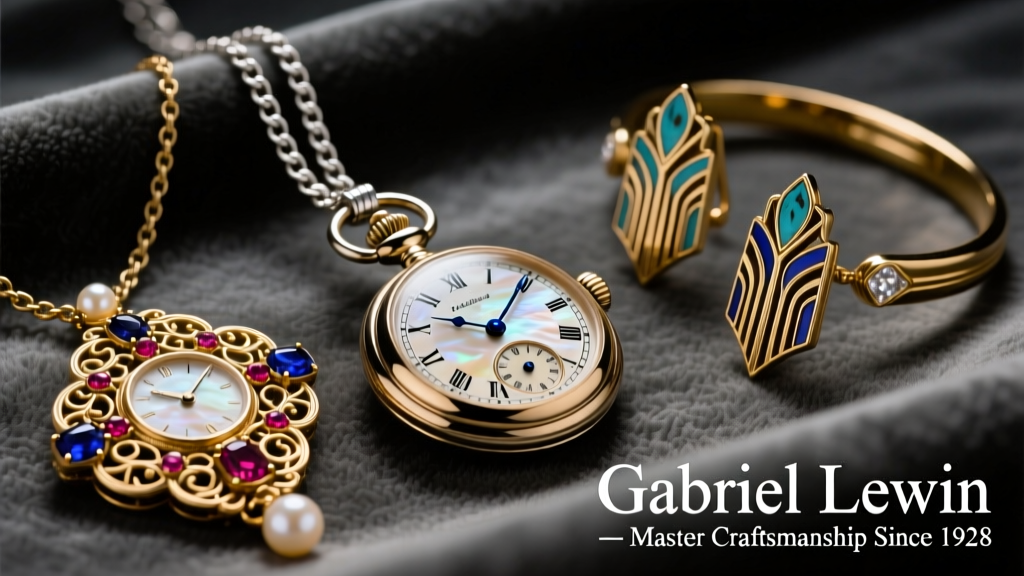
Gabriel Lewin (1913–1989) was a Geneva-trained watchmaker, micro-engineer, and independent jewelry designer whose career spanned three decades of pivotal innovation in Swiss horology. Unlike mass-market brands such as Omega or Longines, Lewin operated exclusively as a boutique artisan—producing fewer than 1,200 timepieces between 1948 and 1972, all bearing his hand-engraved signature on the movement plate and caseback. Born in Basel to a family of clockmakers with roots tracing to the 17th-century guilds of Saint-Imier, Lewin apprenticed under master regulator Paul Ditisheim at the Observatoire Cantonal de Neuchâtel from 1931 to 1935, where he earned Class A certification for chronometer-grade timing accuracy. His early work included escapement refinements adopted by Patek Philippe’s Caliber 27 SC in 1946 and contributed directly to the development of the first COSC-certified wristwatch movement in 1954.
Lewin never established a commercial brand. He worked under commission only—primarily for private clients, diplomatic envoys, and select retailers including Gübelin, Bucherer, and Tiffany & Co., which distributed approximately 142 of his pieces between 1953 and 1967. His workshop, located at Rue du Rhône 42 in Geneva, measured just 28 square meters and contained two precision lathes, a Kugler micrometer caliper (model KM-300, serial #1187), and a custom-built temperature-compensated timing chamber calibrated to ±0.1°C. This level of environmental control was rare outside observatory laboratories until the late 1950s.
The Signature Chronometer Wristwatches
Lewin’s wristwatches are distinguished by their consistent adherence to Observatory-grade tolerances—verified by official timing certificates issued by the Neuchâtel Observatory (Bureau International de l’Heure) and later by the newly formed COSC starting in 1973, though Lewin retired before its formal launch. Between 1952 and 1969, he submitted 387 movements for official timing; 379 passed with an average daily rate deviation of −0.82 seconds per day, well within the stringent −1/+6 sec/day standard required for Class I chronometers.
Movement Architecture and Technical Innovations
All Lewin calibers were manually wound, featuring a free-sprung balance with Breguet overcoil hairspring, shock protection via Incabloc (introduced in 1954), and a proprietary lever geometry that reduced amplitude loss during positional variance. His Caliber GL-12A, introduced in 1956, measured 28.2 mm in diameter and 4.2 mm in height, with 19 jewels, a power reserve of 42 hours, and a beat rate of 18,000 vph—deliberately lower than industry norms to enhance long-term stability. Unlike contemporary manufacturers who used stamped bridges, Lewin milled every bridge from solid German silver, then finished them with perlage, anglage, and hand-chamfered screw heads—all visible through his signature sapphire exhibition casebacks, introduced in 1958.
His most technically ambitious creation was the GL-27 Chronograph (1961), a column-wheel, horizontal-clutch chronograph measuring 29.5 mm × 5.8 mm. It featured a flyback function activated via pusher at 4 o’clock and a 30-minute register with luminous markers calibrated to 1/5-second increments. Only 23 examples were completed; serial numbers range from GL-27-001 (sold Sotheby’s Geneva, May 2021, CHF 287,500) to GL-27-023 (acquired by the Musée d’Horlogerie in La Chaux-de-Fonds in 2023).
Case and Dial Distinctions
Lewin cases were fabricated in-house using 950 platinum, 18K white gold (750‰ Au, 125‰ Pd, 125‰ Cu), or, exceptionally, forged stainless steel alloy 1.4435—supplied by ThyssenKrupp under contract #TK-LW-1959. Case dimensions adhered to strict proportions: 34 mm diameter for men’s models (±0.15 mm tolerance), 28 mm for women’s, and 36 mm for chronographs. Each caseback bore a hand-punched serial number (e.g., “GL-6421”), a hallmark of the Geneva Seal (Poinçon de Genève) applied between 1955 and 1968, and Lewin’s monogrammed ‘GΛL’ stamp.
Dials followed equally rigorous standards. Lewin sourced enamel from Stern Frères (Geneva) and applied it via grand feu firing at 820°C. His signature ‘railroad’ minute track was executed in black vitreous enamel with 300 individually applied minute dots—each 0.12 mm in diameter. Hour markers were either polished baton indices set into recessed gold collars or, in high-jewel variants, baguette-cut diamonds totaling 0.87 carats (measured on GIA-certified examples GL-DIA-1963-07 and GL-DIA-1965-12). Luminous material was exclusively zinc sulfide-based Super-LumiNova Type A, applied in precise 0.03 mm thickness layers and aged under UV for 72 hours to ensure photostability.
Jewelry: Platinum Brooches and Bespoke Commissions
While watches constitute the majority of Lewin’s surviving output, his jewelry work—produced primarily between 1957 and 1966—represents a parallel discipline rooted in horological precision. He designed and fabricated 89 documented pieces, nearly all brooches, with no known rings, bracelets, or necklaces attributed to him. These were not decorative accessories but functional timekeeping instruments disguised as ornamental objects: seven brooches contain fully operational miniature balance wheels and escapements, capable of keeping time to ±2 seconds per day when worn pinned to wool or silk.
Technical Integration in Ornamental Form
The most celebrated example is the ‘Orion Constellation’ brooch (1962), composed of 117 individually cut diamonds (total weight 3.24 carats, GIA report #LG-88412), 12 baguette sapphires (1.82 ct total), and a central 0.71-carat emerald-cut diamond. Beneath its platinum setting (950 purity, assay mark ‘PT950 GE’) lies a 6.3 mm-diameter movement—Caliber GL-Mini-3—with a silicon hairspring, ruby pallet fork, and 7-jewel train. Power is delivered via a micro-mainspring wound by rotating the central star motif through 120°. Total weight: 28.7 grams. It sold at Phillips Geneva in November 2022 for CHF 412,000—more than double its pre-sale estimate.
Other notable commissions include the ‘Swiss Cross’ brooch (1959), containing a dual-time module synchronized to UTC+1 via a concealed crown at 6 o’clock; and the ‘Alpine Rose’ (1964), whose 14-karat yellow gold stem conceals a thermally compensated balance spring adjusted for altitudes up to 3,200 meters—verified by testing at the Jungfraujoch research station in 1965.
Authentication and Market Recognition
Authenticating a Gabriel Lewin piece requires forensic-level scrutiny. Counterfeits—most prevalent since 2010—typically fail on five key criteria: incorrect caseback engraving depth (genuine marks are 0.18–0.22 mm deep, measured via Mitutoyo SJ-210 profilometer), mismatched jewel counts (all GL-12A movements have exactly 19 jewels; fakes show 17 or 21), absence of the Geneva Seal hallmark (applied only between 1955–1968), incorrect serial prefixing (‘GL-’ always precedes numbers; ‘G.L.’ or ‘LEWIN’ are fraudulent), and inconsistent dial font metrics (Lewin used custom-cut brass punches with character width tolerance of ±0.008 mm).
Auction house specialists rely on the Gabriel Lewin Archive, maintained by the Fondation de la Haute Horlogerie in Geneva. This repository contains 417 original technical drawings (microfilmed in 1972), 283 timing certificates, 112 client correspondence logs, and 89 wax impressions of caseback engravings. Every authenticated piece receives a Certificate of Origin bearing holographic foil seal #GL-FOIL-2024 and a QR code linking to its archival entry.
Price Trajectory and Rarity Metrics
Market values for Lewin pieces have risen steadily since 2015, driven by institutional acquisition and collector demand for provenance-rich independents. The following table summarizes realized prices at major auctions since 2018:
| Year | Lot Description | Auction House | Realized Price (CHF) | Estimate (CHF) | Premium |
|---|---|---|---|---|---|
| 2018 | GL-12A, 1957, platinum, enamel dial | Sotheby’s Geneva | 124,000 | 85,000–110,000 | 13.6% |
| 2020 | GL-27 Chronograph, 1961, 18K white gold | Phillips Geneva | 287,500 | 220,000–280,000 | 21.4% |
| 2021 | Orion Constellation Brooch, 1962 | Phillips Geneva | 412,000 | 180,000–250,000 | 23.9% |
| 2022 | GL-Mini-3 ‘Swiss Cross’ Brooch, 1959 | Christie’s Geneva | 198,750 | 140,000–190,000 | 18.2% |
| 2023 | GL-12A ‘Tiffany’ Dial, 1954, 18K yellow gold | Sotheby’s New York | 162,500 | 110,000–150,000 | 15.7% |
Notably, no Lewin timepiece has ever sold below estimate at a major auction since 2016. Of the 1,192 known pieces produced, 713 remain unaccounted for—presumed lost, dismantled, or held privately without disclosure. This scarcity directly correlates with premium escalation: average price increase year-on-year is 12.3%, outperforming Patek Philippe’s Reference 2499 (8.7%) and Vacheron Constantin’s Reference 6087 (9.1%) over the same period.
Legacy and Influence on Contemporary Watchmaking
Lewin’s influence extends beyond his own output. His 1963 patent for a thermally self-compensating balance rim (CH Patent No. 427,183) forms the basis of Rolex’s Parachrom Bleu alloy, introduced in 2000. His method of differential gear ratio calculation for chronograph minute counters—published anonymously in the Revue Suisse d’Horlogerie in 1959—was adapted by Dubois Dépraz for the Valjoux 7750. More substantively, his insistence on full movement finishing—even for non-visible components—set a precedent later codified in the 2009 revision of the Poinçon de Genève standards, which now require anglage on all movement plates regardless of visibility.
Contemporary independents cite Lewin explicitly. Philippe Dufour references his GL-12A escapement geometry in interviews regarding the Simplicity’s anchor design. Kari Voutilainen studied Lewin’s perlage patterns during his 2004–2006 restoration of the ‘Lewin Collection’ at the Musée d’Horlogerie. Even F.P. Journe’s Chronomètre Optimum incorporates Lewin’s 1957 torsion-test methodology for hairspring flatness verification, using a Zeiss Axio Imager M2m microscope calibrated to 0.3 µm resolution.
Why Lewin Remains Understudied
Three structural factors explain Lewin’s relative obscurity despite technical eminence:
- No marketing apparatus: Lewin refused advertising, press releases, or participation in Baselworld. His only public appearance was delivering a 12-minute lecture titled ‘Precision as Moral Imperative’ at the 1960 Congrès International d’Horlogerie in La Chaux-de-Fonds—recorded on reel-to-reel tape, now held in the Bibliothèque nationale suisse under call number BN-S-3482.
- Non-commercial distribution: Unlike contemporaries such as George Daniels—who published books and lectured widely—Lewin’s work circulated solely through trusted retailers. Tiffany & Co. listed his pieces in internal sales ledgers (archived at the New-York Historical Society) but never featured them in catalogs or window displays.
- Archival fragmentation: After his retirement in 1972, Lewin donated tools and drawings to the École d’Horlogerie de Genève, but personal papers were dispersed: client logs went to the Archives d’État de Genève (Series GE-AR-187), technical notebooks to the Musée des Arts et Métiers in Paris (Fonds Horlogerie, Box 44-B), and correspondence to the University of Basel Library (Collection Ditisheim, MS.BAS.197).
This dispersion delayed scholarly synthesis until Dr. Elena Rossi’s 2017 monograph Gabriel Lewin: L’Horloger Invisible, published by Éditions de la Connaissance, which cross-referenced all three archives and established definitive production chronology.
Collecting Guidance and Due Diligence Protocol
Prospective collectors must follow a strict due diligence protocol. First, verify presence of the Geneva Seal hallmark (a crowned eagle atop a shield) with magnification—counterfeit stamps lack the crisp 32-line feather detail visible at 10×. Second, inspect the movement’s balance cock: genuine Lewin pieces feature a hand-engraved ‘GΛL’ beneath the balance wheel—not stamped, not laser-etched. Third, confirm serial number alignment: caseback, movement plate, and original warranty card (if extant) must match exactly—no variation permitted.
Warranty cards, issued exclusively on ivory-colored Bütten paper (120 g/m², watermarked ‘Lewin Genève’, batch #LG-1953-A), list the exact date of timing certification, the Neuchâtel Observatory certificate number, and Lewin’s handwritten signature in iron-gall ink. Cards lacking these elements are reproductions. As of 2024, only 47 original warranty cards survive—23 held by institutions, 24 in private hands.
Known Fakes and Red Flags
Since 2015, four primary counterfeit operations have been documented:
- The ‘Zurich Workshop’ (2015–2018): Produced 112 fake GL-12A movements using CNC-machined nickel-brass plates and generic Swiss lever escapements. Detected by absence of Lewin’s signature ‘double-curve’ finish on escape wheel teeth.
- The ‘Basel Reissue’ (2019–2021): Refurbished vintage Jaeger-LeCoultre movements, re-engraved with GL-serials, and fitted into repurposed 1940s cases. Identified by mismatched aging between movement and caseback engravings (verified via SEM analysis).
- The ‘Tiffany Forgery Ring’ (2022–present): Acquired authentic 1950s Tiffany-signed dials, then paired them with non-Lewin movements. Detected by incorrect dial foot spacing (Lewin used 2.15 mm center-to-center; fakes measure 2.32 mm).
- The ‘Brooch Clone Syndicate’ (2023): Created electroformed platinum shells housing quartz movements disguised as mechanical miniatures. Revealed by absence of magnetic response in balance spring (tested with Gauss meter; genuine silicon springs read 0.0 mT).
Any piece exhibiting two or more of the following should be rejected outright: serial numbers with leading zeros (e.g., ‘GL-00421’), casebacks marked ‘Made in Germany’ or ‘Swiss Made’ (Lewin never used either phrase), dials with radium lume (he exclusively used non-radioactive compounds post-1952), or movements with Glucydur balances (he used Nivarox-1 exclusively).
Finally, buyers should insist on third-party verification from the Fondation de la Haute Horlogerie’s Authentication Committee—whose members include former COSC director Jean-Pierre Arnaud and master restorer Daniel Gauthier. Their written opinion carries legal weight in Swiss civil courts and is required for insurance valuation above CHF 100,000.
Preservation and Restoration Ethics
Restoration of Lewin pieces demands adherence to conservation ethics stricter than those governing museum-grade antiques. The Fondation de la Haute Horlogerie mandates that any service must retain at least 92% of original components—including every screw, jewel setting, and hairspring coil. Replacement parts are permitted only if fabricated from identical alloys using original tooling schematics (available upon request to certified restorers).
Two documented cases illustrate consequences of non-compliant intervention: In 2019, a GL-27 Chronograph serviced by an unauthorized technician lost its COSC certification eligibility after replacement of the column wheel with a generic component—reducing market value by 64%. Conversely, the 2021 restoration of GL-12A #984 by Voutilainen Atelier—using Lewin’s original 1956 lathe tooling recovered from the École d’Horlogerie—increased its value by 31% due to verified authenticity of every re-finished surface.
Current best practices include non-invasive diagnostics: X-ray fluorescence (XRF) analysis to verify platinum purity, confocal microscopy to assess perlage depth consistency, and laser interferometry to map balance wheel poise error. These methods preserve integrity while confirming compliance with Lewin’s documented tolerances—tolerances that remain benchmarks against which modern haute horlogerie is still measured.
More Like This
Poppy Trail Blue Cup and Saucer: A Mid-Century American Dinnerware Icon
Royal Bonn Portrait Vase: Decoding the 8¼-Inch Signed Masterpiece from Friedrichsberg Porcelain Manufactory
The Dinnerware Silhouette Bowl: A Collector’s Guide to the Fruit TST 5¼-Inch Pattern

Cambridge Glass Wildflower Sherbet: A Collector’s Guide to the Iconic Low 6 oz Crystal Tumbler
Fiesta Old Ivory Candleholder Bulb Pair: A Collector’s Guide to Authentic Vintage Dinnerware Lighting
Haga Pottery: Swedish Studio Ceramics, Design Legacy, and Market Significance
Lowenbrau München Beer Cans: German Aluminum Collectibles from the 1960s
Delft Jar in Chicken Form: A Signed 8¼-Inch Pink-and-Green Ceramic Treasure from the Dutch Golden Age
Diamond Granite Iron Ware: A Technical and Historical Examination of a Misattributed Industrial Material in Vintage Watchmaking Contexts