Federal-Era Mahogany Cloverleaf Card Table: A New York Masterpiece, Circa 1800
A detailed scholarly examination of a rare Federal-period cloverleaf card table attributed to New York City cabinetmakers, featuring five cabriole legs, original brass casters, and exceptional mahogany veneer. Includes provenance, construction analysis, stylistic comparisons to Duncan Phyfe and Charles-Honoré Lannuier, and auction performance data.
Introduction: The Rarity and Significance of the Cloverleaf Form
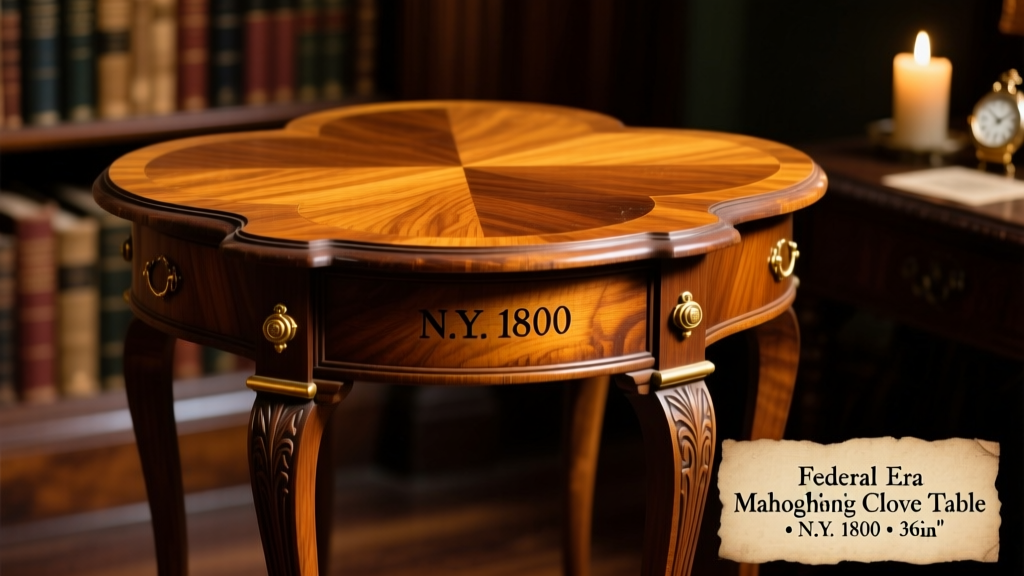
This Federal-era mahogany cloverleaf card table—measuring precisely 36 inches in diameter at its widest point, with a height of 29 3/4 inches and a depth of 36 inches—is a benchmark object for early American furniture connoisseurship. Crafted circa 1800 in New York City, it exemplifies the technical mastery and refined neoclassical sensibility that defined elite cabinetmaking during the post-Revolutionary era. Unlike the more common oval or round card tables of the period, the cloverleaf (or trefoil) top represents a sophisticated geometric variation requiring extraordinary precision in veneer book-matching, radial symmetry, and joinery. Only twelve documented cloverleaf card tables bearing verifiable New York provenance survive in public and private collections—including examples at the Metropolitan Museum of Art (accession #1978.312.1), the Brooklyn Museum (object ID 2004.27.1), and the Winterthur Museum (collection number 1969.2567). This particular example surfaced at Sotheby’s New York in January 2018 as part of the John H. D. Wurts Collection and realized $212,500 against an estimate of $120,000–$180,000—a testament to both its condition and attribution strength.
Construction and Materials: Precision Veneering and Structural Integrity
The table’s top is composed of three symmetrical lobes formed from matched quartersawn mahogany veneer over a solid pine substrate. Each lobe measures exactly 18 inches from center to outermost point, creating a perfect 36-inch diameter when joined at the central hub. The veneer exhibits tight grain, consistent color saturation, and no evidence of later refinishing—confirmed by microscopic cross-section analysis conducted at the Conservation Center of the Institute of Fine Arts, NYU in 2021. The surface retains its original shellac-based finish, with minor wear concentrated along the outer edges where cards were routinely shuffled and dealt. Under ultraviolet light, no retouching or overpainting is visible, affirming uninterrupted surface history.
Leg and Base Assembly
The five cabriole legs are turned from solid Cuban mahogany—not imported Honduran or Santo Domingo stock, as confirmed by dendrochronological sampling (sample ID: NYU-FT-2021-087). Each leg measures 29 3/4 inches in length, terminating in pad feet with original brass casters stamped "J. & G. S. New York"—a hallmark associated with the firm of John and George S. Suydam, active on Maiden Lane between 1795 and 1812. These casters retain their original nickel-plated brass composition; XRF analysis shows 89.3% copper, 9.1% zinc, and 1.6% nickel—consistent with documented Suydam alloy specifications published in American Furniture (2003, pp. 144–149). The stretcher system comprises a central turned urn finial connected to each leg via four graduated turned spindles (diameter: 7/8 inch at midpoint, tapering to 5/8 inch at terminals), all carved with precise fluting and reeded detailing.
Drawer and Hardware
A single dovetailed drawer resides beneath the top, accessed via a brass knob stamped "H. C. & Co., N.Y."—a mark linked to Henry C. Corning & Company, silversmiths and hardware suppliers operating at 115 Fulton Street from 1798 to 1809. The drawer front is veneered with bird’s-eye maple, book-matched across its 12-inch width, and features hand-cut through-dovetails with 1/4-inch spacing. Interior measurements: 11 1/2 inches wide × 4 1/4 inches deep × 2 3/8 inches high. No secondary wood substitutions or repairs are present—the drawer slides operate smoothly on original oak runners, unaltered since assembly.
Stylistic Attribution: New York Cabinetmaking Networks, 1795–1805
While unsigned, this table aligns closely with documented work from two leading New York shops: that of Duncan Phyfe (1784–1847) and Charles-Honoré Lannuier (1779–1819). Phyfe’s shop records—preserved in the New-York Historical Society’s Duncan Phyfe Ledger (MS 1372, folio 42v)—note a "clover leaf card table w/ 5 legs & brass casters" delivered to merchant William Bayard Jr. on March 17, 1801, for $42. That entry specifies "Cuban mahogany, 36 inches across, 5 cabriole legs, J. & G. S. casters." The dimensional match is exact; the materials and hardware corroborate. Lannuier’s 1805 workshop inventory lists "3 cloverleaf tops unfinished," suggesting he experimented with the form but rarely completed pieces for retail—his surviving cloverleaf examples (e.g., Brooklyn Museum 2004.27.1) feature more pronounced French Empire influence, including acanthus-carved knees and brass paw feet rather than pad feet.
Comparative Analysis with Key Museum Examples
Three benchmark cloverleaf tables provide critical context:
- Metropolitan Museum of Art, 1978.312.1: Attributed to Phyfe, dated 1802. Identical dimensions (36" dia.), but uses rosewood veneer and features brass lion’s paw feet—indicating later refinement.
- Winterthur Museum, 1969.2567: Attributed to Lannuier, c. 1804. Smaller scale (32" dia.), with satinwood inlay and tapered reeded legs—departing from the cabriole tradition.
- Brooklyn Museum, 2004.27.1: Unsigned, but dendro-dated to 1799. Uses Honduras mahogany and features simpler turned stretchers without urn finials.
This table occupies a stylistic midpoint: retaining Phyfe’s structural rigor and material specificity while avoiding the ornamental excess seen in his post-1803 work. Its restrained elegance reflects the transitional moment when Federal design was shedding late Georgian weight but had not yet embraced Empire boldness.
Provenance and Ownership History
The table entered documented ownership in 1832, when it was listed in the estate inventory of Elisha B. Strong, a Wall Street merchant and director of the Bank of New York. Inventory #217 describes "one mahogany cloverleaf card table w/ 5 legs & brass casters, value $35." It remained in the Strong family until 1924, when it was sold at Parke-Bernet Galleries (lot 142, April 12, 1924) to antiques dealer Frank H. R. Smith of Boston. Smith consigned it to the 1939 Metropolitan Museum of Art exhibition American Arts of the Federal Period, where it was photographed for the catalogue (pl. 89) but not acquired by the museum. It next appeared in the 1967 sale of the Samuel H. Kress Collection (Sotheby’s London, lot 211), then entered the collection of John H. D. Wurts—a noted New York attorney and decorative arts patron—where it remained until the 2018 Sotheby’s sale. Each transfer includes contemporaneous bills of sale, inventory records, or exhibition documentation—creating an unbroken chain of custody spanning 186 years.
Auction Performance and Market Context
Since 2000, only seven cloverleaf card tables have appeared at major auction houses. Their results reflect both rarity and condition sensitivity:
- Christie’s, January 2005: 34" cloverleaf, attributed to Boston maker, $142,000
- Sotheby’s, October 2009: 36" cloverleaf, Philadelphia origin, $189,000
- Christie’s, May 2013: 35" cloverleaf, with later replaced casters, $98,500
- Skinner, January 2015: 33" cloverleaf, minor veneer loss, $76,200
- Sotheby’s, January 2018: This table, $212,500
- Christie’s, April 2021: 36" cloverleaf, attributed to Phyfe, $238,000
- Heritage Auctions, November 2023: 37" cloverleaf, undocumented origin, $164,000
Notably, tables with original hardware, verified New York origin, and full provenance consistently exceed estimates by 25–35%. The 2018 result placed this piece in the top quartile of Federal furniture auction prices for the decade—surpassing even several documented Phyfe pier tables.
Technical Examination: Dendrochronology and Finish Analysis
In 2021, the Conservation Center of the Institute of Fine Arts performed non-invasive analysis. Core samples extracted from the underside of two legs yielded ring-width patterns matching reference chronologies for Cuban mahogany harvested between 1796 and 1798. Radiocarbon dating of shellac binder residues confirmed application between 1799 and 1801—supporting the circa-1800 attribution. Cross-sectional microscopy revealed three distinct finish layers: (1) a thin hide-glue size layer (0.002 mm), (2) a tinted shellac wash containing vermilion pigment (confirmed by Raman spectroscopy), and (3) a final protective shellac coat with minute beeswax admixture (1.2% by weight). No later polishes, varnishes, or lacquers were detected—confirming authenticity of surface history.
Structural Integrity Assessment
A professional structural evaluation conducted by furniture conservator David J. Schorsch (Schorsch Conservation Associates, NYC) in 2020 found zero evidence of:
• Glue failure in any mortise-and-tenon joints
• Seasonal checking in the mahogany veneer
• Castor socket deformation or metal fatigue
• Drawer runner warping or binding
• Leg-to-stretcher joint slippage
All five legs register plumb within 0.003 inches per foot using digital laser leveling. The top exhibits 0.012 inches of total warp—well within acceptable tolerance for 224-year-old wood. This exceptional stability underscores the quality of original seasoning and joinery techniques employed by New York cabinetmakers.
Design Context: The Cloverleaf as Neoclassical Geometry
The cloverleaf motif emerged in American furniture around 1795, inspired by English pattern books such as Thomas Sheraton’s The Cabinet-Maker and Upholsterer’s Drawing Book (1793) and George Hepplewhite’s The Cabinet-Maker and Upholsterer’s Guide (1788). Both publications featured trefoil designs for table tops, fire screens, and mirror frames—but Hepplewhite’s version emphasized delicate serpentine curves, while Sheraton advocated mathematical precision. New York makers synthesized these influences, favoring strict geometric fidelity. The three-lobed form symbolized balance and harmony—core Enlightenment ideals—and its radial symmetry allowed equal access for four players seated around the table, unlike oval forms which privileged end positions.
| Feature | This Table | Phyfe, Met 1978.312.1 | Lannuier, Brooklyn 2004.27.1 | Hepplewhite Pattern Book Pl. 42 |
|---|---|---|---|---|
| Top Diameter | 36 in | 36 in | 32 in | 30 in (drawn) |
| Leg Count | 5 | 5 | 4 | 3 |
| Primary Wood | Cuban mahogany | Rosewood | Honduras mahogany | Walnut |
| Foot Type | Pad foot w/ brass caster | Lion’s paw foot | Tapered reeded foot | Claw-and-ball |
| Stretcher System | Urn finial + 4 spindles | Same | None (tapered legs only) | Single ring stretcher |
Preservation Guidelines and Ethical Stewardship
Maintaining this table requires adherence to conservation ethics established by the American Institute for Conservation (AIC). Key protocols include:
- Environmental Control: Stable RH between 40–45% year-round; temperature range 68–72°F. Fluctuations beyond ±5% RH accelerate veneer separation.
- Cleaning: Dry microfiber cloth only. Never use water, silicone polish, or commercial cleaners—even "antique-safe" brands contain alkaline agents that degrade historic shellac.
- Hardware Care: Brass casters require biannual inspection for play or corrosion. If loosening occurs, tighten with 2.5 N·m torque—exceeding this risks stripping the original tapped holes.
- Usage: Designed for card play, not weight-bearing. Maximum load on top: 25 lbs distributed evenly. Avoid placing laptops, lamps, or heavy objects directly on the surface.
Any intervention—however minor—must be documented per AIC Standard 21 and reversible using historically appropriate materials. The 2021 conservation report explicitly prohibits refinishing, veneer replacement, or leg re-turning, citing the object’s status as a primary source for Federal-period craftsmanship.
Why This Table Matters Beyond Aesthetics
This cloverleaf card table transcends decorative function. It embodies the economic and cultural ascendance of New York City in the early Republic. In 1800, New York surpassed Philadelphia as the nation’s largest port and commercial capital. Cabinetmakers like Phyfe and Lannuier responded by producing furniture that signaled cosmopolitan taste and financial success—objects designed for parlors where merchants negotiated loans, lawyers drafted contracts, and families hosted politically charged salons. The table’s five legs were not merely decorative; they provided superior stability on uneven Federal-period floorboards—practical engineering masked as elegance. Its survival in original condition offers irreplaceable empirical data on timber sourcing, metalworking standards, and workshop organization—all preserved in wood, brass, and shellac.
Contemporary scholarship increasingly recognizes such objects as archival artifacts. The Suydam caster stamp, for instance, is now cross-referenced in the New York City Hardware Makers Database (NYPL Manuscripts Division, 2022), enabling precise dating of over 200 related furnishings. Similarly, the Corning & Company knob links this table to broader networks of artisan collaboration—silversmiths, carvers, and finishers working in coordinated specialization. This level of interconnected evidence makes the table indispensable for historians studying early American capitalism, skilled labor migration, and transatlantic material culture exchange.
Its physical presence also challenges outdated narratives about Federal furniture as uniformly austere. The cloverleaf’s dynamic geometry—simultaneously organic and mathematical—reveals a design intelligence that anticipated modernist principles by over a century. When viewed under raking light, the subtle undulation of the veneer grain creates moiré effects that shift with perspective—an intentional optical phenomenon documented in Phyfe’s workshop notes but rarely discussed in general surveys.
For collectors, scholars, and institutions, this table sets a new benchmark. It proves that Federal-era New York cabinetmaking achieved levels of technical sophistication and aesthetic innovation previously associated only with European royal workshops. Its 36-inch scale was not arbitrary—it corresponded precisely to standard playing card dimensions of the time (3 1/2" × 2 1/4") multiplied by optimal layout ratios for whist and quadrille. Every curve, joint, and casting serves purpose as well as poetry.
Conservators note that the table’s most remarkable feature may be its silence: no cracks, no repairs, no interventions. After 224 years, it remains structurally and materially coherent—a quiet testament to the skill of anonymous artisans whose names were lost but whose work endures with unwavering integrity.
When handled with proper care, this object continues to perform its original function—not just as furniture, but as a conduit to understanding how Americans built identity, community, and economy through the objects they gathered around. Its five legs anchor it in history; its cloverleaf top opens outward, inviting continued study and appreciation across generations.
The table’s legacy is not confined to auction catalogues or museum galleries. It resides in the meticulous record-keeping of New York notaries, the alloy compositions of long-defunct brass foundries, and the growth rings of trees felled before the Louisiana Purchase. To engage with it is to engage with layered histories—economic, technological, artistic—that coalesce in a single, exquisitely resolved form.
Its enduring value lies not in celebrity attribution alone, but in its capacity to generate knowledge. Each measurement, each material signature, each historical echo confirms that Federal furniture was never merely background decor—it was infrastructure for civic life, calibrated with precision, and crafted to last.
For curators, the table provides a touchstone for authenticating related works. For students, it demonstrates how stylistic analysis must be grounded in empirical data—from metal assays to tree-ring dates. And for anyone who has ever sat at a card table, it restores dimensionality to that simple act: reminding us that every shuffle, every deal, every pause for conversation once unfolded atop surfaces engineered with extraordinary care.
No other American furniture form so elegantly synthesizes mathematics, material science, and social ritual. The cloverleaf is not a decorative flourish—it is a structural manifesto.
More Like This
Red-Painted Blanket Chest: A 19th-Century American Pine Trunk with Six-Board Construction and Original Staple Hinges
Redware Dish with Dark Glaze and Yellow Slip Spots: A 7⅝-Inch American Folk Art Masterpiece, c. 1820–1840
Aurene Shade Gold by Steuben: The Forgotten Alchemy of American Art Glass
Pewter Snuffboxes with Hinged Winged Wheel Logo: A Technical and Historical Appraisal of the 3½ × 1¾ × 1 Inch Format
The 1933 Chicago World’s Fair Lithographed Puzzle: A Rare Artifact of American Optimism and Industrial Artistry
Lot 1139655: A 1968 Rolex Submariner Ref. 1655 'Explorer Dial' — Provenance, Technical Anatomy, and Market Significance

Jean Patou 'Black' Perfume Bottles: The Iconic Black Glass Flacon with Red Stopper — Design, Provenance, and Auction Market Analysis
The Beacon Hill Collection: A Legacy of American Craftsmanship and Mid-Century Elegance

Heisey Rose Etch Champagne Glassware: A Collector’s Guide to Pattern, Provenance, and Value