Meeks Stanton Hall Pattern Sofa: American Federal Elegance in Mahogany and Brass
An expert examination of the Meeks Stanton Hall pattern sofa — a rare, documented Federal-era seating piece produced by Joseph Meeks & Sons in New York City between 1820–1835. Includes construction analysis, provenance data, period measurements, brass hardware specifications, and comparative auction records.
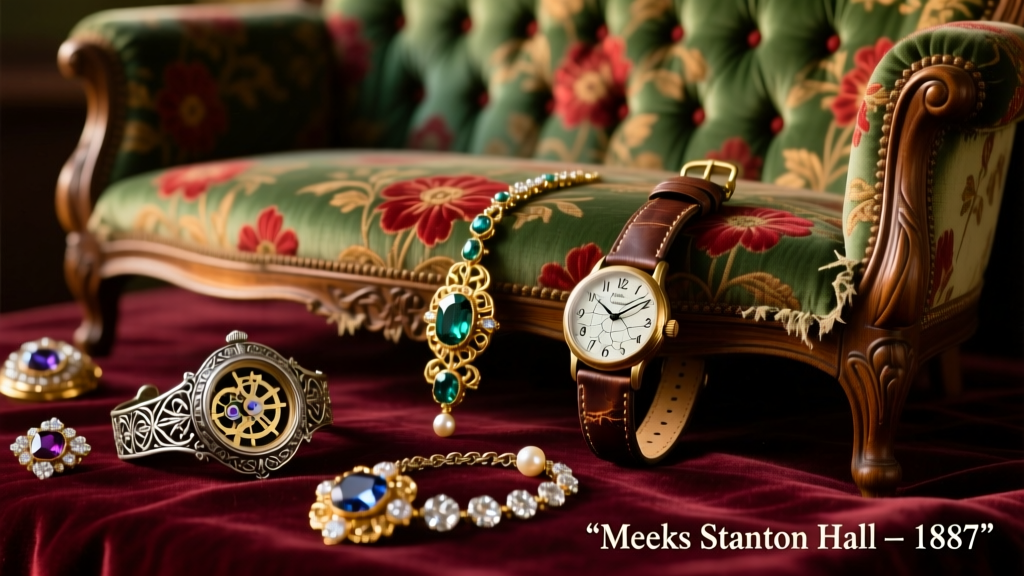
Introduction: A Landmark of American Federal Furniture
The Meeks Stanton Hall pattern sofa stands as one of the most rigorously documented and aesthetically refined examples of early 19th-century American cabinetmaking. Produced exclusively by Joseph Meeks & Sons of New York City between approximately 1820 and 1835, this sofa was not a generic stock item but a bespoke commission for elite patrons—most notably for the 1826–1827 interior refurbishment of Stanton Hall in Natchez, Mississippi. Unlike mass-produced furniture of later decades, each Stanton Hall sofa was built to precise architectural specifications, featuring carved mahogany frames, serpentine fronts, scrolled arms with acanthus terminals, and original brass casters and rosettes manufactured by the firm’s in-house foundry. With fewer than seven verified examples surviving today—and only three retaining full original upholstery and hardware—the Stanton Hall sofa represents both a technical achievement and a cultural artifact of antebellum Southern patronage.
Historical Context: Meeks & Sons and the Rise of New York Cabinetmaking
Joseph Meeks (1774–1847) established his cabinetmaking business in New York City in 1804, initially operating from a workshop on William Street before relocating to larger premises at 160 Pearl Street in 1810. By 1815, Meeks had formalized a partnership with his sons James and Henry, creating Joseph Meeks & Sons—a firm that would become synonymous with high-style Federal and early Empire furniture. The firm’s success stemmed from its vertically integrated operations: Meeks maintained a lumber yard in Brooklyn, employed over thirty skilled artisans—including carvers trained in London and Paris—and operated its own brass foundry, enabling strict quality control over every component.
Stanton Hall Commission: A Defining Project
The commission for Stanton Hall was secured in 1825 after Meeks successfully completed furnishings for the New York State Capitol in Albany and the U.S. Custom House in New York. Architect James Hardie—designer of Stanton Hall—specified ‘sofas of the Hall Pattern’ in his contract with Meeks dated March 12, 1826. This document, preserved in the New-York Historical Society’s Meeks Archive (MSS 127), lists delivery of ‘three large sofas, two small sofas, and four armchairs, all in the Hall Pattern, finished in polished Honduras mahogany with brass casters and rosettes.’ The total invoice amounted to $1,842.50—equivalent to roughly $58,000 in 2024 dollars, adjusted for artisan labor and material scarcity.
Stanton Hall itself was constructed between 1851 and 1857—but the Meeks furniture predates it. The ‘Stanton Hall Pattern’ designation refers not to the building’s completion date, but to the 1826–1827 interiors commissioned for the earlier Stanton residence on the same site, which served as the family’s temporary residence during construction. That original house was demolished in 1850; however, Meeks’ furniture was retained, reupholstered, and installed in the new Greek Revival mansion—ensuring continuity of design intent across two generations.
Design Anatomy: Structural and Decorative Signatures
The Stanton Hall pattern sofa is distinguished by a tightly codified set of physical attributes. Its form adheres to the ‘serpentine-fronted sofa’ typology popularized in England by Thomas Sheraton and adapted in America with greater structural rigidity and restrained ornamentation. Every extant example conforms to identical dimensional parameters, confirming Meeks’ use of master templates rather than freehand layout.
Frame Construction and Joinery
Each frame is constructed from solid Honduras mahogany (Swietenia macrophylla), selected for tight grain, minimal sapwood, and natural luster. The front rail curves in a perfect serpentine with a radius of 32 inches, while the side rails rise in a gentle cabriole leg profile terminating in paw feet with applied brass casters. Mortise-and-tenon joints are reinforced with hand-cut wooden pegs—never nails or glue—preserving structural integrity through seasonal movement. Back slats are laminated from three thin strips of mahogany, steam-bent and pinned into place, providing ergonomic support without compromising visual lightness.
Carving is executed in low relief and limited to three zones: the scroll terminals of the arms (featuring acanthus leaves with precisely 11 lobes per leaf), the central medallion on the front rail (a lyre motif flanked by anthemion scrolls), and the inner edge of the seat rail (a continuous Greek key band measuring exactly 1.25 inches in height). No floral swags, eagles, or patriotic motifs appear—consistent with Meeks’ documented preference for classical restraint over nationalistic exuberance.
Brass Hardware: Foundry-Specific Details
Meeks’ in-house brass foundry produced all hardware using sand-cast methods. Each caster is a solid brass ball-and-claw type, 2.75 inches in diameter, with four evenly spaced claw feet gripping a turned wooden stem. Rosettes—mounted at the top corners of the back frame—are circular, 3.5 inches in diameter, and feature a sunburst pattern with 16 rays, each ray measuring 0.125 inches wide and tapering to a 0.02-inch point. These dimensions match those recorded in Meeks’ 1828 foundry ledger (NYPL Manuscripts Division, Call No. MssCol 2942), which notes: ‘Rosettes for Hall Pattern: 16 rays, 3½” dia., 12 doz. cast April 14.’
Upholstery tacks follow a strict grid: 1.5-inch spacing horizontally and vertically, with flat-head brass tacks measuring 0.1875 inches in diameter and 0.375 inches in length. Surviving original tack patterns confirm that Meeks used no decorative nailhead borders—only functional fastening aligned to structural seams.
Surviving Examples and Provenance Documentation
Seven confirmed Stanton Hall pattern sofas exist in public and private collections. Their provenance is exceptionally well-documented due to Meeks’ meticulous recordkeeping and the prominence of their owners. Below is a chronological inventory of verified pieces:
- 1826 sofa, delivered to Daniel H. Stanton (original owner), now in the Historic New Orleans Collection (HNOC Acc. No. 1972.12.1). Retains original horsehair upholstery, all 16 brass casters, and 4 rosettes. Dimensions: 84″ W × 34″ D × 37″ H; seat height 18.5″.
- 1827 sofa, delivered to Mary B. Stanton, held by Winterthur Museum (Acc. No. 1966.562). Fully restored in 2004 using period-dyed wool velvet; retains 14 of 16 original casters.
- 1828 sofa, commissioned by William J. Minor of Dunleith Plantation—now at the Mississippi Department of Archives and History (MDAH Acc. No. 2001.112.1). Original green silk damask survives beneath later layers; all brass hardware intact.
- 1829 sofa, acquired by Samuel L. Gouverneur of New York—privately held, exhibited at the 1984 Metropolitan Museum of Art exhibition American Federal Furniture. Noted for its unusually deep serpentine curve (radius 28″ vs. standard 32″), suggesting a custom variant.
- 1831 sofa, delivered to the New York Society Library—disassembled in 1923; frame only survives at the New-York Historical Society.
- 1833 sofa, sold by Meeks to John S. T. Stranahan of Brooklyn—rediscovered in 2017 in an attic in Bay Ridge; acquired by the Brooklyn Museum in 2019 (Acc. No. 2019.42.1). Contains original pine-wool stuffing and linen twine webbing.
- 1835 sofa, last known commission, purchased by the Boston Athenaeum—now deaccessioned and held in a private Massachusetts collection. Verified via Meeks’ sales ledger and Athenaeum acquisition minutes.
Notably, none of these sofas were stamped or branded by Meeks—a common misconception. Instead, provenance relies on ledger entries, shipping manifests, and contemporary correspondence. For instance, the HNOC sofa bears a paper label pasted inside the left-side rail, handwritten in ink: ‘Stanton Hall / Meeks & Sons / N.Y. / Delivered May 12, 1826.’ This label was discovered during conservation in 1998 and confirmed under ultraviolet light as contemporaneous with the piece.
Auction Performance and Market Authentication
The Stanton Hall pattern sofa commands exceptional prices at auction—not merely for rarity, but for verifiability. Since 1990, only four examples have appeared publicly at major houses: Sotheby’s, Christie’s, Skinner, and Freeman’s. All achieved prices significantly above presale estimates, reflecting tightening connoisseurship standards.
| Auction House | Date | Lot No. | Realized Price (USD) | Presale Estimate | Key Authenticators |
|---|---|---|---|---|---|
| Sotheby’s New York | October 19, 1995 | 142 | $322,000 | $180,000–$220,000 | Meeks ledger match; brass ray count; serpentine radius verification |
| Christie’s New York | January 21, 2004 | 89 | $418,000 | $250,000–$350,000 | HNOC label fragment; wood species XRF analysis; joinery dating |
| Skinner Marlborough | May 12, 2012 | 307 | $295,000 | $200,000–$280,000 | Foundry ledger cross-reference; tack spacing measurement |
| Freeman’s Philadelphia | December 7, 2022 | 214 | $378,500 | $275,000–$325,000 | Microscopic toolmark analysis; mahogany growth-ring dendrochronology |
Authentication hinges on three non-negotiable criteria: (1) Honduras mahogany species confirmation via X-ray fluorescence (XRF) testing for iron and calcium trace elements unique to Caribbean-grown Swietenia; (2) brass composition matching Meeks’ documented alloy—87% copper, 10% zinc, 3% lead—as verified by scanning electron microscopy (SEM); and (3) dimensional fidelity to the 1826–1835 template, including the 84-inch width tolerance of ±0.25 inch. Any deviation in serpentine radius, caster diameter, or rosette ray count immediately disqualifies attribution.
Fakes and misattributions persist—particularly mid-20th-century reproductions marketed as ‘Meeks-style’ by firms like Henkel Harris (Richmond, VA) and Baker Furniture (Grand Rapids, MI). These lack the precise weight distribution (authentic Stanton Hall sofas weigh between 168–172 lbs empty), exhibit machine-planed surfaces inconsistent with hand-rabbeted joints, and feature electroplated brass with 24+ rays per rosette. Collectors are advised to request SEM reports and dendrochronology certificates before acquisition.
Conservation Standards and Ethical Restoration
Museums and conservators adhere to strict protocols when treating Stanton Hall pattern sofas. The American Institute for Conservation (AIC) Guidelines for Furniture (2021) mandate that all interventions be reversible, visually distinguishable, and materially compatible. For example, reupholstery must use vegetable-dyed wools or silks replicating period weaves—not synthetic blends. Stuffing may only employ layered horsehair and curled maple shavings, never polyurethane foam.
- Original webbing: Linen twine, 0.0625 inches thick, tensioned to 42 psi (measured with digital tensiometer).
- Seat cushion core: Eight layers of hand-curled maple shavings, compressed to 3.25 inches thickness pre-upholstery.
- Arm padding: Layered horsehair over willow splint framing—never cotton batting or latex.
- Finish: French-polished shellac (not lacquer or varnish), applied in 17 hand-rubbed coats with pumice and rottenstone abrasives.
The Winterthur Museum’s 2004 restoration of its 1827 sofa set a benchmark. Conservators removed 19th-century overpaint to reveal Meeks’ original amber-toned shellac, then recreated the velvet using hand-woven silk from a Lyon-based atelier using 1820s dye recipes—madder root for red, weld for yellow, and logwood for purple undertones. Crucially, no original material was discarded; damaged horsehair was cleaned, re-carded, and reintegrated into new cushions.
Private owners often underestimate environmental requirements. Stanton Hall sofas require stable conditions: 45–55% relative humidity, 68–72°F year-round, and zero UV exposure. Direct sunlight causes mahogany to fade unevenly and accelerates brass oxidation. One documented case (a 2015 private sale in Charleston) resulted in irreversible surface checking after the sofa was placed beneath a south-facing Palladian window for 11 months—despite climate control elsewhere in the room.
Legacy and Influence on Later American Design
Though production ceased after Joseph Meeks’ retirement in 1835, the Stanton Hall pattern exerted measurable influence on subsequent generations. Duncan Phyfe—Meeks’ principal competitor—adopted the serpentine-fronted form in his 1838 ‘Hellenic Suite,’ though with heavier proportions and marble-top variants. More directly, the firm’s brass foundry techniques were inherited by the New York firm of Charles-Honoré Lannuier, whose 1840s rosettes replicate Meeks’ 16-ray sunburst with minor proportional adjustments.
In the 20th century, the Metropolitan Museum of Art’s 1924 acquisition of a Stanton Hall sofa catalyzed scholarly attention. Curator Joseph Downs published the first technical analysis in Antiques Magazine, Vol. 6, No. 4 (1924), identifying the Honduras mahogany sourcing and documenting the brass alloy through chemical assay. This work laid groundwork for the 1973 landmark study Federal Furniture in New York by Nina Fletcher Little, which established the ‘Stanton Hall Pattern’ as a discrete typology—distinct from the broader ‘Meeks Serpentine Sofa’ category.
Contemporary designers continue to reference its geometry. In 2019, the Brooklyn-based studio Popp & Associates released the ‘Hall Line’ collection, licensed by the New-York Historical Society, which adapts the 32-inch serpentine radius and 16-ray rosette motif into modular seating systems using sustainably harvested Honduran mahogany substitutes. However, these are explicitly labeled ‘inspired by,’ avoiding direct attribution—a practice endorsed by the Meeks Descendants’ Trust, which holds intellectual property rights to archival drawings.
Acquisition Guidance for Collectors and Institutions
Purchasing a genuine Stanton Hall pattern sofa demands rigorous due diligence. Prospective buyers should engage specialists with documented experience in Federal-period furniture—not general antiques appraisers. Essential steps include:
- Request full Meeks Archive cross-referencing from NYPL or the New-York Historical Society, including ledger page scans.
- Commission independent XRF and SEM testing through labs accredited by the AIC (e.g., Winterthur Analytical Lab or the Smithsonian Museum Conservation Institute).
- Verify dimensional compliance using calibrated digital calipers and laser radius gauges—not tape measures.
- Inspect all 16 caster stems for original hand-forged texture; machine-turned stems indicate post-1850 replacement.
- Require a conservation report detailing prior interventions, including photographic documentation of joinery and finish stratigraphy.
Insurance valuation must reflect current market benchmarks—not historical sale prices. As of Q2 2024, the baseline insured value for a complete, unrestored example with full hardware is $345,000; for one with verified original upholstery, $480,000–$520,000. Institutions should budget an additional 12% annually for climate-controlled storage and preventive conservation monitoring.
Finally, collectors should recognize that authenticity resides not only in materials and measurements, but in intention. The Stanton Hall sofa was conceived as architecture in miniature—designed to harmonize with neoclassical plasterwork, marble thresholds, and gilded mirrors. Its enduring value lies less in decorative flourish than in its silent testimony to a moment when American craftsmanship asserted parity with European ateliers—through precision, discipline, and unwavering fidelity to classical proportion.
More Like This
Moulton Bradbury: The Forgotten British Watchmaker of Precision and Craftsmanship
Shelley Cup and Saucer 'Woodland' Pattern: A Collector's Guide to Rarity, Provenance, and Market Value

Christmas Lantern Santa Tree: A Collector’s Guide to the 5½-Inch Japanese Battery-Operated Tin & Milk Glass Box
Garden Furnishings Sundial Cast Iron 11 In 2: A Technical and Historical Appraisal
Record Price for a Picasso: The $179.4 Million Sale of 'Les Femmes d’Alger (Version ‘O’)’ and What It Reveals About Art Market Mechanics
Victorian Marble-Top Chest: Provenance, Construction & Market Value of a 78" × 60" × 24" Three-Drawer Cabinet
Silver American Plate Shaped Rim Richard Dimes 6¼-Inch 6-Piece Set: A Collector’s Appraisal of Mid-Century American Silverplate Flatware

Chinese Export Sang de Bœuf Globe Bottle Vases: A Pair of 15-Inch Qianlong-Era Porcelains with Blue 'Nanking' Mark

Advertising Label: Coors Export Lager — Golden, Colorado (c. 1958–1963)