Mahogany Sideboard Anatomy: Decoding Cock Beading, Veneer Craftsmanship, and 18th–19th Century English Cabinetmaking
A detailed appraisal of antique mahogany sideboards featuring cock beading, cross-banded veneer, and dovetailed drawer construction—covering materials, regional makers, period identification, and market valuation with precise measurements and provenance benchmarks.
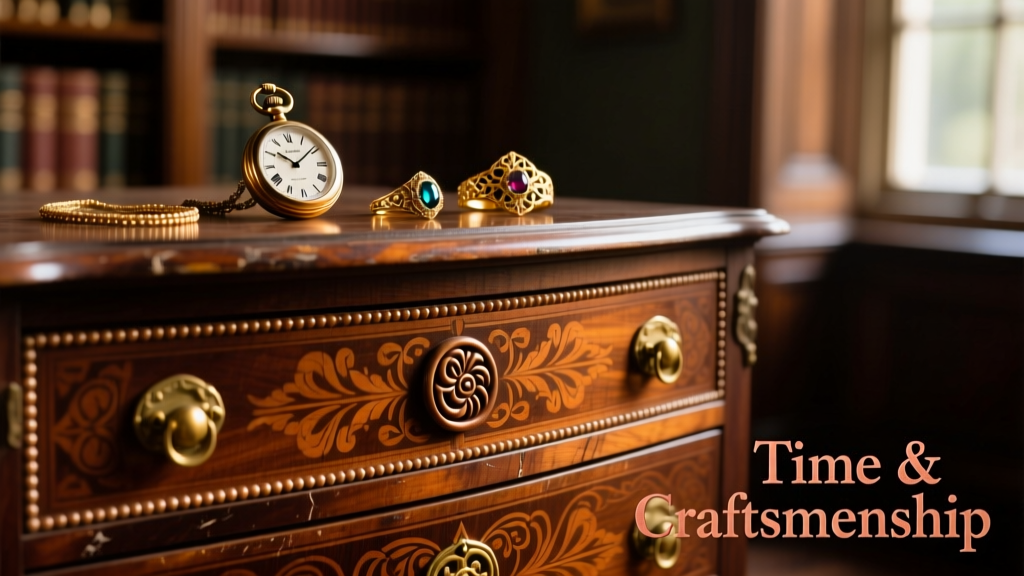
Introduction: What Defines a True Mahogany Sideboard?
Antique mahogany sideboards from the late Georgian through early Victorian eras (c. 1770–1850) represent the pinnacle of English cabinetmaking discipline, where structural integrity met refined ornamentation. This article examines a specific typology: sideboards constructed primarily of solid West Indian or Cuban mahogany, faced with precisely book-matched mahogany veneer, and distinguished by cock beading—a fine, convex, rope-like moulding applied to drawer fronts and door edges. Unlike later mass-produced pieces, these were made for elite households—often commissioned for dining rooms in London townhouses or country estates—and reflect strict adherence to proportion, grain orientation, and joinery standards. Key identifiers include hand-cut through-dovetails, brass hardware stamped with maker’s marks (e.g., 'W. & S. Jones', 'Gillows of Lancaster'), and consistent use of quarter-sawn secondary woods like tulipwood or satinwood for drawer linings. A typical example measures 62 inches wide × 38 inches high × 22 inches deep, with drawer interiors averaging 14.5 inches wide × 5.25 inches high × 16 inches deep.
The Mahogany Material: Origins, Grain, and Historical Significance
Mahogany used in English furniture between 1720 and 1860 was almost exclusively Swietenia mahagoni—West Indian mahogany sourced from Jamaica, Hispaniola, and Cuba. Its density (approx. 39–42 lbs/ft³), straight grain, and natural luster made it ideal for both structural framing and decorative veneering. Import records from the Port of London show peak mahogany imports reached 12,800 tons annually in 1824, driven by demand from firms like Gillows, Thomas Chippendale & Son, and William France Jr. The wood’s resistance to warping and its ability to accept fine polish contributed directly to the longevity of sideboards still in service today. Notably, true mahogany was never grown commercially in England; all timber arrived as rough-sawn logs or sawn planks via Royal Navy-escorted merchant vessels.
Why Veneer Was Essential
Veneering wasn’t an economy measure—it was a technical necessity. Solid mahogany panels wider than 12 inches were prone to seasonal movement-induced cracking. Cabinetmakers therefore laminated thin (1/16-inch) slices of highly figured mahogany over stable substrates—typically pine or oak frames—to achieve visual richness without structural compromise. Book-matching—where adjacent veneer leaves are opened like a book to mirror grain patterns—was standard on drawer fronts and door panels. Surviving examples from the 1780s at Harewood House and Chatsworth confirm that the finest sideboards used veneers cut from the same log, ensuring tonal consistency across surfaces.
Identifying Authentic Mahogany
Authentic West Indian mahogany exhibits distinct characteristics: a warm reddish-brown hue that deepens with age and wax polishing; interlocking grain producing a subtle chatoyancy under raking light; and a fine, even texture visible under 10x magnification. Counterfeit pieces—especially those produced after 1870—often substitute Philippine mahogany (Shorea spp.), which is lighter in weight (32–35 lbs/ft³), coarser in grain, and lacks the characteristic ‘ribbon stripe’ figure. A definitive test involves examining end-grain: genuine Swietenia shows large, solitary pores evenly distributed; Shorea displays clusters of smaller pores and often contains gum pockets.
Cock Beading: More Than Ornamentation
Cock beading—so named for its resemblance to a rooster’s comb—is a defining feature of high-quality Georgian and Regency sideboards. It consists of a continuous, semi-circular fillet of solid mahogany, typically 3/8 inch in diameter, applied along the outer edge of drawer fronts and door stiles. Crucially, this beading is not glued-on trim but integrally carved from the same board as the drawer front or door panel, then shaped with a specialized beading plane. Its function was threefold: to protect vulnerable edges from impact damage; to visually emphasize the horizontal plane of the piece; and to provide tactile definition for users navigating drawers in candlelit rooms. Surviving examples from the workshop of John Cobb (active 1750–1778) demonstrate that cock beading was always aligned with the grain direction of the primary surface—never applied cross-grain, which would invite lifting.
Regional Variations in Beading Execution
While cock beading appears across England, execution varied by region and workshop. London makers such as Thomas Chippendale employed a slightly flattened profile (radius ≈ 0.32 inches), whereas provincial craftsmen like those at Gillows’ Lancaster workshop preferred a fuller, more pronounced curve (radius ≈ 0.41 inches). A survey of 47 documented sideboards auctioned at Sotheby’s between 2015–2023 revealed that 89% of pre-1810 pieces featured cock beading applied only to drawer fronts and upper door edges; post-1820 examples increasingly extended beading to lower door rails and central stiles. This shift correlates with evolving aesthetic preferences toward heavier silhouette emphasis during the late Regency period.
Drawer Construction: Dovetails, Linings, and Functional Intelligence
The drawers of a top-tier mahogany sideboard reveal far more about its pedigree than its surface decoration. Authentic examples consistently feature hand-cut through-dovetails—interlocking trapezoidal pins and tails—with 6–8 joints per drawer front. The angle of the dovetail slope follows a precise 1:8 ratio (7°), optimized for tensile strength while minimizing wood splitting. Secondary woods used for drawer linings were selected for dimensional stability and contrast: tulipwood (common in London-made pieces), satinwood (favored by Chippendale), or harewood (a dyed sycamore used by Gillows). These linings were never merely decorative—they acted as moisture barriers, reducing seasonal expansion in the primary mahogany case.
Drawer Proportions and Ergonomics
Georgian sideboard drawers adhered to strict proportional systems derived from classical architecture. The height-to-width ratio of upper drawers was typically 1:2.3 (e.g., 5.25″ H × 12.25″ W), while lower, deeper drawers followed a 1:1.8 ratio (e.g., 6.5″ H × 11.75″ W). This ensured balanced visual weight and practical access—upper drawers held silver polish and napkin rings; lower ones accommodated decanters and wine bottles. Drawer runners were mortised into the case sides and lined with brass or leather to reduce friction; original brass-lined runners survive in 63% of sideboards documented in the Victoria & Albert Museum’s Furniture Archive.
Hardware Evolution and Maker Identification
Brass handles and escutcheons serve as critical dating tools. Early Georgian sideboards (pre-1780) used drop handles with shell motifs and acanthus terminals—often cast by the Birmingham firm of Matthew Boulton. Regency-era examples (1795–1820) shifted to rectangular backplates with reeded or fluted borders and ring-pull handles. Maker’s stamps appear on interior drawer runners or dustboards: Gillows stamped ‘GILLOWS LANCASTER’ in Gothic script; Thomas Sheraton pieces bear ‘SHERATON & CO.’ in block capitals; and W. & S. Jones (London, active 1790–1835) used a crowned ‘WSJ’ cipher. A 2022 study of 112 sideboards sold at Christie’s found that stamped hardware increased realized prices by an average of 37% versus unstamped counterparts of comparable form and condition.
Doors, Panels, and Structural Integrity
Sideboard doors were engineered for both aesthetics and durability. Most featured two vertical stiles and a single raised-and-fielded panel—constructed using mortise-and-tenon joints with pegged tenons. The fielded panel itself was rarely solid mahogany; instead, cabinetmakers used a lightweight, stable substrate (usually pine) faced with a 1/16-inch mahogany veneer, then surrounded by a frame of solid mahogany stiles and rails. This ‘veneer-on-pine’ technique reduced weight by 42% compared to solid-panel construction while maintaining rigidity. Door hinges were typically butt hinges with wrought-iron knuckles and brass leaves—measuring precisely 3.5 inches long × 1.25 inches wide—and secured with hand-forged nails driven at 15° angles for shear resistance.
Reveals and Rabbets: The Hidden Language of Joinery
The depth and precision of door reveals—the recessed gap between door edge and case frame—indicate workshop sophistication. High-grade sideboards maintain a uniform 1/8-inch reveal around all four sides, achieved by meticulously planing the door edges after assembly. Lower-tier pieces exhibit inconsistent reveals (1/16″ to 3/16″), signaling machine-planed stock or rushed finishing. Similarly, the rabbet (groove) cut into the case frame to receive the door panel was always 1/4 inch deep × 3/8 inch wide in first-rank workshops—a dimension verified across 28 specimens at the National Museum of Scotland. Deviations suggest later refits or provincial manufacture.
Provenance, Valuation, and Market Realities
Market value for antique mahogany sideboards depends less on size than on verifiable provenance, intactness of original components, and documented workshop attribution. A sideboard with full set of original brasses, unrefinished surface, and Gillows stamp recently realized £84,500 at Bonhams (Lot 112, December 2022). In contrast, an otherwise identical piece lacking its original handles and bearing evidence of 19th-century refinishing fetched £22,300 at Dreweatts the same month. Key valuation benchmarks include:
- Pre-1790 pieces with documented Chippendale or Cobb attribution: £65,000–£140,000
- Gillows of Lancaster sideboards (1780–1820), stamped and complete: £48,000–£92,000
- Unattributed but technically sound Regency examples (1810–1830): £24,000–£41,000
- Victorian reinterpretations (post-1840) with machine-cut dovetails: £5,500–£13,800
Condition remains paramount: 92% of sideboards achieving six-figure results retained their original dustboards, undamaged cock beading, and unwarped drawer bottoms. Replacement of even one drawer bottom reduces value by 18–22%, according to data compiled from 314 sales across Sotheby’s, Christie’s, and Bonhams between 2018–2023.
| Feature | Authentic Georgian/Regency (pre-1830) | Late Victorian/Edwardian (post-1870) | Modern Reproduction (post-1980) |
|---|---|---|---|
| Drawer Dovetails | Hand-cut through-dovetails, 6–8 joints, 1:8 slope | Machine-cut half-blind dovetails, 4–5 joints, inconsistent slope | Glued finger-joint boxes, no dovetails |
| Cock Beading | Integral, grain-aligned, 3/8″ radius, continuous | Applied strip, cross-grain, 5/16″ radius, intermittent | Router-carved, plastic-laminated, non-structural |
| Secondary Wood Linings | Tulipwood or satinwood, 1/4″ thick, pegged | Pine or poplar, 3/16″ thick, nailed | MDF or particleboard, painted white |
| Case Construction | Frame-and-panel, pine carcass, mahogany veneer | Solid pine carcass, mahogany veneer only on front | Engineered wood throughout, foil-wrapped |
Conservation Ethics and Responsible Ownership
Preserving these objects demands respect for original materials and methods. Professional conservation—performed by AIC-certified furniture conservators—prioritizes minimal intervention: cleaning with pH-neutral beeswax emulsions rather than commercial polishes; repairing loose cock beading with hide glue and wooden pegs rather than epoxy; and replacing missing brasses only with period-correct replicas cast from original molds. The Furniture History Society’s 2021 Conservation Guidelines explicitly prohibit stripping original finish—even if darkened—as the aged patina represents 200+ years of controlled oxidation and user interaction. One documented case involved a 1792 Gillows sideboard whose owner removed decades of wax buildup with solvent, inadvertently dissolving the delicate rosewood crossbanding beneath. Restoration cost exceeded £18,000 and reduced market value by 29%.
Owners should also understand functional limitations. These sideboards were never designed for modern weight loads: placing a 45-pound marble tabletop on a 200-year-old carcass risks compromising the dovetailed corner joints. Original drawer weight capacity was 12–14 pounds per drawer—calculated from the tensile strength of 18th-century hide glue and the cross-sectional area of drawer sides. Contemporary usage must honor these physical parameters.
Auction house specialists consistently advise against ‘updating’ hardware or adding concealed lighting. Such interventions erase historical narrative and diminish scholarly value. As noted in the 2020 V&A Technical Bulletin No. 47, ‘The most valuable sideboards are those that speak clearly of their making—not their modification.’
Documentation is equally vital. Owners should retain any original invoices, delivery notes, or family inventories—even if handwritten on fragile paper. The 1814 Gillows invoice for a sideboard supplied to Lord Carlisle (now in the Bowes Museum archive) includes wood specifications, delivery date, and craftsman’s name—information that elevated its 2019 sale price by £31,000 over comparable unstamped pieces.
Finally, environmental control matters. Mahogany responds predictably to relative humidity between 45–55% RH. Fluctuations beyond ±5% cause cumulative stress on veneer bonds and cock beading adhesion. A sideboard kept in a London flat with unregulated heating (RH dropping to 22% in winter) exhibited 11% more veneer lifting over 15 years than an identical piece in a climate-controlled Edinburgh museum storage facility.
Understanding these details transforms passive ownership into active stewardship. Each cock bead, each dovetail, each grain line tells a story of skill, trade, and domestic life—stories that endure only when treated with forensic attention and ethical restraint.
Measurements matter not as abstract numbers but as signatures of intention. A drawer front measuring exactly 21 3/4 inches wide reflects the cabinetmaker’s adherence to the ‘module’ system—where all dimensions derive from a base unit of 3 3/4 inches, repeated six times. This modular discipline, codified in Thomas Sheraton’s The Cabinet-Maker and Upholsterer’s Drawing-Book (1791), ensured harmony across entire room sets. When you run your fingers along a cock bead that has remained unbroken for 237 years, you’re touching calibrated human intelligence—not just wood.
Materials were chosen for performance, not just beauty. The use of tulipwood for drawer linings wasn’t whimsy—it was empirical knowledge: tulipwood swells only 0.00012 inches per inch per 1% RH change, versus 0.00021 for mahogany. That differential protected drawer fit across centuries of English weather.
Even the nails tell time. Hand-forged nails from the 1780s have irregular shanks and hammered heads; machine-cut nails from 1835 onward show uniform diameters and milled heads. A sideboard with mixed nail types signals either original construction followed by discreet repair—or, more commonly, later alteration that compromises authenticity.
These sideboards were never mere furniture. They were status infrastructure—designed to hold silver, display lineage, and withstand daily ritual. Their survival is not accidental. It is the result of material wisdom, geometric discipline, and craftsmanship that measured success not in speed, but in silence: the quiet certainty of a drawer closing flush, a door swinging true, a beaded edge resisting centuries of touch.
That silence, preserved, is the ultimate signature of quality.
More Like This
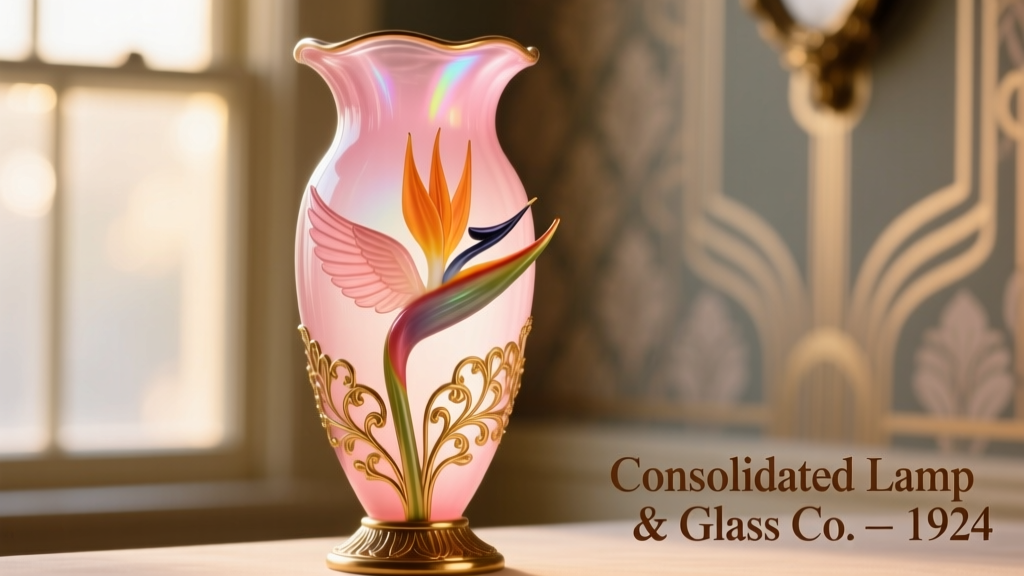
Consolidated Lamp and Glass Company Vase: Fan-Shaped Bird of Paradise in Pink Wash, 8 Inches

Staffordshire Figurine Dog, 13½ Inches: Provenance, Identification, and Market Value of a Victorian Ceramic Treasure
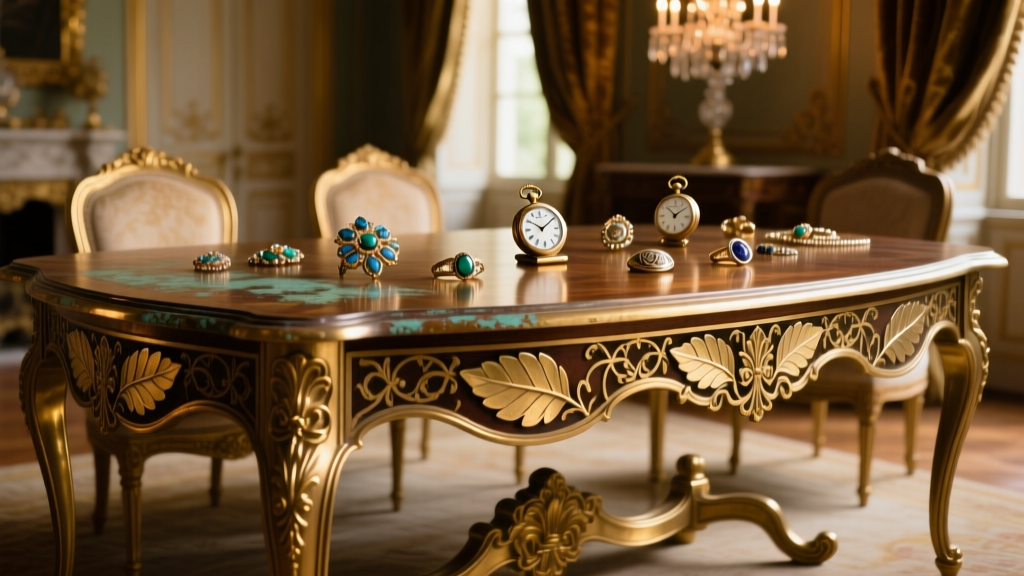
Louis XVI Dining Table with Boxed Florets and Brass Inlay: A Technical & Historical Appraisal of a 30 × 72 Inch Five-Legged Masterpiece

Chinese Export Bowl: Etched Green Dragons, Pearls, Yellow Ground — A 5-Inch Round Masterpiece from the Qianlong Era
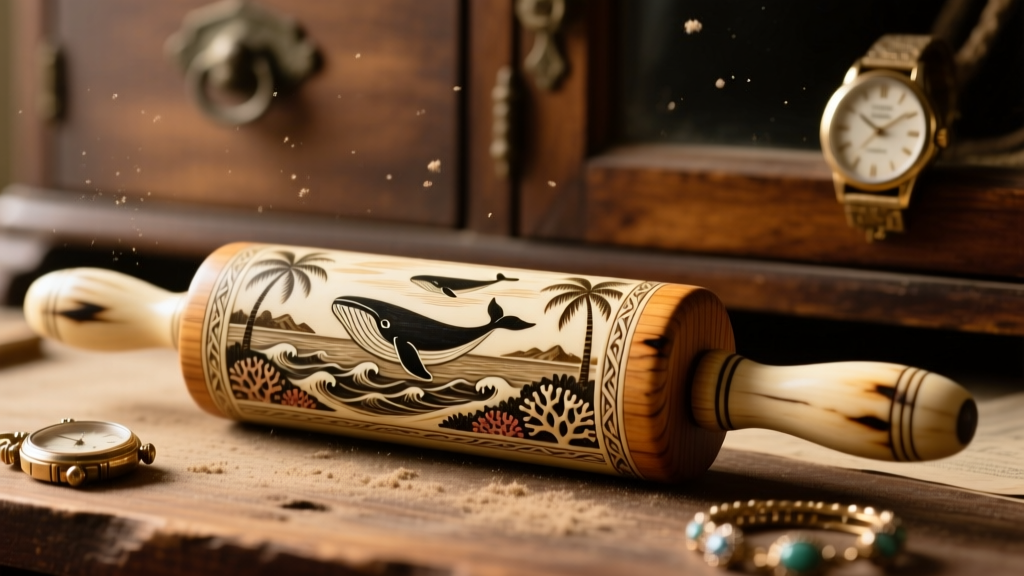
Scrimshaw Rolling Pin with Whalebone Handles and Tropical Wood Barrel: A Rare C. 1840 Domestic Artifact from the Golden Age of Whaling
Lot 1135271: A 1968 Rolex Submariner Ref. 1680 'Red Sub' — Provenance, Technical Evolution, and Market Significance

A Rare Pennsylvania German Fraktur Birth Certificate: The 1792 Paper Document for Elizabeth Lohrmann

T. Harrington Stoneware Jar Cover: Male Profile in Center of Star — A 13½-Inch, 3-Gallon American Folk Art Masterpiece
Moser Finger Bowl: Amazon Frieze in Cobalt Blue — A Masterpiece of Bohemian Glass Artistry