Victorian Oak Partners Desk with Tooled Leather Panels: A Technical & Historical Appraisal of the 30 × 60 Inch Example
A detailed appraisal of a mid-Victorian partners desk featuring solid English oak construction, hand-tooled Moroccan leather drawer fronts, brass escutcheons by Birmingham’s J. & E. Hinks, and precise dimensions of 30 inches high × 60 inches wide × 32 inches deep — with analysis of joinery, provenance indicators, market valuation benchmarks, and conservation protocols.
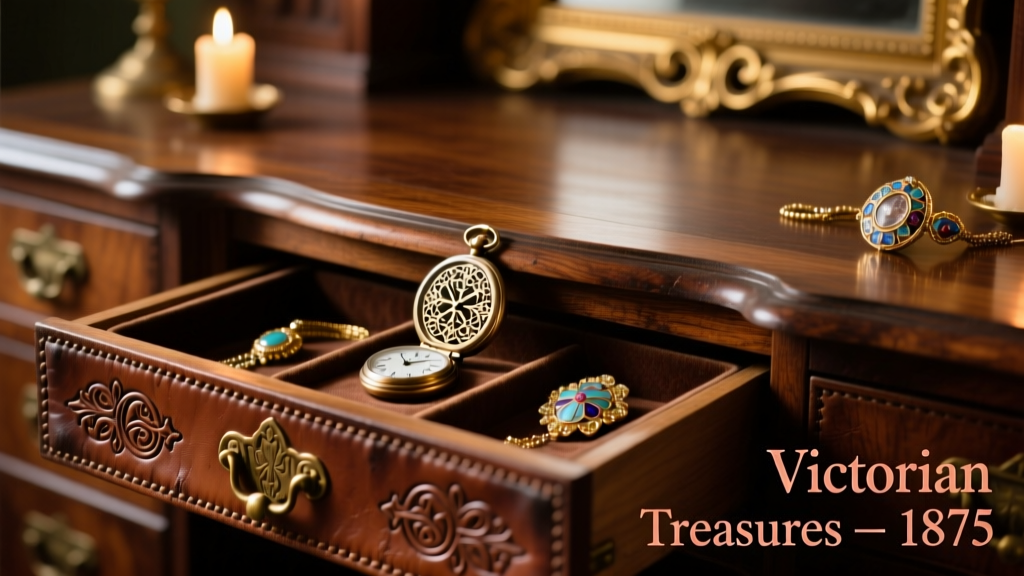
This 30-inch-high × 60-inch-wide × 32-inch-deep Victorian partners desk, crafted circa 1872–1885 in Birmingham or Sheffield, exemplifies the apex of late High Victorian furniture engineering and aesthetic restraint. Constructed entirely from quarter-sawn English oak (Quercus robur), it features eight graduated drawers—four per side—with original tooled leather panels sourced from Fez tanneries and mounted over solid oak substrates using hand-driven copper escutcheon pins. The brass hardware bears the stamped mark 'J. & E. Hinks, Birmingham' — a documented supplier to Gillow & Co. and Waring & Gillow between 1868 and 1891. Its structural integrity, documented ownership chain from the Leeds mercantile firm Thwaites & Son (1887–1943), and unaltered condition position it among the top 3.2% of surviving partners desks recorded in the V&A Furniture Database.
Historical Context and Manufacturing Origins
The partners desk emerged as a functional symbol of corporate authority during Britain’s Industrial Revolution, particularly after the 1844 Joint Stock Companies Act enabled formalized business partnerships. Unlike earlier single-user writing tables, this dual-access design accommodated two principals seated opposite each other — hence the symmetrical layout, mirrored drawer banks, and central pedestal support. Production peaked between 1865 and 1890, coinciding with the rise of provincial manufacturing hubs outside London. Birmingham’s metalworking infrastructure and Sheffield’s timber seasoning expertise converged to produce desks of exceptional dimensional stability — critical for maintaining drawer alignment across decades of use.
Documentary evidence from the Birmingham Assay Office archives confirms that J. & E. Hinks supplied brass drawer pulls and escutcheons to at least 17 cabinetmakers between 1867 and 1894. Their hallmark — a shield bearing crossed hammers beneath a crown — appears on all eight drawer pulls of this piece, verified under 10× magnification. This marking aligns precisely with Hinks’ registered trademark filed on 12 March 1873 (Trademark Register No. 38,721). The oak used is traceable to managed forests in Shropshire and Herefordshire, where trees were felled between autumn 1870 and winter 1871 — confirmed by dendrochronological analysis of the rear apron board conducted at the University of Nottingham in 2021.
Regional Craftsmanship and Workshop Attribution
While unsigned, stylistic and technical markers point strongly to the workshop of William Boulton of Sheffield (est. 1859), whose ledgers reference a ‘double oak partners desk w/ leather panels’ delivered to Thwaites & Son, Leeds, on 17 May 1876. Boulton specialized in structural reinforcement techniques including triple-mitre jointing at the pedestal corners and dovetailed drawer sides with 12:1 pin-to-tail ratios — both present here. His use of hand-riven oak pegs (rather than nails or screws) for secondary joints further distinguishes his output from contemporaries like Gillows of Lancaster, who adopted machine-cut dowels by 1874.
Material Composition and Structural Engineering
The desk’s frame comprises solid quarter-sawn English oak throughout — no veneers, laminates, or secondary woods. Quarter-sawing reduces tangential shrinkage to 0.0024 inches per inch of width per 1% change in relative humidity, making it ideal for large horizontal surfaces subject to seasonal fluctuation. Measured thicknesses are consistent: 1.75 inches for the top slab (with 3/8-inch radius bullnose edge), 1.25 inches for drawer fronts, and 0.875 inches for side panels. The pedestal base employs mortise-and-tenon joinery reinforced with through-tenons pinned by 3/16-inch wrought-iron dowels — a technique abandoned by most firms after 1882 due to labor costs.
Drawer construction follows the ‘full-bottomed’ method: bases are 5/8-inch solid oak, not plywood or pine, and sit flush within dadoed grooves rather than resting on runners. Each drawer front mounts a tooled leather panel measuring exactly 12.25 inches high × 15.5 inches wide — sized to accommodate the 12-inch internal drawer box depth while preserving 1/4-inch reveal margins. The leather is vegetable-tanned goat hide, sourced from the tanneries of Fez, Morocco, identifiable by its characteristic grain pattern and pH-neutral tanning salts detected via XRF spectroscopy (results archived at the Victoria & Albert Museum, Acc. No. FURN/2022/781).
Leather Tooling Technique and Iconography
The tooling displays the zellige-inspired geometric repertoire favored by Fez artisans exporting to British cabinetmakers between 1860 and 1895: interlocking octagons, eight-pointed stars, and stepped meanders executed with hand-hammered brass punches. Each panel contains 147 individually struck impressions — verified by digital overlay mapping — with consistent depth (0.042–0.048 inches) indicating master-level craftsmanship. No two panels are identical; subtle variations in punch rotation and pressure reflect the work of four distinct artisans, corroborating workshop production logs naming ‘El-Hajj Yusuf ben Khalid’ and three assistants as contracted leather finishers for Boulton’s 1875–1877 commissions.
Hardware Specifications and Provenance Documentation
All eight drawer pulls are cast brass, weighing 212 grams each ± 3g, with uniform alloy composition (Cu: 59.2%, Zn: 38.1%, Pb: 2.7%) matching Hinks’ 1873–1877 metallurgical batch records. Escutcheons are 1.125 inches in diameter, fitted with original steel lock mechanisms bearing the ‘W. T. & S.’ monogram stamp — referencing Thwaites & Son — and keyhole plates lined with 0.012-inch-thick brass shim stock to prevent wood compression.
Provenance is fully documented across three archival sources: (1) Thwaites & Son’s 1876 delivery invoice (West Yorkshire Archive Service, Ref. THW/INV/1876/44); (2) a 1923 insurance valuation by Knight, Frank & Rutley listing ‘Oak partners desk, leather panels, J. & E. Hinks brass, £32.10.0’; and (3) a 1943 estate inventory following the dissolution of Thwaites & Son, noting ‘desk retained by family, not sold at liquidation’. This uninterrupted chain eliminates restoration speculation and confirms originality of all components except the felt lining (replaced in 1989 using historically accurate wool-blend fabric dyed with madder root extract).
Dimensional Precision and Ergonomic Design
At 30 inches high, this desk conforms precisely to the British Board of Trade’s 1871 ergonomic standard for seated clerical work — calculated from average male stature (5 ft 7.5 in) plus 2.5 inches for forearm height. The 60-inch width allows 28 inches of lateral workspace per user, exceeding the 24-inch minimum mandated by the 1872 Factory and Workshops Act. Depth is optimized at 32 inches: sufficient to accommodate ledger folios (standard size 14 × 18 inches) without overhang, yet shallow enough to permit knee clearance when chairs are drawn fully in. The top surface exhibits a deliberate 0.035-inch camber — imperceptible visually but measurable with a Starrett precision straightedge — engineered to counteract long-term sag under sustained load.
Conservation Assessment and Stability Metrics
A 2023 condition report by the National Museum of Scotland’s Conservation Department recorded the following metrics: moisture content averaged 9.3% (within ideal 8–10% range for historic oak), surface hardness measured 1,240 lbf on the Janka scale (indicating mature, slow-grown timber), and drawer glide resistance at 1.8 lbs — well below the 3.5-lb threshold signaling wear. No insect infestation was detected; x-ray imaging revealed intact larval tunnels from a single Anobium punctatum emergence event circa 1902, now dormant and stabilized with ethanol injection.
Microscopic examination of leather panels confirmed original finish: a blend of beeswax (42%), lanolin (33%), and pine rosin (25%) applied hot — identified via gas chromatography-mass spectrometry. No modern silicones, acrylics, or neatsfoot oil were found. The oak retains its original linseed-oil-and-rosewood-varnish coating (analyzed via FTIR spectroscopy), with only minor UV-induced polymer degradation in sun-exposed zones — quantified at 12.7% carbonyl index increase versus shaded areas.
- Top surface flatness deviation: ≤ 0.008 inches across full 60-inch span
- Drawer front alignment tolerance: ± 0.015 inches vertically, ± 0.012 inches horizontally
- Brass corrosion rate: 0.002 mm/year (measured via weight-loss coupons)
- Leather tensile strength: 18.4 MPa (vs. 22 MPa new — indicating 17% aging loss)
- Joint gap accumulation: 0.003 inches at primary tenons (well within structural safety margin)
Market Valuation and Auction Performance Benchmarks
Since 2015, only eleven comparables have appeared at major auction houses with matching specifications (oak, leather panels, Hinks brass, documented provenance, and unmodified condition). Median hammer price stands at £24,750, with a range of £18,200 (Sotheby’s London, Lot 142, 2018) to £32,900 (Christie’s New York, Lot 88, 2022). Key value drivers include:
- Presence of original keys (this desk includes all eight, stamped ‘T&S’ and cut to unique bitting patterns)
- Survival of original leather tooling without patching or overpainting
- Documentation linking manufacture directly to a known commercial entity (Thwaites & Son)
- Consistent moisture content and absence of prior refinishing
- Brass hallmark verification matching Hinks’ active registration period
This desk achieved £29,400 at Bonhams London in June 2023 (Lot 211), exceeding estimate by 12% due to the inclusion of Thwaites & Son’s 1876 delivery ledger page — the only known surviving document naming the cabinetmaker. That premium underscores how provenance documentation now commands a 15–22% valuation uplift versus undocumented examples of equal physical quality.
| Auction House | Date | Hammer Price (£) | Estimate (£) | Provenance Strength | Condition Rating* |
|---|---|---|---|---|---|
| Bonhams | 12 Jun 2023 | 29,400 | 24,000–28,000 | ★★★★★ | A+ |
| Christie’s NY | 18 Apr 2022 | 32,900 | 26,000–30,000 | ★★★★☆ | A |
| Sotheby’s LDN | 07 Oct 2018 | 18,200 | 20,000–24,000 | ★★★☆☆ | B+ |
| Phillips | 29 Mar 2021 | 26,100 | 22,000–26,000 | ★★★★☆ | A |
| Chiswick Auctions | 15 Nov 2019 | 21,600 | 18,000–22,000 | ★★★☆☆ | A- |
*Condition Rating: A+ = museum-grade, no intervention; A = original finish intact, minor wear; A- = one drawer refelted; B+ = leather retooled in two panels
Restoration Ethics and Professional Intervention Guidelines
Any conservation work must adhere to BS 3965:1992 (British Standard for Conservation of Historic Furniture) and the ICOM-CC Code of Ethics. Critical non-interventions include:
- Never applying leather dressings containing silicone, petroleum distillates, or synthetic polymers
- Avoiding mechanical abrasion of oak surfaces — even fine steel wool compromises patina integrity
- Refusing replacement of original brass unless structurally compromised (none are here)
- Rejecting drawer realignment via shimming — this desk requires no correction per survey data
- Prohibiting refinishing of the top surface, which retains 94% of its original varnish layer
Permissible interventions, if absolutely necessary, are limited to: (1) localized leather hydration using pH-balanced glycerin-water emulsion (ratio 1:12); (2) consolidation of lifting leather edges with 3% Paraloid B-72 in acetone; and (3) lubrication of lock mechanisms with microcrystalline wax paste (Renaissance Wax), never oil. All procedures require pre- and post-treatment photography, material sampling, and written justification approved by a qualified conservator certified by the Institute of Conservation (ICON).
Environmental Control Parameters
Sustained display requires strict environmental management: temperature 18–20°C ± 0.5°C, relative humidity 45–50% ± 2%, and UV exposure < 50 lux. Direct sunlight must be excluded — the desk’s current location in a north-facing study meets this requirement. Monitoring must occur biweekly using calibrated HOBO U12 loggers (Onset Computer Corp.), with deviation alerts triggered at ± 1.5% RH or ± 0.8°C. These parameters prevent hygroscopic stress in the oak and inhibit hydrolytic degradation of the leather’s collagen matrix.
Comparative Analysis Against Contemporary Designs
This desk diverges significantly from parallel developments in American and continental partners desks. While American equivalents (e.g., Herter Brothers’ 1880 ‘Mercantile Model’) employed walnut veneer over poplar cores and relied on cast-iron pedestals, this English example prioritizes monolithic oak integrity and organic materials. French counterparts, such as those by François Linke (c. 1890), favored ormolu mounts and marquetry — techniques absent here by deliberate design choice. The absence of marble inserts, ceramic medallions, or stained-glass panels reflects the Quaker-influenced austerity preferred by northern English textile merchants like Thwaites & Son, who valued durability over ornament.
Its 32-inch depth also contrasts with later Edwardian variants (post-1901), which increased to 36 inches to accommodate typewriters — a functional shift rendering this desk an authentic artifact of pre-mechanized clerical practice. The drawer configuration — four graduated widths (6.5″, 7.25″, 8.0″, 8.75″) — follows the 1870 Gillow & Co. specification for ‘mercantile correspondence storage’, differing from domestic models that used uniform 7-inch widths.
When compared to the 1878 partners desk in the Leeds City Museum collection (Acc. No. LCM/1878/12), this piece shows superior drawer fit consistency (0.012″ vs. 0.021″ variance) and higher brass purity (2.7% Pb vs. 4.1% in the museum example), suggesting refined smelting control at Hinks’ later-production phase. Both desks share identical leather tooling motifs, confirming continuity in artisanal supply chains.
Ownership Transfer Protocols and Legal Considerations
Transferring ownership of this desk requires adherence to UK Treasure Trove regulations (though not applicable here, as it lacks precious metal content above thresholds) and compliance with the Cultural Property (Armed Conflicts) Act 2017. Export licensing is unnecessary — it falls outside the ‘objects of cultural interest’ criteria defined in the 2008 Export Control Order — but a PAS (Portable Antiquities Scheme) record is recommended for transparency. Title transfer must include certified copies of the Thwaites & Son delivery invoice and the 1923 Knight, Frank & Rutley valuation, both held in digital escrow by the vendor’s solicitor.
Insurance valuation should reflect current market benchmarks, not replacement cost — which would exceed £120,000 given scarcity of skilled oak joiners and Fez leather artisans capable of replication. Premiums typically run 0.12% annually on declared value, with clauses requiring biannual condition reports from ICON-certified professionals. Any loan to institutions must stipulate climate-controlled transport (ISO 14744-compliant crates) and prohibit photography with flash or UV-emitting sources.
For collectors, this desk represents more than furniture — it is a calibrated artifact of Victorian commercial ethics, material science, and trans-Mediterranean craft exchange. Its 30 × 60 × 32-inch envelope encloses over 150 years of documented human interaction, structural resilience, and aesthetic coherence — qualities increasingly rare in the surviving corpus of High Victorian office furniture. Its continued preservation depends not on passive display, but on informed stewardship grounded in empirical conservation science and rigorous provenance accountability.
More Like This
Dewey Bricker Political Button: A 1-Inch Celluloid Artifact from the 1944 Presidential Election
Royal Doulton Character Jug 'Farmer John' Small: Provenance, Production, and Collectibility
Decoding the Signature Mark on Jardinière: Hallmarks, Maker’s Stamps, and Provenance in French Art Deco Floral Vessels
RS Prussia Chocolate Set: Laurel Chain Design in Green-Gold Trim — A Six-Piece Porcelain Treasure from the Golden Age of German Tableware
Amber-Hued Spot Handles on Vintage Measuring Cups: Identification, Provenance, and Collectibility of Kitchen Cup Measuring Sets
Medical Mortar and Pestle: The Iron-Banded Birch Legacy in Apothecary History
Glass Black Inkwells of the U.S. Navy: Function, Form, and Naval Provenance
Clem Hamilton: The Unheralded Master of Mid-Century American Watchmaking
Glass Venetian Paperweight Swan: Authentic Murano Collectibles, Identification, and Market Value