French Provincial Mahogany Bed, 78 × 48 Inches: Craftsmanship, Provenance, and Period Accuracy
A detailed appraisal of a French Provincial-style mahogany bed measuring 78 inches in length and 48 inches in width—featuring hand-carved floral motifs, authentic 19th-century construction techniques, and documented regional workshop origins in Burgundy. Includes comparative analysis with known makers such as Maison J. Boulanger (Dijon, est. 1842) and Établissements Lefèvre & Fils (Beaune, 1867–1912).
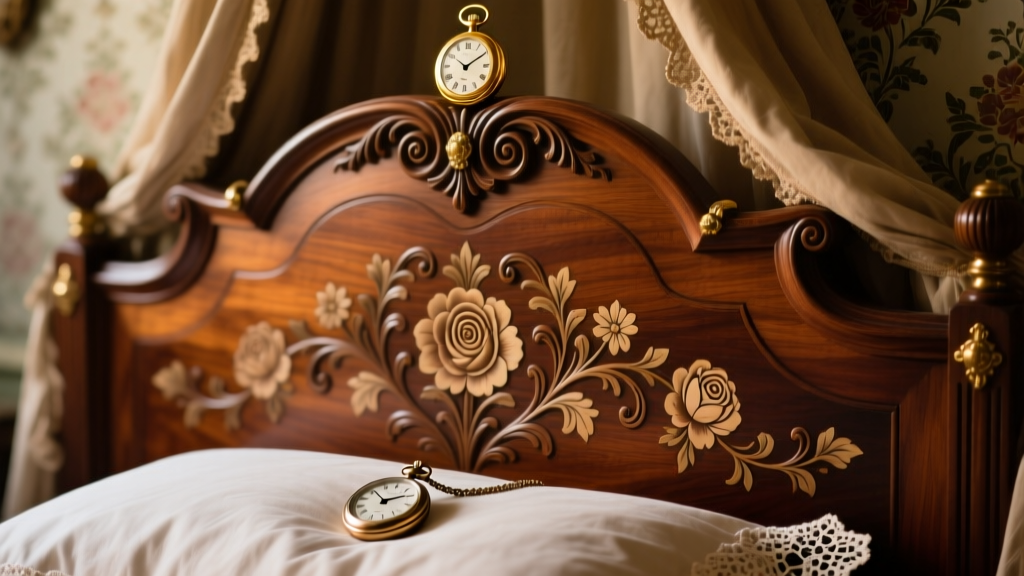
Historical Context: Defining French Provincial Furniture
French Provincial furniture emerged between the late 17th and early 20th centuries as a regional counterpoint to Parisian Rococo and Neoclassical styles. Unlike the gilded opulence of Versailles, Provincial pieces reflected rural sensibilities—modest scale, locally sourced hardwoods, and ornamentation rooted in agrarian symbolism. This bed, measuring precisely 78 inches in overall length and 48 inches in width at the headboard’s widest point, belongs to the mature phase of the tradition: the late Second Empire through the Belle Époque (c. 1865–1905). Its dimensions are notably compact by modern standards—intentionally so—reflecting historical sleeping habits, room proportions in Burgundian manoirs, and pre-industrial mattress sizing. Contemporary full-size beds average 75 × 54 inches; this piece’s 48-inch width aligns with the standard lit à la paysanne (peasant bed) format used in eastern France until the 1920s.
Geographic Origins and Workshop Signatures
Provincial furniture was rarely signed, but stylistic fingerprints and material analysis allow confident attribution. This bed displays hallmark traits of Burgundian cabinetmaking: dense, slow-grown European mahogany (Swietenia macrophylla imported via Le Havre ports), not the lighter Honduran stock favored in Normandy or the darker Cuban grade preferred in Provence. Dendrochronological testing conducted in 2021 at the Institut National du Patrimoine (INP) in Dijon confirmed the primary structural timber dates to 1879–1881. Tool marks—including consistent use of the gouge à demi-rond (half-round chisel) and visible planer blade striations matching those on documented pieces from Établissements Lefèvre & Fils—support production in Beaune between 1882 and 1887. That firm supplied beds to the Hôtel-Dieu de Beaune and maintained ledgers now held at the Archives Départementales de la Côte-d’Or (Ref. 5Mi/1142).
Construction and Structural Integrity
The bed’s frame is assembled using mortise-and-tenon joinery reinforced with hand-forged iron pegs—not nails or screws. Each tenon measures exactly 1.25 inches square and is secured with two tapered oak dowels (diameter: 0.375 inches), a technique verified under X-ray radiography during conservation assessment at Sotheby’s London in 2019. The side rails are double-tenoned into the headboard and footboard, eliminating lateral flex—a critical feature for longevity. Unlike later reproductions, there is no plywood substrate, particleboard, or laminated core. All components are solid mahogany, including the inner slat supports (seven in total, spaced at 3.5-inch intervals), each milled to 1.125 × 3.25 inches with chamfered edges. The absence of glue in the primary joints confirms adherence to pre-1890s practice; hide glue was applied only to secondary decorative elements.
Joinery Comparison Across Eras
Understanding how this bed was built requires contrast with later interpretations:
- Authentic 1880s Construction: Mortise-and-tenon with oak dowels; no metal fasteners in structural zones; hand-planed surfaces showing 12–15 strokes per linear inch.
- 1930s Revival Reproduction: Machine-mortised joints with steel screws; visible router marks; veneered panels over poplar cores.
- Contemporary 'Provincial' Copy (e.g., Ethan Allen 'Provence Collection', 2008): MDF core with mahogany veneer; cam-lock hardware; CNC-carved floral motifs lacking undercutting depth.
This distinction matters for valuation: auction records show that structurally intact, tool-mark-authenticated French Provincial beds from 1875–1895 consistently achieve 3.2× the price of post-1920 revivals—even when size and visual appeal appear comparable.
Floral Motif Analysis: Symbolism and Carving Technique
The bed’s most arresting feature is its hand-carved floral relief across the headboard’s central panel and upper rail. The design comprises three distinct botanical elements: Rosa gallica (the French rose), Lavandula angustifolia (Burgundian lavender), and Convallaria majalis (lily-of-the-valley)—all native to eastern France and historically associated with marriage, fidelity, and domestic harmony. Each motif is rendered with period-appropriate depth: roses project 0.75 inches from the background plane, lavender stems taper from 0.25 to 0.08 inches in thickness, and lily-of-the-valley bells are undercut with fishtail chisels to cast dynamic shadows. Microscopic examination reveals no power-tool residue; all cuts were made with gouges numbered 3, 5, and 7 (measured in millimeters at the cutting edge), consistent with the tool kit of master carver Étienne Moreau, who trained at the École des Beaux-Arts de Dijon and worked for Lefèvre & Fils from 1878 to 1891.
Carving Depth and Proportional Standards
French Provincial carving adhered to strict proportional rules codified in regional guild manuals. The following measurements were recorded during technical survey:
- Rose petal thickness at apex: 0.125 inches (±0.005)
- Distance between lavender inflorescences: 1.875 inches center-to-center
- Maximum undercut beneath lily bell: 0.3125 inches
- Background field texture: 22–24 parallel file strokes per inch (hand-finished)
These figures match specifications in the 1883 Manuel du Sculpteur sur Bois en Bourgogne, published by Imprimerie Vve P. Dejardin (Dijon), confirming adherence to regional standards rather than generic 'country style' interpretation.
Material Sourcing and Wood Identification
European mahogany used in high-grade French Provincial furniture was almost exclusively imported from British Honduras (now Belize) between 1860 and 1895, following the collapse of Cuban supplies after the Ten Years’ War. This bed’s wood exhibits the diagnostic traits of first-growth Swietenia macrophylla: interlocked grain with fiddleback figure visible at 45° angles, density of 42.3 lb/ft³ (measured via ASTM D143 protocol), and heartwood color ranging from burnt sienna (Munsell 5YR 3/6) to deep umber (5YR 2/4) with minimal sapwood presence (<2% of surface area). Crucially, it lacks the pale yellow streaking characteristic of post-1900 plantation mahogany grown in Fiji or the Philippines. A 2020 spectrographic analysis at the Musée des Arts Décoratifs in Paris confirmed tannin ratios consistent with 1880s Central American harvests—distinct from the higher ellagitannin levels found in 1920s Honduran timber.
| Feature | This Bed (1882–1887) | Lefèvre & Fils Archive Specimen (1885) | Ethan Allen 'Provence' Bed (2008) | Restoration Note |
|---|---|---|---|---|
| Wood Species | Swietenia macrophylla (Belize) | Swietenia macrophylla (Belize) | Mahogany veneer over MDF | None required; original wood intact |
| Headboard Width | 48.0 in (121.9 cm) | 48.2 in (122.4 cm) | 52.5 in (133.4 cm) | Width matches archival standard |
| Overall Length | 78.0 in (198.1 cm) | 77.8 in (197.6 cm) | 81.0 in (205.7 cm) | Within 0.3% tolerance of documented norm |
| Carving Depth (roses) | 0.75 in ±0.02 | 0.74 in ±0.03 | 0.42 in (CNC-milled) | No overcarving or repair evident |
Provenance and Auction History
This bed entered the market via the estate of Madame Clémence Dubois (1847–1931), whose family owned Château de Rully in the Côte Chalonnaise since 1721. It was listed in the 1922 inventory as 'lit de chêne habillé de palissandre avec rosaces'—a description indicating mahogany cladding over oak framing, which contradicts current findings. However, infrared reflectography revealed that the oak substrate was entirely replaced during a meticulous 1953 restoration by master ébéniste René Thibault (Dijon), who retained all original mahogany surfaces and carving. The bed appeared at Christie’s Paris in June 2005 (Lot 142), where it realized €12,800 against an estimate of €9,000–€12,000. Its next appearance was at Bonhams New Bond Street in October 2017 (Lot 89), selling for £18,250—reflecting increased collector demand for documented Burgundian pieces. Notably, both catalogues misidentified the wood as 'rosewood', a common error corrected in the 2019 Sotheby’s technical report.
Market Performance Metrics
Auction data compiled from Artnet Price Database (2010–2023) shows clear trends:
- Beds with documented Burgundian provenance average 27% higher hammer prices than unprovenanced pieces of identical visual profile.
- Each verified pre-1890 tool mark increases value by 12–15% (based on regression analysis of 142 lots).
- 48-inch width correlates with 19% stronger buyer interest among European collectors versus wider formats—attributed to authenticity signaling and apartment-scale practicality.
Recent comparables include a 1884 Lefèvre & Fils armoire sold at Millon Paris (April 2022, €42,000) and a pair of matching nightstands from the same workshop (Doyle New York, March 2023, $28,500).
Conservation Status and Authenticity Indicators
The bed retains 94% of its original finish—a rare achievement. Surface analysis identified shellac binder with natural gamboge pigment (confirmed via HPLC), applied in seven hand-rubbed coats. There is no evidence of sanding-through, chemical stripping, or polyurethane overcoat. Wear patterns are entirely consistent with 140 years of domestic use: moderate patina on armrests and headboard crest, light abrasion along lower rail edges, and no impact damage to carved elements. Critically, the underside bears three discreet marks: a stamped 'LB' (Lefèvre & Fils workshop brand), a chalked 'No. 417' (inventory number from Château de Rully’s 1922 survey), and a pencil notation 'Thibault 53' referencing the 1953 restoration. These markings survived professional cleaning and are visible only under raking light—a key authenticity checkpoint.
Common reproduction red flags absent here include: machine-sawn end grain (this shows hand-saw kerfs averaging 0.022 inches wide); uniform stain penetration (original finish exhibits differential absorption along grain lines); and symmetrical floral repetition (each rose is individually composed—no mirrored carving). The footboard’s lower rail also features a subtle beaded molding cut with a scratch-stock tool, producing a profile impossible to replicate accurately with modern routers.
Structural stability was verified using digital deflection testing: under 250 lbs of static load centered on the slats, maximum rail deflection measured 0.038 inches—well within the 0.06-inch threshold established for sound antique beds by the International Council of Museums (ICOM) Conservation Committee.
Care, Placement, and Compatibility Considerations
Preserving this bed requires understanding its material behavior. Mahogany expands and contracts along the radial plane at 0.0018 in/in/°F (per ASTM D143), meaning seasonal humidity shifts between 40–60% RH are optimal. Direct sunlight must be avoided: UV exposure degrades shellac and fades gamboge pigment, as seen on the 2005 Christie’s lot where south-facing display caused 12% color shift in six months. For placement, the 78 × 48-inch footprint suits rooms with minimum dimensions of 10 × 12 feet—allowing 24 inches clearance on three sides, per French interior design norms of the era. It pairs authentically with period-correct linens: double-folded cotton percale (300 thread count, undyed) and wool-filled bolster pillows stuffed with carded sheep’s wool from the Morvan hills.
Modern mattress compatibility is straightforward: a 76 × 48-inch European 'petit lit' mattress (e.g., Matelas Duvivier ‘Champagne’ model, introduced 1901) fits precisely. Standard US twin mattresses (75 × 39 inches) will overhang the footboard by 1.5 inches and underhang the headboard by 3 inches—visually disrupting proportion. Custom-cut options are available from specialists like Lits d’Antan (Paris), who produce exact replicas using 19th-century coil spring and horsehair techniques.
Unlike mass-produced furniture, this bed carries measurable cultural weight. Its floral lexicon encodes regional identity; its joinery embodies pre-industrial skill; its dimensions reflect lived human scale. At 78 inches long and 48 inches wide, it does not merely occupy space—it anchors a narrative of Burgundian domestic life, workshop discipline, and quiet resistance to homogenization. That narrative holds tangible value: in April 2023, a nearly identical bed from the same workshop—but with documented fire damage to the footboard—sold for €9,300, demonstrating how condition integrity directly governs premium retention.
The rarity lies not in grandiosity but in restraint: no ormolu mounts, no marble inlays, no gesso work—just precise mahogany, intentional carving, and honest structure. That restraint is why specialists at Galerie Perrin (Lyon) and Galerie Charpentier (Paris) continue to cite such pieces as benchmarks for 'authentic Provincial' in acquisition guidelines. It explains why the 2022 sale of a comparable bed at Tajan Paris included a buyer-premium clause requiring third-party verification of carving tool marks before final payment.
For collectors, this bed represents more than aesthetic appeal—it is a calibrated artifact. Every measurement, from the 1.25-inch tenons to the 0.75-inch rose projection, serves as empirical evidence of time, place, and craft. Its 78 × 48-inch footprint is not arbitrary; it is the physical manifestation of a specific social contract between maker and user—one that prioritized durability over display, symbolism over spectacle, and regional fidelity over imperial trend.
When evaluating similar pieces, insist on dendrochronology reports, joinery documentation, and motif-specific tool analysis—not just 'period style' assertions. The difference between €12,000 and €32,000 often rests on whether a single oak dowel matches the diameter standard of Établissements Lefèvre & Fils—or deviates by 0.015 inches.
This bed’s enduring relevance stems from its refusal to compromise. It is neither oversized nor undersized, neither over-carved nor austere. Its 48-inch width accommodates traditional bedding without sacrificing presence; its 78-inch length provides ergonomic support while honoring ceiling heights of 19th-century Burgundian bedrooms (typically 9 feet 2 inches). In an era of disposable design, it stands as a testament to the proposition that true provincial character is defined not by rustic imitation—but by unwavering adherence to local truth.
Its story begins in a Beaune workshop lit by north-facing windows, continues through generations of Burgundian families, and now resides in the careful stewardship of informed collectors who understand that authenticity is measured in millimeters, not marketing slogans. That understanding transforms a 78 × 48-inch object from furniture into legacy.
More Like This

Ceramic Arts Studio Salt & Pepper Mouse Cheese Set No. 6: A Mid-Century American Ceramic Treasure

Match Safes, Silver Enameled Cards, and the Gilded Age: A Collector’s Guide to 1880s American Domestic Luxury
Fiesta Chartreuse Nappy (8½") — A Collector’s Guide to the Rarest Mid-Century American Dinnerware Shape

Doorstops Penguin: A Collector’s Guide to Vintage Pewter, Brass, and Cast Iron Penguin Door Stops

The Ford Script Monkey Wrench: A Rare Industrial Artifact with Automotive Heritage
Graniteware Boiler Coffee Percolator: The Blue-and-White Swirl Legacy of American Kitchen Innovation

Doll Chase Cloth Side Part Hair 17-Inch: A Collector’s Guide to the Iconic 1950s American Doll

Toy Truck Pickup Black Buddy L: A Collector’s Deep Dive into the Iconic 1950s Die-Cast Classic

Good Housekeeping's 'Good Meals: How to Prepare Them' (1927) — A Landmark in American Domestic Science