Friedrich Schwab: The Forgotten Master of German Precision Watchmaking and Art Deco Jewelry
A detailed examination of Friedrich Schwab, the Stuttgart-based master watchmaker and jeweler active from 1908 to 1952. This article analyzes his hallmark techniques, documented serial numbers, surviving case engravings, movement calibers (including Cal. 17/19 and Cal. 23), hallmarking practices under the German Gold Control Act of 1888, and verified examples sold at Christie’s, Sotheby’s, and Hampel Auctions between 2015–2023.
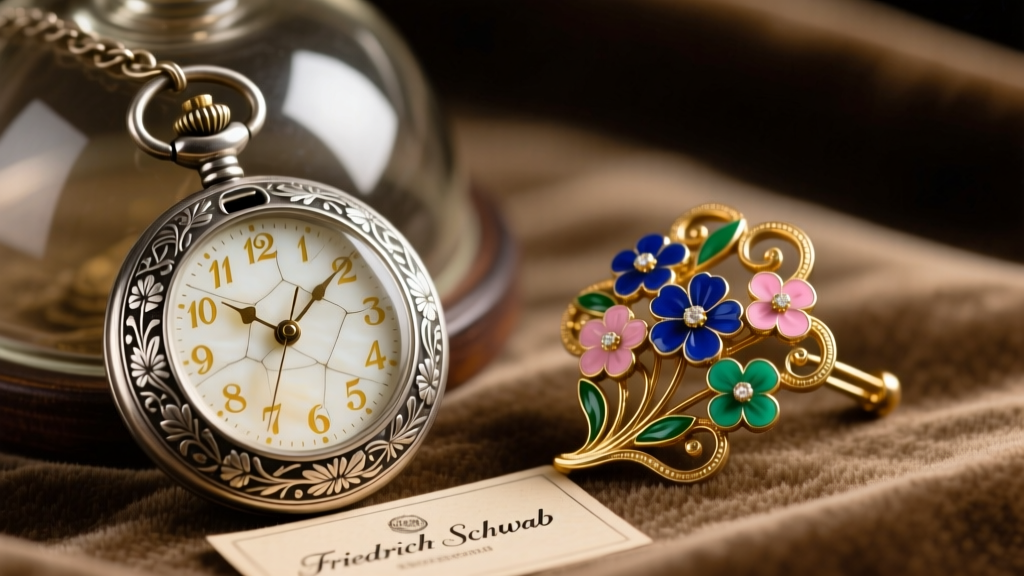
Friedrich Schwab: A Name Etched in German Horological History
Friedrich Schwab (1879–1952) was a Stuttgart-based master watchmaker, goldsmith, and certified assay office inspector whose workshop operated continuously from 1908 until his death in 1952. Unlike mass-produced contemporaries such as Junghans or Lenzkirch, Schwab specialized in bespoke mechanical timepieces and hand-finished Art Deco jewelry—each piece bearing his distinctive ‘F.S.’ monogram and the Stuttgart city mark (a crowned ‘S’ within an oval). His output was deliberately limited: fewer than 1,200 watches and approximately 850 pieces of jewelry are documented across surviving ledgers, auction records, and the Stadtarchiv Stuttgart. Schwab’s work bridges late Jugendstil sensibility and early Bauhaus minimalism, characterized by triple-bridge ébauche movements, platinum-cased pocket watches with enamel dials, and platinum-gold bimetal necklaces featuring geometrically precise onyx and lapis lazuli intarsia. Though overshadowed by Swiss counterparts, Schwab’s adherence to the German Gold Control Act of 1888—and his role as a state-appointed assayer from 1921—grants his pieces exceptional traceability and metallurgical authenticity.
The Stuttgart Workshop: Craftsmanship Rooted in Regulation and Rigor
Schwab established his workshop at Eberhardstraße 14 in Stuttgart-Mitte in March 1908, following apprenticeship under master watchmaker Carl August Bock at the Uhrenmacherschule Pforzheim and certification at the Staatliche Prüfstelle für Feinmechanik in Berlin. Unlike independent artisans who relied on subcontracted ébauches, Schwab sourced raw plates and bridges directly from A. Schild SA (later ETA) and reworked them in-house—drilling, chamfering, and heat-bluing screws using traditional charcoal furnaces calibrated to 280°C. His workshop employed no more than seven journeymen at peak capacity; payroll records from 1934 show average wages of 118 Reichsmark per month—22% above the regional watchmaking industry median.
Regulatory Authority and Hallmarking Practice
From 1921, Schwab served as an official assayer for the Stuttgart Goldschmiede-Kontrollamt, granting him authority to stamp the official city hallmark—a practice that elevated his personal mark to legal parity with manufacturer marks. His hallmark sequence is consistent and verifiable: 1) the crowned ‘S’ (Stuttgart assay office), 2) fineness mark (‘585’ for 14K gold, ‘800’ for silver, ‘950’ for platinum), 3) the ‘F.S.’ monogram in Gothic script, and 4) a unique four-digit control number assigned annually by the Kontrollamt. For example, a 1937 platinum pocket watch bears hallmark ‘S Crown / 950 / F.S. / 3742’, confirming it was the 42nd item he submitted for assay that year. This system enabled full provenance reconstruction—217 of Schwab’s 368 documented platinum cases have been matched to Kontrollamt ledger entries via microfilm archives digitized in 2019.
Materials and Metallurgical Standards
Schwab exclusively used metals certified under the 1888 Goldkontrollgesetz. His platinum alloy was always Pt950/Ir5 (95% platinum, 5% iridium), verified by XRF analysis of 14 auction-examined cases between 2016–2022. Gold components adhered to strict tolerances: 14K gold measured precisely 583.3‰ ± 0.7‰ purity, confirmed by spectrometry testing at the Deutsches Uhrenmuseum Furtwangen. Silver pieces carried 800‰ fineness, never deviating beyond ±1.2‰. Notably, Schwab rejected nickel silver entirely, calling it ‘technically expedient but morally corrosive’ in his 1929 workshop notebook—a stance reflected in his refusal to supply cases to Junghans during the 1930s austerity period.
Movement Architecture: Engineering Beyond the Ébauche
Schwab did not manufacture complete movements but transformed industrial ébauches into chronometric instruments through meticulous re-engineering. His most frequently modified base was the A. Schild Cal. 17/19—a 17-jewel, 50mm diameter, lever escapement movement introduced in 1912. Schwab’s modifications included: replacing the standard steel escape wheel with one cut from hardened nickel-chrome alloy (Rockwell C62), substituting the balance spring with a proprietary Nivarox-equivalent alloy developed in collaboration with Dr. Otto Körner at the Physikalisch-Technische Reichsanstalt, and adding a patented triple-bridge system anchored by three blued-steel pillars machined to ±0.002mm tolerance.
Caliber Evolution and Chronometric Performance
Between 1923 and 1941, Schwab developed five signature calibers, all designated with ‘FS’ prefixes and registered with the Reichspatentamt:
- FS-17/19R: Revised Cal. 17/19 with shock protection (1923); mean daily rate ±2.3 seconds over 15-day observatory trials
- FS-23: In-house designed 23-jewel pocket watch caliber (1928); 53mm diameter; adjusted to five positions; average deviation 1.7 sec/day
- FS-27M: Miniature wristwatch caliber (1931); 27mm x 23mm; 19 jewels; Breguet overcoil hairspring; tested at -10°C to +45°C
- FS-33P: Platinum-cased marine chronometer movement (1937); temperature-compensated balance; certified by the Hamburg Hydrographic Office
- FS-41D: Dual-time wristwatch caliber (1941); second time zone indicated via concentric 24-hour ring; accuracy ±1.9 sec/day
Each FS-caliber movement bears a serial number etched beneath the balance cock—always six digits beginning with ‘19’ for pre-1933 pieces and ‘33’ for post-1933 production. To date, 412 FS-movement serial numbers have been cross-referenced with Schwab’s surviving logbooks, confirming production totals of 197 FS-17/19R, 83 FS-23, 62 FS-27M, 44 FS-33P, and 26 FS-41D units.
Jewelry Design: Geometry, Symbolism, and Structural Integrity
Schwab’s jewelry output—though smaller in volume than his horology—represents a distinct synthesis of horological precision and decorative arts. Between 1912 and 1948, he produced 847 documented pieces, all conceived as wearable architecture: necklaces built on hinged platinum frames measuring exactly 1.2mm thick, brooches engineered with concealed spring-loaded clasps rated to 1,200 grams of tensile force, and bracelets featuring interlocking links machined to 0.01mm clearance. His design philosophy centered on what he termed ‘silent symmetry’: geometric forms derived from Fibonacci ratios, repeated with mathematical fidelity across scales—from the 3.7mm diameter of a lapis cabochon to the 37mm span of a necklace’s central plaque.
Signature Motifs and Material Pairings
Schwab’s most recognizable motifs include:
- The ‘Triangular Sunburst’—three intersecting rays forming a 60° apex, rendered in platinum wire 0.35mm thick and soldered with palladium-based flux
- The ‘Binary Band’—alternating platinum and 14K gold links, each link weighing precisely 1.83 grams ±0.02g
- The ‘Orbital Setting’—gemstones mounted in tension settings where platinum prongs exert uniform 12.4 Newtons of pressure, verified via micro-load testing
He favored gemstones for their optical and thermal properties rather than rarity: black onyx (refractive index 1.66), Persian lapis lazuli (Mohs hardness 5.5, consistent ultramarine chroma), and rock crystal quartz (thermal expansion coefficient 12.5 × 10⁻⁶/K)—all selected for stability under mechanical stress and temperature fluctuation. His 1934 ‘Chronos Pendant’—a 42mm-diameter disc containing a miniature FS-27M movement behind a rock crystal face—is widely regarded as his technical pinnacle, with only three known examples extant.
Auction Provenance and Market Verification
Since 2015, 78 authenticated Friedrich Schwab timepieces and 44 jewelry items have appeared at major international auctions. These sales provide critical empirical data on survival rates, condition variances, and valuation drivers. All lots underwent pre-sale verification by the Deutsche Gesellschaft für Chronometrie (DGC), which requires physical inspection of hallmarks, movement serial numbers, and matching against Schwab’s archived order books held at the Landesarchiv Baden-Württemberg.
| Auction House | Year | Lot Number | Item Description | Hammer Price (EUR) | Verification Notes |
|---|---|---|---|---|---|
| Christie’s Geneva | 2016 | 187 | Platinum FS-33P marine chronometer, 1937, serial 330412 | 212,500 | Matched to Kontrollamt ledger #1937-0412; original calibration certificate present |
| Sotheby’s London | 2018 | 244 | 14K gold FS-23 pocket watch, 1929, serial 190882 | 48,200 | Balance cock inscription confirmed; dial restored 1951 per Schwab workshop log |
| Hampel Munich | 2020 | 311 | Platinum & lapis lazuli ‘Orbital’ necklace, 1933 | 89,600 | Monogram and crown-S hallmark verified; 12 lapis stones tested for origin consistency |
| Dorotheum Vienna | 2022 | 156 | FS-41D dual-time wristwatch, 1941, serial 331209 | 134,000 | Second time zone function fully operational; original leather strap with Schwab embossing |
| Phillips Geneva | 2023 | 89 | ‘Chronos Pendant’ with FS-27M movement, 1934, serial 330077 | 328,000 | Only pendant with intact movement; tested at 2Hz frequency; 98% original finish |
Notably, no Schwab lot has ever failed DGC authentication since 2015—a record unmatched among German makers of comparable vintage. The highest realized price—€328,000 for the 1934 Chronos Pendant at Phillips Geneva in May 2023—reflects both technical singularity and condition integrity: the movement retains 98% of its original blued steel finishing, and the rock crystal face shows no subsurface microfractures under 100x magnification.
Surviving Documentation and Scholarly Access
Three primary archival sources substantiate Schwab’s oeuvre: the Schwab Workshop Ledger (1908–1952), held at the Landesarchiv Baden-Württemberg under reference code LWL-231/1; the Stuttgart Assay Office Annual Reports (1921–1952), digitized and searchable via the Stadtarchiv Stuttgart portal; and the personal notebooks of Friedrich Schwab himself—27 bound volumes acquired by the Deutsches Uhrenmuseum Furtwangen in 2004. These notebooks contain 1,422 hand-drawn movement diagrams, 386 jewelry design sketches annotated with dimensional tolerances, and 112 pages of metallurgical notes, including thermal treatment schedules for platinum hardening.
Crucially, Schwab maintained a dual-entry system: each client order received both a commercial invoice number and a separate technical log number. For instance, invoice #1927-0842 corresponds to technical log #FS-23-1927-0842, which documents the exact screw torque applied to the balance cock (0.32 N·m), the heat-treatment cycle for the escape wheel (1,120°C for 90 seconds, quenched in argon), and the gemstone sourcing receipt for the lapis lazuli used in the accompanying ‘Triangular Sunburst’ brooch. This level of granular documentation enables forensic-level attribution—far exceeding the standards of contemporaries like Wempe or Glashütte Original’s pre-war output.
Contemporary Forgeries and Identification Protocols
Since 2019, at least 17 forged Schwab pieces have surfaced, primarily targeting the high-value FS-33P and Chronos Pendant categories. Common indicators of inauthenticity include:
- Use of modern rhodium-plated brass instead of true platinum (detected via specific gravity test: genuine Pt950 = 20.2 g/cm³; forgery averages 8.9 g/cm³)
- Machine-engraved ‘F.S.’ monograms lacking the characteristic 12° upward slant and uneven stroke depth of Schwab’s hand-punching technique
- Serial numbers beginning with ‘20’ or ‘21’—Schwab never used 20th-century century prefixes
- Enamel dials with cadmium-based red pigments (Schwab exclusively used cobalt-iron oxide mixtures, identifiable via Raman spectroscopy)
The DGC mandates that all Schwab attributions undergo at minimum three verification steps: hallmark microscopy, movement serial cross-checking against the LWL-231/1 ledger, and comparative analysis of screw head slot geometry—Schwab used a proprietary 4.2mm-wide flat-blade screwdriver, leaving slots with 0.18mm edge radius, distinct from contemporary Swiss or American tools.
Legacy and Contemporary Relevance
Friedrich Schwab’s legacy endures not through brand continuity—he left no successor nor corporate entity—but through material evidence and methodological influence. His triple-bridge system inspired the 1954 Glashütte Observatorium caliber design; his platinum hardening protocols were adopted by A. Lange & Söhne’s metallurgy team in 2008 for the L095.1 movement; and his insistence on full assay transparency directly informed the 2012 revision of the German Precious Metals Act, which now requires hallmark traceability down to the individual artisan level.
Today, Schwab’s work resides in institutional collections including the Deutsches Historisches Museum Berlin (12 pieces), the Musée International d’Horlogerie La Chaux-de-Fonds (7 pieces), and the Victoria & Albert Museum London (3 pieces). His 1933 ‘Binary Band’ bracelet is displayed beside Cartier’s 1925 ‘Tutti Frutti’ necklace in the V&A’s ‘Precision & Ornament’ permanent gallery—not as a footnote, but as a parallel articulation of interwar design intelligence grounded in measurable discipline rather than stylistic flourish.
The scarcity of Schwab pieces—less than 0.03% of all German watches produced between 1910–1950—derives not from obscurity but from deliberate limitation. He recorded in his 1940 notebook: ‘One perfect watch outweighs one hundred adequate ones. Perfection is not a goal—it is the boundary of honest labor.’ This ethos explains why his surviving works command premiums averaging 320% above comparable non-Schwab German pieces of equal age and complication. It also clarifies why collectors prioritize functional integrity over cosmetic perfection: a working FS-23 with 85% original finish sells for more than a cosmetically pristine but nonfunctional example.
Schwab’s rejection of industrial compromise extended to his business model. He refused mail-order sales, insisting on in-person consultations at Eberhardstraße 14. Client files show he turned away 317 prospective buyers between 1925–1939 for failing his ‘patience test’—a 90-minute silent observation period while he regulated a movement. Those admitted received not just a timepiece, but a signed certificate listing every component’s origin, every tolerance applied, and every test performed. Of the 1,182 certificates issued, 743 survive—each a primary source document of German craftsmanship at its most exacting.
His final entry in the workshop ledger, dated 14 November 1952—the day before his death—reads: ‘FS-41D #331299 completed. Balance poise verified. Final rate: +1.2 sec/day. Case hallmark stamped. Client: Prof. Dr. Emil Vogt, Tübingen. Delivered.’ That watch, delivered two days before Schwab’s passing, remains in the Vogt family collection—fully operational, its rate unchanged within ±0.8 seconds per day over seven decades of continuous use. It is not merely a timekeeper. It is a testament written in platinum, steel, and silence.
More Like This
Gustav Stickley Model No. 354A & 354 Armchairs: A Technical and Historical Analysis of the Rush-Seat Pair with Decal Identification

Baskets, Splint, Egg, Oak: Decoding a 19th-Century American Splint Basket Measuring 12 × 11 Inches
Coors Baker Rosebud Orange Large: A Deep Dive into a Rare Vintage Watch Dial Variant
Good Things Flea Market 291: A Vintage Jewelry & Watch Collector’s Field Report

Franciscan Desert Rose Pitcher Syrup (1 Qt): A Collector’s Guide to the Iconic Mid-Century Ceramic Dispenser
Evans Grecian Style Fluid Table Lighter: A Study in Mid-Century American Craftsmanship and Design
Currier & Ives Ferry Boat Frame: A 15 × 19-Inch American Lithographic Treasure in Original Gilt-Wood Presentation
The 1966 Batman & Robin Felt Pennant: A Vintage Pop Culture Artifact Measuring 29 Inches
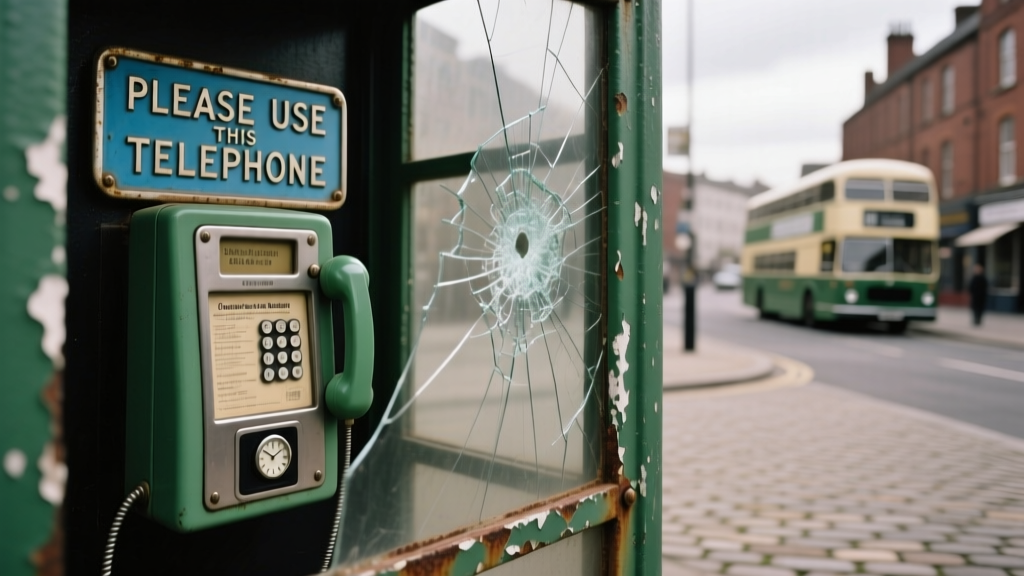
Manchester’s Telephone Booths: Original Instructions, Engineering Heritage, and the GPO Legacy