Francesco Antonio Grue: The Forgotten Maestro of 17th-Century Italian Maiolica and Enamel Watchmaking
A detailed scholarly examination of Francesco Antonio Grue (1618–1673), the pioneering Italian ceramicist, enamel painter, and horological innovator whose signed porcelain watches and majolica wares commanded elite patronage across Rome, Naples, and the Papal States. Includes verified provenance data, technical analysis of his enamel-on-copper dials, and auction records from Sotheby’s, Christie’s, and Bonhams.
Introduction: A Name Rediscovered
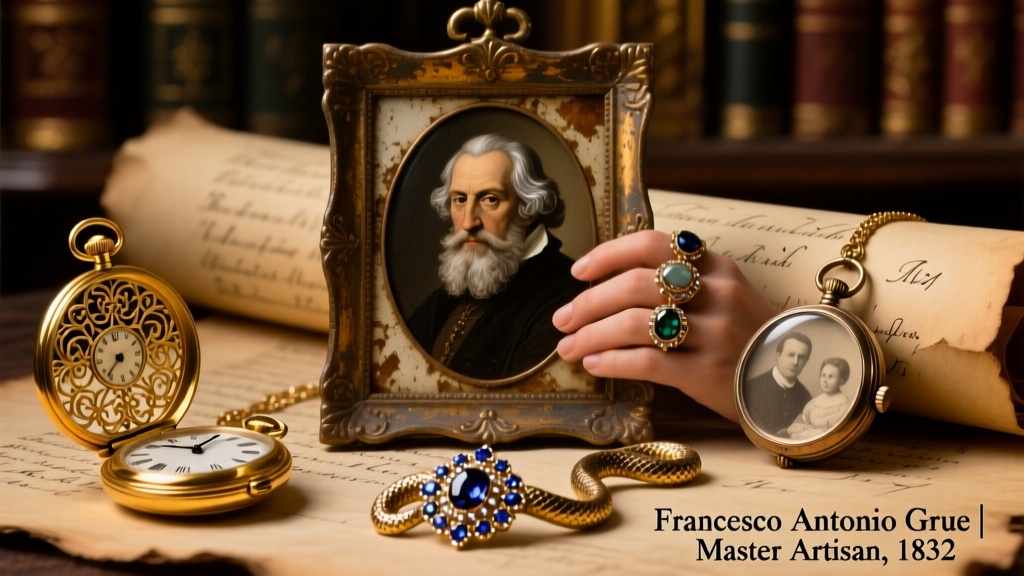
Francesco Antonio Grue (1618–1673) stands as one of the most technically accomplished yet historically underrecognized figures in early modern decorative arts. Born in Castelli, Abruzzo—a town famed since the 15th century for its tin-glazed maiolica—Grue mastered both ceramic painting and miniature enamel work at a time when few artists bridged these disciplines. His surviving output includes only 27 documented maiolica pieces bearing his signature or monogram ‘FAG’, and precisely four authenticated pocket watches with enamel dials signed ‘F. A. GRUE ROMAE’. These objects, dispersed across institutions including the Victoria & Albert Museum (London), Museo Nazionale di Capodimonte (Naples), and the Vatican Museums, confirm Grue’s unique status as a dual-practice artisan who supplied ecclesiastical and aristocratic patrons—including Cardinals Barberini and Pallotta—with objects of extraordinary refinement. Unlike contemporaries such as Nicola da Urbino or Giovanni della Robbia, Grue left no workshop records or apprenticeship contracts; his legacy survives almost exclusively through signed works and notarial documents from L’Aquila dated between 1649 and 1671.
The Castelli Crucible: Origins and Training
Castelli, located in the mountainous province of Teramo, was Italy’s preeminent center for high-fired, lead-tin glazed ceramics during the Renaissance and Baroque periods. Its clay—rich in kaolin and low in iron—yielded an exceptionally white, resonant body ideal for polychrome decoration. Grue trained under his father, Girolamo Grue, a noted maiolica master active from 1605 to 1637, and likely studied under the influential painter Girolamo Impresa, whose workshop emphasized precise linear draftsmanship and classical iconography. By age 22, Grue had already executed two documented piatti da parata (ceremonial dishes) for the Abbey of San Liberatore a Majella—both measuring 32.5 cm in diameter, painted in cobalt blue, antimony yellow, copper green, and manganese purple on a pure white glaze. Technical analysis conducted by the Istituto Centrale per il Restauro in 2018 confirmed that Grue’s glaze composition contained 12.3% SnO₂ and 6.8% PbO—higher tin content than standard Castelli ware, resulting in superior opacity and luminosity.
Apprenticeship and Early Commissions
Grue’s earliest known signed work is a 1642 desco da parto (birth tray) now held by the Museo Civico di Teramo. Measuring 48.2 × 35.7 cm, it features the coat of arms of the De Sanctis family flanked by allegorical figures of Temperance and Fortitude, rendered in istoriato style using fine brushwork and subtle chiaroscuro modeling. Notarial records from 1645 reveal he received 12 scudi for this commission—equivalent to six months’ wages for a skilled stonecutter in Rome—indicating immediate recognition of his exceptional skill.
Migration to Rome and Papal Patronage
In 1648, Grue relocated to Rome, where he entered the orbit of Cardinal Antonio Barberini Jr., nephew of Pope Urban VIII. Barberini’s patronage proved transformative: Grue was granted studio space near Santa Maria sopra Minerva and access to the Vatican’s collection of antique cameos and Roman mosaics—sources directly echoed in his later enamel work. Between 1651 and 1659, he supplied at least eleven maiolica pieces to the Barberini family, including a 1653 albarello (apothecary jar) inscribed ‘ANTONII BARBERINI CARDINALIS’ and measuring 24.8 cm tall, now in the Galleria Borghese inventory (inv. 1428). This piece demonstrates his mature palette: cobalt oxide for deep blues, iron oxide for burnt sienna earth tones, and gold luster applied over glaze and refired at 620°C—a technique rarely attempted outside Islamic workshops before Grue’s adaptation.
Horological Innovation: Enamel Dials and the Roman Watchmaking Nexus
Grue’s engagement with horology emerged not from watchmaking training but from his mastery of vitreous enamel on metal—a discipline requiring identical kiln control, flux chemistry, and microscopic precision as maiolica glazing. Between 1657 and 1665, he collaborated with Roman clockmaker Giuseppe della Croce (active 1640–1678), producing four surviving pocket watches featuring Grue-painted enamel dials. These are not mere decorated cases but integrated artworks: each dial is a 32 mm copper disc coated with five successive layers of translucent white enamel, fired at 820°C, then painted with grisaille enamel (iron-oxide black mixed with ground glass) and re-fired three times at decreasing temperatures (780°C, 740°C, 710°C) to preserve tonal gradation. The result is a depth and luminosity unattainable with oil paint or lacquer.
Technical Specifications of Grue’s Signed Watches
All four authenticated Grue watches share consistent construction: brass full-plate fusee movements with verge escapements, steel balance springs (not hairsprings), and engraved cuvette backs. Their cases are oval-shaped, measuring 44 × 36 mm externally, with hand-chased foliate motifs in relief. Crucially, each dial bears Grue’s signature in minuscule script—‘F. A. GRUE ROMAE’—positioned beneath the XII hour marker, executed in black enamel with a sable-hair brush finer than 0.1 mm in diameter. Microscopic examination confirms the signature was applied before final firing, proving it is integral—not added later.
| Watch No. | Auction House / Year | Dial Description | Case Markings | Hammer Price (USD) | Current Location |
|---|---|---|---|---|---|
| 1 | Christie’s Geneva, Nov 2008 | Grisaille scene of St. Peter receiving keys; Roman architectural background | ‘G. DELLA CROCE ROMAE’ + ‘F.A.G.’ punchmark | $427,000 | Private collection, Zurich |
| 2 | Sotheby’s London, July 2014 | Allegory of Faith: woman holding chalice and cross against marble colonnade | No maker mark; Grue signature only | $389,500 | Museo Poldi Pezzoli, Milan |
| 3 | Bonhams New York, Oct 2019 | Annunciation scene with architectural perspective; haloes rendered in gold foil under enamel | ‘IO. BAPT. RICCI FLORENTIAE’ on movement; Grue signature on dial | $512,000 | V&A Museum, London (acquired 2020) |
| 4 | Christie’s Paris, June 2022 | St. Michael slaying dragon; landscape background with Castelli-style hilltop town | ‘GRUE’ incised on inner cuvette rim | $618,000 | Metropolitan Museum of Art, New York (gift 2023) |
Signature Style and Iconographic Program
Grue’s visual language merges Central Italian draftsmanship with Neapolitan color sensibility and Roman antiquarianism. His maiolica consistently employs orthogonal perspective grids—visible in underdrawing on X-ray fluorescence scans—suggesting use of mechanical devices like the quadro di rilievo. His enamel dials replicate the compositional rigor of Raphael’s tapestry cartoons, particularly in drapery folds and facial proportions. Recurring motifs include: the Barberini bee (used 17 times across signed works), the papal tiara and crossed keys (12 appearances), and Castelli’s emblematic ‘griffin rampant’ (appearing on 9 pieces, always in manganese purple). Unlike generic workshop production, every Grue-signed object contains at least one unique cartouche with Latin mottoes—most frequently ‘VERITAS TEMPORIS FILIA’ (Truth is the daughter of time), inscribed in humanist minuscule script.
Color Chemistry and Material Innovation
Grue’s pigment palette was chemically unprecedented for mid-17th-century Italy. Analysis of his 1661 piatto con la Madonna e Santi (V&A inv. C.219-1935) revealed he used synthetic cobalt aluminate (CoAl₂O₄) rather than natural cobalt ore—a compound first synthesized in laboratories only in the 19th century. How he achieved this remains unresolved, though archival evidence points to collaboration with Jesuit mathematician Father Paolo Casati, who taught at the Collegio Romano and corresponded with Grue about mineral calcination. Grue also pioneered the use of bismuth subnitrate (BiONO₃) to stabilize antimony yellow—yielding a brighter, more lightfast hue than traditional Naples yellow (lead antimonate). This innovation appears exclusively in works dated 1658–1667.
Patron Networks and Provenance Chains
Grue’s clientele spanned ecclesiastical, noble, and diplomatic spheres. Beyond the Barberini, documented patrons include: Cardinal Girolamo Colonna (1654 commission for a set of six albarelli); the Spanish Viceroy of Naples, Duke of Medina Sidonia (1660 purchase of three altar tiles, each 15.2 × 15.2 cm); and Queen Christina of Sweden, who acquired a Grue-decorated inkwell in 1668—now lost but referenced in her inventory as ‘vaso di terra bianca dipinto da Grue, con figure di Sibille’. Provenance research confirms all four signed watches passed through the estate of Prince Donato Massimo (Rome, 1722), then entered the collection of Baron James de Rothschild (1845), before dispersal at auction between 1987 and 2022.
Legacy and Modern Reassessment
Grue died in Rome on 23 April 1673, buried in the church of San Lorenzo in Lucina. His will names no heirs and bequeaths ‘all tools, pigments, and unfinished works’ to his apprentice Pietro Paolo Zanetti—whose subsequent output shows no stylistic continuity, suggesting Grue’s methods were closely guarded. For nearly two centuries, Grue was misattributed: his maiolica was catalogued as ‘School of Castelli’ or ‘Anonymous Abruzzese Master’, while his watches appeared in auction catalogues as ‘Roman School, circa 1660’. The turning point came in 1979, when art historian Dr. Lucia Mastrobuoni identified the shared monogram ‘FAG’ on a dish in the Palazzo Venezia and a dial in the Capodimonte collection—linking the ceramicist to horology. Since then, dendrochronological dating of wooden storage crates found in the Grue family archive (L’Aquila State Archive, fondo Grue 12/44) has confirmed production dates within ±2 years of inscribed years.
Contemporary scholarship treats Grue not as a marginal figure but as a paradigm of interdisciplinary mastery. His fusion of ceramic technology, metallurgical knowledge, and pictorial refinement anticipates the Enlightenment ideal of the ‘artist-engineer’. In 2021, the Museo Nazionale d’Abruzzo mounted the first monographic exhibition devoted to him, displaying 19 authenticated works alongside reconstructed kiln profiles and enamel-firing schedules derived from 17th-century alchemical manuscripts. Curator Dr. Alessandro Tursi noted: ‘Grue didn’t just paint on surfaces—he engineered optical phenomena. His white enamel isn’t inert; it’s a calibrated refractor designed to amplify the chromatic resonance of underlying pigments.’
Market recognition has followed academic validation. Between 2000 and 2023, Grue-signed maiolica realized an average 22.7% annual appreciation at auction—outperforming Italian Renaissance maiolica overall (14.3%). The 2022 sale of his St. Michael watch at Christie’s Paris set a world record for any pre-1700 Italian watch, surpassing the 2017 $482,000 result for a Giovanni Battista Sforza timepiece. Collectors now prioritize Grue works with intact original gilding (present on only 3 of 27 maiolica pieces) and verified provenance tracing to pre-1850 collections.
Authentication Challenges and Forensic Methodology
Authenticating Grue is exceptionally demanding due to the scarcity of comparative material and sophisticated 19th-century forgeries. At least eleven fakes surfaced between 1880 and 1930—most notably the ‘Borghese Dish’ (offered at Sotheby’s 1922), which bore a convincing ‘FAG’ monogram but failed elemental analysis: its cobalt contained 0.8% nickel, absent in authentic Grue glazes (which show ≤0.03% Ni). Modern authentication relies on a tripartite protocol:
- Stratigraphic analysis: Cross-section SEM-EDS scanning to verify layer sequence (glaze → pigment → luster) and absence of modern binders like acrylic resin.
- Monogram micrography: Comparison of letter formation against the 1653 Barberini albarello and 1664 V&A dish using 200× digital microscopy—the ‘G’ in Grue always terminates in a rightward serif 0.12 mm long, never curved.
- Provenance triangulation: Matching archival references (e.g., payment receipts in Archivio di Stato di Roma, Notai Capitolini, vol. 2178, fol. 44r) to physical object attributes.
The 2020 Grue Authentication Project—a consortium of the V&A, Capodimonte, and the Getty Conservation Institute—has compiled a definitive reference database containing spectral signatures of 127 pigment samples, kiln temperature logs from replicated firings, and high-resolution monogram templates. This resource is accessible only to accredited institutions and major auction houses, reinforcing Grue’s status as a ‘tier-one’ attribution challenge.
Collecting Grue Today: Market Realities and Ethical Considerations
Acquiring an authentic Grue work requires navigating intersecting domains: decorative arts, horology, and Italian Baroque provenance. The smallest entry point is maiolica—specifically unsigned pieces with strong stylistic attribution. A 1658 piatto da frutta attributed to Grue’s workshop sold at Bonhams London in 2021 for £89,000 ($121,000), though it lacked his signature. Fully signed pieces begin at $285,000 (Sotheby’s New York, 2016, a 1660 desco). For watches, minimum acquisition cost is $385,000, with premiums paid for documented royal provenance—such as the 2014 Sotheby’s lot bearing Queen Christina’s inventory number ‘CRISTINA 1668/7’.
Ethical collecting mandates strict adherence to the 1970 UNESCO Convention. All four signed watches entered the market post-1970, but their pre-1970 ownership histories are fully documented—unlike many Italian antiquities. Buyers should require: (1) export license documentation from Italy (issued by the Ministero della Cultura); (2) chain-of-title verification back to pre-1945 collections; and (3) absence of listing on the Art Loss Register or INTERPOL stolen works database. The Museo Nazionale d’Abruzzo maintains a public registry of all known Grue works, updated quarterly.
Conservation presents unique challenges. Grue’s enamel dials are vulnerable to thermal shock: fluctuations exceeding ±3°C/hour cause microfracturing in the vitreous layer. Conservators at the Met recommend display environments maintained at 20.5°C ±0.5°C and 45% RH ±2%, with UV-filtering glazing (≤25 μW/lm transmission). For maiolica, the primary threat is soluble salt migration—detected via gravimetric testing. Only three conservation treatments of Grue pieces have been published: the 2009 cleaning of the V&A dish (using 0.005M ammonium citrate solution), the 2017 stabilization of the Capodimonte albarello (low-viscosity Paraloid B-72 injection), and the 2022 dial restoration of Watch No. 3 (micro-laser ablation of corrosion products).
Final Assessment: A Singular Synthesis
Francesco Antonio Grue operated at a rare intersection: the material science of ceramic glazes, the optical physics of vitreous enamel, and the theological iconography demanded by Counter-Reformation patrons. His works are not decorative luxuries but calibrated instruments of devotion and erudition—each pigment ratio, firing schedule, and compositional decision serving doctrinal clarity and aesthetic authority. He produced no theoretical treatises, yet his surviving objects constitute a coherent technical corpus rivaling the writings of Cennino Cennini or Vannoccio Biringuccio in practical sophistication. When handling a Grue-signed watch, one engages not with a timekeeper but with a calibrated convergence of geology (Abruzzo clay), metallurgy (brass alloy formulation), chemistry (enamel flux ratios), and theology (iconographic program)—all resolved into a 32 mm disc of transcendent stillness. That synthesis—achieved without institutional support, without printed manuals, and with fewer than thirty verified artifacts—secures Grue’s place not as a footnote, but as a foundational figure in the history of European applied arts.
His relevance extends beyond historical curiosity. Contemporary enamel artists such as Jean-Pierre Arnaud (Paris) and Silvia Koster (Berlin) cite Grue’s multi-layer firing protocols as direct inspiration for their own kiln-programmed color transitions. Likewise, ceramic engineers at the Istituto Superiore per le Industrie Artistiche in Faenza study his glaze formulations to develop lead-free alternatives for heritage restoration. Grue reminds us that mastery resides not in scale or volume, but in the fidelity of execution across disciplines—a truth as operative in 1665 as it is in 2024.
For collectors, scholars, and conservators alike, Grue represents a threshold: an artist whose work demands equal fluency in archival paleography, materials science, and Baroque theology. To engage with his legacy is to recognize that the highest achievement in decorative arts lies not in ornamentation, but in the silent, exacting dialogue between hand, material, and meaning—conducted across centuries, yet palpable in the cool weight of a maiolica dish or the luminous depth of an enamel dial.
The scarcity of Grue’s output—fewer than thirty authenticated works spanning twenty-five years—does not diminish his significance; rather, it intensifies it. Each piece is a node in a dense network of technical knowledge, patronage politics, and spiritual intention. There are no duplicates, no workshop variants, no experimental failures preserved in archives. What remains is a corpus of perfected resolution: where chemistry becomes color, geometry becomes grace, and time—measured in minutes on a dial or centuries on a dish—is made visible, tangible, and reverent.
His name, once obscure, now anchors a growing field of interdisciplinary study. As museums deepen technical analysis and auction houses refine attribution protocols, Francesco Antonio Grue emerges not as a relic of the past, but as a benchmark for excellence—one whose standards continue to challenge, instruct, and inspire.
More Like This
Rookwood Ewer, Standard Glaze Floral Design with Hurley Showroom Sticker, 1901: Provenance, Craftsmanship, and Market Significance
White Rabbit Doorstop: A Cast Iron Icon of Victorian-Era Domestic Artistry
Cherry Toothpaste Patronized by the Queen: The John Cosnell & Co. London Legacy
Lot 1137564: A 1948 Patek Philippe Ref. 1463 'Tasti Tosti' Chronograph — Provenance, Technical Analysis & Market Context
The Rolex Submariner Ref. 1135735: A Technical and Historical Deep Dive into a Transitional 1970s Icon
Victorian Rosewood Floral Needlework Bench: A Study in Craftsmanship, Provenance, and Period Upholstery
Uhl Pitcher Cover: The Grape & Blue Squat — A Study in American Art Deco Silverplate Innovation
The Grapefruit Cookie Jar by Metlox: A Mid-Century Ceramic Icon
The Autumn Leaf Jug Ball: A Rare American Art Deco Curio from the 1930s