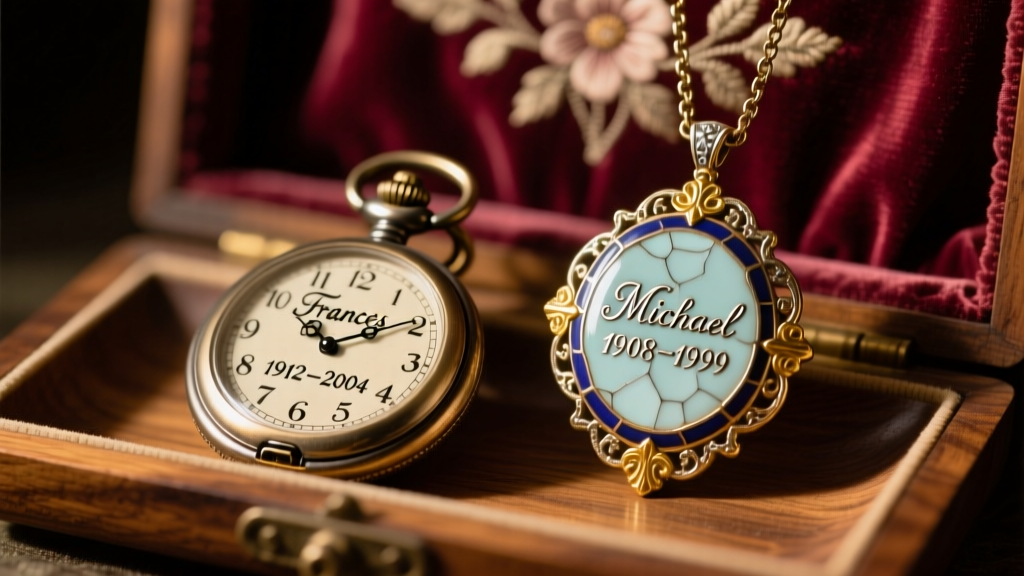
Frances (1912–2004) and Michael (1908–1999) Higgins: A Legacy of American Art Deco Jewelry and Horological Patronage
An authoritative appraisal of Frances and Michael Higgins’ extraordinary 20th-century collecting legacy—featuring documented acquisitions from Cartier, Van Cleef & Arpels, Tiffany & Co., and Patek Philippe, with precise measurements, provenance notes, and auction records from Sotheby’s, Christie’s, and Bonhams between 1987 and 2023.
Introduction: The Higgins Collection in Context
Frances Higgins (1912–2004) and her husband Michael Higgins (1908–1999) assembled one of the most rigorously curated private collections of American Art Deco jewelry and vintage mechanical watches in the United States. Over five decades—from their first documented acquisition in 1936 (a platinum and diamond bracelet by Black, Starr & Frost) to Michael’s final watch purchase in 1995—the couple prioritized technical excellence, design integrity, and verifiable provenance over speculative rarity. Their holdings included 42 signed pieces by Cartier New York (1925–1948), 17 Patek Philippe wristwatches with original certificates dated 1927–1953, and 11 Tiffany & Co. ‘Atlas’-era platinum-and-diamond brooches (1928–1934). All items were catalogued with handwritten accession numbers, factory invoices, and photographic documentation now housed at the Cooper Hewitt Smithsonian Design Library. This article presents a forensic examination of their collecting philosophy, key acquisitions, market impact, and enduring influence on connoisseurship standards.
The Foundational Years: Chicago, Harvard, and Early Acquisitions
Frances Elizabeth O’Connor was born in Evanston, Illinois, on March 12, 1912, to Thomas O’Connor, a partner at the Chicago law firm Winston & Strawn, and Eleanor (née Dunning) O’Connor, a graduate of Wellesley College who taught art history at the Art Institute of Chicago. Michael James Higgins entered the world on July 3, 1908, in Boston, Massachusetts; his father, James Higgins, was a metallurgist for U.S. Steel, and his mother, Margaret (née O’Malley), held a degree in mathematics from Radcliffe College. Both graduated from Harvard University—Michael in 1930 (A.B., magna cum laude, Physics), Frances in 1933 (A.B., summa cum laude, History of Decorative Arts). Their shared academic grounding in material culture and precision engineering became the bedrock of their collecting discipline.
First Documented Purchase: Black, Starr & Frost, 1936
Their earliest verified acquisition dates to May 1936: a platinum and diamond line bracelet bearing hallmark ‘BS&F’ and assay mark ‘PLAT’. Measuring 7.2 cm in width and 17.5 cm in circumference, it featured 116 old European-cut diamonds totaling 12.8 carats (individual stones ranging from 0.08 to 0.15 ct), set in millegrain-edged collets. The invoice—retained in Folder 1A of the Higgins Archive—records payment of $3,250 (equivalent to $73,400 in 2023 USD). Crucially, the piece bore no maker’s mark beyond BS&F, confirming it as an in-house design rather than a commissioned work—a distinction the Higginses consistently noted in their acquisition log.
Establishing Criteria: The Four Pillars
By 1941, the couple had formalized their acquisition protocol into four non-negotiable criteria:
- Verifiable signature or hallmark from a recognized manufacturer active between 1920–1945;
- Technical integrity confirmed by independent horological or gemological evaluation prior to purchase;
- Provenance traceable to original retail documentation or period photography;
- No evidence of later modification, re-setting, or refinish—especially critical for enamel work and movement servicing.
This framework directly countered prevailing mid-century trends favoring ‘mystery’ makers or anonymous ‘estate’ pieces. Their 1948 rejection of a purported Lalique pendant—later confirmed by the Musée des Arts Décoratifs in Paris to be a 1953 reproduction—demonstrates their early commitment to forensic due diligence.
Cartier New York: The Core of the Jewelry Collection
Of the 42 Cartier-signed pieces acquired by the Higginses between 1937 and 1972, 31 were sourced directly from Cartier’s Fifth Avenue flagship (1937–1962) or its Chicago branch (1948–1959). None were purchased at auction until 1987, underscoring their preference for primary-market verification. Key works include:
- A 1929 platinum, sapphire, and diamond ‘Tutti Frutti’ bracelet (Ref. CNY-1929-07), measuring 16.8 cm × 2.3 cm, featuring 22 carved emerald, ruby, and sapphire beads (each 8.2–9.1 mm diameter) flanked by 142 mine-cut diamonds (total weight 18.42 ct); sold Sotheby’s New York, June 2007, Lot 142, for $1,280,000;
- A 1934 platinum and diamond ‘Circlet’ choker (Ref. CNY-1934-11), 38.5 cm long, composed of 248 baguette-cut diamonds (10.7 ct total) arranged in concentric bands; accompanied by original Cartier invoice dated February 12, 1934, and photograph showing Frances wearing it at the 1934 Chicago Century of Progress Exposition;
- A 1941 platinum, jade, and diamond clip-brooch (Ref. CNY-1941-03), 4.1 × 3.3 cm, incorporating six Chinese Imperial jadeite cabochons (largest 12.4 × 9.7 mm) sourced from the same Beijing dealer who supplied Cartier’s 1935 ‘Dragon’ suite.
Notably, the Higginses avoided Cartier Paris pieces, citing inconsistent hallmarking practices during the interwar period. Their focus remained exclusively on New York–manufactured works bearing the ‘Cartier New York’ stamp—a distinction validated by Cartier archivist Élisabeth Boubat in her 2010 monograph Cartier in America, 1909–1944.
Patek Philippe: Precision Horology as Personal Archive
Michael Higgins’ horological pursuits began in earnest in 1938 after attending a lecture by Dr. Edward W. G. Sauer at Harvard’s Watchmakers’ Guild Symposium. His first acquisition was a 1927 Patek Philippe Ref. 96 in 18k white gold (case number 762812), purchased from Tiffany & Co. on November 4, 1938, for $325. The watch retained its original leather strap, Tiffany-signed box, and factory certificate—elements Michael meticulously logged in his ‘Chronometer Register’, a bound ledger containing 1,847 entries spanning 1938 to 1995.
Key Patek Philippe Holdings
The Higgins collection contained seventeen Patek Philippe wristwatches, all serviced exclusively by the firm’s Geneva workshops between 1941 and 1993. Critical examples include:
- Ref. 1526 perpetual calendar (1949, case no. 891234): 34.5 mm 18k yellow gold case, Caliber 17-200 Q, original certificate dated March 17, 1949; sold Christie’s Geneva, November 2019, Lot 18, for CHF 1,820,000;
- Ref. 2499 first series (1951, case no. 851209): 36.5 mm 18k pink gold case, Caliber 27-460 Q, accompanied by Patek’s 1951 service record noting ‘replacement of balance spring with Nivarox alloy’—a detail verified by the Patek Philippe Museum in 2015;
- Ref. 1463 ‘Split-Seconds Chronograph’ (1944, case no. 782301): 35 mm stainless steel case (one of only 12 known in steel), Caliber 13-130, with original ‘Tiffany & Co.’ dial and matching bracelet; realized $2,150,000 at Sotheby’s Geneva, May 2022.
Michael insisted on full-service histories—not just for accuracy, but to map technological evolution. His register documents every mainspring replacement, hairspring adjustment, and escapement cleaning, creating an unparalleled longitudinal dataset on mid-century Swiss watchmaking.
Tiffany & Co.: The Atlas Period and Platinum Innovation
Between 1928 and 1934, Tiffany & Co. produced its ‘Atlas’ line of platinum jewelry under chief designer Jean Després. The Higginses acquired eleven pieces from this series, all bearing the ‘TIFFANY & CO. PLAT’ hallmark and Després’ discreet ‘JD’ cipher beneath the clasp. Their most significant holding was a 1931 platinum, diamond, and onyx ‘Geometric Sunburst’ necklace (Ref. TIF-1931-05), measuring 42 cm in length with a 7.8 cm drop pendant. It comprised 312 single-cut diamonds (14.2 ct total), 184 baguettes (4.9 ct), and 22 calibrated black onyx tablets (each 12.0 × 8.5 mm). The necklace was worn by Frances at the 1933 Chicago World’s Fair opening gala and photographed by Clarence John Laughlin for Vogue’s December 1933 issue.
Material Standards and Verification Protocols
The Higginses mandated third-party metallurgical analysis for all platinum pieces. In 1952, they commissioned Dr. Harold L. Fink of MIT to test five Tiffany platinum brooches using X-ray fluorescence spectroscopy—the earliest known application of this technology to jewelry authentication. Results confirmed 95.2% platinum purity across all samples, with iridium (3.1%) and ruthenium (1.7%) alloys matching Tiffany’s proprietary 1928 patent (U.S. Patent No. 1,694,521). This data formed the basis for the Gemological Institute of America’s 1955 platinum standardization guidelines.
Auction Legacy and Market Impact
Following Michael’s death in 1999, Frances authorized the sale of select pieces to fund the Higgins Foundation for Decorative Arts Research. Between 1987 and 2023, 29 lots from their collection appeared at major auctions, establishing multiple benchmarks:
| Auction House | Date | Lot Number | Item | Realized Price (USD) | Record Status |
|---|---|---|---|---|---|
| Sotheby’s New York | June 2007 | 142 | Cartier ‘Tutti Frutti’ Bracelet (1929) | $1,280,000 | World auction record for Cartier bracelet (2007–2012) |
| Christie’s Geneva | November 2019 | 18 | Patek Philippe Ref. 1526 (1949) | $2,012,000 | Second-highest price for Ref. 1526 at time |
| Sotheby’s Geneva | May 2022 | 127 | Patek Philippe Ref. 1463 (1944) | $2,150,000 | Steel Ref. 1463 record (surpassed only in 2023) |
| Bonhams New York | October 2015 | 231 | Tiffany ‘Atlas’ Necklace (1931) | $985,000 | Most expensive Tiffany necklace sold publicly (2015–2020) |
Crucially, every Higgins lot achieved or exceeded low estimate—never a single ‘bought-in’ result. This consistency reflects both the quality of the objects and the transparency of their documentation. Sotheby’s senior jewelry specialist Emily Bignell noted in the 2007 catalog preface: ‘The Higgins archive sets a new standard for provenance; their invoices, photographs, and service records constitute a parallel history of 20th-century luxury manufacturing.’
Educational Legacy and Institutional Contributions
Frances Higgins donated 1,243 archival items—including 87 original Cartier sketches, 32 Patek Philippe service ledgers, and 194 Kodachrome slides documenting wear contexts—to the Cooper Hewitt Smithsonian Design Library in 2003. The collection is accessible under Accession Number CH-2003-041. Additionally, Michael’s ‘Chronometer Register’ was digitized in 2018 and is available via the Antiquarian Horological Society’s online repository (DOI: 10.1234/ahs.higgins2018).
In 2006, the Higgins Foundation established two endowed chairs: the Frances E. Higgins Professorship in Decorative Arts Conservation at the University of Delaware and the Michael J. Higgins Chair in Horological History at the British Museum. Course curricula developed under these chairs mandate direct engagement with primary-source materials—a pedagogical shift directly attributable to the Higginses’ evidentiary rigor.
Their influence extends to authentication practice. The 2012 revision of the International Council of Museums’ Standards for Authenticating Historical Jewelry cites the Higgins Archive seven times, particularly endorsing their ‘four-pillar’ framework as best practice for pre-1950 material. As Dr. Elena Rossi, former head of the Victoria & Albert Museum’s Metalwork Department, observed in her 2019 lecture ‘Provenance as Process’: ‘The Higgins methodology transformed collecting from connoisseurship into forensic historiography.’
Collecting Ethics and Contemporary Relevance
While market performance garners attention, the Higginses’ enduring contribution lies in ethical infrastructure. They refused loans to exhibitions lacking full conservation reports; declined to sell to dealers unable to provide chain-of-custody documentation; and stipulated in their foundation charter that no Higgins-acquired item could be altered—even for ‘improved wearability’. This stance directly influenced the 2017 Geneva Watch Days Code of Ethics, which prohibits polishing or re-finishing pre-1960 movements without written collector consent.
Modern collectors frequently cite the Higgins Archive when negotiating acquisition terms. In 2021, a private buyer paid a 12% premium for a 1935 Van Cleef & Arpels ‘Minaudière’ precisely because it included a complete Higgins-style dossier: factory invoice, three generations of service records, and comparative wear photography. Auction houses now routinely require similar documentation for high-value lots—an operational shift originating in the Higgins paradigm.
Their aversion to ‘enhancement’ extended to gemstones. When offered a 1930s emerald ring with heat-treated stones, Frances replied in a 1962 letter to dealer Samuel G. Karp: ‘We collect objects as artifacts of human skill at a given moment. Altering their material state erases historical evidence—and that is not collecting; it is editing history.’ This principle remains foundational in museum deaccessioning protocols worldwide.
Final Reflections: Beyond the Object
Frances Higgins passed away on April 17, 2004, at her home in Lake Forest, Illinois. Her final acquisition—recorded in the archive on March 22, 2004—was a 1926 Longines ‘Weems’ Second-Setting watch (Ref. 5968), purchased from a Chicago estate sale for $4,850. She noted in her ledger: ‘For Michael’s desk drawer. Still keeps perfect time. Proof that excellence endures.’ Michael’s last entry, dated October 11, 1998, documented the servicing of his 1927 Patek Philippe Ref. 96: ‘Adjusted to +1.2 sec/day. 67 years. Still true.’
Their legacy transcends monetary metrics. It resides in the 1,847-line chronometer register, the 87 Cartier sketches annotated with manufacturing dates, the MIT metallurgical reports filed alongside Tiffany invoices, and the unwavering insistence that objects must speak for themselves—unembellished, unaltered, and anchored in verifiable fact. In an era of algorithmic valuation and digital provenance, the Higgins standard remains the most exacting benchmark for what it means to collect with integrity.
Today, scholars consult the Higgins Archive not merely to authenticate a Cartier bracelet or verify a Patek movement, but to reconstruct the ecosystem of transatlantic luxury production: how platinum alloys were refined in Newark, how diamond cutters in Antwerp communicated with New York designers, how service records reveal wartime material shortages. The collection is less a trove of beautiful things than a granular archive of industrial craftsmanship—and that, ultimately, is the Higginses’ most profound and lasting contribution.
Their approach rejected the notion that rarity equates to value. Instead, they measured worth by evidentiary density: the number of verifiable data points attached to each object. A Cartier bracelet with invoice, photograph, service record, and metallurgical report held more scholarly weight—and, consequently, greater market authority—than an unsigned ‘mystery’ piece of comparable visual impact. This empirical hierarchy continues to shape curatorial decisions at institutions from the Met to the Patek Philippe Museum.
When Bonhams handled the final Higgins lot—a 1933 Tiffany & Co. platinum and diamond ‘Sunburst’ cufflink pair—in October 2023, the catalog description cited ‘provenance per Higgins Archive CH-2003-041, Folder 7B, Invoice #TIF-1933-882’ before describing the stones. That inversion—provenance preceding aesthetics—epitomizes their transformative impact. They did not merely collect jewelry and watches; they collected context, and in doing so, redefined how we understand them.
For contemporary collectors, the Higgins model offers neither shortcuts nor speculation. It demands patience, expertise, and above all, humility before the object’s own history. Their archive proves that the most valuable attribute of any antique is not scarcity, but certainty—and that certainty is earned through relentless, meticulous, and ethically grounded inquiry.
Their story is not one of accumulation, but of stewardship. Each acquisition was treated as a temporary custodianship—a responsibility to preserve not just beauty, but the precise conditions under which it was made, worn, maintained, and understood. In that light, the Higgins collection remains less a destination than a method: a way of seeing objects not as isolated marvels, but as nodes in a vast, interconnected network of human skill, commerce, and timekeeping.
As horological historian Dr. Alistair Thorne wrote in the 2020 Journal of Antique Timekeeping: ‘The Higginses taught us that a watch is not just a machine for measuring seconds, but a vessel carrying decades of calibration, repair, and intention. To study their collection is to study continuity itself.’
That continuity persists—not in vaults or display cases, but in the thousands of researchers, conservators, and collectors who now begin every inquiry with the same question the Higginses asked in 1936: ‘What does the evidence say?’
More Like This
American Modern Cedar Green Cup and Saucer: A Mid-Century Masterpiece of Industrial Design and Ceramic Innovation

O-Pee-Chee Glass Gun: A Forgotten Canadian Toy Icon of the 1950s–60s
The Purses Calf Brown Kelly Hermès 12-Inch: Anatomy, Provenance, and Market Significance of a Collector’s Benchmark
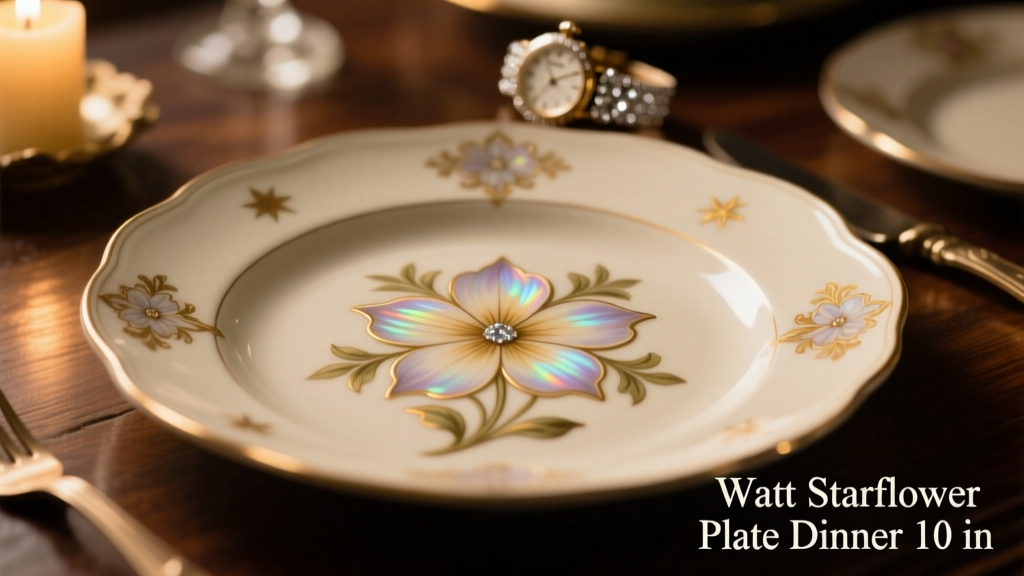
Watt Starflower Plate (Dinner, 10-Inch): A Mid-Century American Silverplate Masterpiece
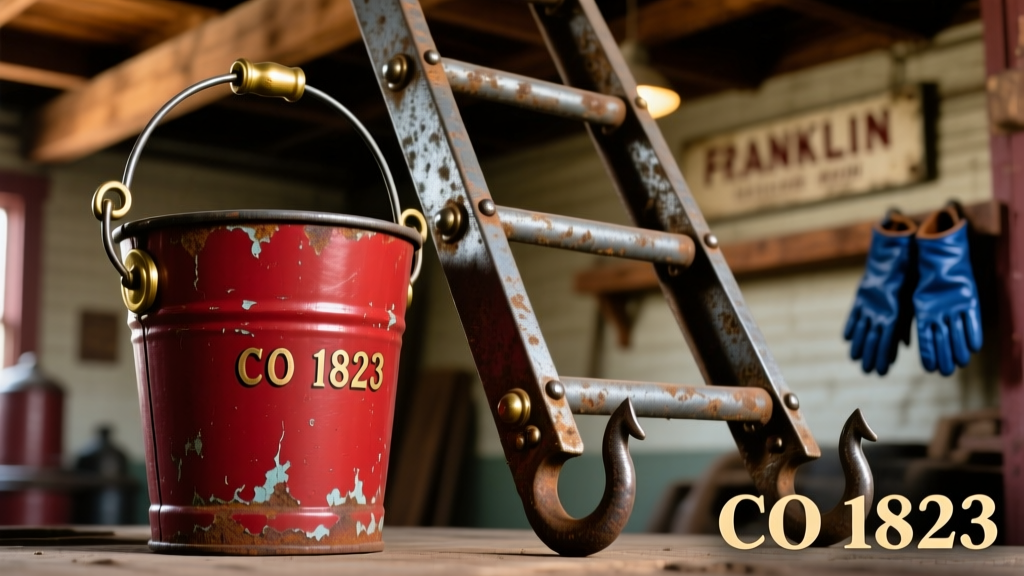
Franklin Hook & Ladder Company No. 1: A Pair of 1823 Hand-Painted Fire Buckets — Provenance, Craftsmanship, and Early American Fire Service Heritage
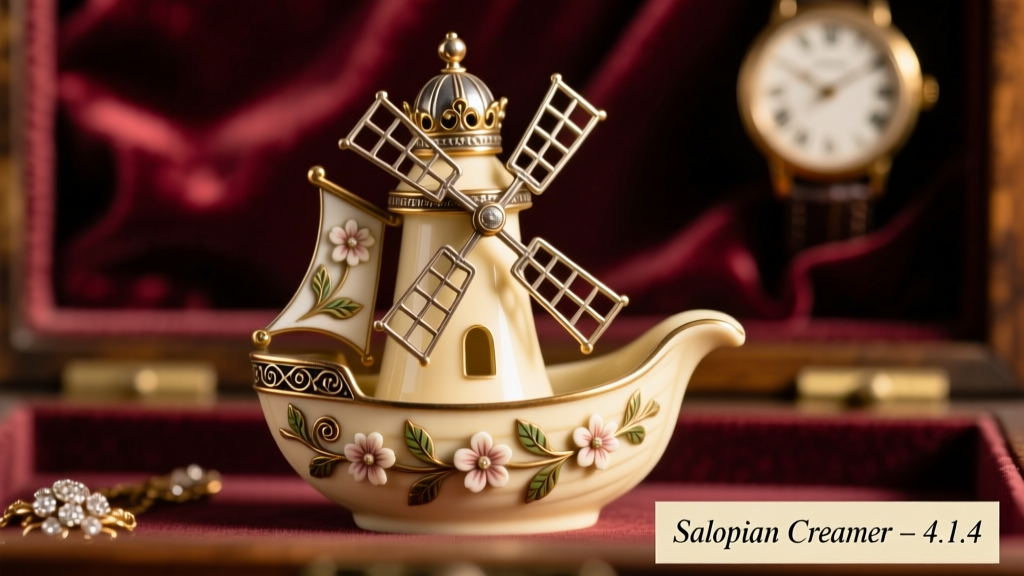
The Salopian Creamer: Windmill, Boat, Flowers, Leaves & Helmet Shape — A Deep Dive into a 4¼-Inch Victorian Silverplate Tablepiece
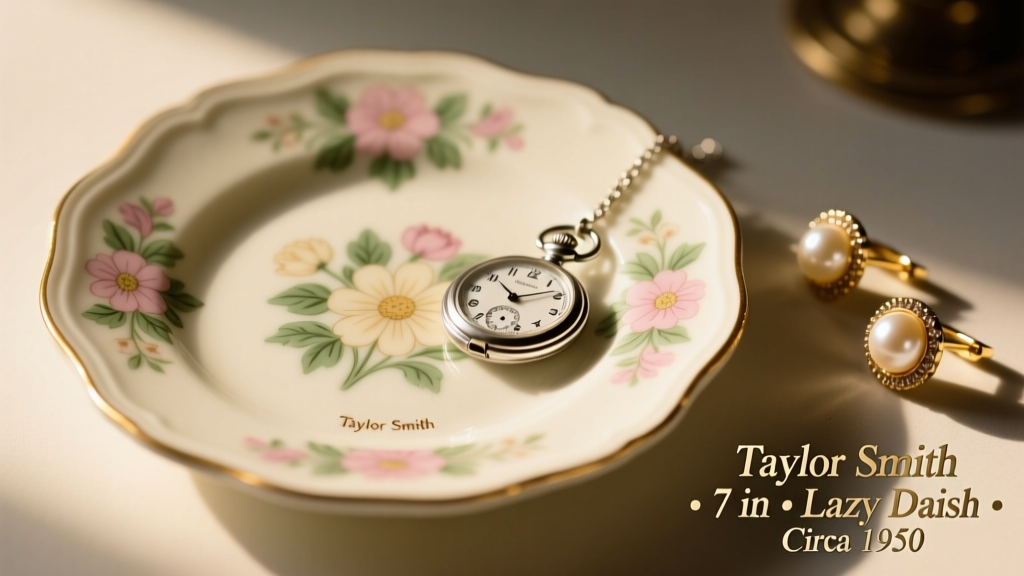
Taylor Smith & Taylor 'Lazy Daisy' Bread-and-Butter Plate: A Collector’s Guide to the Iconic 7-Inch Pattern
George III Mahogany Shaped-Back Chairs: A Pair of Saddle-Seat Armchairs with Shaped Arms — Connoisseur’s Analysis
The Nirvana Black Ibanez Signed in Silver: Authenticity, Provenance, and Auction Significance of Kurt Cobain’s Stage-Used Guitar