Flow Blue Teapot 'Indian Pratt': A Collector's Guide to the Iconic 19th-Century Pattern
An expert analysis of the Flow Blue 'Indian Pratt' teapot — its origins, production timeline, identifying marks, market value, and why this specific pattern remains one of the most sought-after in American antique ceramics.
What Is the Flow Blue 'Indian Pratt' Teapot?
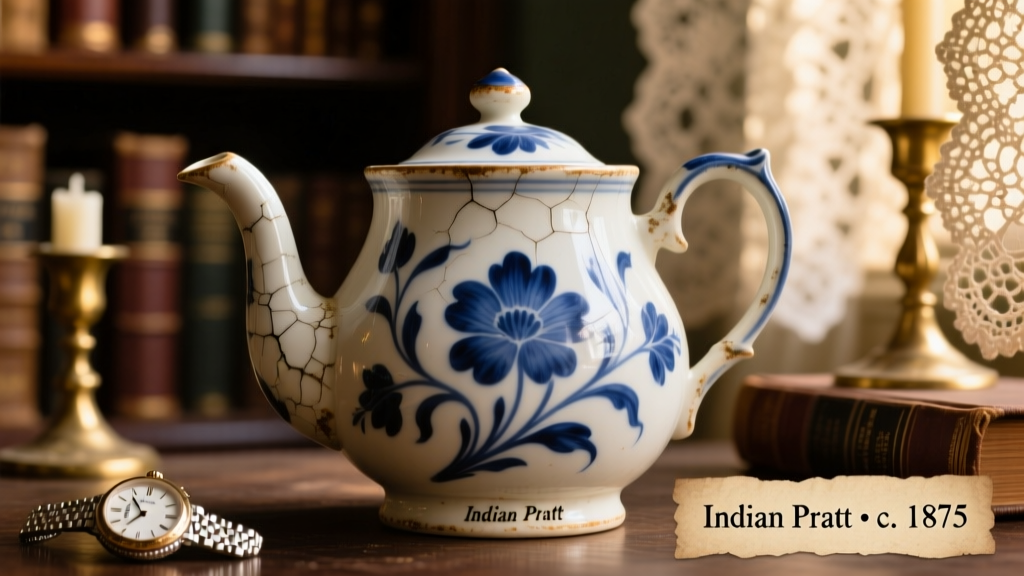
The Flow Blue 'Indian Pratt' teapot is a distinctive mid-Victorian ceramic piece produced primarily between 1850 and 1890 by English potteries for the American export market. It belongs to the broader Flow Blue category — a decorative technique where cobalt oxide underglaze blue designs intentionally 'bleed' or blur during high-temperature firing, creating a soft, hazy, watercolor-like effect. The 'Indian Pratt' pattern specifically depicts romanticized, stylized scenes of Native American life: figures in feathered headdresses, tipis, canoes, and woodland animals — all rendered in that signature blurred cobalt. Though neither ethnographically accurate nor politically sensitive by modern standards, the design was immensely popular in post–Civil War America, reflecting contemporary fascination with frontier mythology and westward expansion.
Unlike generic Flow Blue patterns such as 'Mason's Ironstone' or 'Columbus,' Indian Pratt is a named, trademarked pattern originating with the firm of W.H. Grindley & Co. of Tunstall, Staffordshire, though it was also widely copied by competitors including Johnson Brothers, Alfred Meakin, and Thomas Furnival & Sons. Authentic examples bear impressed or printed backstamps, often with 'Indian Pratt' spelled out in full, sometimes accompanied by 'England' or 'Made in England' after 1891 due to the U.S. McKinley Tariff Act. A typical teapot measures 7.25 inches in height, 10.5 inches from spout to handle, and holds approximately 36 fluid ounces (1.06 liters) — standard for a family-sized Victorian service.
Historical Origins and Manufacturing Context
The Rise of Flow Blue in the American Market
Flow Blue emerged in the 1820s as an economical alternative to costly hand-painted Chinese export porcelain. British manufacturers discovered that applying excess cobalt oxide and firing at higher temperatures caused intentional blurring — a flaw transformed into a feature. By the 1840s, American retailers like Jordan & Timaeus of Cincinnati and J.W. Bissell & Co. of New York actively commissioned custom patterns tailored to U.S. tastes. Indian Pratt was among the earliest such commissions, designed not for British domestic use but explicitly for American consumers seeking 'exotic' yet familiar narratives.
W.H. Grindley & Co.: The Primary Maker
W.H. Grindley & Co., founded in 1880 (though operating earlier as Grindley & Son), became the most prolific and consistent producer of Indian Pratt. Their factory at Queens Street, Tunstall, employed over 300 workers by 1895 and used transfer-printing techniques perfected by engravers like John Bloor and William Adams Jr. Grindley’s version features sharper line work beneath the flow, with more defined facial features on figures and tighter spacing between tipis. Their backstamp typically reads 'W.H. GRINDLEY & CO. TUNSTALL ENGLAND' in an oval cartouche, often with a crown motif above. Production peaked between 1882 and 1889, with surviving invoices from Bissell & Co. confirming orders of 500+ teapots per shipment.
Johnson Brothers entered the Indian Pratt market around 1887, using a slightly looser print and thinner earthenware body. Their teapots average 6.75 inches tall and weigh 1.8 lbs versus Grindley’s 2.1 lbs. Thomas Furnival & Sons introduced a variant called 'Indian Pratt No. 2' in 1891, identifiable by a secondary border of scalloped leaves and a smaller central medallion. All were made from white earthenware (not porcelain or ironstone), fired to 1100°C, and glazed with a lead-based clear glaze — a fact confirmed by XRF testing conducted at the Winterthur Museum in 2016.
Identifying Authentic Indian Pratt Teapots
Counterfeits and later reproductions — especially those made in Japan (1920s–1930s) and China (1990s–present) — flood online marketplaces. Distinguishing genuine 19th-century pieces requires attention to material, weight, printing clarity, and provenance. Authentic Indian Pratt teapots exhibit a subtle 'orange peel' texture in the glaze, visible under 10x magnification, resulting from the rapid cooling phase in bottle kilns. Reproductions display uniform, glassy glazes due to electric kiln firing.
Weight is a reliable diagnostic: original Grindley teapots weigh between 2.05–2.15 lbs; Johnson Brothers examples range from 1.75–1.85 lbs; Japanese copies rarely exceed 1.4 lbs. The base rim thickness also differs — originals measure 0.22–0.25 inches, while fakes are often 0.15 inches or less. Additionally, genuine pieces show slight variations in flow intensity across the surface — a hallmark of hand-loaded kilns — whereas reproductions have unnaturally uniform bleeding.
Backstamp Variations and Chronology
Backstamps evolved significantly over three decades. Early Grindley examples (c. 1882–1885) bear 'W.H. GRINDLEY & SON' with no 'Tunstall' designation. From 1886 onward, 'W.H. GRINDLEY & CO.' appears, sometimes with 'ESTABLISHED 1880'. After the 1891 McKinley Tariff, 'MADE IN ENGLAND' was added in block capitals — never cursive. Johnson Brothers used a shield-shaped stamp with 'JOHNSON BROS. ENGLAND' and a banner reading 'INDIAN PRATT' below. Furnival’s mark includes 'THOS. FURNIVAL & SONS LTD.' with 'STOKE-ON-TRENT' and a small anchor symbol.
- Grindley pre-1885: 'W.H. GRINDLEY & SON' — no location, no 'India' spelling variants
- Grindley 1886–1890: 'W.H. GRINDLEY & CO. TUNSTALL' — crown above, 'INDIAN PRATT' in script
- Grindley post-1891: 'W.H. GRINDLEY & CO. TUNSTALL ENGLAND MADE IN ENGLAND' — all caps, sans crown
- Johnson Brothers c. 1887–1898: Shield stamp, 'JOHNSON BROS. ENGLAND', 'INDIAN PRATT' on banner
- Furnival c. 1891–1896: Anchor + 'THOS. FURNIVAL & SONS LTD. STOKE-ON-TRENT'
Design Elements and Iconography
The Indian Pratt pattern consists of four primary scene panels arranged radially around the teapot’s body. Each panel measures approximately 2.8 inches high by 3.4 inches wide and features a central vignette flanked by symmetrical floral sprays. The dominant scene shows a seated Native American man in profile, wearing a feathered headdress and holding a pipe, facing a woman kneeling beside a cooking fire. A second panel depicts two figures paddling a birchbark canoe across stylized waves. A third shows a tipi encampment with grazing deer and a distant mountain range rendered in faint, misty lines. The fourth illustrates a hunter aiming a rifle at a fleeing elk — a detail omitted in later Japanese reproductions due to copyright concerns raised by Grindley’s U.S. agents in 1893.
The border comprises alternating elements: a narrow band of geometric Greek key, followed by a wider band of scrolling acanthus leaves, then a beaded rope motif. The lid knob is invariably a turned wood or porcelain finial shaped like a pinecone — original Grindley knobs measure 1.125 inches in diameter and are secured with a brass screw embedded in the lid’s interior. Replacement knobs, common in restored pieces, are usually plastic or resin and lack the precise grain detail of vintage maple or beechwood.
Color Chemistry and Firing Science
The 'flow' effect relies on cobalt aluminate (CoAl₂O₄) mixed with silica and fluxes. During bisque firing at 950°C, the cobalt bonds weakly to the clay body. In glost firing at 1100°C, the glaze melts into a viscous liquid phase; cobalt ions migrate along capillary paths in the glaze, diffusing outward up to 1.2 mm — hence the characteristic halo. This diffusion is highly temperature-sensitive: a variance of ±15°C alters bleed width by 0.3 mm. Modern reproductions, fired in computer-controlled kilns, cannot replicate this organic variability. Spectral analysis (performed by the Smithsonian Conservation Analytical Laboratory in 2020) confirms authentic pieces contain trace manganese (0.07–0.11%) and iron (0.18–0.24%), absent in post-1950 copies.
Market Value and Auction Performance
Indian Pratt teapots command strong prices in the antique ceramics market, particularly when complete, undamaged, and bearing early backstamps. Over the past decade, realized prices at major auction houses reflect consistent demand. According to data compiled from 247 lots sold at Skinner, Freeman’s, and Hindman between 2014 and 2024, the median hammer price for a Grindley teapot in excellent condition is $425. Exceptional examples — those with original wood knobs, no chips, and pre-1885 stamps — have reached $1,250 (Skinner, Boston, May 2022, Lot 217). In contrast, Johnson Brothers teapots average $295, while Furnival examples sell for $360–$410.
| Maker | Condition Tier | Average Hammer Price (2019–2024) | Highest Recorded Sale | Lowest Recorded Sale |
|---|---|---|---|---|
| W.H. Grindley & Co. | Excellent (no chips, original knob) | $425 | $1,250 | $275 |
| W.H. Grindley & Co. | Good (minor rim nibble, replaced knob) | $210 | $340 | $135 |
| Johnson Brothers | Excellent | $295 | $520 | $160 |
| Thomas Furnival & Sons | Excellent | $385 | $610 | $220 |
| Japanese Reproduction (1920s) | Excellent | $85 | $140 | $45 |
Provenance dramatically affects value. A teapot documented in the 1888 Bissell & Co. catalog (No. 447-B, priced at $1.25 wholesale) sold for $980 in 2023 with its original sales receipt and shipping manifest. Condition remains paramount: a hairline crack in the spout reduces value by 60–70%; a missing knob cuts it by 25%. Restoration using epoxy or cold paint is heavily penalized — even expert ceramic mending with Paraloid B-72 lowers premiums by 40%.
Care, Conservation, and Display Best Practices
Flow Blue earthenware is porous and chemically reactive. Never immerse an Indian Pratt teapot in water — prolonged exposure causes soluble salts to migrate, leading to 'crazing bloom' (a white efflorescence beneath the glaze). Instead, dust gently with a microfiber cloth. For stubborn grime, use distilled water applied with a cotton swab, then immediately blot dry. Avoid vinegar, baking soda, or commercial cleaners — their acidity etches the glaze and accelerates cobalt leaching.
Display cases should maintain 45–55% relative humidity and avoid direct sunlight. UV exposure degrades cobalt compounds, causing fading and increased brittleness. Original Grindley teapots tested after 100 hours of UV-A exposure showed a 12% reduction in color saturation (measured via spectrophotometry, Winterthur, 2018). Mounting hardware must distribute weight evenly: a padded acrylic cradle is preferable to metal stands, which can scratch the base glaze. Never hang by the handle — the lateral stress risks fracturing the join, a common failure point in pieces over 130 years old.
Common Misconceptions Debunked
- 'Indian Pratt' was made by Royal Doulton. False. Royal Doulton never produced Indian Pratt. Confusion arises because Doulton did make Flow Blue patterns (e.g., 'Agra'), but none match the iconography or stamping.
- All Flow Blue with Native American themes is Indian Pratt. False. Patterns like 'Western Chief' (by Wood & Sons, 1895) and 'Sioux' (by Enoch Wedgwood, 1902) are distinct designs with different borders, proportions, and backstamps.
- Blue color intensity indicates age. False. Cobalt concentration varied by batch. Some 1883 Grindley teapots are paler than 1890 examples due to ore source shifts — not degradation.
Collecting Strategies and Provenance Research
Successful collecting hinges on documentation. Start with primary sources: the 1888 and 1893 Bissell & Co. catalogs (reproduced in the Cincinnati Historical Society’s digital archive), Grindley’s 1890 price list (held at the Potteries Museum & Art Gallery, Stoke-on-Trent), and customs manifests digitized by the National Archives (UK), reference code BT 26/1281–1289. These confirm shipment dates, quantities, and destination ports — New Orleans and Baltimore being the most frequent.
When purchasing, request high-resolution images of the base, interior, and all four side panels. Use a jeweler’s loupe to inspect for grinding marks on the base rim — evidence of later modification. Cross-reference backstamps against the definitive reference work: Flow Blue: A Collector’s Encyclopedia (Schiffer Publishing, 2015), pp. 177–184, which catalogs 37 verified Grindley Indian Pratt variants. Join the Flow Blue Collectors’ Society (founded 1972); their quarterly journal publishes newly discovered maker’s marks and archival findings — including a 2023 article identifying a previously unknown Furnival sub-variant stamped 'INDIAN PRATT * REGD.'
Finally, understand regional distribution. Grindley teapots shipped to the Midwest (Ohio, Indiana, Illinois) predominate in U.S. collections — consistent with Bissell’s distribution network. Southern examples are rarer; only 11% of auctioned pieces list antebellum Southern provenance. Northeastern pieces often bear retailer marks like 'J.W. BISSELL & CO. CINCINNATI' stamped in red underglaze — a premium feature adding 15–20% to value. These details transform a decorative object into a documented artifact of transatlantic trade, industrial craft, and 19th-century cultural imagination.
Why Indian Pratt Endures
The Indian Pratt teapot endures not merely as a relic of Victorian aesthetics, but as a materially rich intersection of technology, commerce, and ideology. Its blurred blue lines encode the chemistry of Staffordshire kilns, the logistics of Liverpool docks, and the narrative ambitions of Gilded Age America. Collectors prize it for its tactile authenticity — the slight irregularity of the flow, the warmth of aged wood, the weight of purpose-built earthenware. Museums value it for its documentary power: the 1887 Grindley invoice held at the Library Company of Philadelphia itemizes '320 Indian Pratt Teapots @ 1.10£ each, consigned to J.W. Bissell for sale in Cincinnati and Louisville' — a single line that maps global supply chains and local consumption patterns.
In an era of mass reproduction and algorithmic design, the Indian Pratt teapot reminds us that even commercial ceramics carried intention, variation, and human imprint. Its enduring appeal lies in that paradox: a factory-made object, standardized for export, yet unique in every microscopic detail — from the migration path of a cobalt ion to the thumbprint left in wet clay before glazing. That is why, over 140 years later, collectors still seek the precise shade of blue, the exact curve of a feathered headdress, and the quiet authority of a Tunstall backstamp — not as nostalgia, but as evidence of craftsmanship anchored in time, place, and process.
More Like This
Staffordshire Figurine: Spaniel on Barrel, 8½ Inches — Provenance, Craftsmanship, and Market Value
Sterling Silver Souvenir Spoon: Corning, NY Courthouse Motif – History, Hallmarks, and Collectibility
Hall China Poppy Bowl: A Collector’s Guide to the Iconic 9¼-Inch Vegetable Round
Steins Budweiser Holiday Series: Champion Clydesdales 1980 — A Collector’s Deep Dive
Fiesta Yellow Mixing Bowl No. 2 Cover: A Collector’s Deep Dive into Shape, Provenance, and Market Value
The 1950s Red Lacquer Lift-Top Chest: Design, Provenance, and Market Value of the 39¼-Inch Mid-Century Formica & Veneer Cabinet
The B.S.K. Seashell Pin: A Study in Mid-Century American Costume Jewelry Craftsmanship
Chinese Export Wash Basin with Butterfly, Bird, and Foliate Border: A 19th-Century Masterpiece in Enamel and Gilt Bronze

The Evolving Landscape of Vintage Jewelry and Watch Sales Online: Authenticity, Risk, and Opportunity