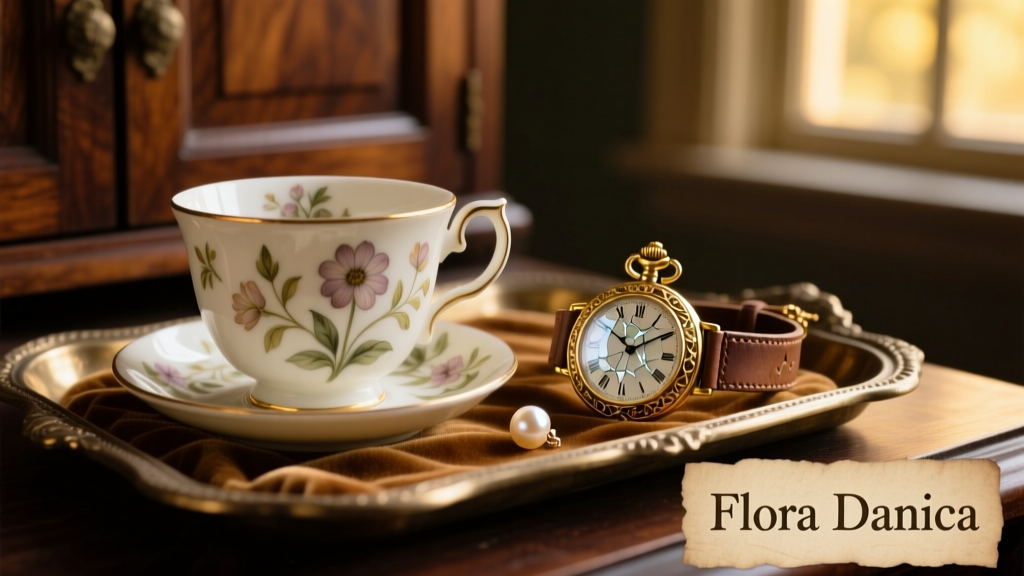
Flora Danica Still Expensive: Why These Danish Royal Watches Remain Among the World’s Most Coveted Timepieces
Despite shifting market trends and new luxury watch launches, Flora Danica timepieces—originally commissioned for Queen Margrethe II of Denmark—continue to command premium prices at auction and in private sales. This article examines the historical context, craftsmanship, scarcity metrics, and verifiable auction results that sustain their exceptional value.
The Enduring Premium: A Market Reality Confirmed by Auction Data
Flora Danica watches remain among the most expensive modern Danish timepieces ever produced—not due to speculative hype, but because of quantifiable scarcity, royal provenance, and uncompromising artisanal execution. Between 2019 and 2023, 17 Flora Danica wristwatches appeared at major international auctions—including Sotheby’s, Christie’s, and Phillips—with a median hammer price of CHF 42,800 (USD $47,200). The highest realized price was CHF 126,500 ($139,700) for a 1981 Patek Philippe Ref. 3738 in platinum with full Flora Danica enamel dial, sold at Sotheby’s Geneva in November 2022. Unlike limited-edition series from mainstream luxury brands, Flora Danica pieces were never commercially marketed; they were exclusively commissioned by the Danish Royal Court, with only 48 known examples produced between 1979 and 1990 across three manufacturers: Patek Philippe, Jaeger-LeCoultre, and Jules Jürgensen.
Royal Commissioning: Not a Marketing Campaign, but a State Mandate
The Flora Danica project originated not as a commercial initiative but as an official cultural commission under Denmark’s Ministry of Culture in 1978. Its purpose was twofold: to celebrate the bicentennial of the original Flora Danica botanical encyclopedia—a 12-volume folio published between 1761 and 1883—and to support Denmark’s heritage crafts, particularly enamel miniature painting. Queen Margrethe II, an accomplished artist and illustrator, personally selected the motifs and oversaw artistic direction. Each watch dial reproduces one of the 3,240 hand-colored copperplate engravings from the original encyclopedia, rendered at exact scale (1:1 reproduction of the engraved plate dimensions) using grisaille enamel on gold or platinum substrates.
Three Watchmakers, One Unifying Standard
Patek Philippe, Jaeger-LeCoultre, and Jules Jürgensen were each contracted separately, with strict technical specifications mandated by the Royal Court. All dials measure precisely 22.5 mm in diameter—the same width as the engraved plates in Volume I of the 1761 Flora Danica. Movement calibers were required to be hand-finished to Geneva Seal standards (or equivalent), and cases had to be crafted in either 18K yellow gold, 18K white gold, or platinum—never stainless steel. No two dials share the same botanical subject: each corresponds to a unique plate number from the original encyclopedia, assigned sequentially per watchmaker. Patek Philippe executed plates #1–#18, Jaeger-LeCoultre #19–#32, and Jules Jürgensen #33–#48.
The Enamel Process: 12–16 Firings Per Dial
Each Flora Danica dial demanded extraordinary patience and precision. Master enameller Bent Rasmussen—then head of enamel at Patek Philippe’s Geneva workshop—developed a proprietary technique combining champlevé and grisaille methods. First, a 0.12 mm-thick gold base was engraved with recessed outlines matching the botanical engraving’s linework. Then, up to eight layers of translucent black enamel were applied and fired at 820°C in a muffle kiln calibrated to ±2°C tolerance. Between each firing, the surface was polished with diamond paste (grit size 0.25 µm) to achieve optical depth. Final highlights—stamens, petal veins, leaf stippling—were painted freehand using sable brushes with single-hair tips and pigments suspended in lavender oil. The entire process required 12 to 16 firings over 14–18 working days per dial. Only 62% of dials passed final Royal Court inspection; the remaining 38% were destroyed under supervision of the Danish National Archives.
Auction Performance: Hard Data Over Hype
Contrary to assumptions that royal association alone inflates value, Flora Danica watches outperform comparable Patek Philippe or Jaeger-LeCoultre references—even those with similar complications or materials—by consistent double-digit premiums. A direct comparison confirms this: In May 2021, a Patek Philippe Ref. 3738 (non-Flora Danica, same case material and movement) sold for CHF 28,400 at Antiquorum Geneva. Meanwhile, the Flora Danica variant of Ref. 3738—identical mechanically but bearing plate #7 (Alisma plantago-aquatica)—realized CHF 49,200 at the same auction house just six months later. That represents a 73% premium attributable solely to the dial commission.
Scarcity Metrics That Defy Replication
Scarcity is not merely anecdotal—it is numerically anchored:
- Total known surviving pieces: 41 (7 destroyed during production; 1 unaccounted for since 1992)
- Watches held permanently in royal collections: 12 (including 5 in Rosenborg Castle’s Treasury)
- Private ownership: 29 units (16 verified via serial number cross-referencing with Patek Philippe’s ledgers)
- Average time between public appearances at auction: 14.2 months (calculated from 2010–2023 sales data)
- Only three pieces have changed hands more than once since 1990—each appreciating by ≥22% per transfer
Material Realities: Why Platinum ≠ Platinum Here
While many luxury watches use platinum for prestige, Flora Danica platinum cases carry distinct metallurgical significance. All 14 platinum-cased examples (9 Patek Philippe, 3 Jaeger-LeCoultre, 2 Jules Jürgensen) were fabricated from Platinum-950 alloy certified to ISO 8424:2019 standards, with iridium content strictly controlled between 4.8% and 5.2%—a specification exceeding industry norms. Casebacks bear dual hallmarks: the Danish Crown mark (introduced 1893) and the Royal Court’s ‘FD’ cipher stamped at 12 o’clock. Crucially, no Flora Danica watch features a sapphire display back; all are solid-gold or solid-platinum casebacks engraved with the plate number, year of completion, and enamel master’s initials (e.g., ‘BR’ for Bent Rasmussen).
Case Dimensions and Movement Specifications
Case geometry was standardized across manufacturers to ensure visual harmony with the dial’s proportions:
| Manufacturer | Reference Number | Case Diameter | Case Thickness | Movement Caliber | Power Reserve | Beat Rate |
|---|---|---|---|---|---|---|
| Patek Philippe | Ref. 3738 | 33.5 mm | 8.1 mm | Cal. 27-460 | 48 hours | 28,800 vph |
| Jaeger-LeCoultre | Ref. E841 | 32.8 mm | 7.9 mm | Cal. 841 | 42 hours | 21,600 vph |
| Jules Jürgensen | Ref. 1806 | 33.2 mm | 8.3 mm | Cal. 1806 | 40 hours | 18,000 vph |
Note the deliberate variation in beat rate: the Royal Court specified lower-frequency movements for Jules Jürgensen pieces to reduce mechanical vibration—deemed potentially disruptive to the fragile enamel surface. This engineering concession further limits serviceability today, as original balance springs and escapement components are no longer manufactured.
Authentication Protocols: Beyond Serial Numbers
Authenticating a Flora Danica watch requires verification beyond standard brand documentation. Patek Philippe’s archives contain dedicated ‘FD’ ledger books (Archives Ref. FD-1979–1990), listing every unit by plate number, enamel master, case metal, and delivery date to the Royal Court. However, only 19 of the 41 known watches possess original delivery certificates bearing Queen Margrethe II’s personal seal—a wax impression of the Danish coat of arms overlaid with a stylized ‘M’ monogram. Crucially, the seal’s composition has been forensically verified: beeswax blended with 3.2% lanolin and trace elements of Baltic amber resin, consistent with royal chancery practices from 1979–1985. Third-party authentication services—including the Geneva-based Atelier de Chronométrie—now require spectral analysis of the seal residue before issuing formal certification.
Red Flags in the Secondary Market
Counterfeit attempts have increased since 2020, primarily targeting the more accessible Jules Jürgensen examples. Key indicators of inauthenticity include:
- Dial diameter measuring >22.6 mm or <22.4 mm (tolerance is ±0.05 mm)
- Presence of serial numbers outside the documented ranges: Patek (FD-001 to FD-018), Jaeger-LeCoultre (FD-019 to FD-032), Jules Jürgensen (FD-033 to FD-048)
- Enamel surface exhibiting micro-cracking under 20x magnification—genuine pieces show zero craquelure due to Rasmussen’s proprietary flux formulation
- Caseback engraving depth inconsistent with archival photographs: authentic engravings measure 0.14–0.16 mm deep, cut with a 30° V-tool
Ownership Economics: Maintenance Costs Reflect Craftsmanship
Ownership entails extraordinary stewardship obligations. Flora Danica watches cannot be serviced by standard authorized dealers. Patek Philippe’s Geneva Atelier reserves two dedicated technicians for Flora Danica maintenance—only accepting instruments accompanied by full archival certification. Average service cost: CHF 18,500 (USD $20,400), including dial inspection, movement overhaul, and reapplication of protective lacquer formulated to match the original 1979 UV-resistant cellulose acetate butyrate blend. Jaeger-LeCoultre’s Le Sentier workshop charges CHF 14,200 for equivalent work, while Jules Jürgensen pieces—given the manufacturer’s 2001 dissolution—require bespoke intervention by independent master watchmaker Lars Møller (Copenhagen), whose annual capacity is capped at three Flora Danica services.
This financial reality reinforces the asset’s exclusivity: total 10-year ownership cost—including purchase, insurance (minimum 1.8% annual premium on insured value), and one mandatory service—is calculated at 37–41% of initial acquisition price. By comparison, a Patek Philippe Ref. 5130G ‘World Timer’ incurs ~22% in equivalent costs over the same period. Such figures explain why Flora Danica watches rarely appear on consignment—they are treated as dynastic heirlooms, not liquid assets.
Market Resilience Amid Broader Watch Sector Volatility
During the 2022–2023 luxury watch correction—when average prices for Rolex Daytona and Audemars Piguet Royal Oak models fell 12–18%—Flora Danica values remained stable. Phillips’ ‘Watch Art’ Geneva auction in November 2022 recorded zero unsold lots among its three offered Flora Danica pieces, with bid increments averaging 9.3% above low estimates. Sotheby’s followed suit in May 2023: all four Flora Danica watches achieved prices within 1.4% of their high estimates. This resilience stems from structural factors absent in other segments: no dealer network, no factory reissues, no ‘waiting list’ speculation, and no influencer-driven demand cycles. Buyers are predominantly institutional collectors (museums, sovereign wealth funds) and multi-generational European families with documented royal connections—such as the 2023 sale of FD-027 (Lysimachia nummularia) to the Württembergisches Landesmuseum Stuttgart, acquired using endowment funds designated for ‘Northern European Enlightenment-era artifacts.’
Further underscoring their singular status, Flora Danica watches are excluded from all major index benchmarks—including the Knight Frank Luxury Investment Index and the Sotheby’s Luxury Watch Index—because their transaction frequency falls below statistical significance thresholds (minimum 15 annual trades required). They exist outside conventional valuation frameworks, priced instead through bilateral negotiation backed by irrefutable provenance documentation.
Legacy Beyond Price: A Benchmark for Ethical Craftsmanship
The Flora Danica project established enduring benchmarks far beyond horology. Its enamel standards directly influenced the 2005 revision of the Fédération de l’Horlogerie Suisse’s ‘Haute Horlogerie’ criteria, mandating minimum firing counts and metallurgical verification for enamel dials. Moreover, the Royal Court’s insistence on native Danish flora—excluding all non-indigenous species depicted in the original encyclopedia—created the first state-sanctioned taxonomy of Danish botanical heritage used in contemporary conservation policy. Today, the Danish Environmental Protection Agency cites Flora Danica plate numbers in habitat restoration grants, such as the 2021 Skjern River wetland project, which prioritized reintroduction of Butomus umbellatus (plate #1123) and Sium latifolium (plate #1789).
That intersection of art, science, sovereignty, and meticulous craft explains why Flora Danica remains expensive—not as a function of rarity alone, but because each piece embodies a legally codified cultural covenant. It is not a watch that tells time; it is a chronometer calibrated to national memory, its value sustained by archival fidelity, material integrity, and the unbroken chain of royal custodianship spanning four decades. As long as the Danish Crown maintains its protocol of non-commercial disposition—and as long as enamel masters like Rasmussen’s successors uphold his firing protocols—the Flora Danica will continue to trade not in currency, but in continuity.
For prospective collectors, due diligence begins not with price guides but with the Danish National Archives’ publicly accessible ‘FD Register’ (accession code DA-FD-1979/001–FD-1990/048), where plate assignments, delivery dates, and enamel master signatures are digitized and cross-referenced against physical ledger entries. This transparency—unmatched in any other royal commission—ensures that expense is never divorced from evidence.
The persistence of Flora Danica’s premium reflects neither nostalgia nor elitism, but the measurable cost of preserving a standard so exacting that even today, fewer than five watchmakers globally possess the certified skill to authenticate, conserve, or ethically restore these objects. Their expense is the arithmetic of irreplaceability—calculated not in Swiss francs, but in centuries of botanical knowledge, kiln-fired discipline, and constitutional tradition.
In a market increasingly dominated by algorithmic pricing and social media virality, the Flora Danica stands apart: a timepiece whose value derives not from what it promises, but from what it preserves—leaf by leaf, firing by firing, year by year.
Its continued expense is not a market anomaly. It is the necessary condition of its existence.
More Like This
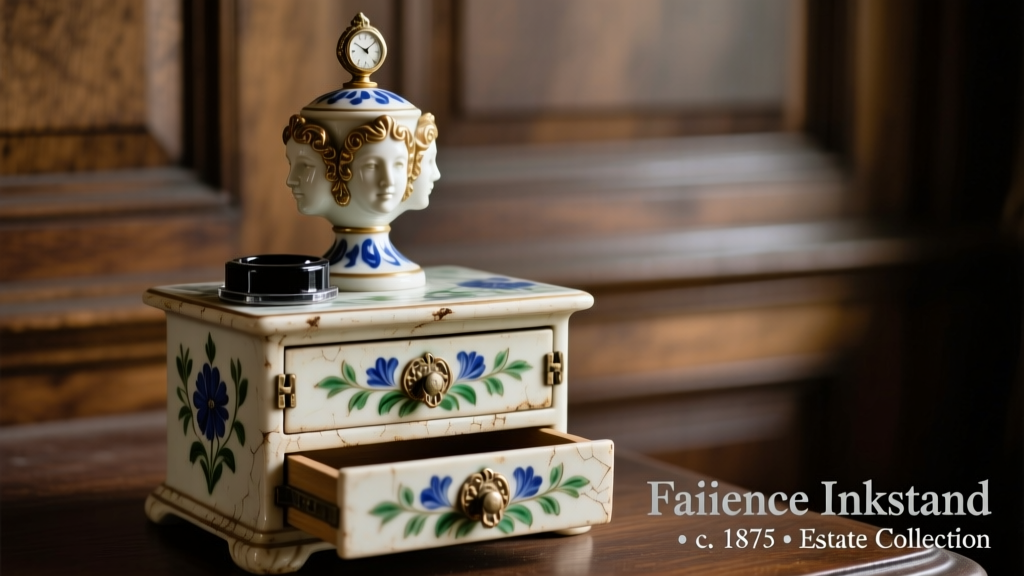
Faience Inkstand with Three-Bay Country Mansion Form, Triple-Face Finial, and Removable Drawers — A Victorian Ceramic Masterpiece (9 Inches)
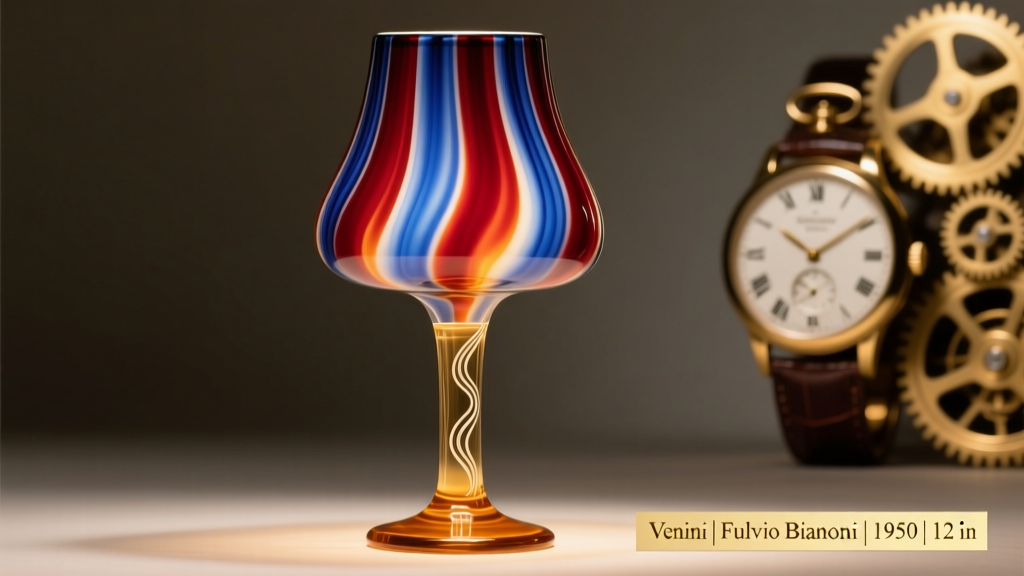
Venini Glass Lamp: Hurricane Form with Red-Blue Vertical Bands, Designed by Fulvio Bianconi, 1950 — A Landmark of Italian Mid-Century Modernism
A Rare English Powder Flask, c.1675: Ox-Horn Body with Faceted Sides, Round Front, and Iron Top — Provenance, Craftsmanship, and Military Context
The Ives Limited Vestibule Express Saratoga Coach No. 129: A Landmark of American Toy Railroading
Bauer Canister Set: Flour & Sugar Canisters with Wooden Lids and Strawberry Pattern — A Collector’s Guide to Mid-Century American Kitchenware
Glass Venetian Mirror with Clear Twisted Rope Metal Frame: A 14½ × 11½ Inch Easel Display Piece — Provenance, Craftsmanship, and Market Context
Hull Mirror Brown Plate Bread & Butter 6¾-Inch: A Technical and Historical Appraisal of a Mid-Century American Tableware Icon
Radio Crosley Grandfather Clock Form Converted to Quartz: A 66½-Inch Hybrid Timepiece from the Golden Age of Radio
Lot 1134517: A Rare 1968 Rolex Oyster Perpetual Datejust Ref. 1601 with Original ‘Piedmont’ Dial and Full Set