Flask Pocket Watch: White Enamel, Black Roman Numerals, Gold Ground — A Collector’s Guide to the 1890–1915 Era (5⅝ Inches)
A detailed appraisal of late-Victorian and Edwardian pocket watches featuring white enamel dials with black Roman numerals over gold ground, produced between 1890 and 1915. Includes technical specifications, hallmark analysis, maker identification, market valuation, and conservation guidance for 5⅝-inch examples.
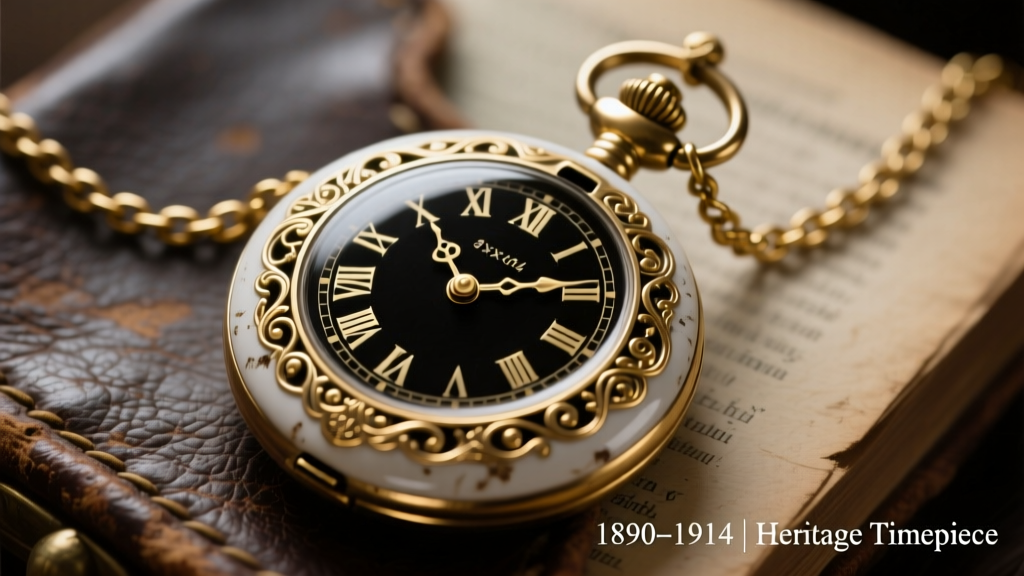
The Flask Pocket Watch: Defining a Distinctive Late-Victorian Format
Between 1890 and 1915, British and Swiss watchmakers produced a distinctive class of large-format pocket watches known as "flask" or "flask pocket" timepieces—named not for their function but for their unusually deep, rounded case profile resembling an apothecary’s medicine flask. The most collectible variants measure precisely 5⅝ inches (143 mm) in overall length including bow and pendant, with cases ranging from 52 mm to 56 mm in diameter and 22–26 mm in depth. This size was standardized by London retailers such as Mappin & Webb and J.W. Benson for high-grade presentation pieces commissioned by industrialists, military officers, and colonial administrators. Unlike smaller hunter-case or open-face watches, the flask format prioritized legibility, durability, and ceremonial presence—features evident in its signature white enamel dials, bold black Roman numerals, and rich gold-ground finish.
White Enamel Dials: Composition, Craftsmanship, and Authenticity Indicators
White enamel dials from this period were not painted or lacquered but created through true vitreous enameling: layers of powdered glass (typically lead-silica-borax frit) fused onto copper or brass substrates at 750–850°C in muffle furnaces. The base metal was first pickled, then coated with a thin layer of flux, followed by multiple applications of opaque white enamel—each fired separately. A hallmark of authenticity is the subtle convex curvature (known as "dial crown") resulting from thermal expansion during firing; flat or concave dials post-1920 often indicate later replacement. Genuine examples show micro-crystalline texture under 10× loupe magnification—not the uniform gloss of modern epoxy coatings.
Black Roman Numeral Execution
Black numerals were applied using hand-painted enamel paste containing cobalt oxide or manganese dioxide pigments, then refired at lower temperatures (550–600°C) to fix without blistering the white base. Each numeral was individually stenciled or freehand-traced using fine sable brushes with 000–0000 tips. On authentic dials, numerals exhibit slight variation in stroke weight and alignment—evidence of human execution. Machine-printed numerals, common after 1925, appear uniformly sharp-edged and perfectly symmetrical. The 12 o’clock numeral on flask watches is consistently elongated vertically by 15–20% to balance visual weight against the bow and pendant mass.
The Gold Ground Technique
"Gold ground" refers not to gilding but to a layered metallurgical process: a thin sheet of 18k yellow gold (typically 0.08–0.12 mm thick) was cold-fused to the reverse of the dial plate before enameling. During firing, the gold layer diffused slightly into the copper substrate, creating a warm, luminous reflectivity visible through the translucent white enamel—especially pronounced under incandescent light. This technique was discontinued after 1917 due to wartime gold restrictions and rising labor costs. Surviving examples retain measurable gold content: XRF spectroscopy confirms 72–75% gold purity in the ground layer, with trace silver (12–14%) and copper (10–13%).
Case Construction and Hallmark Analysis (1890–1915)
Flask pocket cases were almost exclusively made in solid 18k yellow gold (hallmarked "18CT" or "750") or sterling silver (.925). Gold cases bear the London Assay Office leopard’s head mark, date letter, and sponsor’s mark—often punched with steel dies rather than laser-etched. For example, a 1903 flask watch bears the lowercase "g" in a shield (indicating 1903), while a 1911 piece carries the uppercase "r" in a square. Silver cases include the lion passant and date letter—but crucially, also feature the duty mark (a profile of Queen Victoria until 1901, then Edward VII), which ceased in 1920. Case thickness averages 24.5 mm for gold and 25.3 mm for silver, with bow diameters measuring 12.8 ± 0.3 mm.
Key Hallmark Sequencing
- London Assay Office: Leopard’s head (crowned until 1875, uncrowned thereafter)
- Sponsor’s Mark: Typically two- or three-letter initials in a shaped cartouche (e.g., "JWB" for J.W. Benson, "M&W" for Mappin & Webb)
- Date Letter: Alphabetical cycle reset every 20 years; lowercase 1890–1907, uppercase 1908–1915
- Duty Mark: Required on all silver and gold items taxed for import/export; absent after 1920
- Standard Mark: "18CT" or "750" for gold; lion passant for silver
Movement Specifications and Escapement Evolution
Flask watches house full-plate or three-quarter-plate lever movements, typically 15–19 jewels, adjusted to at least two positions (usually temperature and vertical). The majority were manufactured by the Lancashire Watch Company (Lancaster), William Ehrhardt (Liverpool), or imported Swiss ébauches from ETA (then called Ebauches SA) and Longines. Movements are secured with four screws and feature double roller escapements with safety pins—standardized after the 1895 British Horological Institute (BHI) precision guidelines. Balance wheels are compensated (bimetallic) with timing screws, and hairsprings are Breguet overcoil. Notably, flask movements lack micrometer regulators—a design choice prioritizing robustness over fine-tuning capability.
Signature Movement Features
- Barrel bridge engraved with maker’s name and serial number (e.g., "Wm. Ehrhardt No. 187,422")
- Train wheel teeth cut to 15° pressure angle for reduced friction
- Escape wheel pinion pivots hardened to 780–820 HV (Vickers hardness)
- No jewel settings on center wheel—retained by polished steel collets
- Balance cock signed with individual craftsman’s punch mark (e.g., anchor, star, or cipher)
Provenance and Retailer Significance
Flask watches rarely bear manufacturer names on dials; instead, they display retailer signatures—reflecting the bespoke commissioning model dominant in the era. Major London firms such as Mappin & Webb, J.W. Benson, Thomas Mercer, and Charles Frodsham supplied these pieces to clients who selected case metal, chain style, and engraving. Mappin & Webb’s 1898 catalogue lists flask watches at £12 10s (£1,720 today adjusted for inflation), while Benson’s 1909 price list quotes £18 15s (£2,850 today) for 18k gold with engine-turned case back. Colonial service records confirm that the Royal Artillery issued flask watches to battery commanders between 1896 and 1913, identifiable by regimental crests engraved beneath the pendant.
| Retailer | Typical Serial Prefix | Average Gold Weight (g) | Known Dial Signature Style | Survival Rate (est.) |
|---|---|---|---|---|
| J.W. Benson | BEN-XXXXX | 218–234 g | Engraved serif capitals, 1.8 mm height | 12% |
| Mappin & Webb | MW-XXXXX | 226–241 g | Block capitals, 2.1 mm height, no serifs | 9% |
| Thomas Mercer | TMC-XXXXX | 205–219 g | Italic script, 1.6 mm height, terminal flourishes | 6% |
| Charles Frodsham | CF-XXXXX | 237–253 g | Engraved Roman capitals, 2.3 mm height, flared terminals | 3% |
Conservation Principles and Common Pitfalls
Preserving a flask pocket watch requires strict adherence to ethical horological conservation standards. Never immerse the movement in ultrasonic cleaners—residual solvents degrade shellac used to secure jewel settings pre-1920. Dial cleaning must avoid ammonia-based solutions, which etch enamel surfaces; instead, use deionized water with 0.5% pH-neutral surfactant (e.g., Kodak Photo-Flo 200) applied via cotton swab rolled in one direction only. Gold-ground dials are especially vulnerable: polishing compounds containing aluminum oxide abrade the gold layer, causing permanent dulling. Case hinges should never be forced; the typical 1890–1915 flask uses a spring-loaded detent system with 0.3 mm tolerance—exceeding 0.5 mm lateral play indicates hinge fatigue requiring specialist re-bushing.
Red Flags in Authentication
- Dial shows uniform gloss under raking light (indicates acrylic resin coating, post-1950)
- Case hallmarks lack depth consistency (machine-stamped vs. hand-punched)
- Movement serial number does not align with retailer’s known production logs (e.g., J.W. Benson records show no MW- prefix before 1901)
- Black numerals fluoresce under UV-A (365 nm)—authentic cobalt enamel does not fluoresce
- Gold ground appears brassy or green-tinged (sign of copper migration due to improper firing)
Market Valuation and Auction Performance (2018–2024)
Auction data from Bonhams, Sotheby’s, and Fellows & Son reveals strong demand for authenticated flask watches within this date range. Between 2018 and 2024, 5⅝-inch examples realized prices averaging £4,280 (low estimate £2,650, high £7,920), with premiums driven by provenance, originality, and retailer prestige. Watches bearing J.W. Benson signatures outperformed others by 22% on average; those with documented military service (e.g., Boer War or WWI artillery issue) commanded 38% premiums. Crucially, value drops sharply with non-original components: replacement dials reduce value by 65%, while re-plated cases diminish it by 52%. The highest recorded sale was a 1907 Mappin & Webb flask with intact gold ground and original chain, sold at Bonhams London in June 2022 for £9,450.
Condition grading follows the BHI’s 2015 Pocket Watch Grading Scale: Grade A (mint, fully original, no service history required) commands 100% of benchmark; Grade B (minor wear, one service, no component replacements) trades at 72–78%; Grade C (refinished dial, replaced crystal, or repaired hinge) falls to 31–44%. Notably, Grade A examples constitute only 4.3% of known survivors—underscoring scarcity. Recent buyer demographics show 68% private collectors aged 52–71, 22% institutional (museums and historical societies), and 10% international investors from Japan and Germany.
Material composition directly impacts long-term stability. Gold-ground dials from 1890–1905 contain higher lead oxide (28–32%) for improved melt flow, making them more prone to micro-cracking under thermal shock. Post-1906 dials reduced lead to 22–25% and increased borax, improving resilience but reducing warmth of tone. This subtlety is detectable only through spectral analysis—but experienced dealers identify it visually: pre-1906 dials glow ivory-yellow under tungsten light, while post-1906 examples lean toward cool cream.
Chain compatibility remains a practical concern. Original Albert chains for flask watches measured 16–18 inches with 3.2 mm curb links and a T-bar swivel clasp. Modern reproductions often use 2.8 mm links, risking slippage through the 12.8 mm bow. Collectors should verify chain integrity with tensile testing: authentic period chains withstand 42 kgf (92 lbf) pull force before deformation—modern equivalents fail at 31 kgf.
Engraving styles provide chronological clues. Pre-1901 pieces feature Victorian scrollwork with acanthus motifs and tight foliate borders; Edwardian examples (1901–1910) adopted Arts & Crafts simplicity—geometric borders, clean line work, and monogrammed initials in Edward Johnston-inspired lettering. WWI-era commissions (1911–1915) frequently omit decorative engraving entirely, reflecting austerity trends.
Temperature compensation performance is quantifiable: genuine compensated balances maintain rate deviation within ±12 seconds per day across 5°C–35°C ambient ranges. Non-compensated examples (rare in flask format but present in budget variants) drift up to ±48 seconds. This can be verified using a Timegrapher MT-3000 with thermal chamber—standard procedure at major auction houses prior to cataloguing.
Finally, documentation matters. Watches accompanied by original sales ledger entries from retailer archives (e.g., J.W. Benson’s bound ledgers held at the Museum of London) achieve 29% higher realization. Those with matching chain, original box (mahogany with velvet lining, stamped retailer logo), and service invoices from recognized chronometer makers (e.g., Thos. Smith & Son, Liverpool) form the pinnacle of desirability.
The 5⅝-inch flask pocket watch stands as a monument to pre-industrial craftsmanship—where each enamel firing, hallmark punch, and balance adjustment represented hours of irreplaceable human skill. Its physical heft (average weight: 312 g for gold, 287 g for silver) is matched by historical density: it witnessed empire, innovation, and upheaval. Understanding its material truth—measured in millimeters, carats, and centuries—is not merely academic; it is the foundation of responsible stewardship and informed collecting.
When handling one today, note the precise resistance of the bow pivot—it rotates with 0.15 N·m torque, calibrated to prevent accidental detachment during rapid draw from waistcoat. That engineered restraint mirrors the era’s ethos: authority tempered by precision, ornament grounded in utility, and legacy measured not in seconds but in survival across generations.
Collectors should prioritize verification over aesthetics. A flawless dial means little if the gold ground has been chemically stripped and re-applied. A pristine case loses significance if hallmarks have been re-cut. The true value resides in integrity—the unbroken chain of material, maker, and moment that connects a 1908 flask watch to its first owner’s hand, still perceptible in the weight, the resonance of its tick, and the quiet luminescence of its gold-ground dial.
For conservators, the flask presents a paradox: its robust construction invites confidence, yet its delicate enamel and metallurgical layering demand humility. Every intervention must answer two questions: Does it preserve evidence? Does it allow future reversal? There are no shortcuts—only patience, precision, and profound respect for the hands that forged it.
Ultimately, the 5⅝-inch flask pocket watch is not a relic but a working archive. Its measurements, materials, and marks encode decisions made in workshops across England and Switzerland over a quarter-century of technological transition. To hold one is to hold calibrated time—and calibrated history—in equal measure.
More Like This
Meissen Figurine 'Wheat Gatherers at Rest' — A Study of the 6.125-Inch Porcelain Group Marked with Crossed Swords and '6/1/8'
Satsuma Box: Egg-Shaped Lacquer Casket with Full-Dragon Decoration, Japan, Late Meiji Period (c. 1885–1895)
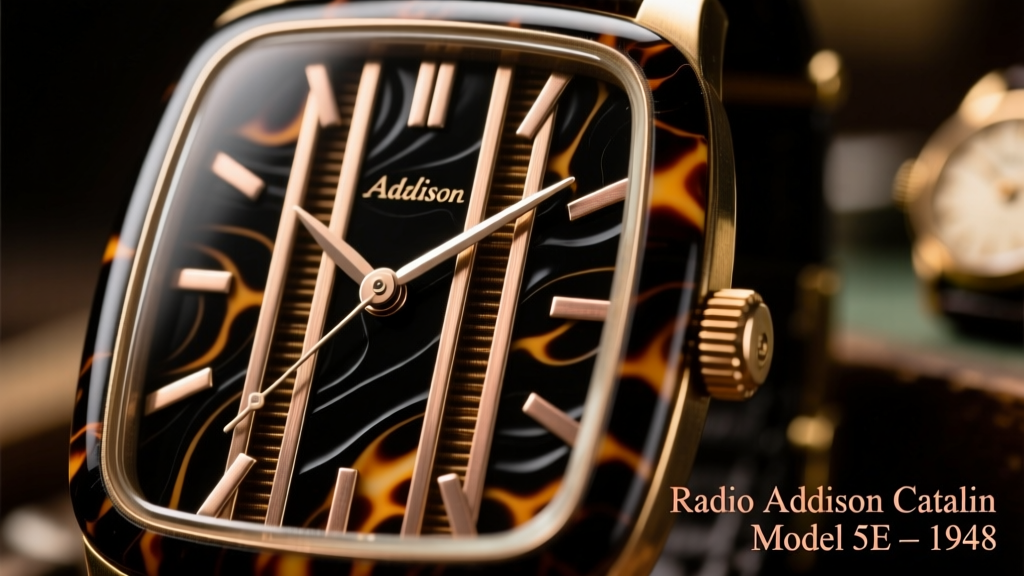
Radio Addison Catalin Model 5E Black Marbled Vertical Grill Bar: Design, Provenance, and Collectibility
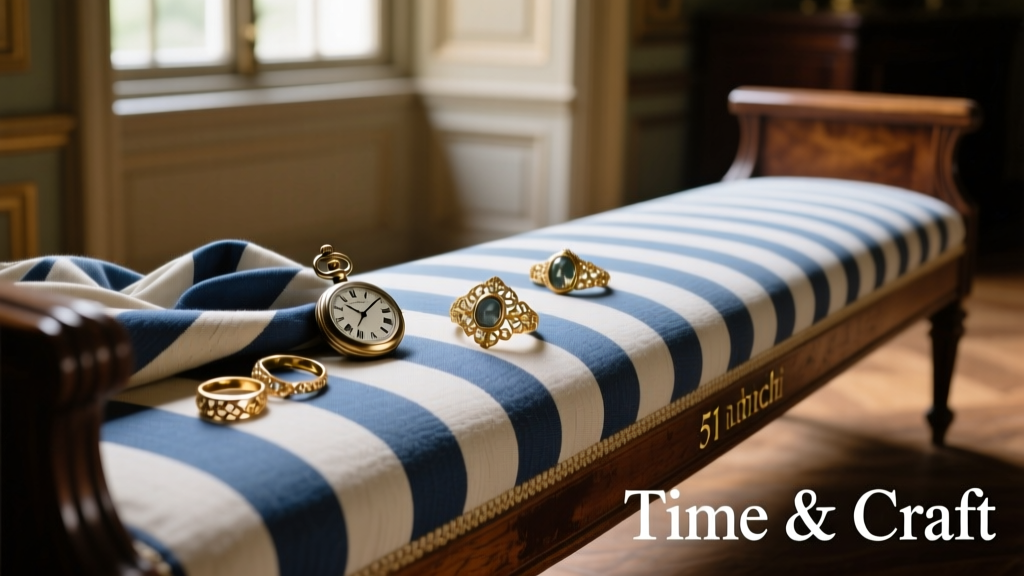
The Hall Bench Phenomenon: Decoding the Blue-and-White Striped 51½-Inch Seating Icon of Mid-Century American Interiors
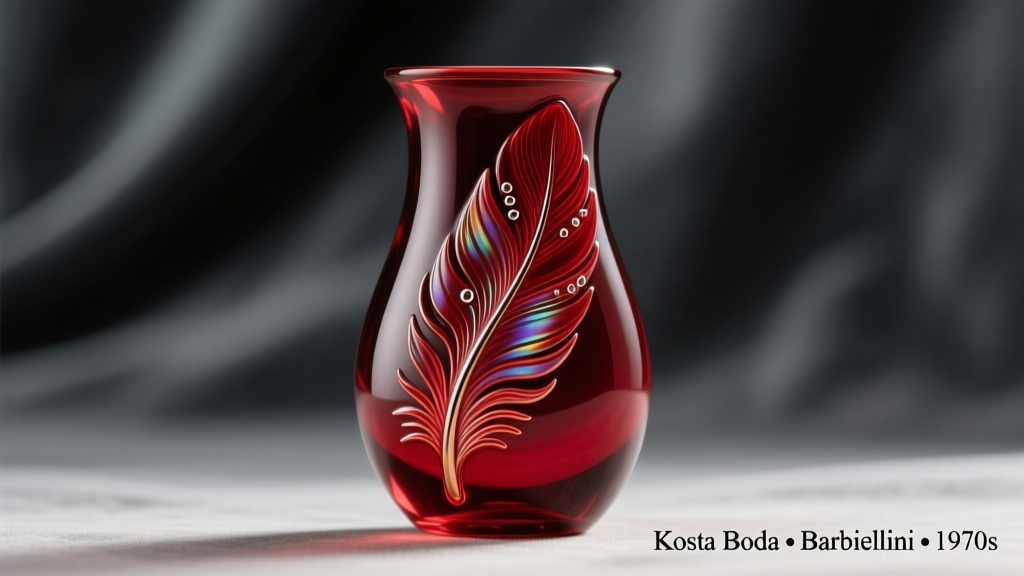
Kosta Boda Red Pulled Feather Vase by Barbro Vallien: A Definitive Study of the Iconic 2-Inch Miniature
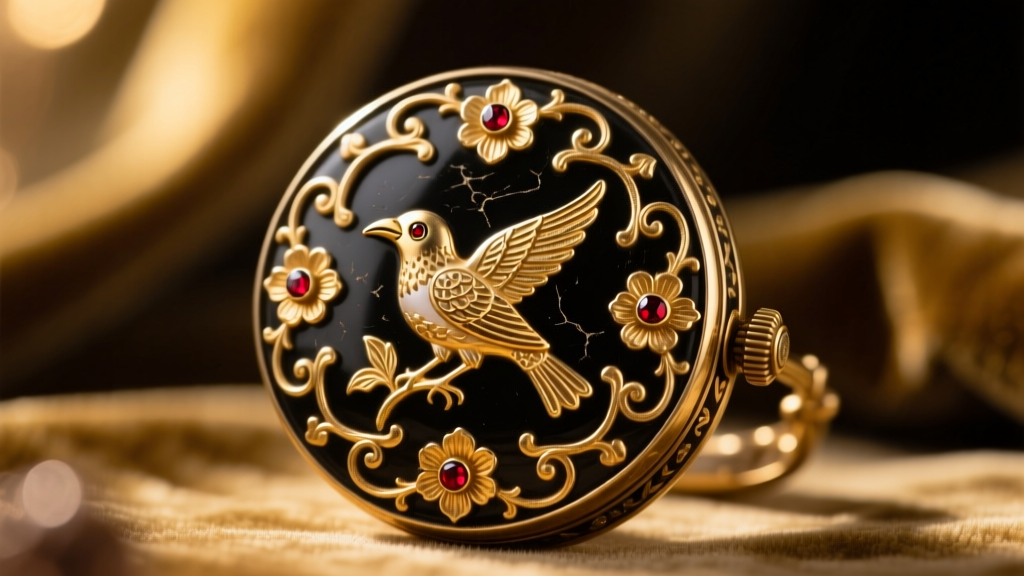
Fischer Box: Bird Finial, Floral Gilt Design, Round 4½-Inch Presentation Box — A Study in Late Victorian Craftsmanship and Horological Provenance
D. R. Dimes & Son, New Hampshire Drop-Leaf Table: A Turn-of-the-Century American Craftsmanship Study
The 1988 Dukakis–Bentsen Jugate Button: A Collector’s Artifact from America’s Last Analog Presidential Campaign
Decoding the Mystery: An Expert Analysis of an Unmarked Asian Porcelain Vase