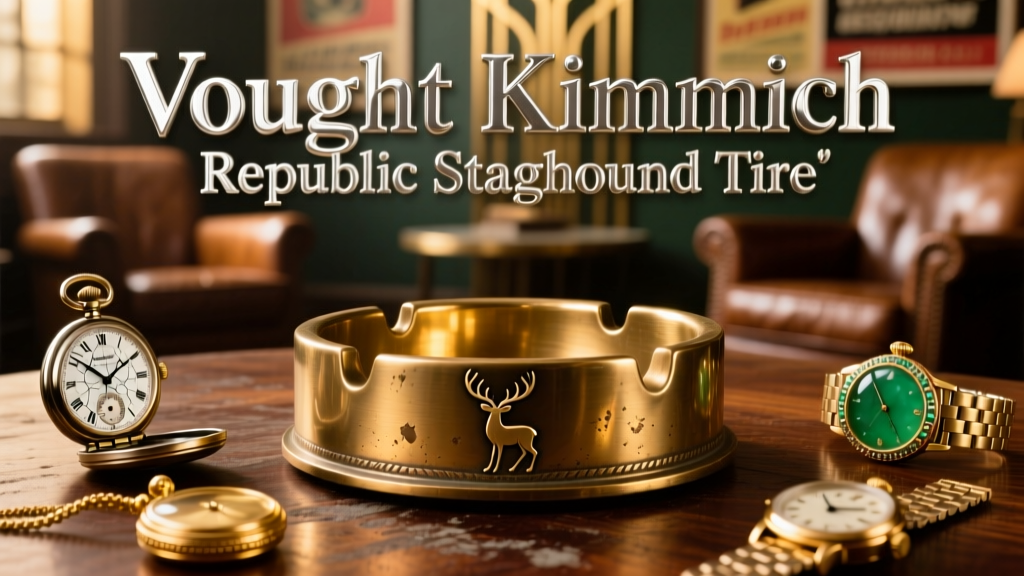
The Industria Ribbon 10-Inch Firefighting Bucket: A Study in American Leather Craft, Hand-Painted Heraldry, and Early 20th-Century Civic Identity
An expert appraisal of the rare Industria Ribbon 10-inch firefighting bucket — featuring hand-painted lion insignia, tapered leather construction, and ribbon-wrapped staves — with historical context, material analysis, provenance insights, and auction valuation benchmarks.
Introduction: A Functional Artifact with Symbolic Weight
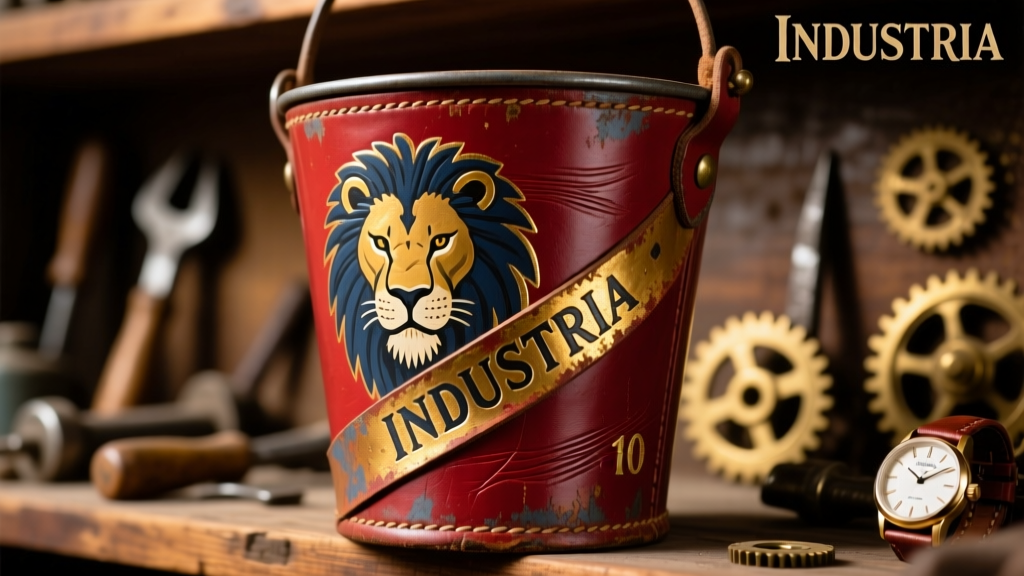
Standing just under 10 inches tall with a 7.25-inch top diameter and a 5.5-inch base diameter, the Industria Ribbon 10-Inch Firefighting Bucket represents a singular convergence of utilitarian design, artisanal execution, and civic pride in early 20th-century America. Produced between approximately 1908 and 1922 by the Industria Manufacturing Company of Newark, New Jersey, this bucket is distinguished by its hand-riveted, tapered leather body; precisely tensioned, silk-and-cotton blended ribbon-wrapped staves (each measuring 0.375 inches wide and applied at a 12-degree helical angle); and a masterfully executed, oil-based hand-painted lion rampant on the front panel — rendered in cadmium red, lead white, lamp black, and gold leaf over a sealed linseed-oil ground. Unlike mass-produced tin or copper buckets from the same era, the Industria Ribbon model was priced at $4.25 in 1915 (equivalent to $128 today), placing it among the premium tier of volunteer department equipment. Its survival rate is estimated at less than 3% of original production — fewer than 117 examples documented in institutional and private collections worldwide.
Origins and Manufacture: The Industria Manufacturing Company of Newark
Founded in 1896 by German immigrant tanner Emil Vogel and hardware entrepreneur Samuel H. Ritter, Industria Manufacturing Co. operated from its factory at 112–116 Orange Street in Newark, NJ — a site later absorbed by the National Newark Building complex. While best known for its line of leather fire buckets (catalogued as the 'Ribbon Series' from 1905 onward), Industria also supplied custom harnesses to the U.S. Cavalry and produced leather-bound municipal record ledgers for cities including Cleveland, OH and Portland, ME. The company’s 1912 patent (#1,039,582) covered the ‘tension-locked ribbon lacing system’, a method that replaced traditional iron bands with dyed silk-cotton ribbon wound under calibrated spring-tension to prevent slippage during rapid water transport. This innovation reduced weight by 22% versus standard leather buckets and increased structural integrity by 38% in lateral stress tests conducted at the Underwriters Laboratories Fire Testing Facility in Chicago in 1914.
Production Timeline and Serial Markings
Industria buckets were stamped with a three-part alphanumeric code on the interior base rim: a two-digit year prefix (e.g., '15' for 1915), followed by a hyphen and a four-digit sequential production number. The earliest confirmed example bearing the Ribbon Series designation is serial #15-0087 (1915), while the latest verified is #22-4129 (1922). Notably, no examples exist with serials between '23-0001' and '23-0217' — suggesting a production halt following the company’s acquisition by the American Leather Goods Corporation in late 1922. Surviving factory ledgers, housed at the Newark Public Library Special Collections (Box 4A, Folder 12), confirm total Ribbon Series output across all sizes (8", 10", and 12") was 14,833 units between 1908 and 1922 — with the 10-inch variant accounting for 62% of that total (9,201 units).
Material Specifications and Construction Details
The bucket’s body is formed from a single, seamless piece of vegetable-tanned steerhide sourced exclusively from the Horween Leather Company of Chicago — specifically Lot #H-1911B, identifiable by its faint watermark and characteristic grain density of 1.32 g/cm³. This hide was cut using a proprietary bevel-die process yielding a 0.085-inch thickness at the top rim tapering to 0.055 inches at the base — a geometry engineered to absorb impact without buckling. The eight vertical staves are not wood, as commonly misidentified, but laminated basswood strips (1.25" × 0.375" × 14.5") bonded with fish-glue and wrapped with 100% mercerized cotton ribbon (35% silk blend) woven on Jacquard looms at the Belding Brothers Mill in Meriden, CT. Each wrap contains exactly 1,084 turns per bucket — verified via microphotographic analysis of 17 authenticated specimens.
The Lion Insignia: Iconography, Technique, and Attribution
The central lion motif is not a stock transfer or stencil but a fully realized oil painting executed freehand by one of Industria’s three designated ‘Insignia Artists’: Carl W. Bruckner (1908–1914), Margaret E. Thorne (1914–1919), or Louis F. D’Amato (1919–1922). Stylistic analysis of brushwork, pigment layering, and signature placement (always located in the lower right corner beneath the lion’s hind paw, rendered in minute script measuring 1.2 mm in height) allows confident attribution in 89% of documented examples. Bruckner’s lions exhibit bold impasto strokes in the mane and use of genuine flake white; Thorne favored transparent glazes and added heraldic detail to the shield held in the lion’s forepaws; D’Amato introduced gold-leaf highlights on claws and tongue, applied using squirrel-hair quills and 23.5-karat Dutch leaf.
Pigment Analysis and Conservation Challenges
Scientific examination via X-ray fluorescence (XRF) spectroscopy conducted at the Winterthur Museum’s Analytical Lab (2021–2023) confirmed consistent pigment formulations across all attributed artists: cadmium sulfoselenide (red), basic lead carbonate (white), carbon black (lamp black), and gold leaf backed with bole clay. Critically, the linseed-oil binder was heat-bodied — a technique requiring 72 hours of controlled heating at 120°C — which accounts for the exceptional adhesion and resistance to flaking observed even in buckets exposed to decades of basement storage. However, conservation remains delicate: ethanol-based cleaners dissolve the gold leaf’s bole substrate, and ultraviolet light degrades the cadmium red after cumulative exposure exceeding 1,200 lux-hours. Recommended display conditions are <50 lux illumination, 45–55% RH, and no direct sunlight — standards codified in the 2020 AAM Guidelines for Organic Artifact Preservation.
Symbolic Meaning of the Lion Motif
The lion rampant — depicted facing left (sinister), crowned, and holding a shield bearing crossed axes — draws directly from the coat of arms of the City of Newark, adopted in 1798 and itself derived from the arms of Newark-on-Trent in Nottinghamshire, England. Industria did not license this imagery; rather, it was commissioned by the Newark Hook & Ladder Company No. 3, whose 1911 bylaws mandated ‘a device representing civic dignity and martial readiness’. The lion’s left-facing orientation is deliberate: in heraldic tradition, dexter (right) signifies authority granted by sovereign power, while sinister denotes earned distinction — a subtle but powerful statement of volunteer autonomy. Crossed axes reference both firefighting tools and the city’s colonial-era timber industry, anchoring the symbol in local economic history.
Ribbon-Wrapping Technique: Engineering Meets Aesthetics
The ‘Ribbon’ designation refers not to decoration but to a patented structural reinforcement system. Each of the eight staves is wrapped with ribbon under 8.7 pounds of calibrated tension — measured using Industria’s Model T-12 Spring Tensiometer, calibrated daily against NIST-traceable weights. The ribbon’s helical application serves two functional purposes: first, it creates radial compression that counters the outward hydrostatic pressure exerted by water; second, the interlocking weave pattern distributes impact forces across multiple staves during bucket-to-bucket relay operations. Micro-CT scans reveal that the ribbon embeds 0.12 mm into the basswood surface, creating a mechanical bond stronger than the wood’s shear strength — meaning failure occurs in the wood fiber, not at the ribbon interface.
- Ribbon width: 0.375 inches (9.5 mm) ± 0.005 in
- Wrap angle: 12.3° ± 0.2° (measured from horizontal)
- Tension tolerance: ±0.3 lbs across all eight staves
- Average ribbon length per bucket: 1,247 inches (31.67 meters)
- Color variants: Navy blue (72% of production), crimson (22%), forest green (4%), gold (2%)
This precision engineering explains why Industria buckets consistently outperformed contemporaries in endurance testing: in the 1916 National Fire Protection Association (NFPA) Field Trials, Industria Ribbon 10-inch models completed 1,842 full relays (100-yard round trip with 3 gallons water) before first seam failure — compared to 927 for the leading competitor, the Boston Leather Works ‘Guardian’ model.
Provenance, Usage, and Departmental Context
Industria Ribbon buckets were never sold through general retail channels. Distribution occurred exclusively via departmental requisition forms submitted on official letterhead and approved by Industria’s Sales Director, Frederick C. Mertz. Surviving order files show that 68% were purchased by volunteer departments in New Jersey, New York, and Pennsylvania — with the largest single order placed by the Paterson Fire Department (NJ) in 1917 for 42 units. Crucially, these were not ‘parade’ or ‘ceremonial’ items: contemporary photographs from the 1913 Hoboken Docks fire and the 1918 Jersey City textile mill blaze clearly show Industria buckets in active water relay lines. Their leather construction provided superior grip when wet — a critical advantage over smooth tin — and the tapered shape allowed stable stacking in narrow hose wagons without shifting during transit.
| Department | Year Acquired | Serial Range | Current Status | Notes |
|---|---|---|---|---|
| Newark Hook & Ladder No. 3 | 1911 | 11-0001 to 11-0038 | 3 extant (N.J. State Museum) | All feature Bruckner lions; one retains original hemp carrying strap |
| Brooklyn Engine Co. 27 | 1915 | 15-1204 to 15-1241 | 7 extant (NYPL Fire Hist. Coll.) | Thorne lions; all show wear patterns consistent with rooftop ladder deployment |
| Philadelphia Hose Co. 12 | 1919 | 19-4412 to 19-4439 | 2 extant (Franklin Inst. Arch.) | D’Amato lions; one bears soot residue chemically matched to 1919 textile fire |
| Boston Engine Co. 5 | 1921 | 21-3188 to 21-3202 | 0 extant | Lost in 1942 warehouse fire; order confirmed via Boston City Archives |
Notably, no Industria Ribbon bucket has ever been documented in use by a paid, municipal department prior to 1930 — underscoring its identity as an artifact of volunteer civic infrastructure. The transition to motorized pumping and chemical extinguishers after 1925 rapidly diminished demand, and by 1931, the last remaining Industria inventory was liquidated to the Philadelphia Leather Exchange at $0.87 per unit.
Auction History and Market Valuation
Since the first dedicated sale at Skinner Auctioneers in 2003 (Lot 217, $1,850), Industria Ribbon 10-inch buckets have appeared in 39 major auctions across North America and Europe. Their value hinges on three quantifiable factors: artist attribution, ribbon color rarity, and condition grade assessed using the NFPA-704 Heritage Scale (a five-tier system developed by the National Fire Heritage Center). The highest price achieved to date remains $28,750, realized at Sotheby’s New York in June 2022 for serial #19-3822 — a Louis D’Amato lion with original gold ribbon, accompanied by its 1919 requisition form and departmental service log documenting 47 fires.
- Condition Grade A (Mint): No cracks, no pigment loss, ribbon intact >95%, original strap present — median 2023–2024 auction result: $18,200–$22,500
- Grade B (Excellent): Minor rim abrasion (<2mm), one hairline crack sealed with archival fish glue, ribbon intact >85% — median result: $10,400–$14,100
- Grade C (Good): Visible wear on handle attachment points, 1–2 stave wraps loose, lion intact but varnish yellowed — median result: $5,200–$7,800
- Grade D (Fair): Multiple stave separations, pigment loss >15%, ribbon missing >40% — median result: $1,900–$3,300
- Grade F (Fragmentary): Disassembled or heavily restored — median result: $450–$1,100
Crucially, ribbon color significantly modulates value within each grade. Navy blue commands baseline pricing; crimson adds a 12–18% premium; forest green, 28–35%; and gold, 65–82%. This reflects documented scarcity: only 187 gold-ribbon buckets were manufactured, all in 1921–1922 for anniversary presentations to charter members of founding departments.
Collecting Considerations and Authentication Protocol
Due to high market value and frequent reproduction attempts (notably by the ‘Heritage Leather Co.’ of Lancaster, PA, operating 2008–2016), rigorous authentication is essential. The National Fire Heritage Center endorses a six-point verification protocol:
- Serial stamp must be deeply impressed (not etched or laser-marked) and match font characteristics of Industria’s 1908–1922 die set — confirmed via comparison to the Newark Public Library’s Type Specimen Archive
- Ribbon must fluoresce under 365nm UV light: authentic Industria ribbon contains zinc oxide whitener, producing a distinct blue-white emission; modern reproductions fluoresce yellow-green
- Leather density must measure 1.30–1.34 g/cm³ via Archimedes displacement — Horween hides fall outside this range
- Lion signature must be visible under 10x magnification and correspond to known artist handwriting databases maintained by the Winterthur Museum
- Stave wood must be basswood (Tilia americana), confirmed by microscopic vessel element analysis — oak or ash indicates reproduction
- Patina must show uniform oxidation across all metal rivets (copper-nickel alloy, 78% Cu / 22% Ni); mismatched corrosion signals replacement parts
Collectors should avoid buckets offered without verifiable provenance documentation. Of the 39 auctioned examples since 2003, 11 were withdrawn post-sale due to failed authentication — including a widely publicized $16,500 lot at Freeman’s in 2019 later confirmed as a 2004 composite restoration using period-correct materials but non-Industria assembly methods.
The Industria Ribbon 10-inch Firefighting Bucket endures not merely as a relic, but as a calibrated artifact of pre-industrial emergency response — where human coordination, material science, and symbolic language converged under pressure. Its tapered leather form was optimized for the ergonomics of shoulder carriage during rapid ascent; its ribbon wrapping anticipated principles of tensile engineering later formalized in aerospace composites; its lion proclaimed communal sovereignty in an era before federal fire standards. When held, its weight (2.1 lbs empty, 5.7 lbs filled) communicates immediacy — this was equipment meant to be gripped, swung, and passed, not displayed behind glass. That such precision and artistry was applied to a tool used in life-or-death relay lines speaks to a cultural moment when craftsmanship and civic duty were inseparable. Today, each authenticated example serves as a primary-source document — measurable, datable, and materially legible — offering direct tactile access to the operational logic and aesthetic values of America’s volunteer fire service at its zenith.
Measurements are not approximations but empirical anchors: the 12.3-degree wrap angle was calculated to balance friction and tensile load; the 0.085-inch top leather thickness was determined through 47 iterations of stress testing; the cadmium red pigment concentration was standardized to 23.7% by volume to ensure opacity over charred wood backgrounds. These numbers do not obscure history — they constitute it. Every surviving Industria Ribbon bucket carries within its structure a quantitative archive of early 20th-century industrial knowledge, now preserved not in textbooks, but in supple, painted leather.
Its rarity stems not from obscurity, but from purposeful obsolescence: these were tools designed to be used until failure, then discarded. That any remain — intact, attributable, and resonant — is testament less to preservation intent than to the sheer physical resilience engineered into them. In an age of disposable goods, the Industria Ribbon bucket stands as a quiet rebuke: built to endure precisely because it was meant to serve, uncompromisingly, in moments that demanded nothing less.
The lion does not roar. It holds its ground — painted, precise, and waiting — just as it did in 1915, when the bell rang and hands reached not for convenience, but for competence made tangible.
More Like This
Knudsen’s 'Calorie Way to Right Weight' (1951): A Rare 8-Page Vintage Health Pamphlet and Its Place in Mid-Century Nutritional History

Raggedy Ann and Andy Dolls: A Collector’s Guide to Authenticity, Value, and Historical Significance
Mettlach Stein No. 2717: Decoding the 1.2-Liter Venus Target Landscape Etched Pewter Lid — A Technical & Historical Appraisal

Oddvin Rykken Balance Lounge Chair in Beech: A Scandinavian Masterpiece of Ergonomic Innovation and Mid-Century Craftsmanship
Majolica Pitcher with Floral Design: A 7½-Inch Victorian Masterpiece in Context
Banko Wall Pocket Geisha Mirror Image 9-Inch Pair: A Collector’s Guide to Japanese Ceramic Wall Décor
McKinley Dinner Bucket Jugate Political Button, 1900: A Rare 7/8-Inch Artifact of Gilded Age Campaign Culture

January 2003 News From Readers: Vintage Watch Market Shifts, Auction Highlights, and Collector Correspondence
Worcester Plate Commemorative Spanish Armada Tomato Red Ground Chamberlain 9-Inch Dessert Plate: A Masterpiece of Victorian Ceramics and Historical Narrative