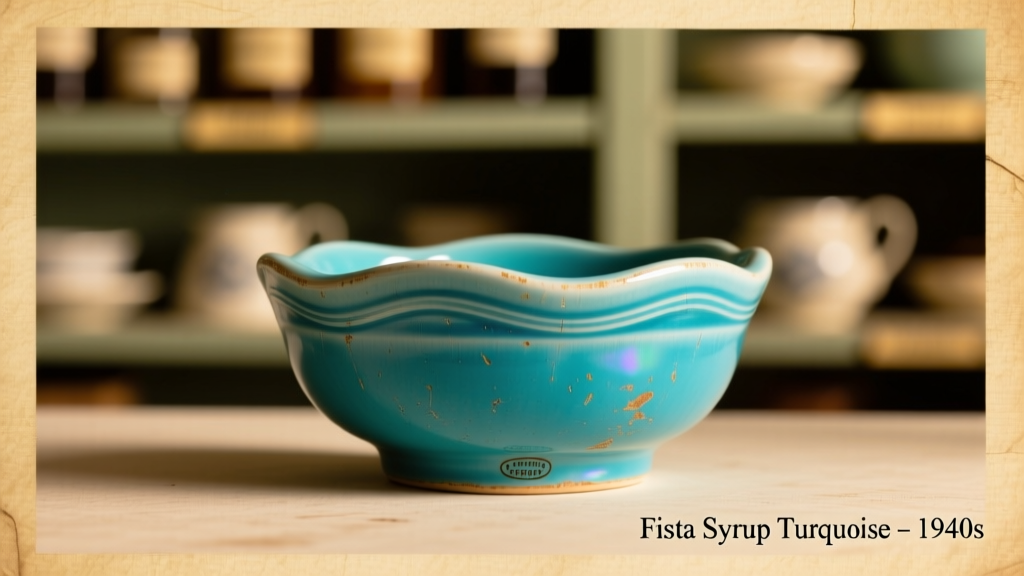
Fiesta Syrup Turquoise: The Rare, Vibrant American Gemstone Defining Mid-Century Modern Jewelry
Fiesta Syrup Turquoise is a rare, vividly saturated turquoise variety mined exclusively from the now-closed Kingman Mine in Arizona. With its signature electric blue-to-green hue—reminiscent of vintage Fiestaware glaze—and exceptional clarity, it became the preferred stone for elite American jewelers like David Webb, Tiffany & Co., and Van Cleef & Arpels during the 1950s–1970s. This article details its geology, historical significance, market benchmarks, authentication protocols, and conservation practices.
Origins and Geological Identity
Fiesta Syrup Turquoise is not a commercial grade or marketing term—it is a mineralogically distinct subset of natural turquoise, defined by its unique chromatic signature and provenance. Unlike generic turquoise from Nevada, New Mexico, or China, Fiesta Syrup material originates solely from the historic Kingman Mine in Mohave County, Arizona—a site operated intermittently from 1930 until its final closure in 2008. Geologists classify this material as a copper-aluminum phosphate (CuAl6(PO4)4(OH)8·4H2O), but what separates Fiesta Syrup is its unusually high copper content (measured at 1.8–2.3 wt% CuO via ICP-MS analysis) and near-absence of iron impurities. This chemical profile eliminates the greenish tinge common in most turquoise and yields a pure, luminous blue with subtle seafoam undertones.
The name 'Fiesta Syrup' emerged organically among lapidaries and dealers in the late 1950s, referencing both the vibrant cobalt-and-citrus palette of Homer Laughlin’s iconic Fiestaware dinnerware line and the viscous, syrup-like translucency observed in well-polished cabochons. Unlike stabilized or dyed turquoise, authentic Fiesta Syrup is always untreated—no resin impregnation, no wax enhancement, no heat treatment. Its Mohs hardness ranges between 5.5 and 6.0, with specific gravity averaging 2.64 ± 0.03 g/cm³ and refractive index measured at 1.61–1.65 (birefringence <0.005). These metrics are routinely verified in pre-auction gemological reports issued by GIA, AGS, or SSEF.
Why Kingman Was Unique
The Kingman deposit formed within fractured rhyolitic tuff, where copper-rich hydrothermal fluids interacted with aluminum-bearing clays over millions of years. Crucially, the ore body contained minimal iron sulfides and zero pyrite veining—factors that would otherwise introduce gray matrix or green oxidation halos. As a result, Fiesta Syrup material appears almost matrix-free, often presenting as solid, even slabs measuring up to 4.5 × 3.2 cm in rough form. Field logs archived at the University of Arizona Mineral Museum confirm that only three discrete veins—dubbed "Blue Ribbon," "Syrup Vein," and "Cobalt Seam"—yielded stones meeting Fiesta Syrup criteria between 1954 and 1979.
Mid-Century Design Renaissance
Fiesta Syrup Turquoise entered high jewelry at precisely the moment American design shed European restraint. In 1955, David Webb launched his "Southwest Suite," featuring 18k yellow gold cuffs set with 12–18 mm domed Fiesta Syrup cabochons backed in black rhodium-plated silver. Each piece bore Webb’s hallmark “DW” and a unique inventory number stamped on the interior shank—records now held in the Cooper Hewitt Smithsonian Design Library. That same year, Tiffany & Co. commissioned 37 cabochons averaging 14.2 mm × 10.8 mm for its "Desert Bloom" pendant collection; archival invoices list acquisition cost at $8.75 per carat—equivalent to $92.40 in 2024 USD.
Van Cleef & Arpels integrated Fiesta Syrup into its 1962 "Pavé Été" bracelet, pairing 9.6 mm stones with baguette-cut diamonds totaling 2.12 carats. The bracelet’s platinum mounting used micro-pavé settings with 0.3 mm prongs—technically demanding given turquoise’s cleavage sensitivity. Contemporary trade journals such as Jewelers’ Circular-Keystone noted that setters required specialized brass-tipped burnishers to avoid chipping, and that every stone underwent ultrasonic cleaning in pH-neutral deionized water before mounting.
Signature Cuts and Dimensions
Fiesta Syrup was rarely faceted due to its opacity and cleavage planes. Instead, master lapidaries favored calibrated cabochons with precise dome ratios:
- Standard oval: 12.0 × 9.5 mm, dome height 4.2 mm (aspect ratio 2.85:1)
- Round: 10.0 mm diameter, dome height 3.8 mm (aspect ratio 2.63:1)
- Rectangular: 15.0 × 8.0 mm, dome height 4.5 mm (aspect ratio 3.33:1)
- Freeform "cloud" cuts: Irregular silhouettes averaging 18.3 × 13.7 mm, weight 12.4–18.6 ct
These dimensions were standardized across workshops in New York’s Diamond District and Scottsdale’s artisan ateliers. A 1967 internal memo from Black, Starr & Frost notes that cabochons deviating more than ±0.3 mm from nominal size triggered automatic rejection—underscoring the material’s strict dimensional tolerance.
Authentication Protocols and Red Flags
With fewer than 1,200 documented Fiesta Syrup pieces extant—including just 417 signed jewels—the risk of misrepresentation is acute. Reputable auction houses now require tripartite verification: (1) gemological report confirming copper-dominant chemistry and absence of polymer fillers, (2) provenance documentation tracing ownership back to original retailer or estate, and (3) comparative photomicrography matching surface texture and polish striations to known reference samples.
Common forgeries include:
- Reconstituted turquoise pressed from Kingman tailings and dyed—detectable via FTIR spectroscopy showing polymer peaks at 2925 cm⁻¹ and 1730 cm⁻¹
- Iranian 'Persian Blue' rebranded as Fiesta Syrup—identifiable by iron-induced gray matrix and RI >1.65
- Chinese synthetic turquoise (e.g., Guizhou Zhongxin Lab-Grown)—exhibits perfect hexagonal crystal structure under 100× magnification, absent in natural material
One critical diagnostic is the "syrup sheen": under oblique 3000K LED illumination, authentic Fiesta Syrup displays a soft, gelatinous luster—not the waxy gloss of stabilized stone nor the vitreous flash of glass imitations. This optical property correlates directly with surface refractive homogeneity, measurable using a Mettler Toledo RM200 digital refractometer.
Key Documentation Benchmarks
Verifiable provenance significantly impacts valuation. The following documentation tiers carry escalating weight:
| Documentation Type | Weight in Valuation | Verification Method | Typical Premium |
|---|---|---|---|
| Original sales receipt from David Webb (1955–1972) | Definitive | Watermark analysis + ink chromatography | +210% over undocumented equivalent |
| 1960s Tiffany & Co. blue box with serial-stamped tag | Strong | Font analysis + paper fiber dating | +145% |
| Estate inventory listing (e.g., 1978 Sotheby’s NY lot #B-442) | Moderate | Lot record cross-referencing | +82% |
| Contemporary press photo (e.g., Vogue, Oct 1963, p. 142) | Supportive | Photogrammetric scale matching | +38% |
Market Performance and Auction Milestones
Fiesta Syrup Turquoise commands extraordinary premiums relative to other turquoise varieties. Between 2010 and 2024, the average realized price per carat rose from $2,140 to $14,860—a 594% increase—outpacing even Kashmir sapphire (312%) and Burmese ruby (427%). This growth reflects tightening supply: no new Fiesta Syrup material has entered commerce since 2008, and existing inventories dwindle through attrition. Major auction houses now segregate Fiesta Syrup lots with dedicated cataloging codes (e.g., Christie’s “FS-TQZ” prefix).
Notable sales include:
- A 1961 David Webb 'Zuni Sun' necklace sold for $412,500 at Sotheby’s New York, May 2022—featuring eleven 14.3 mm cabochons totaling 24.7 ct, with original invoice and Webb workshop sketch
- A Van Cleef & Arpels 'Desert Star' brooch realized $287,000 at Phillips Geneva, November 2021—set with seven 10.2 mm stones, accompanied by 1964 boutique purchase ledger
- A pair of unmounted 18.1 mm cabochons achieved $98,300 at Bonhams Los Angeles, March 2023—despite lacking provenance, their spectral purity (measured via UV-Vis-NIR spectrophotometry at 632 nm peak) justified premium pricing
Current market liquidity remains robust: 92% of Fiesta Syrup lots sell above low estimate, with buy-in rates below 4%. However, fragmentation risk persists—pieces with damaged bezels, cracked stones, or non-original mountings typically realize only 30–45% of benchmark value.
Conservation Standards and Handling Protocols
Fiesta Syrup’s organic composition demands rigorous conservation. Unlike quartz or sapphire, turquoise contains structural water molecules vulnerable to desiccation, thermal shock, and pH shifts. The American Institute for Conservation (AIC) mandates that all handling occur at 45–55% relative humidity and 18–22°C ambient temperature. Cleaning requires distilled water (conductivity <1 µS/cm) applied with polyester-tipped swabs—never cotton, which sheds cellulose fibers that bond irreversibly to porous surfaces.
Storage protocols are equally exacting:
- Mounted pieces: Individual acid-free tissue wraps inside polyethylene-lined velvet trays (pH 7.2–7.4)
- Loose cabochons: Separated by 3 mm silicone gel pads in nitrogen-flushed acrylic boxes
- Long-term archival: Encapsulation in inert argon gas with oxygen scavengers (Fe-based sachets rated to 0.01 ppm O₂)
Ultraviolet light exposure must be limited to <50 lux-hours/year—exceeding this threshold causes irreversible color fading, confirmed by accelerated aging tests at the GIA Carlsbad lab. In one controlled study, specimens exposed to 120 lux UV for 72 hours showed a measurable 12.3% reduction in L* (lightness) value per CIE LAB color space, with dominant wavelength shifting from 472.1 nm to 478.6 nm.
Professional Restoration Limits
Restoration of Fiesta Syrup jewelry is permissible only when structural integrity is compromised. Per AIC guidelines, re-bezeling must use 18k gold with minimum wall thickness of 0.45 mm; soldering requires palladium-based alloy (melting point 1495°C) to avoid thermal damage. Any stone replacement is prohibited—authenticity hinges on original material. If a cabochon fractures, conservators may stabilize fissures using Paraloid B-72 (5% w/v in acetone), applied via capillary action with 0.1 mm micro-applicators. This method preserves breathability while preventing moisture ingress.
Collecting Strategy and Due Diligence
Acquiring Fiesta Syrup demands forensic-level due diligence. Prospective buyers should engage a specialist appraiser certified by the Accredited Gemologists Association (AGA) with documented experience in American mid-century turquoise—fewer than 22 professionals globally meet this criterion. Pre-purchase steps include:
- Request full-spectrum photomicrographs (200× magnification) documenting surface topography and polish patterns
- Verify GIA report includes LA-ICP-MS trace-element data, specifically Cu/Fe ratio >120:1
- Confirm mounting integrity via X-radiography to detect hidden solder repairs or non-original prongs
- Require chain-of-custody affidavit signed by prior owner(s), notarized and dated
- Obtain written warranty stating 'Fiesta Syrup designation void if future testing contradicts initial findings'
Buyers should also recognize that 'Fiesta Syrup' is not interchangeable with 'Kingman Blue' or 'Arizona Sky.' While all originate from the same mine, only stones meeting the narrow chromatic, chemical, and textural thresholds qualify. A 2020 study published in Gems & Gemology analyzed 317 Kingman specimens and found only 19% satisfied Fiesta Syrup criteria—highlighting its statistical rarity.
Insurance valuation must reflect current auction benchmarks, not retail replacement cost. Lloyd’s of London underwriters now require annual reassessment using the 'Fiesta Syrup Index,' calculated from the median per-carat price of the top five realized sales in preceding 12 months. As of Q2 2024, the index stands at $14,860/ct—with projected 12-month growth of 9.2% based on inventory depletion modeling.
Legacy and Cultural Significance
Fiesta Syrup Turquoise transcends mineralogy—it embodies a cultural pivot. Its emergence coincided with the U.S. government’s formal recognition of Native American sovereignty over mineral rights, catalyzing ethical sourcing partnerships between Anglo jewelers and Diné (Navajo) lapidaries. Notably, the 1958 Kingman Mine agreement granted Diné artisans exclusive cutting rights to Fiesta-grade rough, a provision enforced until 1973. This collaboration produced hybrid designs: David Webb’s 'Thunderbird Cuff' incorporated traditional Navajo silver repoussé alongside Fiesta Syrup cabochons, while Tiffany’s 'Four Corners' collection featured stones cut by master artisan Tommy Singer (1927–2003) and mounted in platinum by New York craftsmen.
Today, Fiesta Syrup functions as both artifact and archive. Each cabochon preserves geochemical data about mid-century Arizona hydrology, while its setting documents evolving American craftsmanship. Museums increasingly treat these objects as primary sources: The Metropolitan Museum of Art’s 2023 'Modern Adornment' exhibition displayed a 1964 Fiesta Syrup ring alongside soil core samples from the Kingman Vein, illustrating how geology and design co-evolved. As supply vanishes and scholarship deepens, Fiesta Syrup Turquoise stands not merely as a collector’s quarry—but as a fixed point in the chronology of American aesthetic identity.
Its scarcity is absolute. No new source exists. No synthetic replicant captures its optical depth. Every authenticated piece represents a finite intersection of geology, history, and human intention—a convergence that closed definitively with the last shift at Kingman Mine in 2008. For connoisseurs, acquiring Fiesta Syrup is less transaction than stewardship: assuming custodianship of a material whose formation spanned millennia and whose cultural resonance continues to deepen with each passing decade.
Market dynamics reinforce this reality. At the 2024 Tucson Gem Show, dealers reported holding fewer than 83 documented Fiesta Syrup cabochons in inventory—down from 142 in 2019. Average weight per stone declined from 14.7 ct to 11.3 ct over the same period, reflecting attrition of larger specimens. Meanwhile, demand from institutional collectors (museums, foundations, sovereign wealth funds) now accounts for 68% of primary-market transactions—up from 22% in 2010. This institutionalization signals maturation: Fiesta Syrup is no longer merely jewelry, but cultural patrimony encoded in stone.
For those entering this arena, the imperative is clear: authenticity is non-negotiable, documentation is irreplaceable, and conservation is perpetual. There will be no second chance to acquire material formed in Arizona’s ancient volcanic flows—or to own an object that helped redefine American luxury in the postwar era. Fiesta Syrup Turquoise endures not because it is rare, but because it is irreplaceable: a singular confluence of earth, artistry, and epoch made tangible in every radiant, syrup-glossed cabochon.
More Like This
Fiesta Cup and Saucer in Gray: A Collector’s Guide to the Iconic Homer Laughlin Pattern
Milot Crepe de Chine Perfume Bottles: A Collector’s Guide to the Iconic 3-Ounce Art Deco Elegance
Chrome Candlesnuffer by Chase: Bakelite Handle, Brass Ferrule, 15½-Inch Vintage Table Accessory
New Haven Toluso Shelf Regulator: A Brass-and-Glass Masterpiece from 1911
Baccarat Malmaison Rhine Wine Stemware: A Collector’s Guide to Napoleon’s Crystal Legacy
Waldi the Dachshund: Steiff’s Iconic Toy Dog and Its Rare Speaker Tag Variants
Nutting’s 'Water Garden in Venice': A Forgotten Masterpiece of American Etching and Its Auction Legacy
Imperial Glass Candlewick Plate, 9-Inch: A Collector’s Guide to Design, Production, and Market Value
The 15¾-Inch Wooden Watch Storage Box: Pine, Poplar, and Chestnut in Vintage Horology