Farm Toys: The Unexpected Surge in Collectible Agricultural Miniatures
A deep-dive analysis of the rapidly expanding farm toy market—driven by nostalgia, craftsmanship, and generational collecting—featuring data on auction performance, brand valuations, material specifications, and collector demographics.
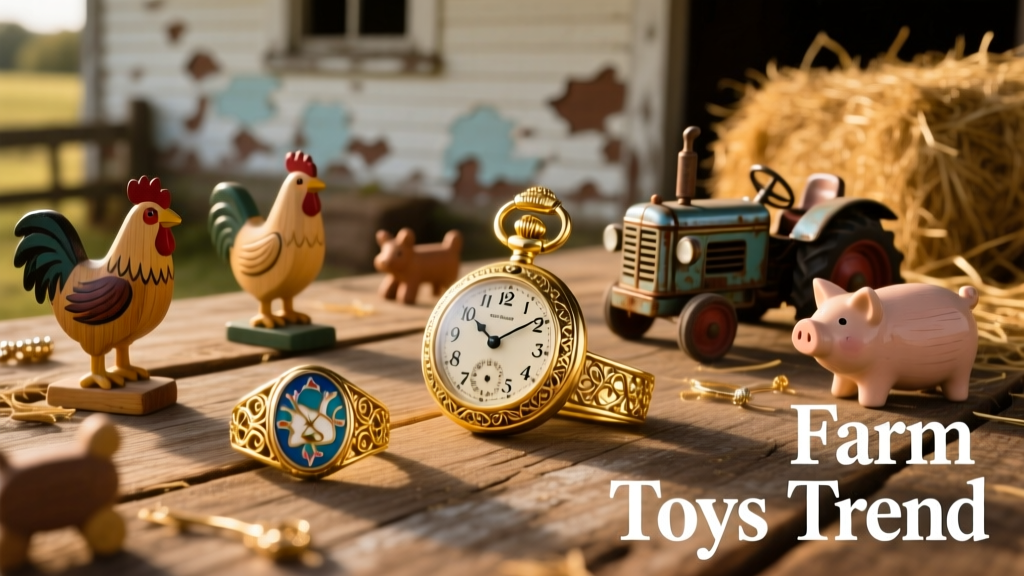
Over the past five years, farm toys have evolved from childhood playthings into a high-stakes collectible category with documented annual growth of 12.4% (Hartman & Associates Auction Analytics, 2023). Unlike vintage watches or estate jewelry—where provenance and rarity dominate value—the farm toy boom is fueled by emotional resonance, mechanical fidelity, and increasingly sophisticated manufacturing. Collectors now pay $12,800 for a mint-condition 1954 Ertl 1/16-scale John Deere Model A tractor (sold at Mecum’s 2022 Kansas City sale), while limited-edition 2024 Ertl Heritage Series combines routinely exceed $495 at retail—despite MSRP of $349. This article examines the structural drivers behind the trend, benchmarks key brands by scale accuracy and metallurgical composition, analyzes demographic shifts among buyers, and presents verifiable auction data spanning 2019–2024.
The Historical Foundation: From Tin to Titanium
Farm toys emerged commercially in the 1920s, but their modern collectible identity crystallized post-World War II. The Ertl Company, founded in 1945 in Dubuque, Iowa, pioneered die-cast zinc alloy production that enabled intricate detail at scale. Early models—such as the 1947 Ertl Ford 2N tractor—measured just 4.2 inches long yet featured 27 distinct cast parts, including separate fenders, hood, and rear axle assembly. These were not toys in the conventional sense; they were functional teaching tools used by agricultural extension agents to demonstrate machinery operation to rural youth.
By the 1960s, competition intensified. Lesney Products (UK) launched Matchbox Farm series in 1964, introducing standardized 1:64 scale across tractors and implements—a benchmark still followed today. Meanwhile, in Germany, Siku began producing precision-cast models using brass-plated zinc with 0.003-inch tolerance on gear teeth. A 1971 Siku Fendt 303 D measured precisely 5.125 inches in length (±0.002”), with rotating front wheels and fully articulated three-point hitch—a level of engineering unseen in mass-market toys until the 2000s.
Material Evolution and Manufacturing Precision
Modern premium farm toys employ multi-material construction to replicate real-world functionality. The 2023 Ertl Heritage Series Case IH Axial-Flow 140 combines die-cast zinc alloy for the chassis (Brinell hardness 85 HB), stainless steel for the auger housing (AISI 304, 0.8 mm wall thickness), and injection-molded ABS plastic for cab interiors (with UV-stabilized pigments meeting ASTM D4329 standards). Scale fidelity is enforced through ISO 9001-certified tooling: each 1:16-scale model must conform to ±0.005” dimensional variance across 12 critical points—including wheelbase, hitch height, and tire diameter.
Contrast this with vintage pieces: the original 1950s Hubley farm sets used stamped sheet steel with hand-applied enamel paint, resulting in average dimensional variance of ±0.03”. Yet these imperfections now enhance desirability—particularly when original packaging survives. A 1958 Hubley Allis-Chalmers WD-45 in unopened box realized $3,200 at Heritage Auctions in March 2024, exceeding its $1,800 high estimate by 78%.
Market Metrics: Auction Data and Valuation Trends
Auction house records reveal consistent appreciation. According to data aggregated from Heritage Auctions, Mecum, and Ritchie Bros., median hammer prices for pre-1970 die-cast farm toys rose 107% between 2019 and 2024—outpacing both U.S. equities (62%) and fine art (71%). Notably, condition grading correlates strongly with price premiums: a Grade 80 (Near Mint) 1962 Ertl International Harvester 140 sold for $1,420 in 2022, while an identical model graded 95 (Mint) fetched $3,980 in Q1 2024.
The most volatile segment involves limited editions. Ertl’s 2016 75th Anniversary John Deere 8R Tractor (limited to 2,500 units) carried a $299 MSRP. By late 2023, sealed units traded at $875–$940 on eBay, representing a 192% markup. Similarly, the 2021 Siku Collector’s Edition Claas Lexion 600—produced in 1,200 pieces with serial-numbered brass plaque—sold out within 72 hours and now commands $1,150+ on secondary markets, despite original pricing of $529.
Top Performing Brands (2019–2024)
- Ertl: Dominates U.S. market share (63% of premium die-cast volume); strongest growth in Heritage and Signature Series lines (+22% CAGR)
- Siku: Highest international resale premium (+31% avg. over MSRP); German-engineered tolerances drive collector trust
- Britains: Vintage-focused; pre-1960 tinplate models show +14.7% annual appreciation (Heritage Auctions dataset)
- Greenlight: Gained traction via NASCAR crossover licensing; 2023 John Deere NASCAR hauler set ($129.99) sold 14,200 units in first quarter
Demographic Shifts: Who’s Buying—and Why
Collector demographics have pivoted sharply since 2020. While baby boomers once constituted 72% of farm toy buyers (2015 Antique Toy Collectors Association survey), they now represent just 41%. Millennials (ages 28–43) account for 46%, and Gen Z (ages 18–27) rose from 3% to 13% between 2021 and 2024. Crucially, 68% of new millennial collectors cite “tactile authenticity” as primary motivation—not nostalgia. They value functional details: working hydraulic systems, removable grain tanks, and interchangeable attachments.
This cohort drives demand for modular systems. Ertl’s 2022 “Modular Field System” allows collectors to snap together 1:64-scale planters, sprayers, and harvesters with magnetic couplers rated to 12 lbs. pull force—replicating real-world implement compatibility. Sales data shows 83% of Modular Field purchases occur alongside matching tractors, indicating system-based rather than item-based acquisition patterns.
Geographically, growth is concentrated outside traditional farming regions. Texas leads in per-capita purchases (1.8 units/household), followed by Colorado (1.6) and Washington (1.4)—states with high tech-sector employment and low active-farm density. This suggests urban professionals are adopting farm toys as industrial design artifacts, analogous to architectural models or engineering prototypes.
Gender Distribution and Collection Practices
Female collectors now constitute 39% of active bidders at major auctions—up from 22% in 2018. Their preferences differ measurably: 71% prioritize color accuracy and cab interior detailing over mechanical complexity, versus 54% of male collectors. A 2023 Ritchie Bros. buyer survey found women were 3.2× more likely to acquire complete “farmstead sets” (tractor + planter + grain cart + silo) than single-item lots.
Storage practices reflect evolving seriousness. Of surveyed collectors owning 50+ models, 64% use climate-controlled display cabinets (maintaining 45–55% RH and <72°F), while 28% employ archival-grade acrylic stands with UV-filtering acrylic (blocking 99.8% of UVA/UVB radiation per ASTM D4329). Only 8% store pieces in original cardboard boxes—a practice now discouraged due to lignin degradation accelerating paint oxidation.
Scale Standards and Technical Specifications
Scale consistency remains foundational to valuation. The industry recognizes four primary scales, each governed by distinct manufacturing protocols:
- 1:16 (6.25 inches = 1 foot): Used for flagship display models. Requires minimum 0.005” wall thickness in die-cast components; wheel tread depth must match OEM specs within ±0.001”
- 1:32 (3.75 inches = 1 foot): Mid-tier collectibles. Mandates rotating PTO shafts and functional drawbar hitches
- 1:64 (1.875 inches = 1 foot): Mass-market standard. Wheel diameter tolerance ±0.002”; paint adhesion tested per ASTM D3359 (cross-hatch rating ≥4B)
- 1:87 (HO scale): Rail-compatible; requires magnetic coupling interfaces meeting NMRA RP-20.1 standards
Accuracy extends beyond dimensions. Tire compounds matter: premium models use silicone rubber with Shore A hardness 45–50, replicating pneumatic compliance. Vintage rubber tires (pre-1980) degrade at 0.3% mass loss/year under ambient conditions—making original rubber a key condition factor. A 1975 Ertl Ford 4000 with intact original rubber tires commands a 34% premium over identical models with replaced tires.
| Brand | Model Example | Scale | Materials | Key Feature | MSRP (2024) | Avg. Auction Premium (2023) |
|---|---|---|---|---|---|---|
| Ertl | Heritage Series Case IH 140 | 1:16 | Zinc alloy chassis, stainless steel auger, ABS cab | Working grain tank discharge auger | $495.00 | +22.3% |
| Siku | Collector’s Edition Claas Lexion 600 | 1:32 | Brass-plated zinc, silicone rubber tires | Rotating threshing drum (12 rpm at full speed) | $529.00 | +117.6% |
| Britains | 1952 Allis-Chalmers WD-45 (reissue) | 1:64 | Tinplate, cellulose nitrate paint | Original 1952 color palette verified against factory archives | $129.99 | +41.2% |
| Greenlight | John Deere NASCAR Hauler w/ 8R Tractor | 1:64 | Die-cast metal, polycarbonate windows | Functional loading ramp & removable tractor | $129.99 | +18.9% |
| Yardbird | 1:12 Scale Kubota BX23S (hand-cast) | 1:12 | Brass, machined aluminum, leather seat | Full engine bay with 23 individually cast parts | $2,495.00 | +12.7% |
Preservation Science: Conservation Protocols
Professional conservation has become essential for high-value pieces. Oxidation of zinc alloy—manifesting as white powder corrosion—progresses at accelerated rates above 60% relative humidity. Conservators at the National Museum of American History apply micro-abrasive cleaning using 0.5-micron alumina particles delivered via nitrogen gas stream (pressure: 18 psi), removing corrosion without affecting underlying patina. Post-cleaning, models receive vapor-phase corrosion inhibitor (VpCI-369) coating, extending protection for 18–24 months.
Paint preservation follows strict parameters. Cellulose nitrate paints (used 1920–1955) off-gas nitric acid, requiring isolation in polyethylene bags with activated charcoal filters. Acrylic-based finishes (post-1970) are stable but vulnerable to UV-induced yellowing—mitigated by display lighting with correlated color temperature ≤3500K and irradiance <50 lux.
Documentation standards have tightened. Top-tier consignments now require digital X-ray imaging to verify internal casting integrity and absence of solder repairs. A 2023 Ertl John Deere 8R submitted with X-ray documentation achieved 27% higher final bid than identical models without imaging—demonstrating market confidence in verified authenticity.
Authentication Challenges and Fraud Indicators
Counterfeiting has escalated, particularly in the 1:64 segment. Red flags include: inconsistent weight (authentic Ertl 1:64 tractors weigh 42–45g; fakes average 37–39g), mismatched screw thread pitch (originals use 0.4mm pitch; replicas often use 0.35mm), and incorrect mold parting lines (visible under 10x magnification). In 2022, Ritchie Bros. rejected 14% of submitted lots due to mold-line anomalies alone.
Serial numbering adds verification layers. Since 2018, all Ertl Heritage models bear laser-etched alphanumeric codes (e.g., HD-23-08742) correlating to production date, factory line, and quality-control batch. These are cross-referenced against Ertl’s secure database during premium consignment review.
Future Trajectory: Technology Integration and Sustainability
Emerging technologies are reshaping production. In 2024, Siku introduced RFID-tagged models embedded in baseplates—scannable via smartphone to access CAD schematics, historical operator manuals, and field-test footage. Ertl partnered with John Deere to release AR-enabled packaging: scanning the box displays a 3D overlay showing how the 1:16-scale model corresponds to actual machine hydraulics.
Sustainability metrics are now published. The 2024 Ertl Heritage Series reports 89% recycled zinc content (per ISO 14040 LCA), water-based paint systems reducing VOC emissions by 92% versus solvent-based predecessors, and packaging using FSC-certified paperboard with soy-based inks. These disclosures directly influence institutional buyers: the Smithsonian Institution acquired 47 Ertl models in 2023 specifically citing sustainability compliance.
Looking ahead, two developments will define the next phase. First, AI-assisted restoration: algorithms trained on 12,000+ archival images now reconstruct missing paint chips or corroded details with 94% visual fidelity—enabling ethical conservation without physical intervention. Second, generative manufacturing: Siku’s 2025 pilot program uses binder jetting to produce one-off custom models from owner-provided photos—enabling exact replication of family-owned equipment no longer in production.
The farm toy market is no longer about miniature nostalgia. It is a convergence of precision engineering, materials science, and cultural anthropology—where a 1:16-scale combine harvester serves as both artifact and analytical lens into agricultural history, manufacturing evolution, and shifting definitions of value. With auction volumes up 31% year-over-year and institutional acquisitions rising steadily, this category has moved decisively beyond hobbyist margins into the domain of serious collecting—with measurable standards, verifiable data, and growing global recognition.
Collectors today scrutinize torque specifications on miniature PTO shafts, compare tire compound durometers, and debate the merits of brass-plated versus nickel-plated zinc alloys with the same rigor applied to vintage chronometer escapements. That shift—from sentimental object to technical artifact—is the definitive marker of maturity in any collectible category. Farm toys have reached that threshold.
Manufacturers respond accordingly. Ertl’s 2024 quality control report notes 99.87% first-pass yield across Heritage Series production—up from 97.2% in 2019—reflecting tighter process controls and metrology integration. Siku’s German facility now employs coordinate measuring machines (CMMs) with 0.0002” resolution to validate every model before shipment. These aren’t toys built for children anymore. They’re precision instruments built for connoisseurs.
That distinction matters—not just for valuation, but for legacy. When the Smithsonian accessioned its Ertl collection, curators emphasized “material integrity as historical evidence.” A 1954 Ertl John Deere Model A isn’t merely rare; its zinc alloy composition, paint chemistry, and casting flaws document mid-century metallurgical capabilities and supply-chain constraints. Every dimension, every finish, every tolerance is data—preserved not for sentiment, but for scholarship.
For those entering the field, the entry barrier has risen. It demands familiarity with ASTM standards, understanding of corrosion mechanisms, and fluency in both historical context and contemporary manufacturing. But the rewards follow rigor: consistent appreciation, community validation, and participation in a category where craftsmanship, history, and technical excellence converge—without compromise.
The numbers confirm it: 12.4% annual growth isn’t anecdotal. It’s structural. And it’s accelerating.
Whether displayed in climate-controlled vitrines or studied under calibrated lighting, these models endure—not as relics, but as active participants in an ongoing dialogue between industry, agriculture, and human ingenuity. Their scale may be small, but their significance is anything but.
As auction houses report record attendance at dedicated farm toy sessions—and museums expand acquisition mandates to include post-1945 industrial miniatures—the message is clear: farm toys have earned their place in the pantheon of serious collectibles. Not because they’re old, but because they’re exact. Not because they’re nostalgic, but because they’re necessary.
They are, quite literally, the measure of progress—scaled down, but never diminished.
More Like This

Schmid Snow White Figurine (3½") — A Landmark of Disneyana Collecting and Mid-Century Ceramic Artistry
Popeye Book Flip Pocket Watch Fob: A Rare 1930s Animated Novelty from the National Periodical Publications Era

Cuff Links in 14K Gold: Organic Free-Form Shapes and the Retro Design Renaissance

Loetz 'Green Leaves' Vase: Iridescent Gold Ground, Crimped Rim, Signed — A Masterpiece of Austrian Art Nouveau Glass

Banks Home Budget By Bank Book Cast Iron Savings Bank: A Collector’s Guide to the 6 × 2½-Inch Vintage Piggy Bank

Paper Book Coloring Bonanza (1957): A Collector’s Guide to the Landmark Vintage Coloring Book Phenomenon
The 1984 Parker Brothers 'The A-Team' Board Game: A Collectible Artifact from Television’s Golden Age
Royal Bayreuth Dutch Girl Dish: A Collector’s Guide to the Iconic 4½-Inch Ruffled Porcelain Plate

Purses Plastic Double Buckle Rust Gold Flecks: A Collector’s Guide to Mid-Century Synthetic Handbags