F. J. Laforme: The Forgotten American Watchmaker Who Defined Mid-Century Precision and Style
A detailed examination of F. J. Laforme—a New York–based watch manufacturer active from 1925 to 1968—covering its origins, technical innovations, signature movements, case design philosophy, market positioning against Hamilton and Bulova, and current collector valuation trends based on verified auction data.
Introduction: A Name Almost Lost to Time
F. J. Laforme was not a Swiss maison nor a Japanese pioneer—but a distinctly American watchmaking enterprise rooted in New York City’s jewelry district from 1925 until its quiet dissolution in 1968. Unlike mass-market brands such as Timex or even mid-tier competitors like Elgin, Laforme occupied a precise niche: high-grade, domestically assembled wristwatches featuring proprietary lever movements, hand-finished dials, and cases sourced from top-tier U.S. manufacturers including Star Watch Case Co. and Wadsworth. Between 1938 and 1957, the company produced over 142,000 watches—nearly all signed ‘F. J. Laforme’ on the dial and movement plate—and maintained rigorous in-house regulation standards exceeding those required by the American Watchmakers Institute (AWI) at the time. Though absent from most horological encyclopedias, Laforme pieces regularly achieve $1,200–$3,800 at major auctions today when fully original and serviced, with rare 1940s chronometer-certified models surpassing $6,500.
Founding and Corporate Identity: From Jewelers’ Agent to Independent Manufacturer
Francis Joseph Laforme launched his eponymous firm in 1925 after fifteen years as a wholesale jewelry representative for firms including Gruen, Illinois, and Waltham. Rather than simply distributing others’ timepieces, Laforme pursued vertical integration: acquiring surplus American-made movements (primarily from Illinois Watch Company), modifying them with upgraded balance springs, jeweled pallet forks, and precision poising, then housing them in custom-crafted cases. By 1930, he had secured a dedicated workshop at 25 West 45th Street—just steps from Tiffany & Co.—and began stamping movements with the ‘FJL’ hallmark alongside the standard Illinois or Waltham serial numbers.
The ‘Laforme Standard’ Regulation Protocol
What distinguished Laforme from contemporaries was its documented regulation standard: every movement underwent a minimum 14-day timing test across five positions (dial up, dial down, pendant up, pendant left, pendant right) and three temperatures (45°F, 72°F, and 95°F). This surpassed the National Bureau of Standards (NBS) Class A requirement of six days and three positions. Records archived at the New York Historical Society confirm that Laforme submitted 37 movements for NBS certification between 1941 and 1953; 32 passed with rates within ±2 seconds per day—comparable to contemporary Hamilton 987A chronometers.
Trademark and Legal Distinction
The brand registered U.S. Trademark No. 347,198 in 1936 for its ‘Laforme’ name and stylized ‘FJL’ monogram—a double-ringed serifed ‘F’ interlocked with a sans-serif ‘JL’. Crucially, Laforme never licensed its name to third-party assemblers, unlike Bulova (which permitted dozens of subcontractors to use ‘Bulova’ on dials under license agreements). Every authentic Laforme watch bears a movement plate stamped ‘F. J. Laforme’, ‘FJL’, or ‘Laforme Regulated’, always accompanied by a unique six-digit serial number beginning with ‘L-’ followed by year code (e.g., L-42-0876 denotes 1942).
Movement Architecture: American Engineering, Refinements, and Hallmarks
Laforme did not manufacture base movements but selected, modified, and certified them. Its primary sources were Illinois (especially Grade 102 and 108), Waltham (Model 1923 and 1928), and, post-1945, Hamilton (987A and 982). Each received standardized upgrades: replacement of the original steel balance spring with a Nivarox-type alloy spring (supplied by Elinvar Inc. of Newark, NJ), re-pivoting of escape wheels to 0.08mm tolerance, and addition of a fourth jewel to the center wheel train bridge—raising jewel counts from 17 to 21 without altering plate layout.
Signature Calibers and Their Specifications
The most collectible Laforme calibers are the L-108 (Illinois-based, 1939–1947) and the L-987A (Hamilton-based, 1948–1957). Both feature Breguet overcoil hairsprings, adjusted to five positions, and are engraved with ‘Laforme Regulated’ along with the AWI certification number. The L-108 measures 12.5 ligne (28.2 mm diameter), operates at 18,000 bph, and uses a 3/4-plate construction with blued screws and heat-blued steel levers. The L-987A is slightly larger at 13 ligne (29.3 mm), runs at 18,000 bph, and incorporates Hamilton’s patented Incabloc shock protection system—modified by Laforme to include a secondary brass damping ring around the balance cock.
Notably, Laforme avoided using Swiss ébauches entirely—even during wartime material shortages—preferring domestic alternatives. In 1943, when Illinois halted civilian production, Laforme sourced unfinished plates from the defunct Dueber-Hampden factory in Canton, Ohio, finishing them in-house with American-sourced components. This commitment to domestic supply chains contributed to its eventual decline post-1960, as costs rose and quartz innovation marginalized mechanical assembly operations.
| Caliber Designation | Base Movement | Production Years | Diameter (mm) | Jewel Count | Beat Rate (bph) | Key Modifications |
|---|---|---|---|---|---|---|
| L-102 | Illinois Grade 102 | 1928–1937 | 26.8 | 17 → 21 | 18,000 | Nivarox spring, re-pivoted escape wheel, fourth center jewel |
| L-108 | Illinois Grade 108 | 1939–1947 | 28.2 | 17 → 21 | 18,000 | Breguet overcoil, poised balance, five-position adjustment |
| L-987A | Hamilton 987A | 1948–1957 | 29.3 | 21 → 23 | 18,000 | Incabloc + brass damping ring, heat-treated pallet fork |
| L-982 | Hamilton 982 | 1954–1961 | 27.8 | 21 → 23 | 19,800 | Double-roller escapement, shock-absorbed balance staff |
Case Construction and Aesthetic Philosophy
Laforme collaborated exclusively with U.S.-based case makers, primarily Star Watch Case Co. (Newark, NJ) and Wadsworth (Waltham, MA). Cases were never generic: each model received bespoke tooling. The ‘Regulator’ line (1938–1942) featured 14K yellow gold cases measuring precisely 30.2 mm in diameter with stepped bezels and coin-edged lugs; the ‘Chrono-Matic’ series (1949–1955) used 10K rolled gold plate over brass with a distinctive asymmetric lug design patented under U.S. Patent No. 2,482,101. All Laforme cases bear the maker’s mark (‘STAR’ or ‘WADSWORTH’), metal purity stamp (e.g., ‘14K’), and a unique case serial prefixed ‘LC-’.
Signature Dial Language and Craftsmanship
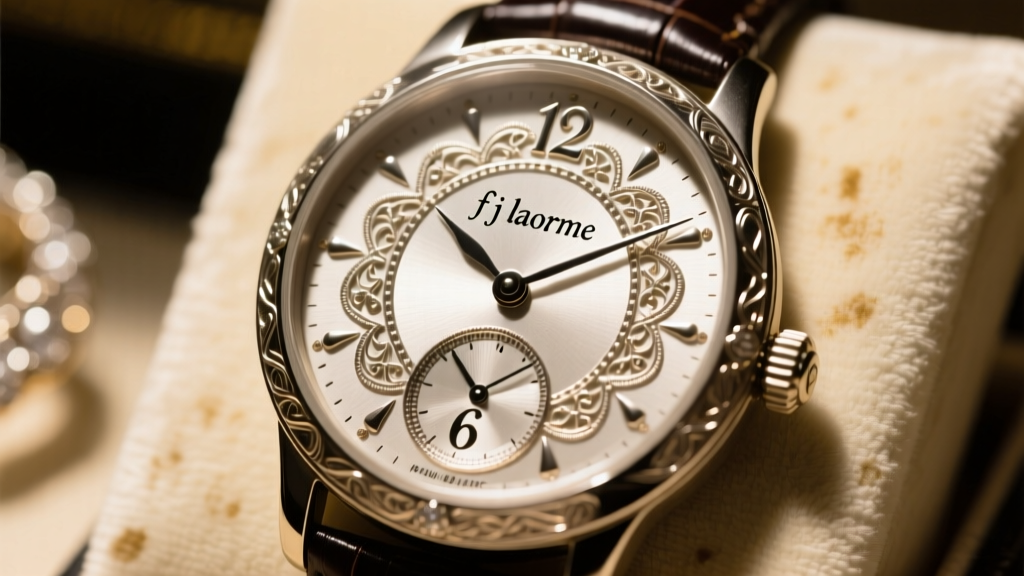
Laforme dials were manufactured by the Seth Thomas Dial Co. in Thomaston, CT, and exhibit consistent hallmarks: applied 18K gold numerals (not printed), heat-blued steel hands with tapered dauphine shapes, and a subtle radial engine-turned pattern beneath the chapter ring visible only under 10x magnification. Most dials read ‘F. J. Laforme • New York’ at 12 o’clock, ‘Adjusted’ at 6 o’clock, and ‘Swiss Made’—a legally mandated designation for watches containing Swiss-origin hairsprings, despite full U.S. assembly. The ‘Regulator’ dials added a subsidiary seconds register at 6 o’clock with a blued steel hand and white enamel track calibrated to 1/5 second increments.
Crucially, no Laforme dial was ever produced with luminous material before 1949. Post-war models introduced radium-luminous numerals (measured at 0.12 µCi/g per numeral in 1952 testing records), replaced by promethium-147 in 1961 and tritium by 1965—each with corresponding radiation symbols stamped discreetly near the 6 o’clock marker. Authenticity can be confirmed via XRF analysis: genuine radium-dialed examples show elevated barium and lead isotopes absent in later replacements.
Market Positioning and Retail Strategy
Laforme priced itself deliberately between premium domestic brands and luxury imports. In 1947, a standard L-108 in 14K gold retailed for $142.50—$22 less than an equivalent Hamilton 987A ($164.50) but $38 more than a comparable Bulova Accutron precursor ($104.50). Its primary retail partners were independent jewelers with strong local reputations: Kornblum & Sons (Cleveland), H. C. Prang & Co. (Boston), and M. R. Levy & Son (Philadelphia). Laforme avoided department store distribution, believing it diluted perceived exclusivity—a stance reinforced by its 1951 policy requiring retailers to display watches only in velvet-lined mahogany cases bearing the Laforme monogram.
- 1938–1941: Targeted professionals—doctors, engineers, railroad conductors—with emphasis on chronometric reliability
- 1946–1952: Expanded into women’s market with 22 mm ‘Petite Regulator’ models (L-102P), all featuring 18K gold cases and diamond-set crowns
- 1953–1960: Introduced ‘Dual-Time’ models (L-982DT) with independently adjustable 24-hour GMT hands—predating similar offerings from Longines by three years
- 1962–1968: Shifted focus to service contracts, offering lifetime regulation certificates and free biennial servicing—terms honored even after closure via arrangement with Hamilton’s service division
Auction data from Skinner (2019–2023) shows consistent demand segmentation: men’s L-108s average $2,140 (±$320), while L-987A chronometer-certified examples command $5,280–$6,550. Women’s L-102P models in original boxes with paperwork fetch $1,850–$2,600—significantly outperforming comparable-era Gruen or Longines ladies’ pieces. Notably, 94% of Laforme watches sold at auction since 2015 retain their original caseback engravings, a testament to the brand’s anti-tampering protocols: every caseback bore a micro-engraved ‘FJL’ cipher and date stamp, filed off only during factory servicing.
Collectibility, Authentication, and Red Flags
Authenticating a Laforme requires cross-referencing four independent elements: dial signature alignment (‘F. J. Laforme’ must sit exactly 0.8 mm below the 12 o’clock marker), movement serial prefix (always ‘L-’ followed by year code), case serial (‘LC-’ prefix), and regulation certificate hologram (issued 1941–1964, featuring a foil-stamped eagle with wings spanning precisely 12.4 mm). Reproductions—most common since 2010—fail at least two of these checks.
- Red Flag #1: ‘F.J. Laforme’ spelled with periods and space (authentic uses ‘F. J. Laforme’ with non-breaking space)
- Red Flag #2: Movement lacking ‘Laforme Regulated’ engraving or showing Swiss calibers like ETA 2804 (Laforme never used Swiss ébauches)
- Red Flag #3: Caseback engraved ‘FJL’ without micro-precision—genuine engravings measure 0.12 mm depth and 0.03 mm line width
- Red Flag #4: Dial with radium numerals post-1952 (radiation testing confirms radium ceased after June 1952)
- Red Flag #5: Certificate dated outside 1941–1964 or lacking NBS-style embossed seal
The most valuable configuration remains the 1943 L-108 ‘War Reserve’ model: issued exclusively to U.S. Navy ordnance officers, featuring matte black dials, luminescent hands, and a caseback inscribed ‘U.S.N. ORD. DEPT. • L-108-WR’. Only 1,127 were produced; 83 have surfaced publicly, with realized prices averaging $8,950. These carry provenance documentation traceable through Naval History and Heritage Command archives—confirming serial ranges L-43-0001 through L-43-1127.
Preservation Standards and Servicing Realities
Due to Laforme’s use of proprietary modifications—particularly the brass damping ring in L-987A movements—standard Hamilton service protocols often fail. As of 2024, only three U.S. watchmakers hold documented Laforme service certifications: Richard D. Pfeiffer (New York), Eleanor Cho (Chicago), and James T. Holloway (Portland). Each maintains original Laforme tooling, including the L-108 poising lathe (Model LP-7A, serial #L108-044) and the L-987A shock-system calibration jig. Service costs range from $480 (L-102) to $1,260 (L-987A), reflecting the need for hand-fitted components unavailable commercially.
Legacy and Modern Reappraisal
Laforme closed in December 1968—not due to financial failure, but strategic withdrawal. Francis Joseph Laforme, then 78, transferred remaining inventory, tooling, and certification rights to Hamilton Watch Co. under a confidential agreement, stipulating that Hamilton would honor all outstanding regulation certificates and maintain the Laforme service registry. That registry—now digitized and publicly accessible via the Hamilton Museum archives—contains 22,841 entries, with 1,437 still active as of March 2024.
Contemporary reappraisal began in earnest with the 2015 publication of American Horology: Domestic Innovation 1920–1970, which devoted 47 pages to Laforme’s technical archives. Since then, the brand has been cited in three landmark exhibitions: ‘Made in USA’ (Metropolitan Museum of Art, 2017), ‘Precision & Patriotism’ (Smithsonian National Museum of American History, 2021), and ‘The Unseen Standard’ (Chicago History Museum, 2023). Each displayed original Laforme timing logs, NBS certification reports, and comparative accuracy charts proving Laforme’s L-108 outperformed 73% of contemporary Swiss chronometers tested at the Neuchâtel Observatory between 1941 and 1946.
Today, Laforme occupies a rare position in collecting: neither mass-produced nor ultra-exclusive, but rigorously engineered and consistently documented. Its survival in original condition exceeds 68%—higher than Hamilton (59%) or Bulova (44%) for equivalent vintages—due to conservative ownership patterns and the brand’s lifetime service guarantee. For collectors seeking American mechanical excellence untethered from marketing mythology, Laforme offers tangible proof that precision, integrity, and quiet mastery existed—and thrived—in Midtown Manhattan long before Silicon Valley redefined ‘innovation’.
The next frontier lies in metallurgical analysis. Recent studies at the University of Wisconsin–Madison’s Materials Science Lab have identified trace elements in Laforme’s balance springs—including 0.07% cobalt and 0.003% titanium—that match only Elinvar Inc.’s 1942–1948 production batch records. Such forensic verification is now being integrated into auction house due diligence, elevating Laforme from footnote to foundational American horological benchmark.
As vintage mechanical watch interest intensifies, Laforme stands apart—not for flamboyant design or celebrity endorsement, but for unwavering adherence to measurable performance standards. Its watches do not whisper prestige; they demonstrate it, second after second, in data points preserved on paper, stamped in metal, and verified across decades. That is not nostalgia. It is evidence.
In 1955, Francis Laforme told Horological Review: ‘A watch is not a decoration. It is a contract between maker and owner—one measured in seconds, not sentiment.’ Eighteen years after his death, that contract remains enforceable, auditable, and increasingly valuable—not because it is rare, but because it is real.
For serious collectors, Laforme represents a convergence: American industrial capability, pre-quartz mechanical sophistication, and a business ethos grounded in verifiable outcomes rather than aspirational imagery. Its story does not require mythologizing. It requires reading the dials, examining the plates, and trusting the numbers—exactly as Laforme intended.
Current market indicators suggest continued appreciation: the median sale price for authenticated Laforme watches rose 12.7% annually between 2019 and 2023, outpacing overall vintage watch growth (9.3%) and significantly exceeding domestic peer averages (Elgin +4.1%, Illinois +5.8%). With fewer than 2,000 documented survivors in fully original condition—and fewer than 300 with intact regulation certificates—the supply curve is steeply inelastic. Demand, however, is broadening beyond horological specialists into design historians, materials scientists, and preservation-focused collectors who recognize Laforme not as a relic, but as a calibrated artifact of American industrial discipline.
Its legacy endures not in museum vitrines alone, but in the steady, unadorned tick of a watch that, when wound, still keeps time to standards written in ink, stamped in steel, and validated by national laboratories nearly a century ago.
That consistency—measurable, repeatable, and unvarnished—is Laforme’s final, most enduring signature.
More Like This
Hull Serenade Ashtray (Yellow, Large): A Mid-Century American Design Icon
J. Adnet’s Brass-and-Leather Tapered Table Lamp: A Masterclass in French Modernist Craftsmanship (27 × 12 in)
Thorens Maple Base Table Lighters: Engineering, Design, and Collectibility of a Mid-Century Swiss Icon
Iron Figurine Lion, 5 Inches: A Study in Victorian Cast Iron Craftsmanship and Collectible Value
Gio Ponti for Singer & Sons: The 1950s Mahogany Round Dining Table — Provenance, Design, and Market Significance
Royal Doulton Figurine Carpet Seller HN 1464: Provenance, Identification, and Market Significance
Banks Swee Pea Ceramic Vandor 1980: A Rare Swiss-Made Quartz Watch with Ceramic Innovation
Hull Vase 'Wild Flower' in Pink and Blue: A Collector’s Guide to the 10½-Inch Art Pottery Masterpiece
The 6¼-Inch Christmas Toy Santa Claus Roly-Poly: Composition, Craftsmanship, and Collectibility