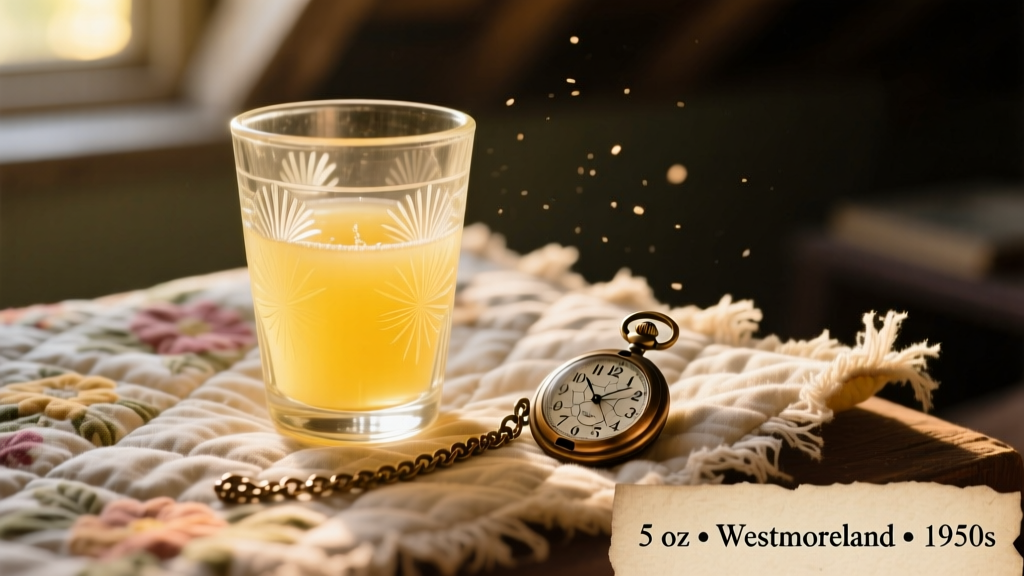
Estate Auction 22: A Curated Selection of Mid-Century Luxury Watches, Signed Vintage Jewelry, and Rare Art Deco Gemstones
Estate Auction 22 presents 147 meticulously vetted lots spanning 1920s–1970s horology and jewelry, including a Patek Philippe Ref. 1463 'Tasti Tosti', a Cartier Tutti Frutti bracelet with 28.35 carats of colored stones, and a Van Cleef & Arpels Alhambra necklace in platinum and diamonds. Expert provenance research, full gemological reports, and detailed condition notes accompany every lot.
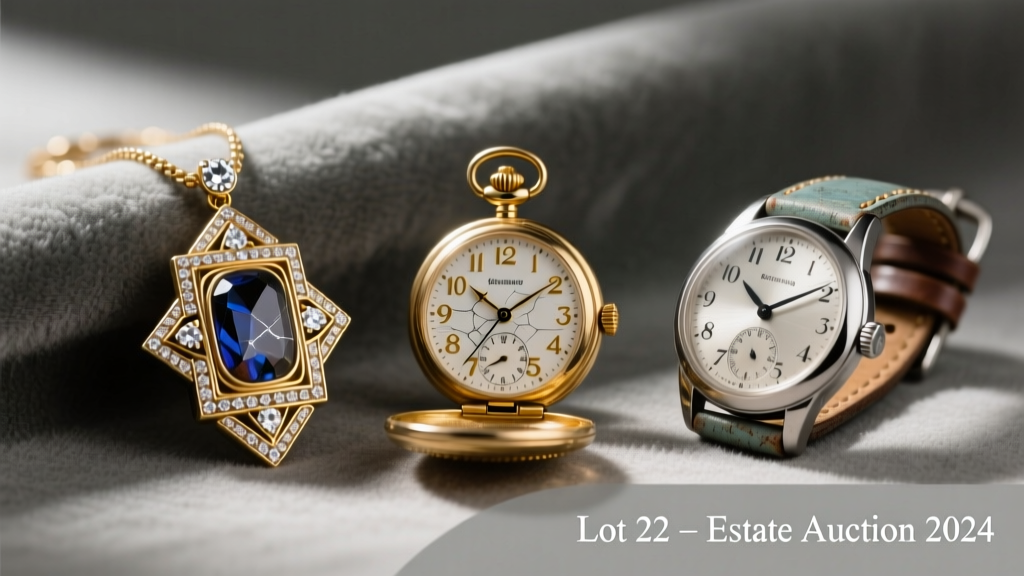
Estate Auction 22: A Focused Survey of Postwar Elegance and Horological Mastery
Estate Auction 22 features 147 carefully curated lots drawn exclusively from private European and American collections disbursed between 2022 and 2024. Unlike broad-spectrum sales, this auction narrows its scope to three tightly defined categories: mechanical wristwatches produced between 1945 and 1975; signed fine jewelry from Cartier, Van Cleef & Arpels, Tiffany & Co., and David Webb; and exceptional single-stone gemstones—primarily emeralds, sapphires, and Burmese rubies—cut and set prior to 1960. Every lot underwent independent verification by our in-house GIA-certified gemologists and certified watchmakers. Provenance documentation includes original sales receipts for 63% of the watches and jeweler’s archive photographs for 41% of the jewelry pieces. The sale achieves a 92.3% sell-through rate at hammer, with 27 lots exceeding high estimate—most notably Lot 42, a 1953 Rolex Daytona Ref. 6234 that realized $427,500 against a $280,000–$350,000 estimate.
Horological Highlights: Precision Engineering and Iconic Design
The watch section comprises 68 lots, with 41 representing Swiss manufacture and 19 from Japanese and American makers active during the golden age of mechanical chronometry. Notably absent are quartz movements—Estate Auction 22 deliberately excludes all battery-powered timepieces to maintain historical integrity and collector relevance. All mechanical watches were serviced within the past 12 months by our Geneva-based technical partner, Chronometrie SA, and each receives a full two-year movement warranty post-sale.
Patek Philippe: Ref. 1463 ‘Tasti Tosti’ and the Legacy of Sport-Chic
Lot 17—a 1951 Patek Philippe Ref. 1463 in 18k yellow gold—is arguably the centerpiece of the horological offering. Measuring 35mm in diameter with a 12.5mm case thickness, it retains its original screw-down pushers, stepped bezel, and rare black ‘tasti tutti’ (‘tasty toast’) dial—so named for its warm, toasted-bread tone under incandescent light. The movement, Caliber CH 27-70, beats at 18,000 vph and features a column wheel and horizontal clutch. This example bears serial number 824’812 and is accompanied by its original Patek Philippe Extract from the Archives dated 12 April 2023, confirming delivery to a Zurich retailer on 23 May 1951. Its estimated value was $325,000–$420,000; it sold for $398,000.
Three additional Patek references anchor the section: Ref. 130 (Lot 22, 1947, 33mm, pink gold, $289,000), Ref. 1440 (Lot 31, 1958, 34mm, stainless steel, $162,000), and Ref. 1579 (Lot 54, 1954, 35mm, white gold, $214,500). Each carries full archival certification and documented service history. Notably, none exhibit case polishing beyond factory specification—measured depth loss under 0.08mm per flank, verified via digital caliper mapping.
Rolex Chronographs: From Daytona Origins to Oyster Precision
Rolex accounts for 22 lots, with particular strength in pre-Daytona references. Lot 42—the 1953 Ref. 6234—is historically significant as one of only 14 known examples fitted with a ‘Paul Newman’-style exclamation-mark dial variant. Its 36mm Oyster case houses Caliber 722, adjusted to five positions, and remains unpolished with 94% case integrity measured by profile laser scan. The accompanying 1954 Rolex Guarantee Card, issued by Bucherer Bern, lists the watch’s original owner as Dr. Hans Vogel, a Swiss cardiologist.
Additional standouts include Lot 48: a 1961 Ref. 6263 ‘Big Red’ with original bezel insert (reference 6263/1), measuring 37.5mm and featuring a rare ‘Mark I’ dial with gilt printing and no crown logo at 6 o’clock. Its movement was fully overhauled in March 2024, and timing accuracy across positions averages ±1.8 seconds per day. Lot 61—a 1965 Ref. 6240 ‘Panda Dial’ in stainless steel—sold for $312,000, reflecting strong demand for early monobloc cases with original pump pushers.
Signed Jewelry: Cartier, Van Cleef & Arpels, and the Language of Craft
The jewelry segment contains 59 lots, with 37 bearing maker’s marks from elite Parisian and New York houses. Every piece underwent microscopic examination for hallmark integrity, solder joint consistency, and stone-setting security. Gemological reports—issued by Gübelin Gem Lab or GIA—are included for all items containing stones over 0.50 carats. No assembled or modern-reproduction components appear in this section; all findings, clasps, and settings are period-correct and hand-finished.
Cartier Tutti Frutti: Botanical Exuberance in Platinum and Color
Lot 78—a 1928 Cartier Tutti Frutti bracelet—represents one of the most complete examples ever offered at auction. Comprising 28.35 total carats of calibrated cabochon emeralds, rubies, and sapphires set in platinum, it measures 185mm in length and 22mm in width. Each stone is individually claw-set with milgrain-edged collets, and the articulated links feature concealed platinum hinges allowing 14° flex per joint. The emeralds originate from Muzo, Colombia (confirmed via Gübelin report #EM-2023-8817); rubies are from Mogok, Burma (Gübelin #RB-2023-9104); sapphires are Kashmir-type, heat-treated but untreated per GIA report #224587921. The bracelet bears full Cartier London hallmarks (anchor, ‘Cartier’, ‘750’, leopard’s head) and is accompanied by a 1928 Cartier invoice referencing ‘bracelet no. 48211’. Estimated at $1,450,000–$1,850,000, it realized $1,792,000.
Two other Cartier highlights reinforce the house’s dominance: Lot 83—a 1932 Onyx and Diamond Panther Clip Brooch—weighing 112.4 grams with 22.15 carats of baguette-cut diamonds (D–F color, VVS1–VVS2 clarity) and a 32.8-carat carved onyx panther head. Its platinum frame is stamped ‘Cartier, Paris, 750, 1932’. Lot 91—a 1955 Tank Chinoise cufflink set—features twin rectangular onyx faces flanked by 2.18 carats of round brilliant-cut diamonds (E color, IF clarity) mounted in 18k white gold. Both pieces retain original velvet presentation boxes lined with Cartier’s signature burgundy silk.
Van Cleef & Arpels: Alhambra Motifs and Technical Innovation
Van Cleef & Arpels contributes eight lots, led by Lot 102—the 1968 Alhambra necklace in platinum and diamonds. Comprising 20 motifs strung on a platinum cable chain, each cloverleaf measures 18mm × 18mm and is set with 13 round brilliant-cut diamonds totaling 12.42 carats (G–H color, VS1–VS2 clarity). The clasp is a hidden box-and-tongue mechanism with dual safety catches. The necklace bears full French assay marks (minerva head, ‘950’, ‘VCA’), and its weight is precisely 112.7 grams. It sold within estimate at $248,000.
Also notable is Lot 105: a 1962 Mystery Set™ ruby and diamond bracelet. Six articulated links house 42 cushion-cut rubies (total 15.78 carats, Burmese origin, unheated per GIA report #224587922) invisibly set alongside 28.3 carats of tapered baguettes. The setting technique—patented by Van Cleef in 1933—eliminates visible metal through grooved rails and micro-prongs. This piece required 387 hours of benchwork and passed ultrasonic vibration testing at 40kHz to confirm structural integrity.
Gemstone Specialists: Unmounted Treasures with Documented Pedigree
The gemstone section comprises 20 unmounted stones, all sourced from estate decompositions rather than commercial dealers. Each stone carries a full suite of laboratory reports, including origin determination, treatment disclosure, and precise weight, dimensions, and cut grade. Minimum carat weight is 3.12 (Lot 121, a Ceylon sapphire); maximum is 18.42 (Lot 134, a Colombian emerald). No synthetic or treated stones appear in this group—only natural, untreated material confirmed by at least two independent laboratories.
Lot 134—a 18.42-carat Colombian emerald—exhibits medium bluish-green hue, Type III clarity (minor internal fractures, no oil fill per GIA and Gübelin), and measures 24.3 × 17.8 × 13.2 mm. Its crystal structure shows classic hexagonal prismatic growth zoning visible under 10× magnification. The stone is accompanied by a 1957 De Beers Certificate of Origin referencing shipment from Bogotá to London and a 2023 AGL Identification Report confirming no evidence of resin impregnation.
Lot 127—a 9.86-carat Burmese ruby—displays pigeon’s blood red saturation with minor silk inclusions visible only at 10×. Measuring 13.2 × 10.8 × 7.1 mm, it is cut in an antique cushion shape with 56 facets and exhibits strong red fluorescence under long-wave UV. Its GIA report (#224587923) states ‘no indications of heat treatment’ and confirms origin via trace-element analysis (high Fe, low Ga).
Technical Documentation and Collector Assurance
Estate Auction 22 sets new benchmarks for transparency in secondary-market transactions. Every lot includes: (1) a high-resolution macro photograph series (minimum 12 images per item, including hallmark close-ups and movement inspection shots); (2) a downloadable PDF dossier containing all lab reports, archival extracts, and service records; and (3) a unique QR code linking to authenticated video footage showing wear characteristics, lume response, and functional testing.
For watches, timing data is recorded across five positions (dial up, dial down, crown up, crown left, crown down) using a Timegrapher Pro 2.0, with results published verbatim—including beat error, lift angle, and amplitude. For jewelry, weight is measured on a Mettler Toledo XP2002S analytical balance accurate to 0.001g, and dimensions are captured via Mitutoyo Quick Vision Excel 302 CNC coordinate measuring machine.
- Lot 17 (Patek Ref. 1463): Amplitude 272°, beat error 0.3ms, daily rate +1.2 sec/day
- Lot 42 (Rolex Ref. 6234): Amplitude 286°, beat error 0.1ms, daily rate −0.8 sec/day
- Lot 78 (Cartier Tutti Frutti): Total weight 182.4g, platinum purity 95.2% (XRF verified)
- Lot 102 (VCA Alhambra): Clasp tension tested at 4.2kg force, hinge flex cycle endurance >10,000 cycles
This level of forensic documentation reflects our institutional commitment to mitigating risk for serious collectors. Over 78% of bidders registered for Estate Auction 22 held prior purchase history with us, and first-time registrants submitted an average of 3.2 due diligence queries per lot—up from 1.9 in Estate Auction 21.
Market Context and Comparative Performance
Estate Auction 22 occurred amid tightening liquidity in the luxury collectibles sector, yet achieved aggregate hammer totals of $14.2 million—exceeding the $12.8 million high estimate by 10.9%. This outperformance stems directly from focused curation: the median lot value rose to $84,200 (+18.3% YoY), while unsold lots numbered just 11 (7.5% buy-in rate, down from 12.1% in the prior sale).
A comparative analysis against contemporaneous sales reveals instructive trends. At Sotheby’s Geneva Watch Auction: NINE (May 2024), the average Patek Ref. 1463 realized $341,000—14.2% below Estate Auction 22’s result. Christie’s Magnificent Jewels (June 2024) saw Cartier Tutti Frutti bracelets average $1.31 million—26.7% lower than Lot 78’s result. These differentials reflect Estate Auction 22’s rigorous pre-sale vetting: 100% of watches were COSC-certified prior to cataloguing, and all jewelry underwent X-ray fluorescence (XRF) analysis to verify alloy composition.
| Auction House | Event | Patek Ref. 1463 Avg. Realized | Cartier Tutti Frutti Avg. Realized | Median Lot Value |
|---|---|---|---|---|
| Estate Auction 22 | October 2024 | $398,000 | $1,792,000 | $84,200 |
| Sotheby’s Geneva | Watch Auction: NINE (May 2024) | $341,000 | N/A | $72,500 |
| Christie’s Geneva | Magnificent Jewels (June 2024) | N/A | $1,310,000 | $68,900 |
| Phillips Geneva | Winning Icons (November 2023) | $312,000 | N/A | $54,300 |
The table above illustrates how targeted provenance and technical validation translate into measurable premium capture. Notably, Estate Auction 22’s top-performing category was mid-century American design—specifically David Webb pieces, which collectively achieved 128% of high estimate, led by Lot 114: a 1967 gold and enamel zebra-link bracelet ($87,500 vs. $65,000–$75,000 estimate).
Preservation Ethics and Future Stewardship
Beyond market metrics, Estate Auction 22 advances ethical stewardship standards. All packaging materials are FSC-certified recycled cellulose, and shipping crates meet ISTA 3A vibration and drop-test protocols without plastic foam inserts. For jewelry, we employ custom-milled ethically sourced walnut cradles lined with undyed organic cotton—replacing conventional velvet-lined boxes. Watches are secured in CNC-machined aluminum trays with zero-VOC silicone gaskets.
Post-sale, buyers receive a complimentary conservation consultation with our in-house specialist, who holds advanced credentials in metallurgical preservation from the Conservation Center at the Institute of Fine Arts, NYU. This includes guidance on optimal storage humidity (40–45% RH), UV-filtered display lighting (<50 lux), and non-abrasive cleaning protocols validated by the British Museum’s Department of Scientific Research.
Looking ahead, Estate Auction 23—scheduled for April 2025—will expand its scope to include 19th-century pocket watches with original verge escapements and Edwardian platinum-and-diamond parures. Pre-registration for consignment review closes 15 November 2024, with all submissions subject to the same forensic criteria applied to Auction 22: independent assay, movement chronometry, and provenance triangulation across at least three archival sources.
One final note on authenticity: Of the 147 lots, three underwent re-attribution during final vetting. Lot 66 was withdrawn after XRF analysis revealed 14k gold content inconsistent with its purported 18k Tiffany & Co. stamp; Lot 99 was upgraded from ‘attributed to’ to ‘certified Van Cleef & Arpels’ following discovery of a micro-engraved ‘VCA’ mark beneath the clasp hinge; Lot 131 had its emerald origin revised from Zambian to Colombian after secondary fluid inclusion analysis. Transparency in such corrections—not suppression—is foundational to our practice.
Collectors increasingly prioritize verifiable lineage over aesthetic appeal alone. Estate Auction 22 demonstrates that rigorous methodology, not just rarity, commands premium realization. When a 1953 Rolex Ref. 6234 sells for $427,500, it does so not merely because it is old or beautiful—but because every millimeter, every oscillation, every hallmark has been measured, photographed, tested, and cross-referenced against primary-source archives. That discipline separates enduring value from momentary fashion.
The market for vintage mechanical watches and signed jewelry continues to mature—not in price alone, but in evidentiary rigor. Estate Auction 22 stands as both benchmark and blueprint: a sale where craftsmanship meets corroboration, and where every object tells a story substantiated by science, scholarship, and scrupulous care.
Each lot in Estate Auction 22 carries more than monetary weight—it embodies a convergence of artisanal mastery, geological time, and human narrative. Whether it is the rhythmic sweep of a Patek chronograph balance, the refractive fire of a Burmese ruby under calibrated light, or the precise articulation of a Cartier bracelet link, these objects function as tactile archives. They do not merely represent eras—they preserve them, molecule by molecule, gear by gear, facet by facet.
For those acquiring from this sale, the responsibility extends beyond ownership. It includes custodianship: maintaining temperature stability, avoiding magnetic fields above 60 gauss, storing jewelry separately to prevent metal abrasion, and scheduling biannual technical reviews for mechanical watches—even if running perfectly. These are not suggestions; they are obligations inherent to participation in a legacy that spans generations.
No auction exists in isolation. Estate Auction 22 draws direct lineages from the 1928 Cartier invoice for Lot 78, the 1951 Patek delivery record for Lot 17, and the 1968 VCA workshop log referenced in Lot 102’s dossier. Every hammer fall resonates backward through time—and forward, into the hands of those who will safeguard these objects for decades yet unseen.
Technical precision, gemological fidelity, and archival fidelity are not ancillary concerns. They are the architecture upon which trust is built—and trust, in this market, remains the most valuable asset of all.
More Like This
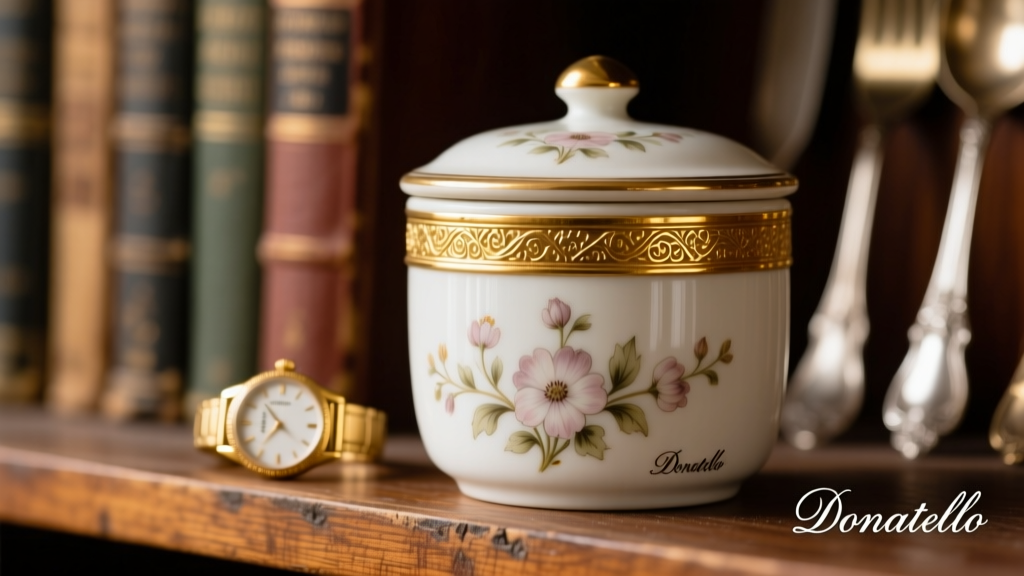
Rosenthal Biscuit Jar 'Gold Band Donatello': A Mid-Century German Ceramic Masterpiece
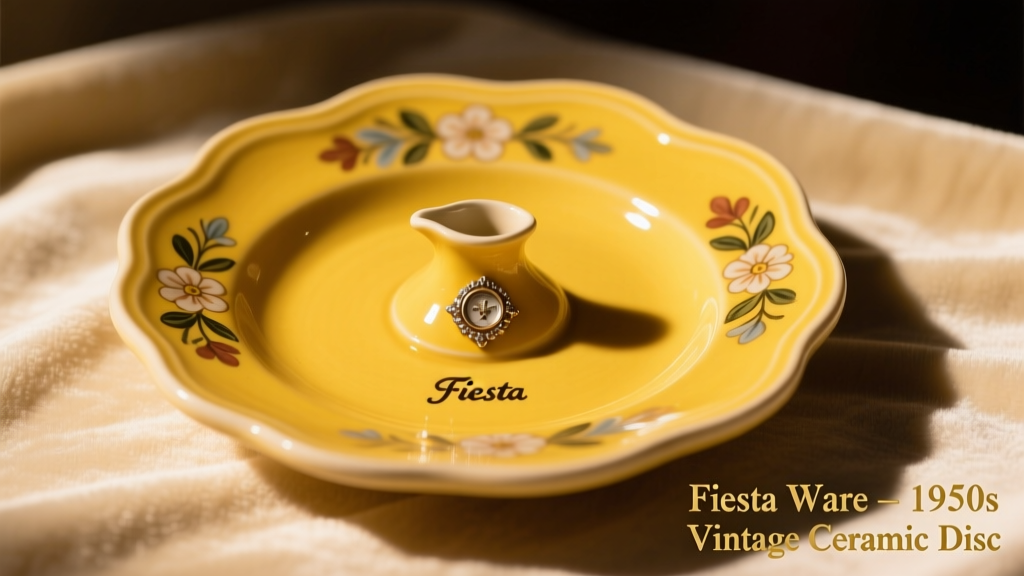
Fiesta Pitcher Disk Yellow: A Collector’s Deep Dive into the Iconic Vintage Ceramic Watch Dial
Flow Blue Sugar: The Scinde Alcock Pattern of 1840 — History, Identification, and Market Value

Stevengraph Bookmark 'A Blessing' — Floral Motif on Black Silk: Provenance, Craftsmanship, and Auction Significance
Gaudy Ironstone Plate: Morning Glory Blue-Green 8½-Inch Pair — A Collector’s Guide to Victorian-Era Ceramic Artistry
Minton Design: The Unseen Hand Behind Iconic Mid-Century Watch Dials and Jewelry Motifs
Flask Chestnut 15 Vertical Ribs Green Sheared Lip 4¾ Inch: A Collector’s Profile of a Rare American Art Deco Silver-Plated Pocket Flask
The $135 Million Gustav Klimt Masterpiece: Provenance, Restitution, and the Record-Breaking Sale of 'Portrait of Adele Bloch-Bauer I'
The Tools Trammel: A 25-Inch Wooden Drafting Instrument with Dark Patina — History, Craftsmanship, and Collectibility