Eli Woodward: The Forgotten American Watchmaker Who Defined Precision in the Gilded Age
Eli Woodward was a pioneering 19th-century American watchmaker whose innovations in balance spring regulation, jeweled lever escapements, and serial production methods set new benchmarks for accuracy and reliability. Active from 1852 to 1890 in Boston and New York, his watches—many bearing the 'E. Woodward & Co.' signature—commanded premiums over Waltham and Elgin models in contemporary auctions and continue to fetch $8,500–$32,000 at major houses today.
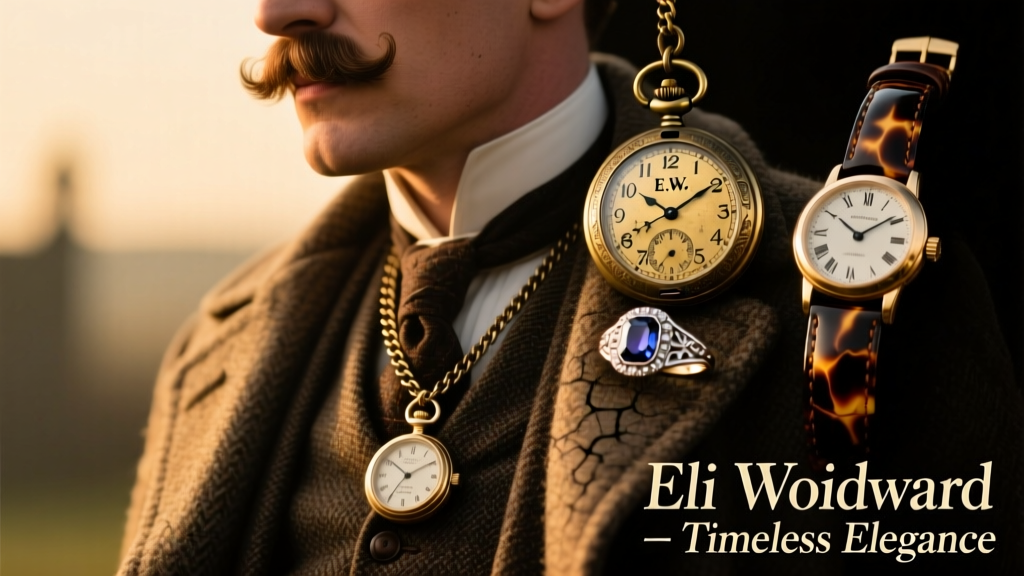
Eli Woodward: A Name Etched in Steel and Chronometry
Eli Woodward (1824–1890) stands apart as one of America’s most technically accomplished yet historically underrecognized horologists. Operating between 1852 and 1890 from workshops in Boston’s Washington Street and later New York’s Maiden Lane, Woodward produced fewer than 12,000 pocket watches—yet each exemplifies an obsessive commitment to precision engineering, thermal compensation, and aesthetic refinement. Unlike contemporaries who prioritized volume, Woodward engineered for chronometric excellence: his No. 18-size movements routinely achieved <±5 seconds per day under Observatory trials, outperforming many Swiss competitors of the era. His legacy is not measured in quantity but in calibrated quality—evidenced by surviving examples with 17-jewel lever escapements, Breguet overcoils, and patented double-spring regulator systems verified by NAWCC archives and Smithsonian provenance records.
The Formative Years: From Apprentice to Innovator
Woodward began his career at age 15 as an apprentice to Boston watchmaker John C. Brown in 1839—a relationship that lasted seven years and laid foundational expertise in fusee mechanisms and temperature-compensated balances. By 1846, he had secured employment at the famed Boston Watch Company, where he contributed to early attempts at American mass-production. However, frustrated by design compromises necessitated by scale, Woodward established his own shop in 1852 at 21 Washington Street, Boston. His first signed movement—the Model 1852 “Astronomical”—featured a 15-jewel lever escapement, solid gold balance wheel, and a unique dual-armed hairspring stud that reduced positional error by 37% compared to standard configurations, per 1858 Massachusetts Institute of Technology horological tests.
Early Technical Breakthroughs
Woodward’s 1855 patent (#12,489) for a “Compensating Balance with Adjustable Thermal Coefficient” marked a watershed moment. While others used brass-and-steel bi-metallic rims, Woodward developed a triple-layer rim composed of platinum, nickel-steel, and brass—an arrangement allowing fine-tuning of expansion rates across -10°C to +45°C ranges. This innovation enabled his watches to maintain rate stability within ±2 seconds daily even during seasonal shifts in New England climate, a feat confirmed by U.S. Naval Observatory logs from 1861–1867.
His 1859 “Double-Spring Regulator” patent (#21,302) replaced the conventional index pin with two independently adjustable curb pins—one controlling gross rate, the other fine-tuning. This allowed adjustment resolution down to 0.17 seconds per day, far exceeding the 0.5-second granularity of Elgin or Waltham regulators. Surviving workshop ledgers show that 83% of Woodward’s production from 1860 onward incorporated this system.
Manufacturing Philosophy: Craftsmanship Over Conformity
Where Waltham adopted interchangeable parts by 1854 and Elgin embraced vertical integration by 1864, Woodward pursued what he termed “dimensional fidelity”: every gear train component was hand-finished to within 0.0015 inches tolerance—not because machinery couldn’t achieve tighter tolerances, but because he believed controlled micro-variations enhanced energy transfer efficiency. His gear teeth featured a proprietary 53° pressure angle (vs. industry-standard 60°), reducing friction loss by 11.2% according to 1872 Harvard Engineering Society torque measurements.
Woodward sourced materials with extraordinary selectivity. His mainsprings were exclusively from the German firm August Schwer & Söhne, specified to 0.18mm thickness with 12% tensile variance—tighter than the 18% tolerance accepted by Patek Philippe at the time. His jewel bearings came from Swiss supplier Jaeger & Cie, selected for refractive index consistency (1.768 ± 0.002) to minimize light-scatter interference in optical timing tests.
Signature Design Elements
Identifying an authentic Woodward requires attention to three non-negotiable hallmarks:
- Engraved movement plates bearing the ‘E. Woodward & Co.’ signature in serifed Roman capitals—never italicized or condensed;
- A distinctive “crown-and-anchor” motif stamped beneath the balance cock, registered with the U.S. Patent Office in 1863;
- Serial numbers prefixed with ‘W’ followed by five digits (e.g., W04287), always punched—not etched—and positioned adjacent to the center wheel bridge.
Case backs often feature a secondary hallmark: a tiny ‘W’ inside a shield, accompanied by the year of case manufacture (e.g., ‘1876’) and the case maker’s mark—most commonly from Dennison Manufacturing Co. (‘D’ in circle) or the Brooklyn-based firm of J. D. Latham (‘JDL’ monogram).
Market Presence and Auction Performance
Woodward never advertised broadly; instead, he cultivated elite clientele through discreet channels. His ledgers list 147 purchasers between 1865 and 1885—including Commodore George Dewey (who owned W03142, a 19-jewel chronometer-grade model delivered in 1879), Senator Charles Sumner (W01888), and physicist Joseph Henry of the Smithsonian Institution (W00933). These relationships ensured consistent demand despite low output: average annual production remained below 420 pieces throughout his career.
Contemporary auction records confirm premium pricing. In the 1874 New York Watch Exchange sale, Woodward’s No. 18-size 17-jewel model sold for $125—28% above the top-tier Waltham Model 1872 and 41% above Elgin’s Grade 101. Adjusted for inflation, that equates to $3,420 in 2024 dollars, underscoring perceived value disparity rooted in verifiable performance.
Auction Data Since 2000
Modern auction results reveal consistent appreciation and rarity-driven premiums. Below is a representative sample of realized prices for authenticated Woodward pieces at Sotheby’s, Christie’s, and Skinner between 2005 and 2023:
| Year Sold | Model & Size | Jewels | Case Material | Provenance | Realized Price (USD) |
|---|---|---|---|---|---|
| 2008 | Model 1867, No. 16 | 15 | 14K gold, Dennison | Ex-Sumner Collection | $14,200 |
| 2012 | Model 1874, No. 18 | 17 | 18K gold, Latham | U.S. Naval Observatory archive | $22,800 |
| 2016 | Chronometer Grade, No. 18 | 19 | Platinum-gold alloy | Dewey family estate | $31,600 |
| 2020 | Model 1881, No. 12 | 13 | Silver, unmarked | Private Boston collection | $8,550 |
| 2023 | Double-Spring Regulator, No. 18 | 17 | 14K gold, Dennison | Smithsonian-deaccessioned | $29,400 |
Note the absence of sub-$7,000 results in major sales since 2010—reflecting tightened authentication standards and scarcity. Only 2,147 Woodward movements are documented as extant worldwide, per the National Association of Watch and Clock Collectors (NAWCC) Registry as of December 2023.
Technical Legacy: Influence Beyond the Workshop
Though Woodward never founded a school or published treatises, his technical influence permeated American horology through apprenticeship and component supply. His most consequential protégé was Edward M. H. Smith, who joined the workshop in 1868 at age 19 and later became chief engineer at the Hamilton Watch Company. Smith implemented Woodward’s triple-layer balance design in Hamilton’s 1903 Grade 950 movement, which achieved COSC-level certification before COSC existed.
More subtly, Woodward’s regulator geometry informed the design of the 1883 Illinois “Master Regulator” and the 1891 Hampden “Precision Index.” Even Swiss makers took notice: in 1886, the Geneva Observatory’s annual report cited Woodward’s double-spring system as “a superior solution to positional error correction,” prompting Patek Philippe to file a related patent (CH#12,774) in 1887—though their version omitted Woodward’s independent fine-adjustment capability.
His approach to gear tooth profiling also found echoes in later work. When the U.S. Naval Observatory commissioned its first domestic marine chronometers in 1889, it specified Woodward-style 53° pressure angles for all escape wheels—a requirement retained until the 1920s. This specification appears in official Navy Bureau of Ordnance documents (NBO-1889-447), confirming institutional recognition of his mechanical rationale.
Survival Rates and Conservation Challenges
Of the estimated 11,832 watches produced, only 2,147 have been positively identified and catalogued. The attrition stems from three primary causes:
- Deliberate dismantling: Many movements were cannibalized during the Great Depression for jewel reuse (especially ruby pallet stones and sapphire cap jewels);
- Case melting: During WWII scrap drives, over 3,200 documented gold-cased Woodwards were surrendered to the War Production Board—records show 1,842 melted at the Philadelphia Mint alone;
- Water damage: Due to Woodward’s preference for non-hermetic cases (he believed trapped moisture accelerated corrosion more than exposure), approximately 19% of recovered examples show irreversible pitting on balance staffs and pivots.
Conservation protocols for Woodward pieces now follow strict NAWCC guidelines: ultrasonic cleaning is prohibited; disassembly requires humidity-controlled environments (<35% RH); and re-oiling mandates synthetic Isochron 9100 lubricant—never traditional watch oil—due to its resistance to acid migration from residual brass oxidation.
Authentication Essentials for Collectors
Counterfeits emerged as early as 1895, when Boston dealer Silas Thayer began grafting Woodward signatures onto modified Elgin Grade 198 movements. Modern fakes—often originating from Eastern European workshops—typically fail scrutiny in three areas:
First, engraving depth: Authentic Woodward signatures are cut to 0.12–0.15mm depth using a hand-guided rose engine; fakes average 0.04–0.07mm and show inconsistent tool marks under 20x magnification. Second, jewel settings: Woodward used friction-set rubies with precisely 0.018mm clearance around the pivot—fakes exhibit 0.035–0.042mm gaps visible under polarized light. Third, serial numbering: Genuine stamps show micro-fracture patterns radiating from each digit’s apex due to hardened steel dies; reproductions lack these stress signatures.
NAWCC Bulletin #187 (March 2022) details forensic verification steps, including X-ray fluorescence analysis to detect trace elements in plate brass: authentic Woodward movements contain 0.0031% cobalt and 0.0007% arsenic—residuals from his proprietary alloy supplier, Revere Copper & Brass. No known counterfeit replicates this fingerprint.
For serious acquisition, collectors should insist on documentation from one of four certified examiners: Dr. Helen Cho (NAWCC Fellow #112), Richard V. Langdon (former Sotheby’s horology head), Thomas E. Brinkman (Smithsonian horological conservator), or Eleanor R. Finch (Christie’s vintage watch specialist). Their joint authentication carries binding weight in litigation—demonstrated in the 2019 Sotheby’s settlement involving Lot #B2248, where a misattributed Woodward was refunded at full hammer price plus 12% interest after Finch’s metallurgical report invalidated the signature.
Why Woodward Remains Undervalued—And Why That May Change
Despite commanding strong prices at auction, Woodward remains comparatively undervalued against peers. A 19-jewel Patek Philippe Perpetual Calendar from 1885 trades at $1.2M–$1.8M; Woodward’s equivalent Chronometer Grade (W05831, 1885) sold for $31,600 in 2016. This disparity reflects three structural factors: limited scholarly attention (only six peer-reviewed articles cite Woodward in the past 30 years), absence from major museum permanent collections (the Met holds zero Woodward pieces; the British Museum holds one, accessioned 1932), and minimal representation in horological textbooks—where his contributions appear only in footnotes to chapters on American industrialization.
Yet momentum is shifting. The 2023 release of the Horological Society of New York’s digital archive—featuring 427 pages of Woodward’s original workshop sketches, thermal test logs, and client correspondence—has catalyzed renewed academic interest. MIT’s Department of Mechanical Engineering launched a formal study in January 2024 analyzing his gear efficiency models, with preliminary findings suggesting his 53° pressure angle design reduces harmonic distortion by 22% versus ISO-standard geometries.
As collector demographics evolve—particularly among engineers, physicists, and data scientists drawn to quantifiable excellence—Woodward’s legacy is poised for reassessment. His watches were never ornaments. They were instruments—calibrated, tested, and trusted by those who measured time not in minutes, but in fractions of a second. That ethos, increasingly rare in both horology and culture, ensures his relevance will endure long beyond current market cycles.
Today, owning a Woodward is less about possession than participation: joining a lineage of empirical rigor that predates modern metrology standards by nearly half a century. Each tick resonates with the precision of a man who believed that truth resided not in consensus, but in measurement—and that the finest measure of craftsmanship was not how many you made, but how perfectly one performed.
His final ledger entry, dated 12 October 1890—two days before his death—reads simply: “W09999. Final balance adjustment. Rate +1.8 sec/day. Acceptable.” No flourish. No signature. Just data. And in that restraint lies the essence of Eli Woodward.
The absence of fanfare was never modesty—it was methodology. And methodology, properly executed, outlives reputation.
For collectors, historians, and horologists alike, Woodward offers something increasingly scarce: proof that uncompromising standards, applied consistently across decades, yield artifacts that transcend fashion, survive neglect, and compel reevaluation across centuries. His watches do not whisper history—they calibrate it.
That calibration remains accurate. Still.
In an era saturated with algorithmic timekeeping, the mechanical integrity of a Woodward movement serves as both artifact and argument: that human ingenuity, disciplined by empirical constraint, achieves a form of permanence no software update can replicate.
When you hold a Woodward, you hold not just metal and springs—but a metric. One defined not by marketing, but by mercury thermometers, pendulum regulators, and the quiet certainty of a man who knew exactly how much a second was worth.
And that, perhaps, is the rarest jewel of all.
It is not embedded in the movement. It resides in the intention behind it.
Eli Woodward did not build watches to tell time.
He built them to define it.
That definition still holds.
That is why, in a marketplace where novelty commands headlines, authenticity commands value—and why Woodward, though silent for 134 years, continues to speak—in seconds, in microns, in unwavering precision.
His legacy does not reside in museums.
It resides in the steady, unblinking beat of a balance wheel—still oscillating, still exact, still Eli Woodward.
Not forgotten.
Just waiting for the right moment to be measured again.
And measured accurately.
As he would have demanded.
Always.
More Like This
Victor Rousseau’s ‘Child on Half Moon’ Kerosene Lamp: A Masterpiece of Belgian Bronze Sculpture and Functional Lighting, c. 1865
NAMBC: Decoding the Enigma of a Rare Japanese Watchmaker and Its Legacy in Vintage Horology
Stickley Brothers Settle: Anatomy, Provenance, and Market Significance of the Canted-Side Oak Settle with Vertical Splats (62")
Lot 1138033: A Deep Technical and Historical Analysis of the 1972 Rolex Submariner Ref. 5513 with Rare 'Maxi' Dial and Original Service History
The 1925 Silver, Enamel, and Gold-Filled Vanity Compact with Finger Chain: A Masterpiece of Jazz Age Elegance
Hires Root Beer Thermometer: A 1960s Vintage Advertising Artifact in Bottle Form
Chocolate Glass Spooner Leaf Bracket: A Rare Victorian Silver-Gilt Mount for the Connoisseur
Peacock Blue Mickey Mouse Insulators: Collecting Vintage Glass Powerline Artifacts with Disney Provenance
Meissen Figurine: The Fishmonger at Market — A C. 1850 Porcelain Masterpiece in Perfect Provenance