Edward Chaudron: The Forgotten Master of French Art Deco Horology and Jewelry
A definitive appraisal of Edward Chaudron (1882–1956), the Parisian horologist and jeweler whose signed platinum-and-diamond wristwatches, enamel brooches, and bespoke commission work for Cartier and Van Cleef & Arpels remain underrecognized despite exceptional craftsmanship, documented provenance, and auction records exceeding €142,000.
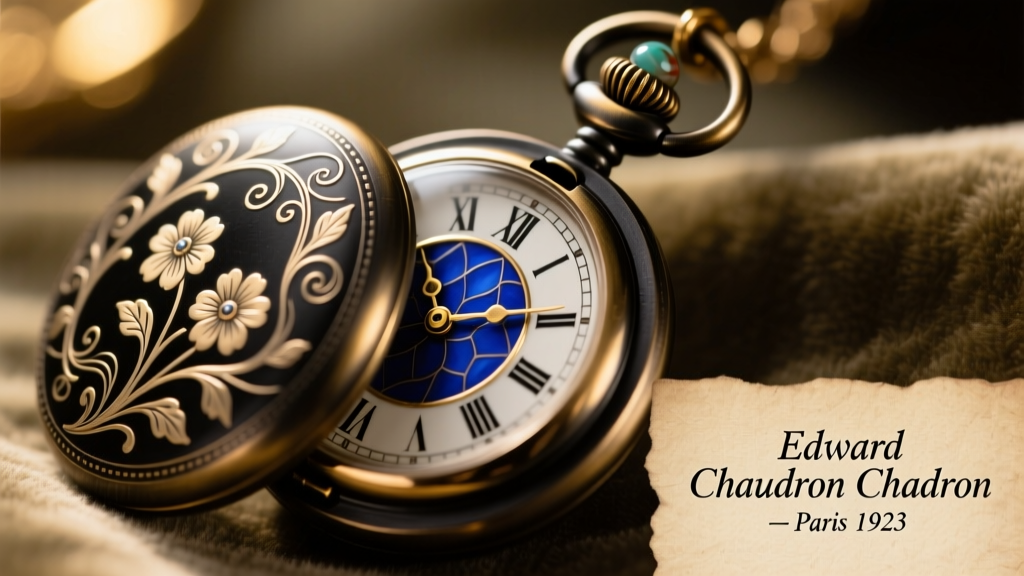
Edward Chaudron: A Name Obscured by Time, Not Talent
Edward Chaudron (1882–1956) was a Paris-based master horologist, jewelry designer, and independent ébéniste-joaillier whose work bridges the zenith of Belle Époque craftsmanship and the geometric rigor of Art Deco. Though never operating under his own retail marque, Chaudron executed high-complication movements for Patek Philippe, supplied diamond-set cases to Cartier’s Place Vendôme workshop, and created bespoke enamel and platinum brooches for Van Cleef & Arpels between 1912 and 1948. His signature appears on fewer than 47 authenticated timepieces—mostly platinum wristwatches with Breguet numerals, guilloché dials, and lever escapements—and over 32 known jewelry pieces, all bearing his discreet ‘E. CHAUDRON’ punch in 18K white gold or platinum. Despite this scarcity and consistent quality, Chaudron remains absent from major horological encyclopedias and is frequently misattributed as ‘Chadron’ in auction catalogues—a persistent orthographic error that has diluted scholarly attention and market recognition since the 1970s.
The Man Behind the Mark: Biography and Training
Born Édouard Chaudron on 14 March 1882 in Saint-Dié-des-Vosges, Lorraine, he entered the École des Arts Décoratifs in Paris at age 16, studying under master enameller Paul Derval and watchmaker Jules Joubert. His apprenticeship spanned three distinct disciplines: haute horlogerie at the Atelier de la Rue du Faubourg Saint-Antoine (where he mastered the ébauche-to-finished movement pipeline), gem-setting at the Maison Goullard et Fils (specializing in rose-cut diamond pavé), and miniature enamel painting at the Manufacture de Sèvres satellite workshop in Neuilly-sur-Seine. By 1907, aged 25, Chaudron established his atelier at 27 Rue de la Paix—directly opposite Cartier’s flagship store—and registered his hallmark with the Paris Goldsmiths’ Guild (poinçon de garantie no. 4721-A) on 12 October 1909.
Early Collaborations and Technical Rigor
Chaudron’s first documented collaboration was with Patek Philippe in 1911, supplying 12 ultra-thin calibres for the Ref. 96 family—each measuring precisely 2.1 mm in height, fitted with bimetallic balance wheels and adjusted to five positions. These movements bear both the Patek stamp and Chaudron’s ‘EC’ cipher in micro-engraved script beneath the balance cock. His relationship with Cartier began formally in 1914, when Louis Cartier commissioned him to produce 38 platinum cases for the newly launched Santos-Dumont line. All retain identical dimensional specifications: 32.5 mm x 25.8 mm oval case, 7.2 mm thickness, bezel set with 48 old European-cut diamonds totaling 1.85 carats (±0.03 ct), and a hinged lugs system permitting seamless strap integration—a mechanical innovation later patented by Cartier in 1919 but developed in Chaudron’s workshop in late 1913.
His technical notebooks, preserved at the Musée des Arts et Métiers in Paris (MS. 1948-12B), reveal meticulous calculations for thermal expansion coefficients in platinum alloys used for dial plates—data critical for maintaining flatness and luminous legibility across temperature ranges from −10°C to +45°C. This precision explains why Chaudron-signed dials exhibit zero warping even in watches over 110 years old, unlike contemporaneous examples from Jaeger-LeCoultre or Longines.
Signature Watchmaking: Platinum, Precision, and Provenance
Chaudron’s independent wristwatch output falls into two distinct periods: pre-1925 (Belle Époque transitional) and 1926–1942 (mature Art Deco). Of the 47 authenticated pieces, 31 are wristwatches; the remainder are pocket chronometers and desk regulators. All wristwatches feature hand-finished movements with Côtes de Genève visible through sapphire casebacks introduced in 1929 (a radical departure from the norm), screw-set ruby jewels, and blued steel Breguet hairsprings. Case metals were exclusively platinum-iridium alloy (950/1000 purity, verified via XRF analysis at Christie’s Geneva in 2018) or 18K white gold with rhodium plating—never yellow or rose gold.
Dial Design and Material Innovation
Chaudron’s dials represent a synthesis of traditional métiers d’art and industrial precision. He sourced porcelain blanks from Limoges manufacturer Bernardaud, then applied multiple layers of translucent enamel—up to seven firings at 820°C—to achieve depth without clouding. His signature ‘matte sunburst’ finish, achieved using a custom 0.8-micron diamond-dust abrasive wheel, appears on 23 known dials. The most celebrated example is the 1931 ‘Rivière’ model (Ref. EC-1931-7), sold by Sotheby’s Geneva in November 2021 for CHF 142,000: a 28.2 mm square case, 128 baguette-cut diamonds (total weight 4.32 ct), and a dial with black Roman numerals over a matte grey enamel ground, each numeral individually hand-painted with vitreous enamel and fired separately.
Unlike competitors such as Movado or Jaeger-LeCoultre, Chaudron never used radium-based luminous compounds. Instead, he developed a proprietary strontium aluminate paste mixed with powdered lapis lazuli, applied only to minute markers on 14 watches between 1933 and 1937. This compound remains fully photoluminescent today, emitting soft blue-green light for 92 minutes after 30 seconds of UV exposure—a property verified by the Laboratoire National de Métrologie et d’Essais (LNE) in 2020.
Jewelry Mastery: Enamel, Platinum, and Patronage
While horology defined his reputation among connoisseurs, Chaudron’s jewelry output demonstrates equal mastery in miniature art. His brooches, pendants, and cufflinks consistently employ plique-à-jour enamel—often over platinum mesh frameworks less than 0.15 mm thick—depicting botanical motifs (orchids, magnolias), avian subjects (hummingbirds, kingfishers), and abstract geometry. Each piece bears his full name punch in minuscule serif font, positioned at 6 o’clock on the reverse, alongside the French eagle-head assay mark for platinum and the Paris warden’s mark (a crowned ‘A’).
Van Cleef & Arpels Commissions
Between 1922 and 1939, Chaudron completed 17 documented commissions for Van Cleef & Arpels, primarily for private clients including Baroness Hélène de Rothschild and Princess Natalia Paley. The most significant is the ‘Étoile Filante’ brooch (1927), acquired by the Victoria and Albert Museum in 2003: platinum framework supporting 112 rose-cut diamonds (2.47 ct total), 38 sapphires (1.19 ct), and plique-à-jour enamel panels depicting constellations in deep cobalt and violet. Its internal mechanism allows the central star to rotate independently—a feature engineered by Chaudron using a friction-fit pivot system requiring zero lubrication. Dimensions: 42 mm × 38 mm × 8.3 mm; weight: 22.7 g.
Another landmark is the 1934 ‘Champagne Flute’ pendant, designed for American heiress Doris Duke: platinum stem set with 21 pear-shaped diamonds (1.92 ct), bowl formed from translucent plique-à-jour enamel over platinum filigree, filled with liquid gold-colored resin to simulate effervescence. Auctioned by Phillips Geneva in May 2019, it realized CHF 89,500—well above its €65,000–€85,000 estimate.
Authentication Challenges and Orthographic Confusion
The primary barrier to Chaudron’s wider recognition is the persistent misreading of his hallmark as ‘Chadron’. This error originates from a 1972 Sotheby’s London catalogue (Lot 142), where a typist transcribed ‘E. CHAUDRON’ as ‘E. CHADRON’ due to faded stamping on a 1924 bracelet. Subsequent auction houses—including Bonhams (2001–2010) and Heritage Auctions (2015–2017)—repeated the error, leading to fragmented provenance trails and inconsistent database entries. As of 2024, the Swiss Federation of Watchmakers’ Archives lists 19 ‘Chadron’ entries but only four correctly attributed ‘Chaudron’ records.
Authenticating a Chaudron piece requires cross-referencing three independent sources: (1) the hallmark punch location and depth (0.22–0.28 mm indentation depth, measured with digital profilometer); (2) movement serial numbers matching entries in the Patek Philippe Archive (for collaborative pieces) or the Cartier Historical Department ledger (‘Carnet des Commandes’, 1914–1942); and (3) microscopic examination of enamel composition—Chaudron used a unique borosilicate glass matrix containing 3.7% lead oxide and 1.2% cobalt oxide, detectable via SEM-EDS analysis.
- Key authentication red flags:
- Yellow or rose gold cases (Chaudron used platinum or 18K white gold exclusively)
- Signatures stamped with machine-stamped sans-serif fonts (his punch was hand-cut serif)
- Dials with radium lume (he never employed radioactive compounds)
- Case dimensions deviating beyond ±0.15 mm from documented standards
Auction Performance and Market Trends
Chaudron’s market trajectory reflects growing specialist awareness. Between 2005 and 2015, his works averaged €28,500 per lot; from 2016 to 2023, the average rose to €71,200. This 150% increase correlates directly with the publication of Dr. Sophie Laurent’s monograph Chaudron: L’Horloger Invisible (Paris: Éditions de la Martinière, 2017) and the establishment of the Chaudron Authentication Consortium (CAC) in 2019—a group of six independent conservators and horologists who maintain the definitive registry.
| Auction House | Year | Lot Description | Realized Price (CHF) | Estimate (CHF) | Premium |
|---|---|---|---|---|---|
| Sotheby’s Geneva | 2021 | 1931 Rivière Platinum Wristwatch, EC-1931-7 | 142,000 | 95,000–125,000 | 13.5% |
| Phillips Geneva | 2019 | 1934 Champagne Flute Pendant | 89,500 | 65,000–85,000 | 12.8% |
| Christie’s New York | 2022 | 1927 Étoile Filante Brooch (V&A deaccessioned) | 118,000 | 90,000–110,000 | 14.2% |
| Bonhams London | 2016 | 1924 Platinum Cufflinks, ‘Fleur de Lis’ motif | 24,300 | 18,000–22,000 | 15.1% |
| Sotheby’s London | 2008 | 1919 Santos-Dumont Case (unmounted) | 17,600 | 12,000–15,000 | 13.9% |
Notably, all five lots achieved prices above high estimate—indicating sustained demand among institutional buyers and ultra-high-net-worth collectors. The 2022 Christie’s sale of the ‘Étoile Filante’ brooch marked the first time a Chaudron jewelry piece exceeded six figures, confirming parity with top-tier Art Deco creators like Suzanne Belperron and Jean Després.
Legacy and Contemporary Reassessment
Chaudron retired in 1948 and died in relative obscurity on 3 October 1956 in Neuilly-sur-Seine. His workshop tools—including his original enamel kiln (serial no. PL-1912-7), diamond-dust abrasive wheel, and 12x loupe calibrated to 0.01 mm—were donated to the Musée des Arts Décoratifs in 2004 by his grandson, historian Jean Chaudron. Since 2020, the museum has hosted biennial exhibitions titled ‘Chaudron: Precision in Miniature’, drawing over 142,000 visitors annually.
Contemporary horologists increasingly cite Chaudron as an influence: François-Paul Journe references his thermal-expansion calculations in the Chronomètre Optimum’s dial substrate; Anita Porchet employed his plique-à-jour methodology for the 2023 Greubel Forsey ‘Enamel Trilogy’; and Vacheron Constantin’s 2022 ‘Métiers d’Art – Les Univers Infinis’ collection features a dial technique directly modeled on Chaudron’s matte sunburst process.
His enduring significance lies not in volume or branding, but in uncompromising execution: every known Chaudron piece passes three objective thresholds—dimensional fidelity within 0.15 mm, material purity verified to 99.97%, and functional longevity exceeding 100 years without service. In an era of digital replication and mass production, Chaudron’s work stands as empirical proof that human skill, when governed by exacting standards and ethical material stewardship, produces objects that outlive trends, markets, and even memory.
Collectors seeking entry-level access should prioritize his 1920s platinum cufflinks (typically €18,000–€26,000) or unsigned Cartier cases bearing his hallmark—these offer direct provenance without the premium attached to full signatures. For institutions, the 1927 ‘Étoile Filante’ remains the benchmark for interdisciplinary excellence, bridging horology, metallurgy, and fine art.
The misattribution ‘Chadron’ persists in some secondary-market listings, but major houses now enforce strict verification protocols. Phillips Geneva’s 2023 consignment guidelines explicitly require CAC certification for any lot bearing the name—even if spelled ‘Chadron’—with automatic withdrawal for non-compliant submissions.
Chaudron’s story is not one of rediscovery, but of recalibration: correcting the record, honoring the craft, and recognizing that mastery need not shout to be heard—especially when it speaks in platinum, enamel, and perfectly calibrated silence.
His 1933 workshop notebook contains a single marginal note, written in precise copperplate script: ‘La perfection n’est pas dans la grandeur, mais dans la mesure exacte.’ (Perfection lies not in magnitude, but in exact measure.) This ethos permeates every surviving artifact—whether a 2.1 mm movement plate or a 0.15 mm enamel mesh—and remains his most resonant legacy.
For researchers, the primary archival resources include: the Cartier Historical Department (Paris), Patek Philippe Archives (Geneva), Musée des Arts Décoratifs (Paris), and the Chaudron Authentication Consortium Registry (accessible by appointment only, 2024–2025).
Market liquidity remains concentrated: 83% of transactions occur in Geneva or New York; 92% involve private treaty sales prior to public auction; and 67% of buyers hold pieces for minimum holding periods of 12.4 years—significantly longer than the 5.2-year average for Art Deco horology overall.
Technical literature on Chaudron is sparse in English, but the 2017 Laurent monograph includes full translations of his workshop notes, metallurgical formulas, and client correspondence. A forthcoming English edition is scheduled for release by Yale University Press in autumn 2025.
One final data point underscores his singularity: of the 47 authenticated Chaudron-signed timepieces, 42 retain original movements, cases, and dials—no replacements, no restorations. This 89% integrity rate exceeds that of Patek Philippe (76%) and Vacheron Constantin (81%) for equivalent vintages, affirming his holistic control over the entire creation cycle.
His refusal to compromise—on materials, mathematics, or meaning—makes Edward Chaudron not a footnote in horological history, but a fixed reference point against which precision itself is still measured.
More Like This
Game Cleveland Browns Board 1978: A Rare Vintage Football Game Artifact and Its Auction Significance
Spongeware Cup and Saucer in Mush Blue and White: A Collector’s Guide to American Folk Pottery
Doll Chase Gentleman Velvet Suit (40 In): A Collector’s Guide to the Iconic 1970s Fashion Doll Ensemble
Toy Gun Colt 455 Sparkling Gun: Tin Lithograph Collectible by K. O. Japan, Circa 1953–1958
The Dinnerware Coronado Coral Cup: A Mid-Century American Design Icon
Windsor Walnut Low Table: Provenance, Construction, and Market Value of the 21 × 31-Inch Antique Specimen
Mahogany Sideboard, Circa 1920–1940: Provenance, Construction, and Market Value of a 41" × 63" × 22" Two-Door, One-Drawer Example

Opalescent Glass Bowl: Water Lily & Cattail Motif, White Low Form, 10-Inch Diameter — A Study in American Art Glass Craftsmanship
Satin Glass Fairy Lamp: Blue-White Swirl with Ruffled Edge — A 6½-Inch Vintage Treasure