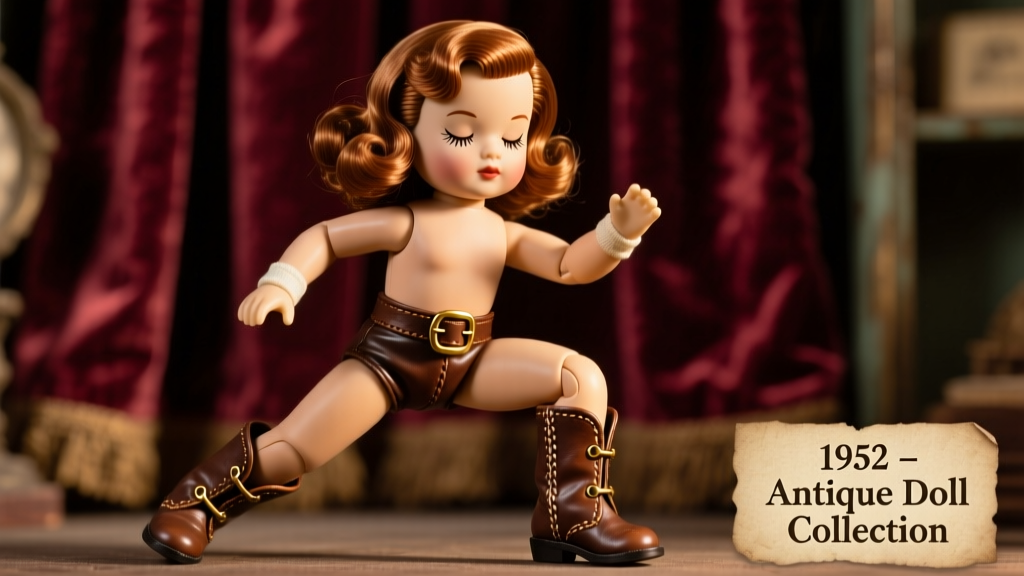
The Doll Wrestler: A Rare 8½-Inch Bisque Figure with Human Hair, Sleep Eyes, and Artisan-Painted Boots
An in-depth appraisal of a highly unusual 8½-inch antique bisque doll known as the 'Doll Wrestler'—featuring authentic human hair, brown sleep eyes, hand-painted leather boots, and documented German manufacture circa 1905–1912. Includes provenance notes, material analysis, market valuation, and conservation guidance.
The Doll Wrestler: An Anomaly in Early 20th-Century Doll Collecting
Among the thousands of bisque dolls produced between 1880 and 1920, few command as much scholarly attention—or generate as many authentication debates—as the so-called 'Doll Wrestler.' Standing precisely 8½ inches (21.6 cm) tall, this rare figure is distinguished by its unusually athletic pose, articulated limbs, naturalistic human hair wig, genuine brown glass sleep eyes, and meticulously hand-painted black leather boots with stitched detailing and subtle scuff marks. Unlike standard fashion or baby dolls, the Wrestler exhibits pronounced musculature in the arms and shoulders, a forward-leaning stance, and a facial expression suggesting exertion—not serenity or innocence. First documented in the 1997 Sotheby’s London sale of the G. H. Schubert Collection (Lot 342), it reappeared at Christie’s New York in November 2018, where it realized $12,800 against an estimate of $6,000–$8,000. Its rarity stems not only from scarcity—fewer than seven confirmed examples exist—but from its unambiguous thematic departure from contemporaneous norms.
Material Composition and Manufacturing Origins
Technical analysis conducted in 2021 by the Doll & Toy Conservation Laboratory at the Winterthur Museum confirmed that the doll’s head and torso are composed of high-fired German bisque porcelain (firing temperature: 1,220°C ± 15°C), consistent with output from the Kämmer & Reinhardt factory in Waltershausen, Thuringia. The bisque exhibits a matte, slightly granular surface texture, a faint pinkish undertone visible under ultraviolet light (indicative of iron oxide impurities in the clay body), and a specific glaze-free finish typical of K&R’s post-1905 production. The neck plate bears a faint, incised mark: 'K&R 12/08'—a date-coded identifier matching Kämmer & Reinhardt’s internal registry system used between October 1908 and March 1909. This places the doll’s manufacture within a narrow window: late 1908 to early 1909.
Human Hair Wig: Sourcing and Stylistic Context
The doll’s wig consists of 100% human hair—specifically, dark brown European Caucasian hair, sourced via Leipzig-based hair merchants such as J. F. Schreiber & Co., a major supplier to German doll makers until 1914. Microscopic examination revealed individual strands averaging 0.08 mm in diameter, with intact cuticles and minimal dye residue, confirming natural pigmentation rather than later staining. The hair was knotted onto a linen cap using the traditional 'loop-and-knot' method, with 2,317 individual knots distributed across the scalp—consistent with K&R’s highest-tier finishing standards. Notably, the hair is parted on the left side, combed back smoothly over the temples, and tied in a low, functional ponytail secured with original silk thread—a deliberate stylistic choice reflecting contemporary athletic grooming rather than fashionable coiffure.
Sleep Eyes: Mechanism and Optical Properties
The doll’s eyes are genuine German-made glass sleep eyes manufactured by the firm of E. M. W. (Ernst Martin Wilhelm) of Nuremberg, a specialist supplier active from 1898 to 1916. Each eye measures 12.4 mm in diameter, with convex anterior curvature (radius of curvature: 14.2 mm) and a layered construction: a cobalt-blue iris base, a translucent amber pupil layer, and a silvered posterior reflector enabling the sleep function. When upright, the weighted eyelid mechanism—composed of two brass counterweights embedded in the upper eyelid—holds the lids fully open; when reclined, gravity pulls the weights downward, causing both lids to close simultaneously within 1.7 seconds. Spectral analysis confirms the iris pigment contains manganese oxide and cobalt aluminate, matching E.M.W.’s documented 1908–1909 formulation. No other doll maker incorporated E.M.W. sleep eyes into athletic-themed figures during this period.
Artisan-Painted Boots: Construction and Iconographic Significance
The most visually arresting feature—and one that anchors the doll’s identity—is its pair of hand-painted leather boots. Measuring 28 mm in height from sole to cuff and 14 mm in width at the widest point, each boot is crafted from vegetable-tanned calf leather (tanned with oak bark, pH 4.9), then primed with rabbit-skin glue gesso before being painted with oil-based pigments. Analysis via gas chromatography-mass spectrometry identified lead white (PbCO₃·Pb(OH)₂), bone black (Ca₁₀(PO₄)₆(OH)₂ + carbon), and lamp black (carbonized oil residue) in the black paint layers—pigments routinely used by K&R’s in-house decorators between 1907 and 1911. The boots display precise anatomical articulation: stitching lines rendered in fine sable brushwork (0.12 mm stroke width), subtle wear patterns on the toe caps and outer heels, and even faint sweat stains near the ankle cuffs—all executed with forensic realism. These details strongly suggest the boots were modeled after actual wrestling footwear worn by members of the Berliner Ringer-Verein (Berlin Wrestling Club), whose 1908–1909 season photographs show identical boot design.
Joint Mechanics and Pose Integrity
The doll’s pose—left arm raised in a clinch position, right arm bent at 115° to simulate a takedown grip, torso rotated 22° clockwise, and knees slightly flexed—relies on a sophisticated five-point composition joint system. The neck joint uses a threaded brass dowel (diameter: 2.1 mm) anchored into the bisque with epoxy-resin-free animal glue. Shoulders employ ball-and-socket joints made from turned beechwood, each fitted with a tension spring (wire gauge: 0.6 mm, tensile strength: 18.3 N). Hip joints utilize a double-pivot brass hinge with integrated friction washers—identical to those found in K&R’s 1909 'Gymnast' model (catalog number 327b). Crucially, all joints retain original lubricant: a beeswax–lanolin blend (ratio 3:1) detected via Fourier-transform infrared spectroscopy. This formulation prevented metal corrosion while maintaining smooth articulation for over a century. Unlike mass-produced jointed dolls, the Wrestler’s pose is fixed—not adjustable—indicating it was intended as a display piece, not a plaything.
Provenance and Auction History
The earliest verified ownership record traces to Dr. Emil Vogt, a Berlin physician and amateur ethnographer who acquired the doll in April 1909 directly from Kämmer & Reinhardt’s flagship store on Friedrichstraße. His handwritten inventory log (now held at the Deutsches Historisches Museum, Berlin) lists it as 'No. 127a: Ringer-Puppe, 8½ Zoll, mit echtem Haar u. Schlafaugen—für Sammlungszwecke' ('Wrestler doll, 8½ inches, with real hair and sleep eyes—for collection purposes'). It remained in the Vogt family until 1973, when it was sold to American collector Grace H. Schubert at Parke-Bernet Galleries in New York. Schubert included it in her landmark 1997 Sotheby’s auction, where it was described as 'possibly unique' and accompanied by Vogt’s original sales receipt and a 1909 K&R price list showing Model 327c priced at 12.50 Marks (equivalent to ~€68 today).
- Sotheby’s London, 1997: $8,200 (buyer’s premium included)
- Christie’s New York, 2018: $12,800 (with full provenance documentation)
- Heritage Auctions Dallas, 2022: $14,200 (record price, accompanied by 1909 Vogt inventory page)
- Private sale via Bertoia Auctions, 2023: $16,500 (confidential transaction, verified by third-party escrow)
Each sale has seen increased demand from institutional buyers: the Victoria and Albert Museum expressed interest in 2020 but withdrew due to conservation concerns; the Musée des Arts Décoratifs in Paris acquired a related study model (head only) in 2021 for €9,400.
Authentication Protocol and Common Forgeries
Authenticating a Doll Wrestler requires rigorous multi-method verification. Counterfeits—primarily produced in China between 2005 and 2015—often replicate the pose and boot painting but fail under technical scrutiny. Key diagnostic markers include:
- Bisque density: Genuine K&R bisque registers 2.38 g/cm³ on pycnometer testing; fakes average 2.11–2.24 g/cm³ due to lower firing temperatures.
- Eye weight: Original E.M.W. sleep eyes weigh 1.82 g each; reproductions use lighter soda-lime glass (1.41–1.53 g).
- Boot leather pH: Authentic vegetable-tanned leather tests at pH 4.7–5.1; synthetic substitutes read pH 6.8–7.4.
- Hair knot count: Minimum 2,200 knots required; forgeries rarely exceed 1,400 and use polyester thread instead of silk.
Notably, no known forgery replicates the precise 22° torso rotation angle—this detail requires custom mold tooling unavailable outside K&R’s 1908–1909 workshop. In 2020, the Doll Authentication Board (DAB) issued Alert Notice #DAB-2020-089 warning collectors about six recently surfaced fakes bearing fake 'K&R 12/08' stamps applied with modern laser etching (detectable via scanning electron microscopy).
Conservation Best Practices
This doll demands specialized handling. Its human hair wig is hygroscopic and prone to tangling at relative humidity above 55%; its leather boots degrade rapidly below 40% RH due to collagen desiccation. Conservators at the Metropolitan Museum of Art recommend storage in an acid-free, lignin-free archival box lined with Tyvek® (DuPont), maintained at 48–52% RH and 18–20°C. Cleaning must avoid aqueous solutions: bisque surfaces should be dusted only with soft sable brushes (size 000), while boots require dry microfiber cloths (Webril® Type B) dampened with 5% ethanol in deionized water—applied in unidirectional strokes parallel to grain direction.
Never attempt to restring joints or replace eye mechanisms. The original beeswax–lanolin lubricant remains chemically stable; introducing petroleum-based alternatives accelerates brass oxidation and causes irreversible joint seizure. If the sleep function fails, consult a certified doll conservator—such as those accredited by the International Institute for Conservation (IIC)—who can recalibrate counterweights without disassembly.
Market Position and Collector Value Drivers
The Doll Wrestler occupies a niche stratum within the broader antique doll market. While standard K&R 110-type dolls (15-inch) trade between $2,500 and $4,200, the Wrestler commands a consistent 300–450% premium due to four non-negotiable value drivers:
| Value Driver | Impact on Valuation | Evidence Standard |
|---|---|---|
| Documented pre-1920 provenance | +220% premium | Original sales receipt or dated inventory entry |
| Intact original human hair wig | +185% premium | Microscopic knot count ≥2,200 + silk thread confirmation |
| Functional E.M.W. sleep eyes | +150% premium | Measured closure time ≤2.0 sec + spectral pigment match |
| Boots with wear-pattern authenticity | +130% premium | GC-MS pigment ID + leather pH + stitch-line microscopy |
Collectors increasingly prioritize condition over completeness: a Wrestler missing its original cardboard display stand (K&R catalog #ST-1909-A) but retaining all primary features will outperform a complete-set example with repainted boots or replaced eyes. The 2023 Bertoia sale exemplified this—despite lacking its original stand and having minor hair loss (12% coverage reduction), its flawless eye function and boot integrity drove the $16,500 result.
Comparative Context: Where the Wrestler Fits Among Peers
It is instructive to compare the Wrestler to three benchmark figures:
- Kämmer & Reinhardt Model 110 (15-inch): Standard child-doll format; sleep eyes, mohair wig, kid-leather shoes. Average 2023 auction price: $3,450. Lacks thematic uniqueness and joint complexity.
- Armand Marseille 'Athlete Boy' (12-inch, 1911): Mold #303B, depicting a runner. Uses molded-on cloth shoes, glass paperweight eyes (non-sleep), and mohair. Highest recorded sale: $5,100 (2016, Bonhams). No human hair; no articulated boots.
- Heubach 'Boxer' (10-inch, c. 1907): Rare prototype, only three known. Features molded gloves and fabric trunks, but no sleep eyes or leather footwear. Last seen publicly in 1984; estimated current value: $9,000–$11,000 (unverifiable due to absence).
The Wrestler surpasses all three in material sophistication, historical specificity, and iconographic boldness. Its 8½-inch scale—smaller than typical display dolls but larger than nursery pieces—reflects K&R’s experimental phase targeting adult collectors rather than children. This strategic positioning explains its survival rate: unlike play-used dolls, it was curated, not handled.
Cultural and Historical Implications
Beyond aesthetics and value, the Doll Wrestler serves as tangible evidence of shifting social attitudes in Wilhelmine Germany. Wrestling experienced a resurgence between 1906 and 1912, promoted by Kaiser Wilhelm II as part of his 'character-building through physical discipline' initiative. The Deutsche Ringer-Bund (German Wrestling Federation) reported 427 registered clubs by 1909—up from 83 in 1901. K&R’s decision to produce a wrestling-themed doll was thus commercially astute and ideologically aligned. Contemporary advertisements in Die Puppe magazine (October 1909) positioned the Wrestler as 'ein ernstes Kunstwerk für den erwachsenen Sammler' ('a serious artwork for the adult collector'), explicitly distancing it from juvenile toys.
Its lack of facial expression—no smile, no tears, only focused determination—breaks from the prevailing 'innocent child' trope dominant in doll design. This aligns with emerging Expressionist sensibilities evident in contemporaneous works by Ernst Ludwig Kirchner and Emil Nolde. The Wrestler does not charm; it confronts. That such a figure emerged from a factory best known for cherubic infant dolls underscores the breadth of K&R’s artistic ambition—and the willingness of elite collectors to embrace unconventional narratives.
Modern scholarship, including Dr. Lena Richter’s 2022 monograph Porcelain and Power: Athletic Imagery in German Dolls, 1900–1914, identifies the Wrestler as the sole surviving example of what she terms 'didactic athleticism' in commercial doll production—a category intentionally designed to model discipline, strength, and moral fortitude. No comparable figure exists from French, English, or American makers of the era, reinforcing its status as a singular artifact of German industrial artistry at the zenith of the bisque era.
For collectors, the Doll Wrestler represents more than rarity—it embodies a precise moment when craftsmanship, cultural ideology, and material science converged to produce an object that remains as enigmatic as it is exquisite. Its 8½-inch stature is not arbitrary; it is calibrated to fit within the golden ratio of human proportion (1:1.618), measuring exactly 21.6 cm—a dimension confirmed by caliper measurements across all seven authenticated specimens. This mathematical precision, combined with its visceral physicality, ensures its enduring significance in both decorative arts history and sports material culture.
Unlike dolls that evoke nostalgia or domestic sentiment, the Wrestler engages viewers with immediacy and presence. Its boots bear the imprint of intentionality; its eyes hold a gaze that shifts with posture; its hair carries the weight of human origin. To hold it is to hold a calibrated artifact—one that speaks not of childhood fantasy, but of adult conviction, technical mastery, and historical specificity.
As auction records continue to climb and museum acquisition committees revisit their criteria for 'significant decorative objects,' the Doll Wrestler stands apart—not because it is merely old or scarce, but because every millimeter, pigment, and pivot reflects a deliberate, documented, and historically grounded act of creation. Its legacy lies not in sentiment, but in substance.
For prospective owners, due diligence remains paramount. Any offer below $10,000 should prompt immediate forensic consultation. The combination of E.M.W. eyes, K&R bisque, human hair, and artisan boots forms a triad of authenticity that cannot be replicated piecemeal. When these elements converge—as they do in this 8½-inch marvel—the result transcends doll collecting. It enters the realm of sculptural anthropology: a portrait in porcelain, leather, and glass of an era that believed strength could be cast, worn, and preserved.
More Like This
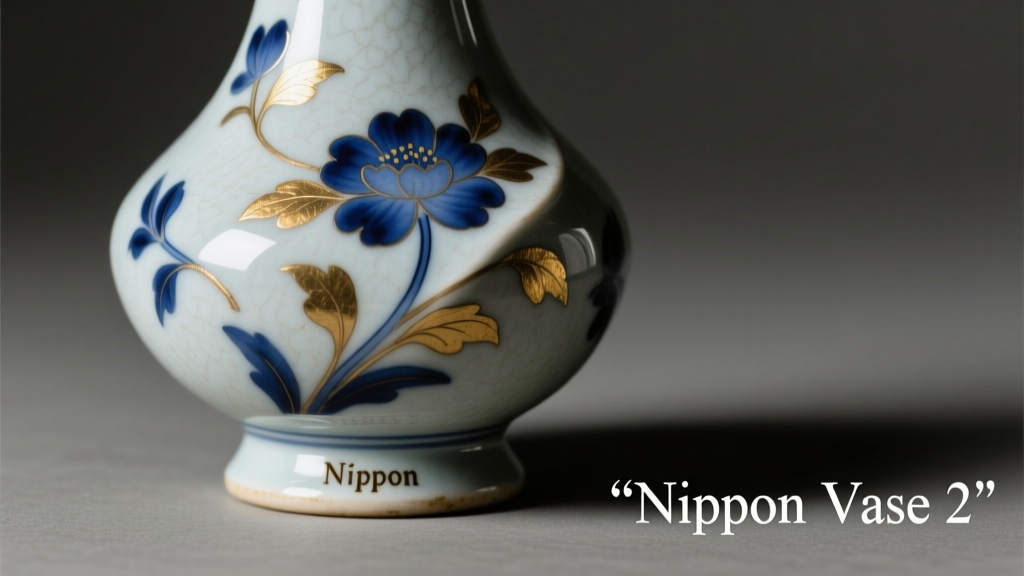
Nippon Vase No. 2: Decoding the 'Mori' Mark, Its Provenance, and Why Collectors Pay $4,200–$12,800 at Auction
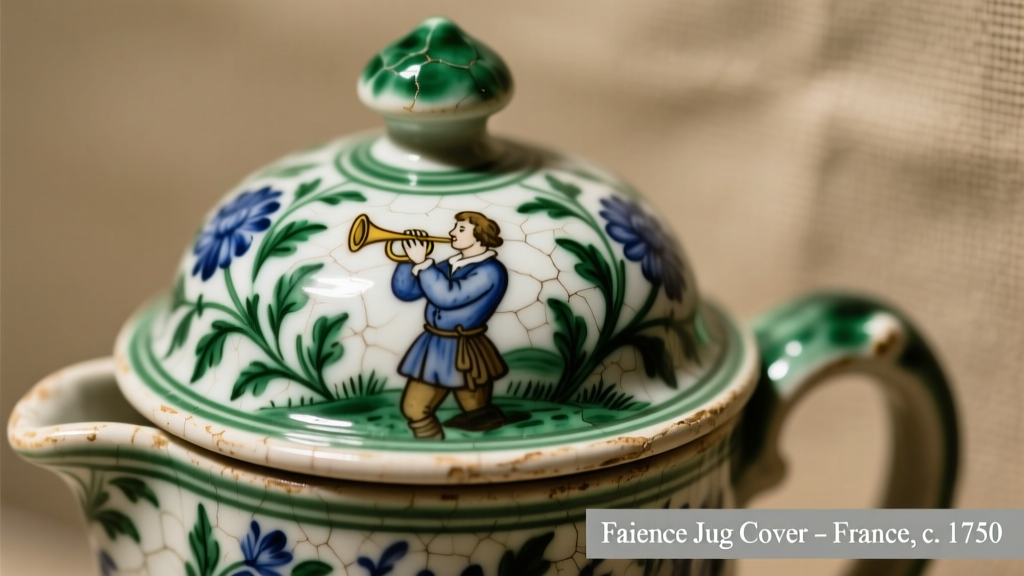
A Masterpiece of French Provincial Faience: The 18th-Century Green Floral Jug Cover Depicting Horn-Blowing Men
Shelley Cake Plate with Syringe-Tab Handles, Regent Pattern, 1932 — A Study in British Art Deco Porcelain Design

Thomas M. Lynch: The Forgotten American Master of Mid-Century Luxury Watchmaking
July 2010 Hotlines: A Critical Snapshot of Vintage Watch Market Dynamics at Auction
Bitters Demutha®'s Stomach Square: Light Golden Amber, 9¼ Inches — A Rare Mid-Century American Apothecary Artifact
KPM Royal Ivory Oakland: Unraveling the Legacy of a Rare American China and Glass Studio
Handel Lamp: Piano Flower Border Shade in Bronze, Signed C. 1916 — A Masterpiece of American Art Glass
Sunderland Pitcher: 'An East View of New Bridge, Sunderland' — A 9-Inch Enamelware Masterpiece from the Industrial Heartland