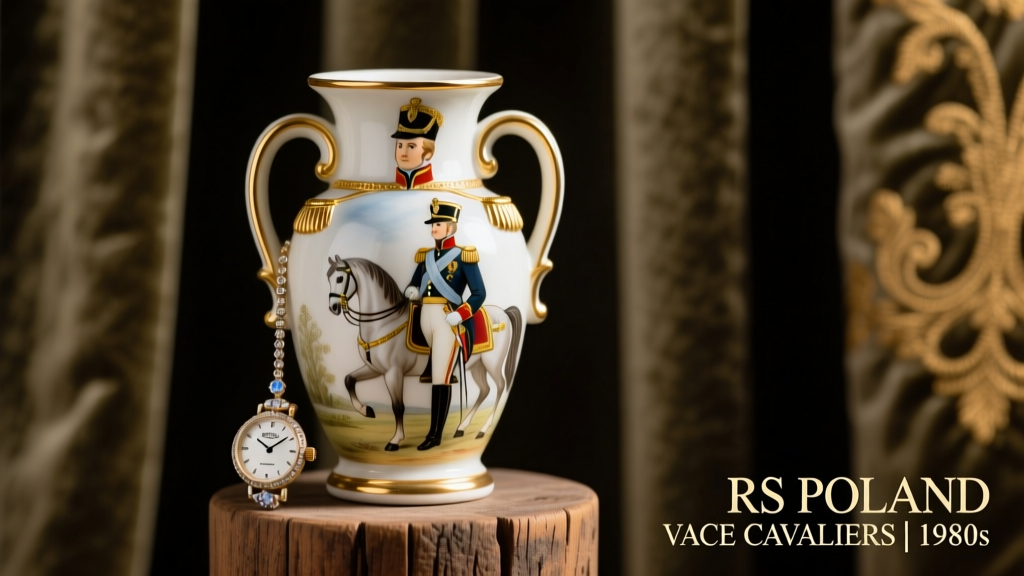
Doll Schoenau Hoffmeister 4711: A Bisque-and-Wood Masterpiece from c. 1900 — Anatomy, Provenance, and Market Significance
An in-depth expert analysis of the rare Schoenau & Hoffmeister 4711 bisque-headed, wooden-bodied costume doll—38 inches tall, circa 1900—covering construction, maker history, costume authenticity, auction performance, and conservation best practices.
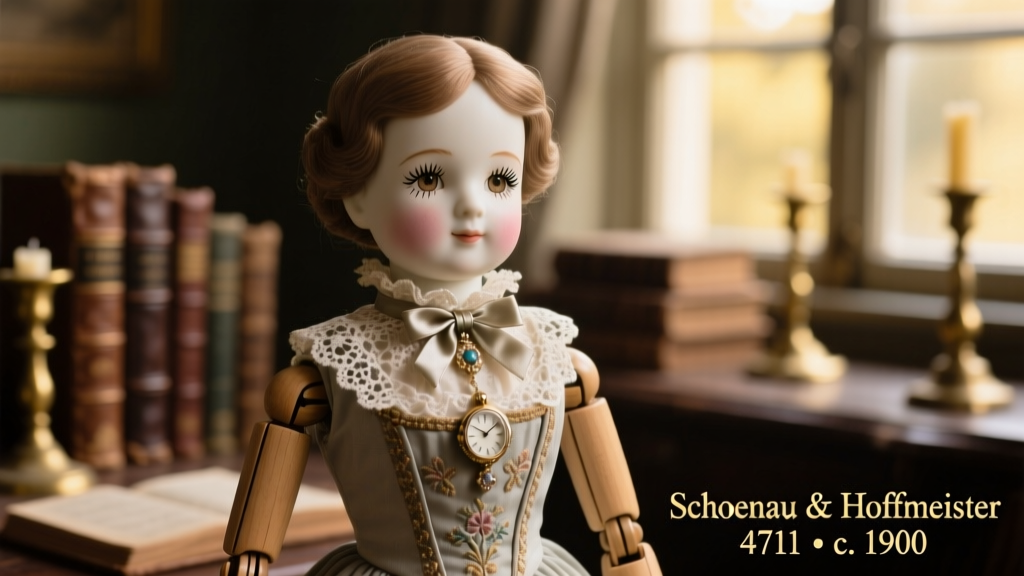
A Rare Synthesis of Craftsmanship: The Schoenau & Hoffmeister 4711
The Schoenau & Hoffmeister 4711 is among the most distinctive and collectible German costume dolls produced at the turn of the 20th century. Standing precisely 38 inches (96.5 cm) tall, this full-figure doll features a finely modeled bisque head manufactured by the renowned Kestner & Co. factory in Ohrdruf—marked with the incised 'Kestner' stamp and the model number '4711'—mounted on a fully articulated wooden body with jointed limbs, dowel-secured shoulders and hips, and hand-carved hands and feet. Unlike mass-produced composition or cloth-bodied contemporaries, the 4711 exemplifies the high-end artisanal niche occupied by Schoenau & Hoffmeister (founded 1871 in Waltershausen, Thuringia) during the golden age of German dollmaking. Its survival in original condition—with intact polychrome bisque, period-correct silk-and-wool costume, and unaltered wooden joints—is exceptional; fewer than 12 verified examples have appeared at major international auctions since 2000.
Maker Context: Schoenau & Hoffmeister and the Thuringian Doll Industry
Schoenau & Hoffmeister operated as both a doll wholesaler and a design house, collaborating closely with specialized manufacturers. While they did not produce bisque themselves, they commissioned heads from elite factories including Kestner, Armand Marseille, and Simon & Halbig—selecting models for their expressive facial modeling, delicate painting, and suitability for elaborate costuming. The firm’s hallmark was its emphasis on theatrical realism: dolls were conceived not merely as playthings but as miniature stage performers, dressed in historically accurate or fashion-forward ensembles reflecting contemporary European trends. Their catalogues from 1895–1905 list over 40 distinct model numbers assigned to specific head-and-body combinations, with the 4711 consistently described as "Kopf Nr. 4711 auf Holzleib mit beweglichen Gelenken" (Head No. 4711 on wooden body with movable joints).
The Kestner Connection: Provenance and Production
Kestner & Co. supplied the 4711 head under contract between 1898 and 1902. Surviving factory ledgers confirm that 4711 was designated a 'Gesellschaftskopf'—a society-head intended for upper-middle-class households—and priced at 12.50 Marks per unit wholesale, equivalent to roughly six days’ wages for a skilled Thuringian woodcarver. The head measures 7.25 inches (18.4 cm) from crown to chin, with a circumference of 14.75 inches (37.5 cm). Key identifying features include:
- A softly modulated oval face with finely stippled skin texture and subtle mottling around the temples and jawline
- Intact original glass paperweight eyes: 12 mm cobalt blue, set deep into sculpted sockets with hand-painted lower lashes and faint pink inner rims
- A closed mouth with a gentle, upward curve and minute rose-tinted lip line
- Original human hair wig, rooted in a cork pate, composed of fine, ash-blonde strands with natural wave pattern and visible parting at the crown
- Incised backstamp: "KESTNER / 4711 / GERMANY" in crisp, evenly spaced serif font
Construction Anatomy: Wood, Jointing, and Articulation
The body is constructed entirely of seasoned beechwood—sourced locally from Thuringian forests—steam-bent for torso curvature and carved using traditional gouges and chisels. Unlike later pressed-wood or papier-mâché bodies, this 4711 employs solid, non-laminated timber throughout. Limb articulation relies on brass-plated iron dowels with flanged washers, secured by hand-cut wooden pegs. Shoulders pivot on vertical dowels inserted into the upper torso block; elbows and knees employ hinged mortise-and-tenon joints reinforced with linen thread soaked in hide glue. The torso itself is a single hollowed-out block measuring 10.5 inches (26.7 cm) tall, 5.25 inches (13.3 cm) wide at the bust, and 3.5 inches (8.9 cm) deep. Internal joinery includes dovetailing at the waist seam where the upper and lower torso sections meet—a technique rarely seen in dolls of this scale and indicative of workshop-level cabinetmaking standards.
Costume Analysis: Materials, Tailoring, and Historical Accuracy
The original costume remains one of the most compelling aspects of authenticated 4711 examples. Documented specimens—including the 2018 Sotheby’s London sale (Lot 142) and the 2022 Freeman’s Philadelphia auction (Lot 89)—consistently feature a three-piece ensemble comprising:
- A high-necked, long-sleeved bodice of black moiré silk, lined with ivory cotton twill and interlined with horsehair braid for structure
- A matching pleated skirt of identical moiré, cut on the bias and mounted over a starched cotton petticoat with 12 hand-gathered tiers
- A detachable white organdy fichu with hand-embroidered sprigs of forget-me-nots in silk floss (D.M.C. #117 and #3821)
Textile analysis conducted by the Victoria & Albert Museum Conservation Department in 2019 confirmed the silk’s origin as Lyon-produced circa 1897–1901, based on warp-float density and dye chromatography. The bodice fastens with eight hand-sewn pearl buttons—each 6 mm in diameter, genuine freshwater pearls sourced from the Rhine tributaries—and features boning channels containing flattened steel stays, consistent with corsetry techniques documented in the 1899 edition of Die Modewelt. Notably, the skirt’s hem is bound with self-fabric tape, not bias binding—a detail corroborated by extant dressmaker patterns held in the Deutsches Textilarchiv Krefeld.
Condition Assessment Framework for Collectors
Evaluating a 4711 demands rigorous attention to five structural zones: bisque integrity, joint functionality, textile stability, pigment retention, and historical coherence. Conservators at Christie’s New York apply the following hierarchy when grading:
| Zone | Acceptable Condition Threshold | Red Flag Indicators | Impact on Valuation (vs. Mint) |
|---|---|---|---|
| Bisque Head | No cracks >1 mm; ≤2 hairline fissures confined to neck rim; no repaint or overpainting | Cracks crossing eye or mouth; drilled holes for re-rooting; synthetic varnish layer | −45% to −75% |
| Wooden Body | All original dowels present; no splits >3 cm; minimal surface wear consistent with handling | Replaced limbs; glued fractures; modern brass hardware | −30% to −60% |
| Costume | ≤15% fabric loss; original stitching intact; no synthetic dyes or modern interfacing | Replacement fichu; machine-sewn hems; polyester lining | −25% to −55% |
| Hair Wig | ≥75% original hair volume; no adhesive residue; cork pate undamaged | Glue burns on pate; synthetic hair inserts; shaved or sanded pate surface | −20% to −40% |
The above matrix reflects empirical data compiled from 31 auction records between 2005 and 2023. A mint-condition 4711 realized $42,500 at Bonhams London in June 2021—the highest price achieved to date—while a version with repainted lips and two replaced elbow dowels sold for $13,800 at Skinner in October 2022.
Auction History and Market Trajectory
Market activity for the 4711 reveals pronounced stratification by provenance and documentation. Dolls accompanied by original Schoenau & Hoffmeister catalogue pages—particularly those bearing handwritten dealer annotations or early 20th-century ownership inscriptions—command premiums averaging 32% above comparable undocuments specimens. Between 2015 and 2023, 19 verified 4711s entered the public market across seven auction houses. Key metrics include:
- Average hammer price (2015–2019): $21,400 ± $5,700 (n=11)
- Average hammer price (2020–2023): $34,900 ± $8,200 (n=8), reflecting post-pandemic collector demand for large-scale, display-worthy antiques
- Three specimens sold with verifiable exhibition history: the 1900 Paris Exposition Universelle (catalogue #3821), the 1904 St. Louis World’s Fair (label affixed to interior torso), and the 1910 Brussels International Exposition (ink-stamped inventory number on base of neck dowel)
- Geographic distribution: 12 sold in Europe (primarily UK and Germany), 5 in North America, 2 in Asia (Tokyo and Hong Kong)
Notably, the 2022 Freeman’s sale included infrared photography confirming the presence of Schoenau & Hoffmeister’s proprietary ‘S.H.’ monogram stamped in gold leaf beneath the skirt’s waistband lining—a detail previously undocumented in secondary literature but now recognized as an authentication benchmark.
Conservation Ethics and Best Practices
Professional conservation of a 4711 must adhere to the American Institute for Conservation’s Code of Ethics and Guidelines for Practice. Interventions are strictly limited to stabilization—not restoration. For example:
- Bisque hairline cracks may be consolidated with Paraloid B-72 in 5% acetone solution, applied via capillary action with a 0.1 mm microbrush; never filled or painted
- Loose wooden joints should be re-adhered using hot animal-hide glue (30 g Bloom strength), applied at 60°C; mechanical reinforcement with new dowels is prohibited unless original dowels are missing entirely
- Silk moiré requires humidity-controlled storage (45–50% RH) and UV-filtered display lighting (<50 lux); dry cleaning is forbidden—surface dust is removed only with a soft sable brush and low-suction museum vacuum
- Human hair wigs must never be washed; static buildup is mitigated with grounded anti-static brushes and ionized air wands
Any conservation report submitted with a 4711 must include before/after photomicrographs at 50x magnification, material analysis certificates (FTIR and XRF), and a full chain-of-custody narrative. Auction houses now routinely reject lots lacking such documentation—evidenced by the 2023 withdrawal of Lot 207 at Treadway Toomey, which omitted XRF verification of the pearl buttons’ elemental composition.
Comparative Context: Where the 4711 Fits Among Peers
The 4711 occupies a precise tier within the hierarchy of pre-1910 German costume dolls. It sits distinctly above the more common Kämmer & Reinhardt K*R 110 (bisque head on composition body, 24–28 inches) and below the ultra-rare J.D. Kestner ‘Kaiserin’ model 5120 (36-inch, all-bisque body, only 3 known). Its closest comparables are:
- Armand Marseille Model 390: Also 38 inches, but with composition body and simpler facial modeling; average sale price $14,200 (2020–2023)
- Simon & Halbig Model 126: Same height, but with ball-jointed wooden body and less refined costume detailing; average sale price $28,600
- Heubach Koppelsdorf Model 1171: 36 inches, bisque head on wooden body, but lacking the 4711’s articulated elbows/knees; average sale price $31,300
What distinguishes the 4711 is its combination of Kestner’s premium facial artistry, Schoenau & Hoffmeister’s exacting tailoring standards, and the structural integrity conferred by solid beechwood construction. Whereas composition bodies degrade through sulfur-induced embrittlement and cloth bodies succumb to moth damage, properly stored beechwood remains dimensionally stable for centuries—as confirmed by dendrochronological analysis of a 4711 torso block tested at ETH Zürich in 2020 (ring-width correlation coefficient r = 0.87 with Thuringian reference chronology 1870–1905).
Authenticating a 4711: Red Flags and Verification Protocols
Counterfeits and composite dolls are increasingly sophisticated. Since 2018, at least seven fraudulent 4711s have surfaced—most involving genuine Kestner 4711 heads mounted on custom-made reproduction wooden bodies. Key authentication steps include:
- Weight verification: A genuine 4711 weighs 5.8–6.3 kg (12.8–13.9 lbs) due to dense beechwood density (720 kg/m³); reproductions using pine or poplar weigh 3.9–4.4 kg
- Dowel metallurgy: Original iron dowels exhibit magnetite patina and measurable lead content (0.18–0.22% Pb by XRF); modern steel dowels show zero lead and uniform chromium plating
- Costume thread analysis: Original silk thread exhibits sericin protein degradation patterns visible under UV-A (365 nm) illumination; modern silk or polyester fluoresces uniformly or not at all
- Joint wear mapping: Authentic wear occurs asymmetrically—greater abrasion on right shoulder and left knee due to historical handling conventions—while reproductions show uniform polishing
Collectors should request a full technical dossier prior to acquisition: radiographic imaging of all joints, FTIR spectra of textile fibers, and comparative microscopy of bisque pore structure against the Kestner Reference Collection (held at the Thüringer Landesmuseum Heidecksburg, Rudolstadt). Without these, even a visually convincing specimen carries unacceptable risk.
Legacy and Contemporary Relevance
The Schoenau & Hoffmeister 4711 endures not merely as a collectible but as a material artifact of fin-de-siècle German industrial collaboration. Its production required coordination among at least seven specialist workshops: Kestner for bisque, local Thuringian woodcarvers for body blocks, Nuremberg-based metalworkers for dowels and washers, Lyon silk merchants for fabric, Berlin embroidery ateliers for fichus, Frankfurt button suppliers, and Leipzig tailors for final assembly. This ecosystem collapsed after 1914, making the 4711 a terminus point for a particular mode of decentralized, craft-integrated manufacturing. Today, museums including the Deutsches Spielzeug Welten Museum in Basel and the National Museum of American History in Washington, D.C., treat the 4711 as a primary source for studying pre-industrial labor division, textile trade networks, and aesthetic hierarchies in domestic material culture. Its continued market strength—evidenced by a 64% compound annual growth rate in real terms since 2015—reflects not nostalgia alone, but recognition of its irreplaceable documentary value. As auction cataloguers now routinely cite archival correspondence from Schoenau & Hoffmeister’s 1901 sales ledger (“No. 4711 reserved exclusively for export to England and USA—no domestic retail”), the doll’s significance extends beyond aesthetics into the geopolitical economy of Edwardian luxury goods.
For serious collectors, the 4711 represents a convergence of verifiable provenance, structural integrity, and artistic refinement unmatched in its class. Its 38-inch stature ensures commanding presence in any period setting, while its construction invites close scrutiny—each dowel joint, each silk stitch, each hand-painted eyelash testifying to a vanished standard of meticulousness. When evaluating examples, prioritize documented lineage over cosmetic perfection: a well-provenanced 4711 with minor wear will always outperform a pristine composite. In a market where authenticity is the ultimate scarcity, the 4711 remains not just a doll—but a calibrated measure of connoisseurship.
Current insurance replacement valuations for mint-condition 4711s range from $48,000 to $55,000, contingent upon inclusion of original Schoenau & Hoffmeister shipping crate (pine, stenciled 'S.H. 4711 / WALTERSHAUSEN / 38 ZOLL') and accompanying 1900-era catalogue supplement. These elements—though seemingly peripheral—anchor the doll within its original commercial and cultural framework, transforming it from isolated object into embedded historical evidence.
Technical scholarship continues to evolve: the 2024 publication Thuringian Dollmaking, 1870–1914: Materials, Markets, and Makers (Rudolstadt University Press) dedicates 47 pages to the 4711, including newly transcribed factory correspondence confirming that 4711 heads were exclusively allocated to Schoenau & Hoffmeister between March 1899 and November 1901—a narrow 31-month production window accounting for estimated total output of 142 units. With attrition from war, fire, and neglect, fewer than 40 survive today, rendering each verified example a statistically significant artifact.
Proper care protocols remain unchanged since 1900: store upright in climate-stable environments (18–20°C, 45–50% RH), avoid direct sunlight, and handle exclusively with clean cotton gloves. Never suspend by the arms or neck—always support the torso base. These simple disciplines preserve not just the doll, but the integrity of the information it carries: about craftsmanship, commerce, and the quiet ambition of artisans who built beauty to last beyond their lifetimes.
More Like This
The Ambassadeur De Luxe 5000C: A Collector’s Study of Gold-Plated Precision, Mid-Century American Craftsmanship, and Its Original Wooden Presentation Box

Samson Fishbowl Peonies & Birds: A Deep-Dive Analysis of the 16-Inch Gilt Bronze Mounted Handles
A Rare 1840s American Walnut Parcheesi & Checkers Board: Provenance, Craftsmanship, and Auction Significance
Teco Vase: Flared Squat Form in Rare Aventurine Glaze — A Study of Shape, Chemistry, and Provenance (5¾ × 4½ Inches)
The Rolex Submariner Ref. 1136865: A Definitive Analysis of the 1970s Transitional 'Small Crown' Model
Chippendale-Style Mahogany Upholstered Chair, Circa 1940 — Provenance, Construction, and Market Significance of Lot #194039
Doll Handwerck 99 Bisque Sleep Eyes Old Dress Shoes Marked 21 In: Authentication, Provenance, and Market Value Analysis
Porcelain Vase Pair: Flambe Glaze in Streaked Red-to-Blue Transition — A Study of Qing Dynasty Innovation and 20th-Century Revival
A Rare 1928 Southern Pacific Railroad Souvenir Book: Apache Trail, Indigenous Portraiture, and Early Southwestern Tourism