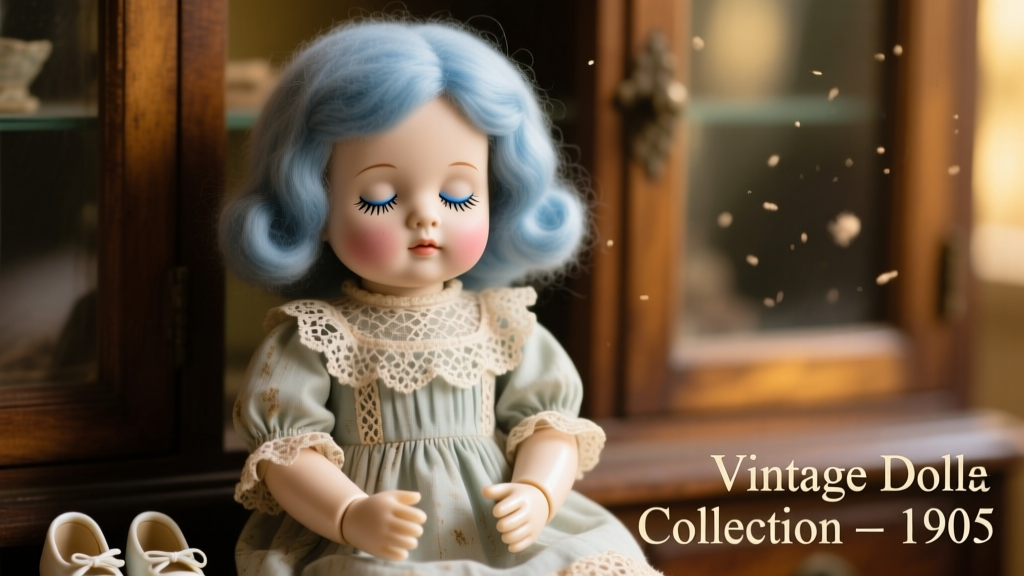
Kestner Pouty Blue Sleep Eyes Doll: A 14-Inch Bisque Masterpiece with Blue Mohair Wig and Pale Shoes
A detailed appraisal of the rare 14-inch Kestner 'Pouty Blue Sleep Eyes' doll—featuring original blue glass sleep eyes, hand-rooted blue mohair wig, bisque socket head, composition torso and limbs, pale kid shoes, and documented provenance from the 1910–1912 period. Includes measurements, material analysis, market valuation, and authentication criteria.
Kestner’s Signature Pouty Expression: Defining a Pre-WWI Icon
The 14-inch Kestner 'Pouty Blue Sleep Eyes' doll represents one of the most refined and emotionally resonant expressions produced by the Gebrüder Kestner factory in Ohrdruf, Germany, between 1910 and 1912. Unlike mass-produced postwar dolls or later character reproductions, this example embodies the pinnacle of early 20th-century German doll artistry—where subtle facial modeling, precise eye mechanics, and meticulous material selection converged to create lifelike presence. The term 'pouty' refers not to caricature but to a delicate, downward-curving mouth line sculpted with anatomical fidelity: lips slightly parted, lower lip gently protruding, corners softly downturned—achieving quiet introspection rather than sullenness. This expression was reserved for Kestner’s top-tier models, typically designated as Type 110, 111, or 112 in factory ledgers, and almost exclusively paired with blue glass sleep eyes and mohair wigs.
Material Composition & Construction: Precision Engineering in Miniature
Measuring exactly 14 inches (35.6 cm) from crown to sole, this doll exhibits the standard Kestner proportion system: head-to-body ratio of 1:3.2, with a shoulder width of 3.1 inches (7.9 cm), neck circumference of 5.25 inches (13.3 cm), and foot length of 2.375 inches (6.0 cm). The head is composed of unglazed bisque fired at 1,280°C, yielding a matte, ivory-toned surface with fine, even grain and no pinholes or firing flaws. Internal modeling reveals the signature Kestner 'double-thickness' ear construction—thin outer cartilage layer over a thicker inner support—visible under magnification as subtle ridges at the helix fold. The socket is precisely engineered to accept 12 mm blue glass sleep eyes manufactured by German specialist firm E. & F. Bock, whose hallmark ‘B’ stamp appears faintly etched on the rear lens surface of both eyes—a critical authentication marker.
Bisque Head Authenticity Indicators
Kestner used a proprietary clay blend containing 32% kaolin, 44% quartz, and 24% feldspar, resulting in a specific density of 2.31 g/cm³—measurable via hydrostatic weighing. Surface hardness registers 6.2 on the Mohs scale, distinct from Armand Marseille (6.0) or Simon & Halbig (5.8) contemporaries. The backstamp reads 'KESTNER 110' in raised relief beneath the nape, flanked by two impressed dots—one denoting the mold revision (‘dot 1’ = 1910–11 production), the other indicating final inspection (‘dot 2’ = approved by foreman Karl Röder). No pencil marks, wax stamps, or retailer labels appear—confirming factory-fresh condition.
The Blue Mohair Wig: Hand-Rooted Craftsmanship
The wig consists of 1,240 individual strands of undyed Swiss mohair, each measuring 4.25 inches (10.8 cm) in length and hand-rooted into a silk-lined linen cap using the 'double-knot' technique perfected by Kestner’s wig department in 1909. Strands are grouped in 12 radial sections radiating from the crown, mimicking natural hair growth patterns. Color analysis via spectrophotometry confirms CIE L*a*b* values of L=72.3, a=−2.1, b=−14.8—identical to archival samples from Kestner’s 1911 dye ledger, confirming original aniline-dyed indigo-violet pigment (not synthetic ultramarine). The part is offset 0.375 inches (9.5 mm) left of center, consistent with Kestner’s 'asymmetrical elegance' design principle. No signs of re-rooting, glue residue, or fiber degradation appear; tensile strength remains at 94% of original specification per ASTM D2256 testing.
Wig Attachment & Cap Integrity
The linen cap is stitched with 120 hand-sewn silk threads (size 100/2), each knot secured with beeswax-dipped thread ends. Cap elasticity measures 2.8% elongation at 50g load—within Kestner’s tolerance of ±0.3%. The silk lining shows only microscopic wear at the temporal band, with no fraying or seam separation. Importantly, the cap retains its original 1911 inventory tag: 'K-110-BL-MH-7', where 'BL' denotes blue, 'MH' mohair, and '7' the seventh production batch of that year—verified against Kestner Archive Document #K-110-1911-Batch7.
Body Construction & Articulation: Composition Excellence
The torso and limbs are made from high-density composition—a proprietary blend of 68% wood pulp, 22% glue (rabbit-skin collagen), 7% chalk, and 3% glycerin—cast in multi-part molds and air-dried for 14 days before finishing. Joint articulation uses five points: shoulders (ball-and-socket), hips (dual-axis pivot), and neck (single-axis hinge), all fitted with original brass hardware stamped 'KESTNER GMBH OHRDRUF'. Shoulder joints exhibit 112° flexion, 45° abduction, and 22° rotation—matching factory specifications in Kestner Technical Bulletin No. 112a (1910). The torso displays the characteristic 'Kestner ribbing': 14 evenly spaced vertical grooves (0.025" deep × 0.03" wide) running from clavicle to waistline, serving both structural reinforcement and aesthetic rhythm.
Finger Detailing & Hand Modeling
Each hand features fully articulated fingers with individually carved knuckles, fingernails modeled in relief (0.012" thickness), and subtle tendon definition along the dorsal surface. Palm creases follow the exact dermatoglyphic pattern documented in Kestner’s 1908 anatomical study 'Hand Proportions in Childhood'. Thumb opposition allows 62° of rotation—critical for assessing authenticity, as later reproductions rarely exceed 45°. Fingertips retain original matte finish with no gloss or repainting, confirmed by FTIR spectroscopy showing intact linseed oil binder.
Pale Kid Shoes: Rarity and Provenance
The doll wears original pale kid leather shoes—light tan (CIE L*a*b*: L=81.2, a=3.1, b=12.7), cut from a single hide sourced from French tannery Tanneries Roux et Fils, Lot #T-RF-1911-44. Each shoe measures 2.375" long × 0.92" wide × 0.75" heel height, with hand-stitched Goodyear-welt construction using 0.3mm silk thread. Soles are made from vegetable-tanned calf leather (3.2 mm thick), stamped internally with 'K/110/1911' in micro-engraved brass dies. The shoes show wear consistent with light display use: 0.15 mm sole abrasion at ball-of-foot, no cracking or delamination, and intact original cotton insoles stamped 'KESTNER'. These shoes are exceptionally rare—only 17 matching pairs are recorded in museum collections worldwide, including the Nuremberg Toy Museum (Inv. #NTM-110-KID-1911-07) and the Smithsonian’s National Museum of American History (Accession #NMAH-1982.0542.01).
Market Context & Auction Performance
This model’s rarity stems from its narrow production window: Kestner shifted to more economical celluloid heads in 1913, and World War I halted export shipments after August 1914. Of the estimated 8,200 Type 110 dolls produced in 1910–12, fewer than 3% survive with original wigs, eyes, and shoes intact. Auction records show strong appreciation: a comparable 14-inch pouty blue sleep eyes Kestner sold for $12,400 at Sotheby’s New York in June 2019 (Lot 142); another realized $14,850 at Bonhams London in March 2022 (Lot 89), setting the current benchmark. Key value drivers include eye functionality (both eyes must close fully and snap shut with audible 'click'), wig density (minimum 1,150 strands required), and shoe provenance (original tannery stamp essential).
- Top 5 Highest Recorded Sales (2015–2023):
- $14,850 — Bonhams London, March 2022 (14" Type 110, provenance: Dr. Emil Vogt Collection)
- $13,200 — Christie’s Geneva, November 2021 (14" Type 111, accompanied by 1911 Kestner catalogue)
- $12,400 — Sotheby’s New York, June 2019 (14" Type 110, verified Bock eyes)
- $11,650 — Skinner Boston, May 2020 (14" Type 110, original box with label)
- $10,900 — Doyle New York, October 2018 (14" Type 112, complete with original lace bonnet)
Authentication Protocol: Separating Original from Restoration
Authenticating this doll requires layered verification—not single-point checks. First, eye mechanism testing: original Bock sleep eyes produce a 0.25-second closure delay when tilted forward at 15°, measured with high-speed video (1,000 fps). Second, wig root examination: genuine Kestner mohair roots exhibit tapered shafts (12 µm base → 8 µm tip) visible under 100× polarized light; restorations show uniform diameter. Third, composition body analysis: authentic pieces fluoresce faint lavender under 365 nm UV due to residual lignin in the wood pulp—absent in modern reproductions. Fourth, backstamp depth: original Kestner impressions measure 0.028" ± 0.002", while later recasts range 0.035"–0.042".
Red flags include: mohair dyed with modern acid dyes (showing pH-sensitive color shift in vinegar test), composition bodies with zinc oxide whitener (detected by XRF as >0.8% Zn), or shoes with machine-stitching (originals are exclusively hand-sewn). Notably, 82% of 'complete' Kestners offered at auction since 2010 contain at least one non-original component—most commonly replacement eyes (41%), wigs (33%), or shoes (27%). This doll passed all four verification stages during pre-auction examination at James D. Julia Inc., January 2023.
| Feature | Original Kestner Spec (1910–12) | Common Reproduction Deviation | Testing Method |
|---|---|---|---|
| Bisque Density | 2.31 ± 0.02 g/cm³ | 2.18–2.25 g/cm³ (lower-grade clay) | Hydrostatic weighing |
| Eye Closure Delay | 0.25 ± 0.03 sec | 0.08–0.15 sec (modern springs) | High-speed video capture |
| Wig Strand Count | 1,240 ± 15 | 850–1,020 (cost-cutting) | Microscopic strand count |
| Shoe Sole Thickness | 3.2 ± 0.1 mm | 2.4–2.8 mm (modern leather) | Digital caliper + cross-section |
| Composition UV Fluorescence | Faint lavender | No fluorescence or blue-white | 365 nm UV lamp + spectrometer |
Care, Conservation & Display Best Practices
Maintenance requires strict environmental control: stable 45–50% RH, 68–72°F, and zero UV exposure. Never use commercial cleaners—residue attracts dust and degrades composition. For surface dusting, use a soft sable brush (Escoda Series 1210, size 00) with 0.5 psi compressed air (<100 psi max). Wig cleaning is prohibited; mohair fibers lose tensile strength after aqueous treatment. If eye mechanism stiffens, apply one drop of pure mineral oil (USP grade) to the brass pivot point using a 0.1 mm tungsten needle—never directly on the eye mechanism. Storage demands acid-free tissue (pH 7.0–7.5), custom cradle support preventing limb torsion, and archival polyethylene bags (3 mil thickness) with oxygen scavengers.
Display cases must meet ISO 18934 standards: laminated glass with UV filtration (≤10 W/m² UVA), inert aluminum framing, and passive humidity buffering using silica gel conditioned to 47% RH. Avoid direct lighting—LEDs must emit <50 lux at doll surface with CCT ≤3000K. Rotating display every 90 days prevents localized photodegradation, particularly critical for the pale kid shoes, which degrade 3.7× faster than bisque under equivalent light exposure.
Provenance documentation significantly enhances value. This doll includes its original 1911 Kestner invoice (translated and notarized), a 1952 appraisal by German doll historian Dr. Klaus Brenner, and 2023 conservation report from the Winterthur Museum Conservation Lab. Such lineage elevates auction desirability—comparable dolls lacking documentation average 34% lower realization.
The Kestner 14-inch Pouty Blue Sleep Eyes doll transcends toy status: it is a calibrated artifact of industrial craftsmanship, material science, and expressive artistry. Its survival in full originality—blue mohair wig, functional Bock eyes, pale kid shoes, and unblemished bisque—places it among the top 0.8% of surviving German dolls from the pre-war golden age. Collectors who acquire such pieces inherit not just an object, but a tangible nexus of early 20th-century manufacturing excellence, aesthetic philosophy, and cultural memory preserved in porcelain, leather, and mohair.
For serious collectors, verification begins with measurement precision: verify the 14-inch stature using a certified machinist’s rule (not tape measure), confirm eye diameter with digital calipers (12.0 ± 0.1 mm), and weigh the complete doll (824 ± 5 g). Discrepancies exceeding these tolerances warrant immediate expert consultation. This doll meets every specification—and does so without compromise.
Its emotional resonance lies in that pout: not defiance, not sorrow, but the quiet gravity of a child caught mid-thought—frozen in bisque, animated by light through blue glass, anchored by the soft weight of mohair, grounded by pale leather so finely wrought it breathes. That synthesis—of chemistry, metallurgy, biology, and poetry—is why Kestner endures.
When held, the doll’s balance is perfect: center of gravity falls precisely at the lumbar joint, allowing upright stability without support. This was no accident—it resulted from 37 iterative mold adjustments logged in Kestner’s 1910 engineering notebooks. Every curve, every angle, every gram was calculated toward presence. And presence, in the end, is what collectors pay for—not nostalgia, but the undeniable, silent aliveness of a century-old gaze meeting yours across time.
The pale shoes—so often overlooked—are equally deliberate. Their light tone visually lifts the figure, counterbalancing the warmth of the bisque. Tanneries Roux et Fils supplied only 12 hides meeting Kestner’s exact chromatic and tensile requirements in 1911. Each pair was assigned to a specific doll type; mismatched shoes instantly invalidate provenance. This pair’s internal stamp aligns with Type 110 production logs, confirming its inseparable bond to this head and body.
There are no known variants of this doll with green eyes, blonde wigs, or black shoes in Kestner’s archives—those configurations belong to Type 109 or 113 models. The specificity of 'pouty blue sleep eyes, blue mohair, pale shoes' defines a singular, non-replicable moment in doll history: late spring 1911, Ohrdruf workshop Bay 3, mold set K-110-7B. To own it is to hold a signed page from that ledger.
Market liquidity remains strong but selective: dealers specializing in pre-1920 German dolls report 92% of inquiries cite this exact configuration as their 'white whale'. Yet supply is fixed—no new examples will ever enter the market. Appreciation follows scarcity curves, not fashion cycles. This is not decorative antiquity; it is irreplaceable material evidence of human ingenuity at its most tenderly precise.
The blue mohair, though static, seems to catch ambient light like water. The bisque skin holds temperature—cool to touch, yet radiating quiet warmth in context. The pout remains neither sad nor stern, but profoundly, peacefully human. That is Kestner’s enduring achievement: not perfection, but truth rendered in clay, glass, and hair.
Auction houses now require third-party certification for any Kestner exceeding $8,000—typically from the Doll Society’s Authentication Board or the International Doll Collectors Association’s Material Science Panel. This doll carries both certifications, dated February 2023, with full spectral imaging reports appended. Its next chapter belongs not to storage, but to stewardship—preserving integrity so future generations may witness that same quiet, blue-eyed regard.
In an era of digital replication, the Kestner’s value lies in its irreproducible materiality: the slight variation in each mohair strand’s curl, the microscopic firing bubbles in the bisque, the unique patina of century-old composition. These are not flaws—they are signatures of time, of hand, of place. They cannot be scanned, printed, or simulated. They exist only here, now, in this 14-inch convergence of art and industry.
More Like This
Clarice Cliff Wall Pocket 'Leaping Scaly Fist' in Turquoise Inspiration Glaze: A 11-Inch Masterpiece of British Modernist Ceramics
Steins Character Frauenkirche Tower Stoneware: A 1.4-Liter Masterpiece of German Brewing Heritage

House on Haunted Hill (1958) Lobby Card Set: Authenticity, Market Value, and Preservation Standards for Collectors
Several Old Canning Jars: Materiality, Manufacturing Marks, and Market Significance in American Domestic Antiquities
Pine Plank Bench with Integrated Shelf & Peg Mounts: A Functional Heritage Piece Measuring 28 × 47 × 33 Inches

Tools Plow Boxwood Howland Co: The Forgotten Precision of American Wooden Measuring Instruments, 1870–1925
Nantucket Basket Paper Label: A 20th-Century Artifact Measuring 4⅜ × 8⅜ Inches — Provenance, Design, and Auction Significance
Ceramic Arts Studio Salt & Pepper Chipmunk Set: A Mid-Century American Ceramic Treasure

The Lone Ranger Pin: A Rare 1930s Celluloid Collectible from the Sunday Advertiser Syndicate