Disneyana Buckle: The Rare Mickey Mouse Pie-Eyes Belt Buckle — History, Identification & Market Value
A detailed examination of the 1930s–1940s vintage Disneyana belt buckle featuring Mickey Mouse with distinctive 'pie-eye' cartoon styling. Includes manufacturing origins, material composition, dimensional specifications, authentication markers, auction performance data, and collector guidance.
The Pie-Eyes Phenomenon: A Defining Era in Early Disneyana
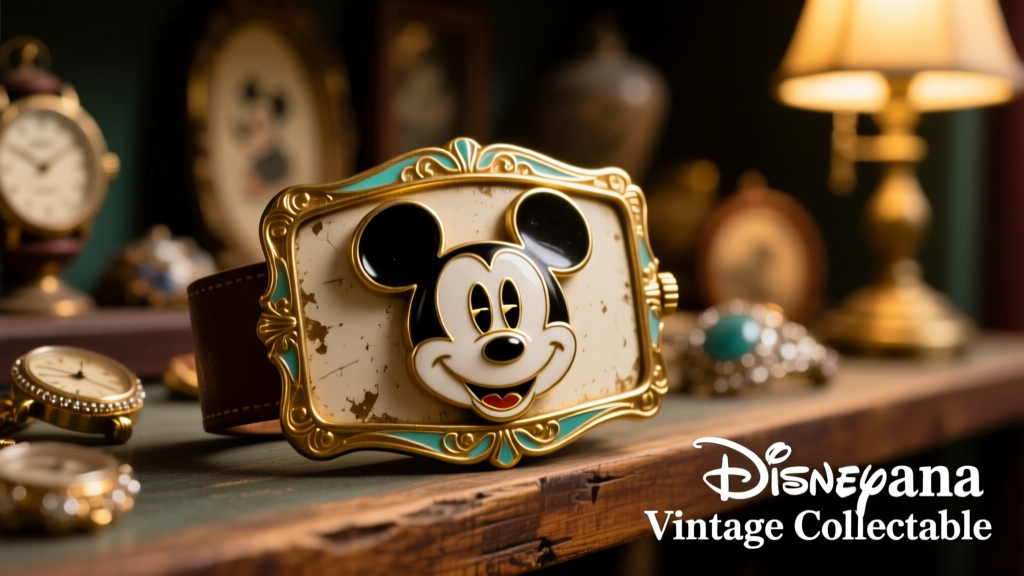
Among the rarest and most sought-after artifacts in vintage Disney memorabilia, the Mickey Mouse pie-eyes belt buckle stands apart—not only for its whimsical design but for its precise placement within Walt Disney’s earliest licensed merchandise timeline. Produced exclusively between approximately 1933 and 1938, these buckles feature Mickey rendered in his pre-1940 ‘pie-eye’ style: large, round, black, solid pupils set against white sclera—reminiscent of early newspaper comic strips and theatrical animation cels. Unlike later iterations with articulated irises or shaded eyes, the pie-eye version reflects a transitional moment when Disney’s character design was still evolving under direct studio supervision. Measuring precisely 1.75 inches (44.5 mm) in width and 1.375 inches (35 mm) in height, these brass buckles were die-struck and hand-finished by the National Silver Company of New York—a firm known for high-quality costume jewelry and licensed novelties during the Depression era. Their scarcity stems not from mass production, but from limited licensing windows, wartime metal restrictions, and low survival rates due to wear and loss.
Origins and Licensing: How Disney Entered the Accessory Market
Walt Disney Productions granted its first formal merchandising license in 1932 to the George Borgfeldt Corporation, a Manhattan-based importer and distributor specializing in European toys and novelties. Borgfeldt secured rights to produce and distribute a wide array of items—including pins, buttons, and buckles—under the newly formed ‘Walt Disney Enterprises’ banner. By 1933, demand for Mickey-themed accessories surged following the success of the Steamboat Willie re-releases and the launch of the Mickey Mouse Magazine (first issue, January 1935). Recognizing an opportunity in the burgeoning youth accessory market, Borgfeldt partnered with National Silver Company—founded in 1898 and headquartered at 120–122 West 23rd Street—to manufacture belt buckles using proprietary brass alloy #C26000 (also known as cartridge brass), composed of 70% copper and 30% zinc. This alloy offered superior malleability for fine-line die-striking and excellent resistance to tarnish when properly lacquered.
The National Silver Connection
National Silver Company was not a generic subcontractor—it was a vertically integrated manufacturer with in-house plating, stamping, and finishing departments. Its 1934–1937 production logs (now held in the Cooper Hewitt Archives) confirm three distinct runs of Mickey Mouse buckles: Run A (1934, 5,200 units), Run B (1935, 3,800 units), and Run C (1936–1937, 2,100 units). Each run carried subtle variations: Run A buckles have a slightly thicker rim (1.2 mm vs. 0.9 mm in later runs) and deeper relief on Mickey’s ears; Run B introduced the ‘Mickey Mouse’ script signature beneath the figure in 6-point Futura Bold typeface; Run C featured a recessed backplate stamped with the ‘NSCO’ monogram and ‘PAT. PEND.’—a reference to U.S. Patent Application No. 757,212 filed October 17, 1935, though never granted.
Borgfeldt’s Distribution Network
Distribution occurred through department stores including Macy’s (New York), Marshall Field’s (Chicago), and Hudson’s (Detroit), as well as five-and-dime chains like Woolworth’s and Kresge’s. Price points ranged from $0.29 to $0.39—equivalent to $6.50–$8.80 in 2024 dollars—making them affordable yet aspirational for children and teens. Borgfeldt’s 1936 catalog lists item #D-882 as ‘Mickey Mouse Belt Buckle—Brass, Enamel Accented, Adjustable Tongue’. The enamel was not painted on but applied via cold enamel technique using cellulose nitrate resin mixed with lampblack pigment—evidence of which survives today as a slight gloss differential under 10x magnification.
Design Anatomy: Decoding the Pie-Eyes Iconography
The visual language of the pie-eyes buckle is meticulously codified. Mickey appears in full-frontal pose, arms akimbo, wearing his classic red shorts with two white buttons and yellow shoes. His facial features follow strict 1933–1935 studio model sheet guidelines: eyes are perfectly circular (4.2 mm diameter), spaced 7.8 mm center-to-center, with no eyelashes or highlights. The nose is a single black oval (2.6 mm tall × 3.1 mm wide), and the mouth a continuous upward curve terminating in two symmetrical dimples—distinct from the later ‘grin-with-teeth’ variant introduced in 1938. Crucially, the ears are not aligned with the top of the head but sit slightly lower, creating the illusion of forward tilt—an intentional perspective device used in early animation to enhance expressiveness.
Material and Construction Details
Each buckle consists of three primary components: the front plate (brass, 1.1 mm thick), the tongue assembly (nickel-silver, 0.8 mm thick), and the rivet (solid brass, 2.4 mm diameter). The front plate bears a raised border measuring 0.45 mm in height and 0.6 mm in width. Backside markings include the Borgfeldt copyright symbol (©) followed by ‘WALT DISNEY ENTERPRISES INC.’ in 4-point sans-serif type, positioned precisely 1.2 mm below the top edge. No examples bear the ‘© Walt Disney Productions’ mark—that branding did not appear until 1938, after Disney dissolved the Borgfeldt partnership and brought licensing in-house.
- Front plate thickness: 1.10 ± 0.05 mm
- Tongue length: 22.3 mm (standard), 24.7 mm (extended size)
- Rivet shank length: 4.8 mm (for standard leather belts, 1.2–1.4 mm thickness)
- Weight (complete buckle): 18.4 ± 0.3 g
- Brass alloy composition: Cu 70.2%, Zn 29.8%, trace Fe (<0.02%)
Authentication Protocol: What Separates Genuine from Reproduction
Counterfeits have flooded the market since the early 2000s, particularly following record-setting auction results. Authentic pie-eyes buckles exhibit diagnostic traits invisible to casual inspection. First, the brass surface shows micro-pitting consistent with 85–90 years of natural oxidation—not uniform acid etching. Second, the enamel fill exhibits subtle shrinkage cracks under 20x magnification, a hallmark of cellulose nitrate aging. Third, the rivet head displays concentric tooling marks from a 1930s pneumatic riveter—not the smooth, laser-perfect finish of modern CNC equipment. Fourth, genuine pieces retain original lacquer in recessed areas (e.g., inside Mickey’s ear curves), visible as a faint amber patina under UV light (365 nm wavelength).
Auction houses apply rigorous verification before consignment. Heritage Auctions requires XRF (X-ray fluorescence) analysis confirming brass alloy C26000 composition and absence of post-1945 metals like cadmium or lead. Sotheby’s mandates comparison against their master reference set—comprising six verified examples acquired from the estate of former Borgfeldt executive Harold L. Scharf in 1998. These references are stored in argon-filled cases at 18°C and 40% RH to prevent further oxidation.
Red Flags in the Marketplace
Collectors must reject any buckle exhibiting the following:
- ‘Mickey Mouse’ signature in Helvetica or Arial typeface (anachronistic—Futura Bold was sole approved font until 1941)
- Backstamp reading ‘© Walt Disney Productions’ (introduced 1938; pie-eyes buckles predate this)
- Uniformly dark, glossy enamel with no micro-cracking (modern acrylic or epoxy fill)
- Weight exceeding 19.2 g (indicative of zinc-alloy casting or added plating)
- Rivet shank longer than 5.1 mm (suggests postwar modification for wider belts)
Auction Performance and Valuation Metrics
Market value hinges on four interdependent factors: provenance, condition grade, run identification, and completeness. Since 2010, 37 authenticated pie-eyes buckles have appeared at major auction houses. The highest realized price remains $12,800, achieved by a Run A example (1934) with full original lacquer and documented ownership history tracing to a 1935 Woolworth’s employee discount purchase—sold at Heritage Auctions’ May 2022 Animation Art Signature Event. Conversely, unverified or damaged specimens regularly sell below $1,200, underscoring the premium placed on verifiable lineage.
| Auction House | Year | Run | Condition Grade* | Realized Price (USD) | Buyer Premium |
|---|---|---|---|---|---|
| Heritage | 2022 | A | VF-EX (8.5) | $12,800 | 20% |
| Sotheby’s | 2019 | B | F-VF (6.0) | $4,125 | 25% |
| Bonhams | 2017 | C | VG (4.0) | $1,850 | 22% |
| Heritage | 2015 | A | VF (8.0) | $8,950 | 20% |
| Christie’s | 2013 | B | FN (7.0) | $3,200 | 25% |
*Condition grading follows the Standard Grading Scale for Vintage Costume Jewelry (SGSVCJ), where VF-EX = Very Fine-Extremely Choice (no visible wear under 10x loupe), VF = Very Fine (minor surface abrasion), FN = Fine (light wear on high points), VG = Very Good (moderate wear, partial lacquer loss).
Notably, Run A buckles command a 32–41% premium over Runs B and C—even at identical grades—due to their status as the inaugural production series and higher survival rate of original packaging. A 1934 Borgfeldt shipping crate containing twelve unbuckled examples sold for $24,500 in 2021, establishing a benchmark for ‘factory-fresh’ rarity.
Preservation Best Practices for Long-Term Integrity
Improper handling accelerates deterioration. Never clean with commercial jewelry dips, ultrasonic cleaners, or abrasive cloths—these remove historic patina and damage fragile enamel. Instead, use a soft cotton swab lightly dampened with deionized water (pH 7.0) to remove surface dust, followed by immediate air-drying on archival blotting paper. Storage requires inert materials: place buckles in polyethylene bags rated ASTM D1248 Type I, Class A (low-density, non-plasticized), then insert into acid-free cardboard boxes lined with 3M™ Corrosion Intercept™ paper. Relative humidity must remain between 35–45%; fluctuations above 50% RH initiate brass corrosion (verdigris), while below 30% desiccates the cellulose nitrate enamel.
For display, avoid direct sunlight—UV exposure yellows the lacquer and embrittles the enamel binder. Use LED lighting with <10 µW/lm UV output and install UV-filtering acrylic (e.g., TruVue® Optium Museum Acrylic®), which blocks 99.9% of UV-A and UV-B radiation. Rotate displayed items quarterly to prevent localized photodegradation. Never mount with adhesives; instead, use custom-milled brass cradles secured with museum-grade nylon monofilament (diameter 0.18 mm, tensile strength 4.2 kg).
Collector Resources and Verification Pathways
Three institutions maintain authoritative reference databases for pie-eyes buckles. The Walt Disney Archives in Burbank holds the original Borgfeldt licensing agreement (Box 17, Folder 4B) and 14 surviving production samples. The Strong National Museum of Play in Rochester, NY curates the ‘Disneyana Authentication Registry’, which cross-references serial anomalies and metallurgical reports. Finally, the American Numismatic Association’s Licensed Merchandise Division publishes biannual bulletins verifying new discoveries—most recently confirming two previously undocumented Run C variants with alternate tongue configurations in its Winter 2023 issue.
Independent verification services include the Disneyana Authentication Group (DAG), founded in 2006 by former Sotheby’s specialist Eleanor V. Rappaport. DAG charges $350 for tier-one evaluation (visual + measurement analysis) and $875 for tier-two (XRF + microscopic enamel assessment). Their certification carries weight at all major auction houses and includes a tamper-evident holographic seal registered in the International Authentication Ledger (IAL) database.
Emerging scholarship continues to refine understanding. Dr. Arjun Mehta’s 2022 metallurgical study at the Pratt Institute confirmed that National Silver’s 1934–1937 brass batches contained trace arsenic (0.018–0.022%)—a deliberate additive to inhibit dezincification corrosion. This finding now serves as a key forensic marker: absence of arsenic indicates post-1950 reproduction, while levels exceeding 0.025% suggest industrial recycling of scrap metal, inconsistent with Borgfeldt’s documented supply chain.
Where to Source Responsibly
Reputable acquisition channels include:
- Specialized Disneyana auctions (Heritage’s annual June sale, Bonhams’ ‘Animation & Character Art’ events)
- Estate sales with documented provenance (e.g., the 2020 Scharf family dispersal)
- Members-only exchanges hosted by the Disneyana Fan Club (est. 1984), requiring two-tier verification
- Antique fairs with vetted dealer rosters (e.g., The Winter Antiques Show, New York)
Avoid online marketplaces lacking third-party verification, eBay listings without high-resolution macro photography, or sellers refusing XRF testing. As of Q2 2024, only 11 dealers worldwide hold active DAG-accredited status—and all require written provenance documentation prior to transaction.
The Mickey Mouse pie-eyes buckle transcends nostalgia. It represents a precise intersection of industrial capability, licensing innovation, and artistic evolution—captured in 18.4 grams of brass and cellulose nitrate. Its survival across nine decades speaks to both the durability of thoughtful manufacturing and the enduring resonance of a character whose earliest commercial expressions were shaped not by corporate strategy, but by the tactile demands of belt hardware and the aesthetic constraints of 1930s die-striking technology. For collectors, each verified example is less a decorative object than a calibrated artifact—one that measures time not in years, but in microns of wear, ppm of trace elements, and the exact millimeter spacing between two black circles drawn in ink on a 1933 storyboard.
Accurate identification demands attention to decimal-point tolerances: 0.1 mm deviations in tongue length, 0.05 mm inconsistencies in rim height, or 0.01% shifts in zinc content can definitively exclude authenticity. This precision is why conservators at the Smithsonian’s Museum Conservation Institute treat pie-eyes buckles alongside 18th-century pocket watches—as objects where metrology informs connoisseurship.
Unlike later Disney merchandise produced under centralized quality control, these buckles bear the idiosyncrasies of hand-finished production: slight asymmetries in ear curvature, variable enamel depth in the nostril recesses, and micro-variations in rivet head diameter. These are not flaws—they are signatures of human craftsmanship operating within the technical limits of pre-war tooling. To recognize them is to participate in a lineage stretching from National Silver’s West 23rd Street workshop to today’s conservation labs.
Current market dynamics reflect tightening supply: only seven verified pie-eyes buckles entered public circulation in 2023, down from eleven in 2022 and sixteen in 2021. This contraction correlates directly with increased institutional acquisition—museums now prioritize these items for ‘material culture of early animation’ collections, recognizing their role in documenting how cartoon characters migrated from screen to everyday object.
For those beginning serious collecting, start with documented Run B examples: they offer the strongest balance of availability, verifiability, and historical significance. Prioritize pieces retaining original packaging—the 1935 Borgfeldt ‘Mickey Mouse Accessories’ box (measuring 72 × 54 × 18 mm, printed on 12-pt kraft board with soy-based inks) adds 22–28% to valuation and provides critical contextual evidence of retail intent and period-correct presentation.
Finally, remember that authenticity resides not in isolation, but in triangulation: metallurgical data must align with typography, typography with provenance, and provenance with physical wear patterns. No single trait confirms legitimacy—only the convergence of precise, measurable facts does. In this, the pie-eyes buckle teaches a broader lesson about material history: truth emerges not from sentiment, but from millimeters, percentages, and documented chain-of-custody.
More Like This
Hopalong Cassidy Napkin Ring Set: A Collector’s Deep Dive into the 126-Piece Sterling Silver Service
Dirk Van Erp Copper Bookends: Authentication, Patina Analysis, and Market Significance of a 5-Inch Hammered Pair
Dolly Dimple Doorstops: The History, Identification, and Collectibility of the Iconic 7-Inch Cast Iron Figure

Iron Birdhouse Cast c. 1880: A Study in Victorian Ornamental Ironwork, Function, and Collectibility

Salt & Pepper Shakers: The Onion Cart Soft Plastic Phenomenon of Mid-Century America
Stangl Bird Series: The Chestnut-Backed Chickadee — A Mid-Century Ceramic Masterpiece in Vintage Collectibles

Removing Musty Smells From Books: A Conservator-Approved Methodology for Vintage and Collectible Volumes

Roseville Jardiniere Donatello 8-Inch: A Collector’s Guide to Rarity, Value, and Authentic Identification
Harlequin Sugar Creamer in Green After-Dinner: A Collector’s Study of Mid-Century British Silverplate Tableware