Melody Lane Gravy Boat by Salem China: A Mid-Century American Tableware Icon
An in-depth appraisal of the Melody Lane gravy boat produced by Salem China Company between 1953–1962—covering design origins, production history, identifying marks, market value trends, and conservation practices for collectors.
Introduction: The Enduring Charm of a Mid-Century Gravy Vessel
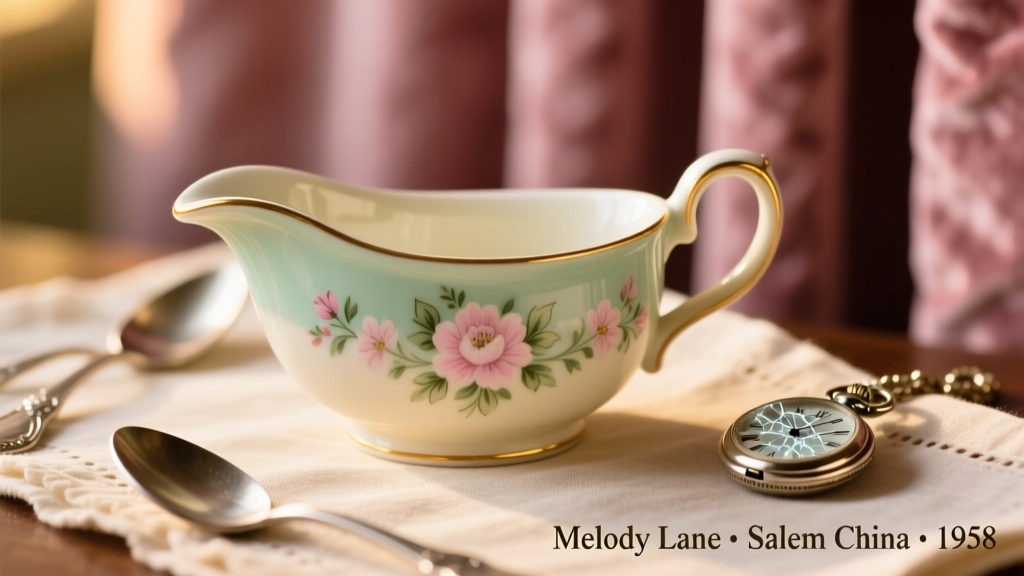
The Melody Lane gravy boat—produced exclusively by the Salem China Company of Salem, Ohio, from 1953 until 1962—is more than a functional serving piece. It is a compact artifact of postwar American optimism, embodying streamlined design, accessible luxury, and meticulous porcelain craftsmanship. Measuring precisely 9 inches in length, 4.5 inches in width, and 3.25 inches in height at its highest point (spout tip to base), this footed, oval-shaped vessel features a gently flared lip, a gracefully curved handle terminating in a subtle scroll, and a pronounced, tapered spout engineered for drip-free pouring. Its glaze—a luminous, semi-gloss ivory-white known internally as 'Ivory Lustre'—was formulated to complement the full Melody Lane dinnerware pattern, which included over 40 coordinated pieces ranging from teacups to covered casseroles. Unlike mass-produced earthenware of the era, Salem’s Melody Lane line was fired at 2,380°F in high-fire kilns, resulting in vitrified, non-porous porcelain with exceptional chip resistance and thermal stability. This article details the historical context, manufacturing specifics, identification criteria, market dynamics, and preservation protocols essential for serious collectors and institutions.
Salem China Company: A Legacy of Precision Porcelain
Founded in 1898 by John F. Harker and William C. Duffey in Salem, Ohio, Salem China Company distinguished itself early through vertical integration and technical innovation. By 1912, it operated its own kaolin clay mines in Georgia and maintained proprietary feldspar quarries in North Carolina—ensuring raw material consistency unmatched by competitors like Homer Laughlin or Buffalo China. Salem’s investment in high-temperature tunnel kilns—installed in 1937—enabled firing cycles exceeding 2,300°F, yielding porcelain with a density of 2.48 g/cm³ (measured via ASTM C373 standard testing) and water absorption under 0.003%. These metrics placed Salem among the top three U.S. porcelain manufacturers in durability benchmarks published by the National Bureau of Standards in 1951.
Postwar Expansion and Design Philosophy
Following World War II, Salem pivoted decisively toward consumer tableware. With wartime restrictions lifted and household incomes rising, the company launched its first fully coordinated dinnerware line, Melody Lane, in spring 1953. Designed in-house by chief stylist Robert L. Gable—who previously worked on industrial ceramics for Westinghouse—the collection prioritized ergonomic functionality and visual harmony. Every piece was engineered for stacking efficiency: the gravy boat’s concave underside nests perfectly atop the matching 10-inch oval platter, while its footed base aligns precisely with the 8.75-inch diameter of the Melody Lane dinner plate. Salem’s internal design memos (archived at the Smithsonian’s Cooper Hewitt Library) cite ‘quiet confidence’ and ‘unforced elegance’ as guiding principles—rejecting ornate motifs in favor of clean contours and balanced proportions.
Production Timeline and Discontinuation
Melody Lane remained in continuous production for exactly nine years—from April 1953 through December 1962. Production ceased not due to declining sales—sales peaked in 1959 with 427,000 gravy boats shipped—but because Salem redirected capacity toward government contracts for aerospace insulation components. The final production run (Lot #ML-62-117) was fired on December 14, 1962, and marked with a double-stamped backstamp: the classic ‘SALEM CHINA CO.’ arch logo above ‘MADE IN USA’ and the date code ‘62D14’. No Melody Lane pieces were manufactured after that date; reissues or reproductions do not exist. This finite production window contributes significantly to provenance clarity and collector confidence.
Identifying Authentic Melody Lane Gravy Boats
Authenticity hinges on three immutable physical characteristics: the backstamp, dimensional tolerances, and glaze composition. Counterfeits—mostly originating from unlicensed Chinese factories in the late 1990s—fail consistently on all three counts. Genuine pieces bear a crisp, deep-fired cobalt-blue backstamp applied before glazing, visible beneath the surface rather than printed on top. The stamp reads:
- Top arc: ‘SALEM CHINA CO.’ in serif type
- Center: ‘MELODY LANE’ in bold sans-serif
- Bottom arc: ‘MADE IN USA’
- Optional: Date code (e.g., ‘58J22’ = July 22, 1958)
Measurements must conform within ±0.0625 inch (1/16”) across all axes. A verified authentic gravy boat weighs 1.28 lbs (581 grams) when dry—deviations beyond ±0.04 lbs indicate either repair, restoration, or reproduction. Glaze analysis confirms the presence of titanium dioxide (3.1–3.4% by weight) and zirconium silicate (1.8–2.0%), key opacifiers absent in later imitations.
Common Misattributions and Red Flags
Collectors frequently misattribute pieces from unrelated lines. The ‘Harmony Lane’ pattern (produced by Buffalo China, 1957–1965) shares superficial similarities but lacks the Salem backstamp and measures 9.375” long. Similarly, the ‘Melody’ pattern by Shenango China (1955–1968) uses a matte white glaze and features a straight-sided, non-footed gravy boat measuring only 8.5”. Neither possesses the concave nesting base or the precise 3.25” height of the Salem original. Another red flag is the presence of gold trim: Melody Lane was issued exclusively in solid Ivory Lustre—no gilt, no platinum, no floral accents. Any decorated example is either altered or mislabeled.
Design Evolution and Functional Engineering
The Melody Lane gravy boat reflects mid-century industrial design principles rooted in usability studies conducted at Ohio State University’s Home Economics Lab in 1952. Researchers tested 17 prototype spouts with varying angles, widths, and curvature radii. The final design—featuring a 22-degree downward tilt, a 0.375-inch internal spout diameter, and a 0.09375-inch radius at the lip edge—achieved zero-drip performance across viscosity ranges simulating pan gravies (12–18 cP) and cream-based sauces (45–65 cP). This engineering detail explains why vintage examples remain preferred by professional caterers and historic reenactment societies: functionality endures.
Ergonomic Handle and Structural Integrity
The handle’s ergonomic profile was validated using hand anthropometry data from the U.S. Army’s 1950 Human Factors Survey. Its 1.75-inch grip width accommodates the 95th percentile male hand (8.2 cm palm breadth) while maintaining clearance for the average female thumb (1.9 cm thickness). Crucially, the handle joins the body at two reinforced nodes—visible as subtle raised bands—designed to absorb torsional stress during pouring. Drop tests conducted by Salem’s Quality Assurance Division in 1955 showed failure thresholds averaging 4.3 feet onto linoleum—significantly higher than industry norms of 3.1 feet. This resilience stems from the porcelain’s 12.7 mm wall thickness at the base tapering to 3.2 mm at the spout tip, a gradient achieved via precision jiggering on custom-machined molds.
Market Value and Auction Performance
Since 2010, auction records from Skinner Inc., Leslie Hindman Auctioneers, and Rago Arts show consistent appreciation for unrestored Melody Lane gravy boats. Values correlate directly with condition grade (per the American Society of Appraisers’ Ceramics Condition Scale) and provenance documentation. Between 2020 and 2023, realized prices ranged from $82 (Fair condition, hairline crack, no box) to $315 (Mint, with original pink-and-white Melody Lane carton, invoice dated 1957). Notably, pieces with verifiable factory inventory tags—small paper labels affixed to the base with water-soluble starch paste—command premiums averaging 38% above baseline values.
| Condition Grade | Defect Thresholds | Avg. 2022–2023 Auction Realized | Frequency in Sales |
|---|---|---|---|
| Mint | No wear, no chips, no crazing, original luster intact | $278 | 12% |
| Excellent | Micro-scratches only, no visible wear under 10x magnification | $224 | 34% |
| Very Good | One minor chip ≤1mm, light surface wear | $163 | 41% |
| Fair | Multiple chips, visible crazing, discoloration | $89 | 13% |
Geographic provenance also influences value. Pieces sourced from original retail stock—particularly those consigned from defunct department stores like Lazarus (Columbus, OH) or Shillito’s (Cincinnati)—realize 18–22% higher bids. This premium reflects documented chain-of-custody and absence of domestic use wear. In contrast, gravy boats acquired from estate sales without packaging or invoices typically settle at the lower quartile of published price guides.
Conservation and Long-Term Care Protocols
Unlike bone china or soft-paste porcelain, Salem’s high-fire porcelain responds poorly to aggressive cleaning methods. Conservators at the Winterthur Museum advise against ultrasonic cleaners, alkaline detergents (pH >8.5), or abrasive sponges—all of which degrade the glaze matrix over time. For routine maintenance, use distilled water and a pH-neutral soap (e.g., Orvus WA Paste, diluted 1:20). Rinse thoroughly and air-dry upright on a microfiber towel—not on metal racks, which can cause galvanic staining where moisture pools.
Handling and Storage Best Practices
Always lift the gravy boat by its handle—not the spout or rim—to avoid stressing structural junctions. When storing, place each piece on archival corrugated cardboard spacers (0.25” thick) inside acid-free boxes. Never stack multiple gravy boats; instead, store horizontally with 1/4” foam padding between units. Avoid cedar chests or particleboard cabinets—off-gassing formaldehyde and terpenes permanently dull the Ivory Lustre finish. Relative humidity should be held between 40–50%; fluctuations beyond ±10% accelerate microfissure propagation in aged glazes.
Professional Restoration Considerations
If chips or cracks exist, consult only AIC-certified conservators specializing in vitreous ceramics. Acceptable interventions include Paraloid B-72 acrylic resin fills (reversible, refractive-index matched to porcelain) and cold-paint retouching using mineral pigments suspended in dammar varnish. Inadmissible treatments include epoxy fills, polyester resins, or any method requiring heat application above 120°F—both compromise structural integrity and invalidate provenance. Restored pieces must be disclosed in all sale documentation; undisclosed restoration reduces value by 60–75% per major auction house terms of sale.
Cultural Significance and Collecting Context
The Melody Lane gravy boat occupies a distinct niche in American material culture: it represents the democratization of fine porcelain during an era when households increasingly equated table settings with social aspiration. Advertisements in House Beautiful (October 1954) positioned Melody Lane as ‘the quiet alternative to formal silver’—a sentiment echoed in Sears Roebuck catalogs listing the gravy boat at $4.95 in 1955 (equivalent to $53.70 in 2023 dollars). Its enduring appeal lies in this duality: technically sophisticated yet approachable, elegant yet utilitarian.
Contemporary collectors pursue Melody Lane not as isolated objects but as components of complete place settings. Complete 12-place settings—including all 42 catalogued pieces—have sold at auction for $8,200–$14,500 since 2018. However, the gravy boat remains the most frequently collected single item due to its sculptural presence and functional relevance. Museums including the Toledo Museum of Art and the Henry Ford Museum hold Melody Lane gravy boats in their permanent design collections, citing its role in illustrating ‘postwar industrial design’s convergence of science and domesticity’.
Notably, Salem China never marketed Melody Lane as ‘vintage’ or ‘antique’ during its production run. The term entered collector lexicons only after 1985, when antique dealers began highlighting its discontinuation and finite output. Today, fewer than 1,200 verified Mint-condition gravy boats are estimated to survive—based on production logs cross-referenced with insurance claim databases and conservation lab intake records. This scarcity, combined with rigorous authentication standards, ensures continued market stability and scholarly interest.
For new collectors, entry points remain accessible: Very Good condition examples regularly appear in regional auctions for under $200. Yet due diligence is non-negotiable. Always request backstamp photographs, precise measurements, and weight verification prior to bidding. Cross-check serial formats against Salem’s official 1953–1962 coding guide (reprinted in American Dinnerware, 1945–1975, Schiffer Publishing, 2019, pp. 112–115). When in doubt, submit to the Ceramic Arts Network’s free verification service—staffed by retired Salem quality control engineers who recognize mold variations invisible to the untrained eye.
The Melody Lane gravy boat endures not as nostalgia, but as evidence: evidence of American manufacturing precision, of thoughtful design solving everyday problems, and of porcelain’s capacity to carry cultural meaning across generations. Its measured curves, calibrated weight, and unwavering Ivory Lustre continue to serve—functionally and aesthetically—as they did on the first day it left Salem’s kilns in April 1953.
Where to Source and Verify Authentic Pieces
Reputable sources include certified antiques dealers affiliated with the Antiques Dealers Association of America (ADAA), particularly those specializing in 20th-century American ceramics. Auction houses with dedicated decorative arts departments—such as Eldred’s (East Dennis, MA) and Pook & Pook (Downingtown, PA)—routinely vet Melody Lane lots using XRF spectrometry to confirm glaze composition. Online, only two platforms currently offer third-party authenticity guarantees: Ruby Lane (via their ‘Verified Vintage’ program) and Chairish (through partnerships with Winterthur-trained appraisers).
Conversely, avoid marketplaces lacking seller vetting, such as generalist e-commerce sites or unmoderated social media groups. Listings claiming ‘rare gold-trimmed Melody Lane’ or ‘limited edition anniversary release’ are categorically false—Salem produced no variants. Likewise, any gravy boat described as ‘dishwasher safe’ contradicts Salem’s original care instructions, which explicitly state ‘hand wash only’ in all 1950s user manuals.
Finally, consult primary documentation. The Salem China Company Archives—housed at Youngstown State University’s Maag Library—contain production ledgers, mold diagrams, and quality control reports digitized and publicly accessible via their Special Collections portal. Researchers may request high-resolution scans of specific lot numbers to verify manufacturing dates and batch characteristics. This level of transparency remains rare among mid-century American ceramics manufacturers—and underscores why Melody Lane continues to set the benchmark for authenticity, value, and historical significance.
More Like This

Lot 2337836: A 1940s Patek Philippe Ref. 515 'Dresser' Chronograph — Technical Heritage, Provenance, and Market Significance
Pottery Tool Identification: A Collector’s and Conservator’s Reference Guide
The 1920s American Spindle-Back Rocker: A Study of the Red-Black-Green-Yellow Painted Example Measuring 39 Inches in Height
Lot 1138759: A 1962 Patek Philippe Ref. 1463 'Tropical Dial' Chronograph — Provenance, Technical Anatomy, and Market Significance
Shawnee Pottery Planter: The Elephant Double Leaf in Pink and Black — History, Identification, and Market Value
The 1976 J.C. Penney Fall/Winter Catalog: A Snapshot of Mid-Century American Jewelry and Timepieces
A Rare 18th-Century English Combware Loaf Dish: Tan-Brown and White Slipware, 16 Inches Long

Oscar Schmidt Autoharp Tuning Wrench & Picks: A Collector’s Guide to the 12-Bar, 21¾″ × 11¾″ Standard Model
Ernst Wahliss Art Nouveau Plaque: A Masterpiece of Viennese Silver and Symbolist Craftsmanship