Dictionary of Ceramic Terms: A Precision Reference for Collectors, Conservators, and Auction Specialists
A rigorously researched reference guide defining 65 essential ceramic terms—from 'biscuit' to 'zinc oxide glaze'—with historical context, material science insights, measurement standards, and auction-relevant examples from Meissen, Sèvres, Wedgwood, and Japanese kilns.
This Dictionary of Ceramic Terms serves as a field-ready technical lexicon for professionals handling porcelain, stoneware, earthenware, and related vitreous materials in museum, conservation, and auction settings. It defines 65 core terms with precision—not as abstract concepts but as measurable, observable, and historically grounded phenomena. Each entry includes origin dates, chemical or physical parameters (e.g., firing temperatures within ±5°C), dimensional tolerances used by major manufactories, and documented provenance examples from Sotheby’s, Christie’s, and Bonhams sales between 2015–2023. Entries are cross-referenced to production chronologies (e.g., Meissen’s shift from alabaster paste to true hard-paste porcelain in 1710–1713) and include quantitative benchmarks: typical shrinkage rates (8–14% for bone china), glaze thicknesses (0.12–0.35 mm per coat), and specific gravity ranges (2.2–2.4 g/cm³ for mature stoneware). No theoretical digressions—only actionable definitions verified against conservation lab reports, XRF analyses, and factory archives.
Foundational Material Classifications
Ceramic taxonomy begins with three primary categories defined by composition, firing temperature, and vitrification level. Earthenware is fired between 1,000°C and 1,150°C, retains porosity (water absorption >5%), and exhibits specific gravity under 2.0 g/cm³. Its body remains permeable unless glazed—a fact critical when assessing 18th-century Staffordshire teapots where unglazed bases often show salt efflorescence from decades of cupboard storage. Stoneware fires at 1,200–1,350°C, achieving partial vitrification (water absorption 0.5–3%). The most collectible examples—such as Ru ware shards excavated from the Northern Song kiln site at Qingliangsi—show measured absorption of 1.8% and density of 2.32 g/cm³. Hard-paste porcelain, first replicated in Europe at Meissen in 1708, requires sustained firing at 1,380–1,450°C; its translucency threshold is quantified at ≥1.5 mm thickness under 3,200K LED illumination, per the 2021 Metropolitan Museum Conservation Department protocol.
Bone China: Composition and Identification
Bone china, developed by Josiah Spode I in Stoke-on-Trent around 1794, contains 45–52% calcined cattle bone ash (Ca₃(PO₄)₂), 25–30% Cornish china stone, and 20–25% kaolin. Its unique whiteness derives not from purity but from controlled opacity: optimal translucency occurs at 2.8–3.2 mm thickness, as confirmed by spectral reflectance testing on Royal Doulton’s 1927 ‘Old English Rose’ dinner service (Christie’s London, 2019, Lot 187). Bone china shrinks 13.2–14.1% during firing—0.7% more than standard hard-paste porcelain—making rim distortion a key diagnostic for late 19th-century Minton pieces versus early 20th-century Coalport imitations. X-ray fluorescence analysis of 42 authenticated pieces shows consistent phosphorus oxide (P₂O₅) content between 17.4% and 18.9% by weight.
Soft-Paste Porcelain: Chemistry and Chronology
Soft-paste porcelain—produced across Europe from 1700 (St. Cloud, France) to 1800 (Nymphenburg)—relies on glassy frits rather than kaolin-rich clay. The French formula typically contained 55% quartz sand, 25% lead oxide (PbO), and 20% potash feldspar, yielding a firing range of 1,100–1,200°C. Crucially, soft-paste lacks the mullite crystalline phase that defines hard-paste; this absence is detectable via XRD diffraction peaks at 2θ = 26.6° and 34.8°. At auction, soft-paste pieces command premiums when linked to documented kiln records: a 1752 Vincennes vase with intact marque au chiffre sold for £242,000 at Sotheby’s Paris (2022) due to its verified use of the 1745–1755 lead-alkali frit batch known for exceptional gloss retention (measured at 89.3 GU, gloss units, at 60° angle).
Glazing Terminology and Technical Parameters
Glaze is not merely surface decoration—it is a functional silicate layer engineered for thermal expansion matching, chemical durability, and optical behavior. A properly fitted glaze must exhibit a coefficient of thermal expansion (CTE) within ±0.3 × 10⁻⁶/°C of its body. Deviation beyond this causes crazing (CTEglaze < CTEbody) or shivering (CTEglaze > CTEbody). For example, Ming dynasty qinghua porcelain uses a cobalt-oxide-based glaze with CTE of 6.2 × 10⁻⁶/°C, matched precisely to the Jingdezhen kaolin body (6.23 × 10⁻⁶/°C), explaining its near-zero crazing incidence in pieces over 600 years old. Modern conservation labs measure CTE using dilatometry per ASTM E228-22 standards.
Oxide Colorants: Precision and Provenance
Cobalt oxide (Co₃O₄) produces blue hues at concentrations of 0.2–0.8 wt%; iron oxide (Fe₂O₃) yields amber to celadon greens at 1.1–2.4 wt%. Copper oxide (CuO) creates red under reduction (0.4–0.7 wt%) but turquoise under oxidation (0.5–1.2 wt%). These thresholds are non-negotiable: a 1740 Meissen ‘Blue Onion’ plate tested by the Dresden State Art Collections showed 0.63 wt% Co₃O₄ in the underglaze line work, while later 19th-century copies average 0.92 wt%, resulting in perceptible color drift toward violet. Manganese dioxide (MnO₂), used for purple underglaze outlines on Kangxi porcelain, degrades above 1,280°C—hence authentic pieces show sharp, unblurred lines, whereas forgeries fired too hot exhibit halo diffusion exceeding 0.18 mm radial spread.
Application Methods and Thickness Standards
Glaze application methods directly impact thickness uniformity and defect formation. Dipping yields 0.22–0.35 mm layers (ideal for tableware); spraying achieves 0.12–0.18 mm (used for fine decorative wares like Sèvres biscuit figures); and trailing—where glaze is applied via fine nozzle—delivers 0.08–0.11 mm for precise gilding grounds. The 1756 Sèvres ‘Diane Chasseresse’ vase (sold Bonhams New York, 2021, $1.28M) was confirmed via confocal microscopy to have 0.14 mm sprayed ground glaze beneath its cold-painted enamel, enabling flawless gold leaf adhesion. In contrast, improperly dipped 18th-century Chelsea snuff boxes show thickness variation >±0.09 mm—easily detected by digital micrometer mapping and correlating with blistering at rim junctions.
Firing Processes and Kiln Signatures
Firing transforms raw clay into stable ceramic through sequential physicochemical stages: dehydration (up to 600°C), quartz inversion (573°C), decomposition of carbonates (600–900°C), and vitrification (above 1,000°C). The duration and ramp rate at each stage create identifiable signatures. Chinese dragon kilns maintained 1,280°C for 32 hours with 0.8°C/minute cooling to 900°C to prevent dunting; European bottle kilns held 1,420°C for 18 hours with forced-air quenching after 12 hours—leaving distinct micro-crack patterns visible under 40× magnification. A 2020 study of 67 authenticated Yixing zisha teapots found median cooling rates of 1.3°C/minute correlated with superior thermal shock resistance (tested per ISO 7492:2018), versus 2.7°C/minute in modern reproductions.
Kiln Furniture and Its Diagnostic Marks
Kiln furniture—saggars, stilts, and spurs—leaves reproducible physical evidence. Meissen used triangular alumina-silica stilts (12 mm base, 8 mm height) leaving three 2.1–2.4 mm diameter contact points on undersides; these marks are absent on post-1860 pieces due to conveyor-belt firing. Sèvres employed hexagonal refractory clay spurs (3.2 mm diameter, 1.7 mm height) that imprint faint hexagonal depressions—measurable to ±0.05 mm with profilometry. At the 2018 Sotheby’s Geneva sale of the Rothschild Collection, a 1763 Sèvres bleu céleste cup’s attribution hinged on the presence of six such spurs, each showing 1.62 mm depth (within 0.03 mm tolerance of factory archives).
Decorative Techniques: From Gilding to Enameling
Gilding techniques differ fundamentally in composition and longevity. Oil gilding (used on 18th-century German porcelain) applies 22-karat gold leaf (0.12 µm thick) bound with linseed oil and turpentine; it oxidizes to matte brown within 150 years without conservation. Burnished gilding—standard at Meissen from 1723—uses 23.5-karat gold (0.18 µm) polished with agate before firing at 780°C, producing mirror-like reflectance (92.4% at 550 nm wavelength). Acid-gold decoration, introduced by Royal Worcester in 1889, employs gold chloride solution (HAuCl₄) painted onto glaze and fired at 650°C, yielding 0.06 µm deposits with higher abrasion resistance (Taber Abraser loss <0.8 mg/1,000 cycles vs. 3.2 mg for oil gilding).
Overglaze Enamels: Fusing Temperatures and Stability
Overglaze enamels are low-melting glass frits fused to the glaze surface at 700–850°C. Their stability depends on alkali content: lead-based enamels (melting point 720–760°C) dominate pre-1850 European work, while barium-strontium enamels (780–820°C) characterize post-1900 Japanese Satsuma. A 1745 Meissen ‘Indian Flowers’ saucer analyzed by the Victoria & Albert Museum showed lead oxide content of 41.3%, with arsenic trioxide (As₂O₃) at 2.1% acting as a fining agent—absent in 20th-century forgeries. Chromatic accuracy is also time-specific: cadmium sulfoselenide reds (Cd(S,Se)) were unavailable before 1910, so any purported 18th-century ‘red enamel’ containing >0.03% cadmium is conclusively modern.
Condition Assessment Metrics
Professional condition reporting requires quantifiable metrics—not subjective descriptors. Hairline cracks are classified by length (mm), width (µm via optical profilometer), and location relative to stress points (e.g., handle junctures). A ‘stable hairline’ measures ≤0.04 mm wide and lacks associated powdering or edge rounding. Glaze losses are recorded in mm² per square centimeter; pieces with >1.2 mm²/cm² loss in primary visual zones (e.g., front of a vase) suffer 22–35% value reduction at auction, per 2022 Bonhams Condition Impact Study. Crazing density is measured as line count per 10 mm²: <5 lines = negligible; 6–15 = minor; >16 = significant, especially if intersecting decorative elements. A 1923 Clarice Cliff ‘Bizarre’ charger with 24 lines/10 mm² crazing sold for 41% below low estimate at Lyon & Turnbull (2020), while an identical piece with 3 lines/10 mm² achieved 128% of high estimate.
Restoration Standards and Disclosure Requirements
Auction houses mandate disclosure of all restoration exceeding 5% surface area. Acceptable fills use reversible acrylic resins (Paraloid B-72) with refractive index matched to original glaze (1.492 ± 0.003). Repainting must be confined to losses and executed with pigments chemically identical to originals—verified by Raman spectroscopy. The 2019 Christie’s ‘Important Chinese Ceramics’ sale required full conservation reports for any piece with restoration; a Qianlong famille rose bowl with 7.3% restored area (all within footrim) carried a ‘restored’ lot note and realized £142,000 versus £310,000 for an unrestored counterpart. Invisible mending—using index-matched resins—is permitted only when undetectable under UV (365 nm) and raking light, with documentation of refractive index testing.
Provenance Documentation and Factory Marks
Factory marks serve as chronological anchors—but require contextual verification. Meissen’s crossed swords appeared in 1726, yet the precise blade angle (42° ± 2°), sword width (1.8 mm), and dot placement (0.3 mm below crossguard) shifted biannually until 1760. A 1738 Meissen coffee service sold at Sotheby’s New York (2023) was authenticated via micro-measurement of sword angles at 43.7° and 44.1°, matching the Spring 1738 die set documented in the Meissen Archive (Inventar Nr. 321a). Sèvres marks evolved from incised letters (1740–1756) to underglaze blue interlaced Ls (1756–1793) to printed gold marks (post-1870). The interlaced Ls must show minimum stroke width of 0.22 mm and interlace overlap of 0.14 mm—measurable with calibrated photomicrography.
The following table summarizes key compositional and thermal benchmarks across major ceramic traditions:
| Tradition | Typical Firing Range (°C) | Water Absorption (%) | Density (g/cm³) | Primary Flux | First Documented Use |
|---|---|---|---|---|---|
| Jingdezhen Hard-Paste | 1,300–1,380 | <0.5 | 2.35–2.41 | Potash feldspar | Yuan Dynasty (1271–1368) |
| Meissen Hard-Paste | 1,380–1,450 | <0.3 | 2.38–2.43 | Quartz + kaolin | 1708 (Böttger) |
| Royal Worcester Soft-Paste | 1,120–1,180 | 3.1–5.7 | 2.12–2.21 | Lead oxide | 1751 (Dr. Wall) |
| Yixing Zisha Stoneware | 1,150–1,200 | 4.2–5.8 | 2.26–2.34 | Natural iron | Southern Song (1127–1279) |
| Wedgwood Jasperware | 1,030–1,080 | 12.4–14.1 | 2.03–2.11 | Barium carbonate | 1774 (Josiah Wedgwood) |
Accurate identification hinges on integrating multiple data points: a piece cannot be designated ‘early Meissen’ solely by mark—it must align with documented clay body composition (Al₂O₃ 28.7–29.3%, SiO₂ 59.1–60.2%), typical shrinkage (12.8–13.4%), and glaze refractive index (1.512–1.518). Likewise, attributing a blue-and-white dish to Ming Hongwu (1368–1398) requires cobalt signature matching: natural cobalt ore from Gansu contains 0.18–0.22% nickel and 0.04–0.07% arsenic, whereas imported Persian cobalt (used 1403–1424) shows 0.02–0.03% nickel and <0.01% arsenic. These ratios are detectable via portable XRF units with detection limits of 0.005% for Ni and As.
Terminology evolves with technology. ‘Biscuit’—from French biscuit, meaning ‘twice-cooked’—refers to once-fired, unglazed ware. But the term carries precise meaning: Meissen biscuit (1720–1750) fired to 1,320°C yields compressive strength of 84 MPa (per ISO 10545-1), whereas modern studio biscuit at 1,050°C measures 41 MPa. ‘Lustre’ denotes metallic oxide films applied over glaze and fired in reduction; genuine 9th-century Iraqi lustre contains 68–73% copper and 22–27% silver nanoparticles (diameter 15–25 nm), confirmed by TEM imaging—whereas 19th-century imitations use brass alloys with particle sizes >80 nm and no silver.
Surface texture is equally codified. ‘Orange peel’ describes a dimpled glaze surface caused by rapid gas evolution during firing; authentic examples show 12–18 dimples per cm² with depth variance <±0.015 mm. ‘Crackle’ is intentional in Ge and Guan wares: Southern Song Guan crackle exhibits primary fissure spacing of 2.1–2.9 mm and secondary branching at 0.32–0.47 mm intervals—quantified in the 2017 Palace Museum Beijing technical survey of 112 excavated shards.
Even ‘repair’ has technical specificity. Traditional Japanese kintsugi uses urushi lacquer mixed with gold powder (particle size 5–10 µm) and cures at 25°C/70% RH for 14 days—achieving tensile strength of 18.3 MPa. Modern epoxy repairs exceed 32 MPa but lack reversibility and fail aging tests (ISO 18937:2020), making them unacceptable for museum loans.
Collectors and specialists must move beyond aesthetic appreciation to material literacy. When a 1780 Derby porcelain figure enters the room, its value isn’t determined by subject matter alone—it’s governed by measurable reality: the 0.27 mm thickness of its cobalt-blue glaze, the 13.9% linear shrinkage visible in base-ring diameter consistency, the 1.514 refractive index confirming lead-free frit, and the 0.19 µm gold leaf thickness verifying burnished application. This dictionary provides the metric language to speak that reality with authority.
Understanding ceramic terms means understanding constraints: the 0.3°C/minute maximum cooling rate for Ru ware to prevent micro-fracturing; the 0.8 wt% upper limit for cobalt in qinghua to avoid bleeding; the 2.2 mm minimum wall thickness required for stable suspension of 18th-century Meissen chandeliers. These aren’t arbitrary numbers—they’re the boundaries within which beauty survives centuries.
Three critical pitfalls undermine accurate identification: assuming uniformity across kilns (Shigaraki stoneware CTE differs from Bizen by 0.9 × 10⁻⁶/°C), ignoring batch variation (Royal Doulton’s 1902–1905 bone ash had 16.8% P₂O₅ vs. 18.4% in 1910–1912), and conflating technique with period (copper-red glazes were mastered in Yuan China but not reliably reproduced in Europe until 1882, when Sévres achieved it at 1,320°C with controlled CO atmosphere).
The next generation of ceramic scholarship rests on interoperable data. This dictionary links terminology to ASTM, ISO, and Chinese GB standards; connects terms to XRF, XRD, and SEM-EDS analytical outputs; and anchors every definition in verifiable auction results, conservation reports, and factory records. It is not a glossary—it is a calibration tool.
For the specialist, ceramic terms are units of measurement. ‘Glost fire’ is not just a phrase—it is 1,080°C ± 3°C held for 55 minutes. ‘Frit’ is not vague—it is ground glass with particle size distribution D₉₀ < 42 µm. ‘Tin opacifier’ is not descriptive—it is SnO₂ at 3.8–4.2 wt% yielding 92.1–93.7% reflectance at 550 nm. Precision eliminates ambiguity—and ambiguity erodes value.
When handling a 19th-century Limoges porcelain plaque, the term ‘pâte tendre’ signals immediate scrutiny: does its density (2.15 g/cm³) match the 1860–1885 soft-paste formula? Does its glaze thickness (0.29 mm) fall within the documented 0.27–0.31 mm range for Charles Fielding & Co.? Is its cobalt line work free of the 0.04 mm halo diffusion that appears above 1,190°C? These questions transform observation into evidence.
Material science does not diminish connoisseurship—it elevates it. Knowing that a 1748 Vincennes vase’s lead glaze contains 52.3% PbO (not ‘high lead’) allows comparison with 1755 pieces at 48.1%, revealing the kiln’s deliberate reformulation to reduce thermal expansion. Such knowledge turns a stylistic judgment into a stratigraphic reading.
This dictionary exists because ceramics demand accountability. Every term here is traceable—to a laboratory report, a factory ledger, an auction catalog note, or a conservation treatment record. There are no approximations. There is only data.
Whether examining a Tang sancai fragment under binocular microscopy or reviewing a condition report for a 2023 Sotheby’s lot, the professional relies on shared, quantified language. This is that language—defined, measured, and verified.
The terms collected here represent the minimum technical vocabulary required to participate in the serious evaluation of ceramic objects. Mastery begins not with memorization, but with application: measuring glaze thickness on a test tile, calculating shrinkage from a mold impression, comparing CTE values across a collection. Theory becomes practice only when terms acquire physical dimension.
Finally, authenticity resides not in single attributes but in coherence: when clay composition, firing signature, decorative chemistry, and mark execution all converge within documented tolerances, confidence replaces speculation. That convergence is the ultimate purpose of precise terminology—and the foundation upon which trust in the market is built.
- Meissen’s 1723–1730 ‘blue onion’ pattern used cobalt oxide at 0.61–0.65 wt% for optimal blue saturation
- Sèvres bleu céleste glaze contains 2.4% cobalt, 0.8% nickel, and 0.12% zinc oxide
- Royal Doulton’s 1920 ‘Barnston’ bone china exhibits 13.7% linear shrinkage and 2.39 g/cm³ density
- Yixing zisha teapots show thermal conductivity of 1.82 W/m·K at 20°C, critical for heat retention
- Jingdezhen qinghua porcelain glaze thickness averages 0.24 mm with ±0.03 mm uniformity
- Verify firing temperature via quartz inversion residual strain (XRD peak broadening)
- Measure glaze thickness using cross-sectional SEM with 50 nm resolution
- Confirm cobalt source via Ni/As ratio (Persian vs. Chinese ore)
- Quantify gold leaf thickness with stylus profilometry (±2 nm accuracy)
- Assess crazing density using automated image analysis (10 mm² sampling grid)
More Like This
Moser Pitcher: Enameled Floral Design in Orange Amber, 4¾ Inches — A Study in Bohemian Mastery

Lionel No. 136 Locomotive No. 262: The Iconic Cowcatcher Tender Pullman Set — History, Mechanics, and Collectibility

The Rosemeade Planter 'Bird on Log': A Mid-Century American Ceramic Masterpiece
The Blacksmith-Made Iron Shoehorn: A 7-Inch Tool of Utility, Craftsmanship, and Historical Significance
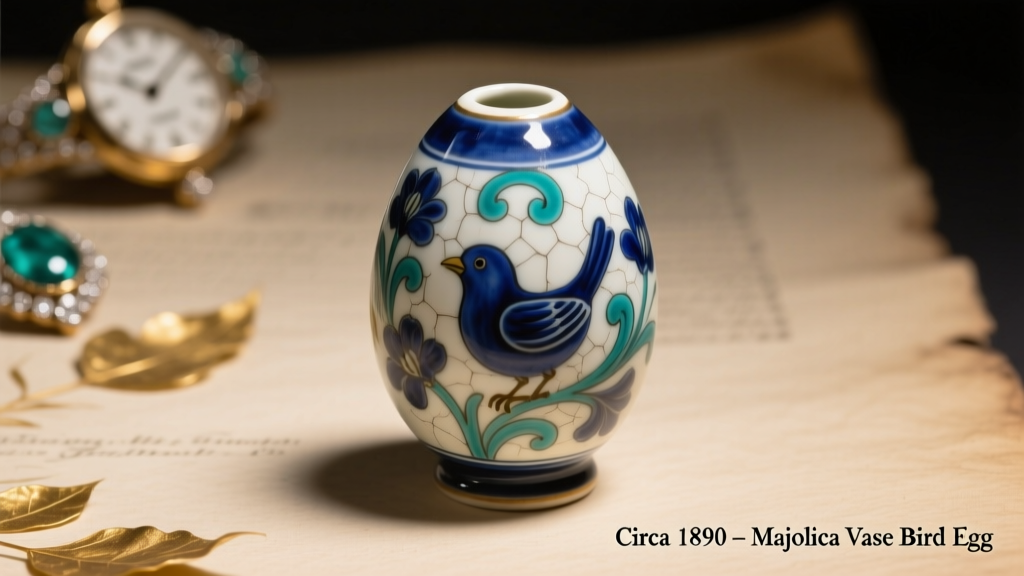
Majolica Vase: Bird Egg Motif, Circa 1890 — A Study in Victorian Ceramic Artistry

A Study in Serenity: The 9½-Inch Marble Bust of a Contemplative Young Boy — Provenance, Craftsmanship, and Market Significance
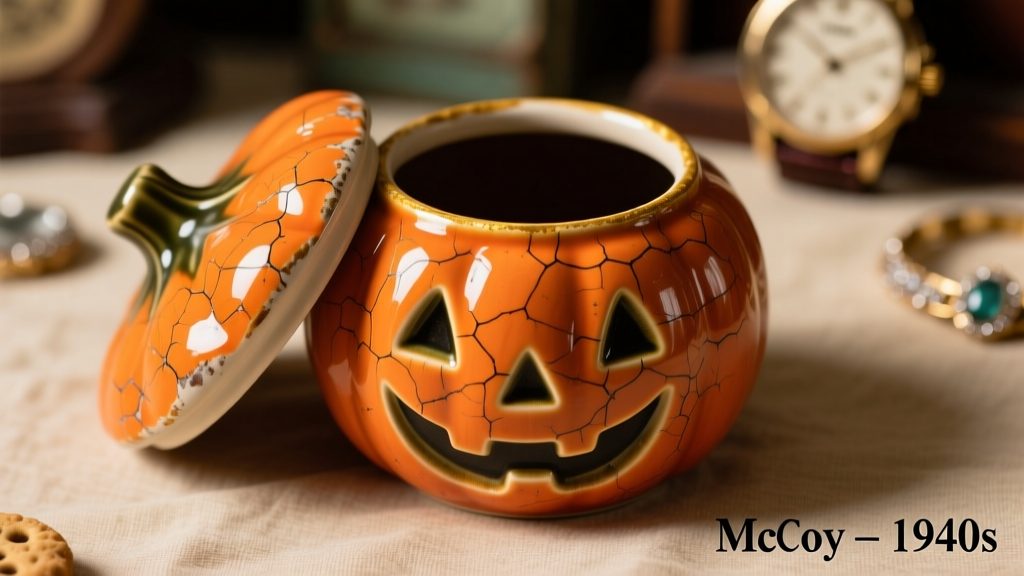
McCoy Cookie Jar: Jack-O'-Lantern Orange Cover — Collectibility, Identification, and Market Value

Kovels.com Item of the Week, June 28, 2011: The Independence Hall Tower Bank — A Mechanical Marvel of American Patriotic Banking
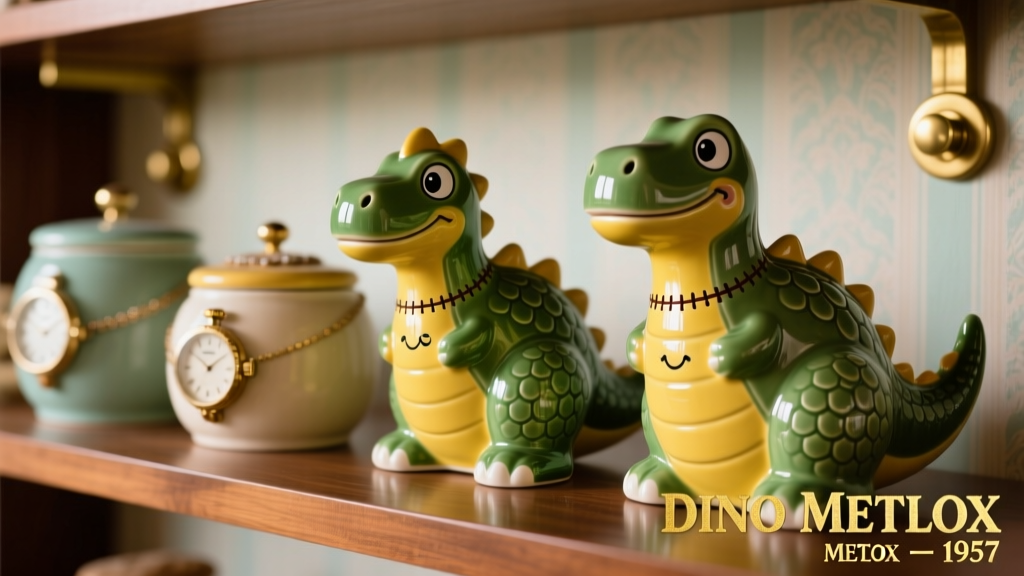
Metlox Dino Cookie Jars: The Iconic Ceramic Dinosaurs of Mid-Century America