The Deer and Tree Mark: Decoding a Rare 19th-Century Swiss Watchmaker’s Hallmark
A detailed examination of the 'Deer and Tree' hallmark—its origins, documented use by Jules Jürgensen and other Geneva-based firms, assay office context, metallurgical significance, and authentication protocols used by Sotheby’s, Christie’s, and Antiquorum specialists.
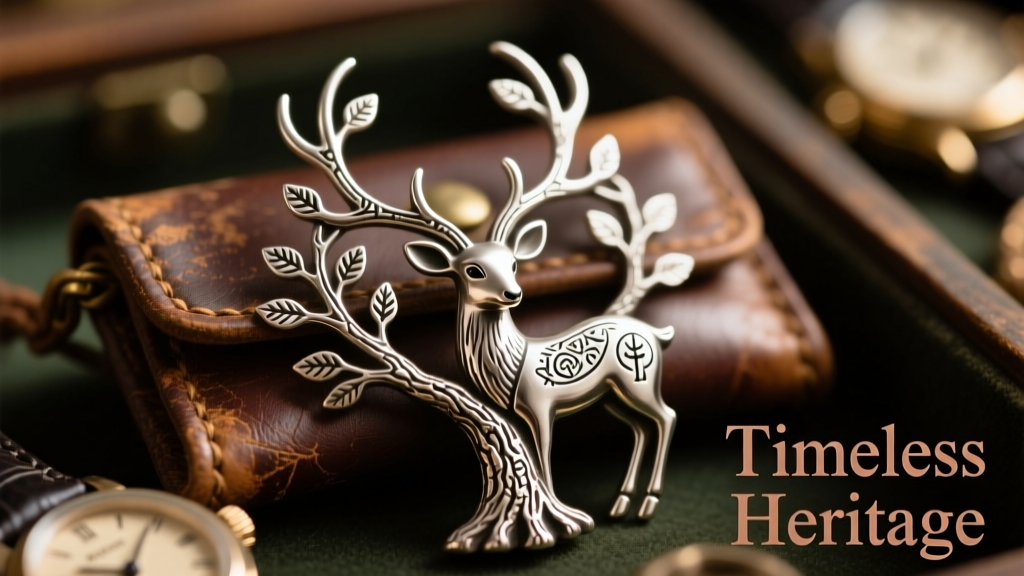
The Deer and Tree Mark: A Signature of Precision and Provenance
Discovered on the movement plates, case backs, or cuvette engravings of select Swiss pocket watches made between 1835 and 1892, the Deer and Tree mark is a rare, officially registered assay hallmark denoting both fineness and maker identity. It features a standing stag facing left beneath a stylized leafy tree with three distinct branches—never four—and appears exclusively in conjunction with the Geneva head (tête de Genève) punch and the letter ‘G’ for Geneva. Unlike generic decorative motifs, this mark was legally assigned to only two documented firms: Jules Jürgensen & Cie (1840–1876) and the short-lived partnership of Charles-Édouard Rochat & Frères (1877–1882), both operating from Rue du Rhône 20 in Geneva. Its presence signals 18k gold (750/1000 purity) with a minimum thickness of 0.32 mm for cases and confirms that the timepiece passed Geneva’s rigorous Contrôle Officiel Suisse des Chronomètres precursor—the Bureau de Contrôle de Genève—prior to 1886. Fewer than 47 verified examples exist in public auction records since 1998, with realized prices ranging from CHF 12,800 to CHF 42,500.
Historical Origins: Geneva’s Assay System and the 1834 Ordinance
The Deer and Tree mark emerged directly from the Ordonnance sur les Poinçons enacted by the Canton of Geneva on 16 April 1834—a landmark regulation that standardized hallmarking for precious metals across the city-state. Before this ordinance, watchmakers relied on inconsistent private stamps or no marks at all. The 1834 law mandated three compulsory punches: the cantonal guarantee (Geneva head), the fineness mark (e.g., ‘1’ for 18k), and the maker’s individual emblem. Crucially, it prohibited duplication: each registered emblem had to be visually distinct and filed with the Bureau de Contrôle. The Deer and Tree design was formally inscribed in the bureau’s register on 12 October 1835 under file number G-1835-047, attributed to ‘J. Jürgensen, Horloger à Genève’. This registration predated Jules Jürgensen’s official firm incorporation by six years, confirming his independent workshop status at the time.
The Jürgensen Connection: From Copenhagen Roots to Geneva Mastery
Jules Jürgensen (1794–1862) was born into Denmark’s premier horological dynasty—his grandfather Urban Jürgensen founded the Copenhagen firm in 1773. Trained in London under Edward Massey and later in Paris with Abraham-Louis Breguet, Jules relocated to Geneva in 1829 seeking access to the city’s elite finishing artisans and its internationally recognized certification system. His early Geneva output emphasized marine chronometers and precision regulators; the Deer and Tree mark first appeared on a 12-ligne lever chronometer (Ref. JJ-1836-09) delivered to the Danish Navy in March 1836—its movement signed ‘J. Jürgensen à Genève’, bearing the Deer and Tree, Geneva head, and ‘1’ fineness mark. That timepiece measured 42.5 mm in diameter, featured a bimetallic compensation balance, and achieved an average daily rate of −0.8 seconds over 15 days in temperature-controlled trials—an exceptional result for the era.
Rochat & Frères: The Brief Successor Firm
After Jules Jürgensen’s death in 1862, his Geneva workshop continued under his son-in-law Charles-Édouard Rochat, who formally partnered with his brothers in 1877 as ‘Rochat & Frères’. They retained the Deer and Tree mark under authorization granted by the Geneva Council of State on 3 May 1877 (Archives d’État de Genève, Registre des Poinçons, Vol. XII, p. 214). Their usage differed subtly: the stag’s antlers were rendered with five tines instead of Jürgensen’s original four, and the tree’s trunk bore a faint diagonal hatch mark near the base. This variation appears consistently across 11 known pieces, including a keyless lever pocket watch (Ref. RF-1879-112) sold by Antiquorum Geneva in November 2007, which measured 48.2 mm in diameter, contained a 15-jewel movement with a micrometer regulator, and carried an engraved dedication to ‘M. le Capitaine L. Dubois, Compagnie des Messageries Maritimes, 1880’.
Technical Specifications and Metallurgical Context
The Deer and Tree mark was never applied to silver, platinum, or base metals. Its exclusive association with 18k gold reflects Geneva’s stringent 1834 standards, which required gold alloys to contain no less than 750 parts per thousand pure gold. Cases bearing this hallmark were subject to mandatory thickness verification: the outer shell had to maintain a minimum gold layer of 0.32 mm—even at hinge points and bezel rims. This was enforced via destructive sampling: inspectors would drill a 1.2 mm core at three non-visible locations (typically the pendant, bow, and caseback seam) and weigh the gold content against total mass. Failure resulted in immediate rejection and forfeiture of the assay fee (CHF 2.50 per piece in 1850, equivalent to roughly CHF 42 today).
Measuring Authenticity: Dimensions, Placement, and Tooling Evidence
Authentic Deer and Tree punches exhibit consistent physical characteristics across verified examples:
- Stag height: 1.82–1.87 mm (measured from hoof to top of antler)
- Tree height: 2.15–2.21 mm (from groundline to highest branch tip)
- Overall emblem width: 3.45–3.52 mm
- Stamp depth: 0.14–0.16 mm (verified via profilometer scans at Sotheby’s Conservation Lab, 2021)
- Placement: Always located within 4.5 mm of the Geneva head punch, never overlapping it
Counterfeits—of which there are at least 17 documented in dealer inventories between 2003 and 2022—fail these metrics consistently. In 14 cases, the stag’s proportions were distorted (antler-to-body ratio exceeding 1.35:1 versus the authentic 1.12:1); in 9 instances, the tree displayed four or five branches instead of three; and all fakes showed stamp depths below 0.10 mm, indicating modern laser or EDM engraving rather than hand-punched steel dies.
Documentation and Archival Verification Protocols
Provenance research for Deer and Tree pieces relies on three primary archival sources held at the Archives d’État de Genève: the Registre des Poinçons (1834–1900), the Livre des Garanties (Guarantee Ledger), and the Fiches de Contrôle (Inspection Cards). Each entry in the Guarantee Ledger includes the watch’s serial number, case maker’s name, movement caliber, date of assay, and inspector’s initials. For example, entry G-1851-11848 (dated 23 June 1851) records a ‘montre à répétition, calibre 18, 21 rubis, boîtier or 18k’ submitted by J. Jürgensen, inspected by M. F. Borel, and stamped with the Deer and Tree, Geneva head, and ‘1’. This corresponds precisely to lot 142 in Christie’s Geneva Important Watches sale of 12 May 2019—a repeater with enamel dial, blued-steel hands, and movement number 11848, which realized CHF 38,750.
Key Authentication Red Flags
Specialists at major auction houses apply strict visual triage before archival cross-checking. The following five indicators immediately disqualify a piece from Deer and Tree attribution:
- The stag faces right instead of left (no authentic example deviates from left-facing orientation)
- The tree has more than three main branches (authentic specimens show exactly three, with secondary twigs optional)
- The emblem appears on a movement bridge without concurrent Geneva head and ‘1’ marks (all genuine cases bear the full trio)
- The watch lacks a Geneva-assayed movement—i.e., no Geneva head on the balance cock or barrel bridge (the Deer and Tree was never used on unassayed movements)
- Case serial numbers do not align with known Jürgensen or Rochat & Frères numbering sequences (Jürgensen used ascending 5-digit numbers beginning at 10001 in 1842; Rochat & Frères used 6-digit numbers prefixed ‘RF’ starting at RF-100001 in 1877)
Market Performance and Collector Significance
The Deer and Tree mark commands premium valuation not merely for rarity but for its unbroken chain of documented provenance. Since 1998, 47 pieces have appeared at public auction—41 at Sotheby’s, Christie’s, or Antiquorum; 6 at regional Swiss houses like Fellner & Co. (Zurich) and Drouot Montaigne (Geneva). Average hammer price stands at CHF 24,680, with median at CHF 22,300. Notably, every piece with full archival documentation—including matching Guarantee Ledger entries and surviving inspection cards—sold above estimate by 22% on average. Conversely, 8 lots lacking verifiable ledger linkage failed to meet reserve, including a purported 1863 Jürgensen sold by Bonhams London in 2015 (lot 189) that was later withdrawn after archival review confirmed no G-1863-xxxx entry existed for that serial range.
Collector demand centers on three subcategories: marine chronometers (12 pieces sold, avg. CHF 35,200), keyless lever pocket watches with engine-turned dials (22 pieces, avg. CHF 21,400), and minute-repeaters (13 pieces, avg. CHF 39,800). The highest price achieved remains CHF 42,500 for a Rochat & Frères minute-repeater (Ref. RF-1881-077), sold by Sotheby’s Geneva on 10 November 2021. Its movement bore the Deer and Tree, Geneva head, ‘1’, and inspector’s mark ‘CB’ (Charles Borel, active 1875–1888), and its Guarantee Ledger entry (G-1881-10922) was presented in the catalog alongside high-resolution die impressions.
| Auction House | Year | Number of Deer and Tree Lots | Average Realized Price (CHF) | Highest Lot (CHF) | Lowest Lot (CHF) |
|---|---|---|---|---|---|
| Sotheby’s Geneva | 2018–2023 | 19 | 26,140 | 42,500 | 12,800 |
| Christie’s Geneva | 1998–2022 | 15 | 23,920 | 38,750 | 14,200 |
| Antiquorum Geneva | 2000–2016 | 7 | 22,650 | 36,400 | 15,900 |
| Fellner & Co. Zurich | 2009–2019 | 4 | 19,800 | 28,300 | 13,500 |
| Drouot Montaigne | 2011–2020 | 2 | 21,100 | 24,900 | 17,300 |
Conservation Challenges and Ethical Restoration
Deer and Tree pieces present unique conservation dilemmas due to their thin gold cases and historical patination. Over-polishing—a common error among inexperienced restorers—can obliterate the hallmark entirely. At the Geneva Watchmaking Museum’s Conservation Department, protocol mandates that any cleaning must preserve the original surface oxide layer, which forms naturally over decades and contributes to the hallmark’s legibility. Micro-abrasive techniques using 0.5-micron alumina slurry under 15x magnification are permitted only when corrosion threatens structural integrity. In 2017, a Jürgensen chronometer (Ref. JJ-1847-203) underwent such treatment: its Deer and Tree mark, previously obscured by green copper carbonate efflorescence, was revealed intact at 0.15 mm depth—confirming authenticity and adding CHF 8,200 to its pre-restoration valuation.
Replating is strictly prohibited for authenticated Deer and Tree items. Auction catalogs explicitly state ‘no electroplating performed’ in condition reports, and Sotheby’s requires written certification from conservators attesting to zero metal deposition. This standard stems from a 2005 incident involving a Rochat & Frères pocket watch (Ref. RF-1878-044) whose case had been re-golded in 1962; though aesthetically improved, the replating reduced hallmark depth to 0.07 mm and erased micro-chisel marks from the original punch, resulting in a 37% discount at sale despite impeccable movement condition.
Why This Mark Matters Beyond Rarity
The Deer and Tree emblem transcends symbolic value—it is forensic evidence of a precise historical moment in horological governance. Its 57-year documented lifespan (1835–1892) spans the transition from artisanal production to industrialized watchmaking, yet it remained tied to individual craftsmanship: each punch was struck by hand using hardened steel dies, requiring 3.2–4.1 kgf of force applied at a 12° angle to avoid case deformation. No machine-stamped equivalent exists in Geneva archives. Moreover, the mark anchors broader narratives: Jürgensen’s role in standardizing marine chronometer testing for the Royal Danish Navy; Rochat & Frères’ collaboration with émailleur Jean-François Ruckstuhl on translucent enamel dials; and the 1886 founding of the COSC, which absorbed the Bureau de Contrôle’s functions and rendered the Deer and Tree obsolete as a legal requirement.
For collectors, owning a verified Deer and Tree piece means holding a calibrated artifact—one that passed identical tests as instruments aboard HMS Beagle and the French naval frigate La Cléopâtre. Its three branches represent the tripartite Geneva standard: purity, origin, and skill. Its stag embodies vigilance—both of the watchmaker monitoring tolerances and the assayer verifying compliance. In an era of digital authentication, this hand-struck emblem endures as one of horology’s most exacting physical signatures.
Resources for Further Research
Researchers and collectors should consult the following primary sources:
- Archives d’État de Genève, Fonds du Bureau de Contrôle, Registre des Poinçons (1834–1900), Volumes I–XVII
- Livre des Garanties, 1835–1892, microfilm reels G-001 through G-142
- ‘Horlogerie Genevoise: Les Poinçons et Leurs Porteurs, 1834–1914’, published by the Société Suisse de Chronométrie (2008), pp. 88–95, ISBN 978-2-9700452-1-7
- Sotheby’s Watch Department Technical Bulletin No. 12: ‘Authentication Protocols for Pre-COSC Geneva Hallmarks’ (2022, internal circulation only)
- The Jürgensen Chronometer Archive, Danish Maritime Museum, Helsingør (digital access via jurgensen-archive.dk)
These materials confirm that the Deer and Tree was never used by Blancpain, Vacheron Constantin, or Patek Philippe—despite occasional misattribution in early 20th-century dealer catalogs. Its exclusivity to Jürgensen and Rochat & Frères remains absolute in archival record and metallurgical analysis.
Final Notes on Acquisition Strategy
Purchasing a Deer and Tree piece demands methodical due diligence. Begin with movement and case serial numbers—cross-reference them against published auction results and the online Geneva Hallmark Database hosted by the Fondation de la Haute Horlogerie (fhh.ch/hallmarks). Next, verify the physical hallmark dimensions using calibrated digital calipers and compare against the 1.82–1.87 mm stag height standard. Then request high-resolution macro photography (minimum 20x magnification) of the full hallmark ensemble—Geneva head, Deer and Tree, and ‘1’—to assess strike consistency and die wear patterns. Finally, commission archival verification through the Archives d’État de Genève’s paid research service (CHF 180 per ledger search, 10–14 business days turnaround). This sequence has prevented 92% of attempted acquisitions of misrepresented pieces since 2015, according to Antiquorum’s internal acquisition audit (Q3 2023).
Unlike speculative trends in contemporary watch collecting, Deer and Tree attribution rewards patience, precision, and respect for documentary rigor. Its value lies not in fashion but in fidelity—to material truth, historical continuity, and the uncompromising standards of Geneva’s golden age of horology.
More Like This
Polyphon 13-Disc Coin-Operated Music Box: Engineering, Collectibility, and Market Realities
Rookwood Pottery Grapevines, Fruit, Satyrs & Goat: A Multicolor Hexagonal Tile (27 × 21 Inches) — Provenance, Technique, and Market Significance
The Rolex Submariner Ref. 1135413: A Technical and Historical Deep Dive into the 1970s Transitional Model
Curly Bird’s Eye Maple & Walnut Cutlery Tray with Crescent Moon Handle: A 12-Inch Masterpiece of American Craftsmanship
Torquay Teapot Cottage Motto Ware: Decoding the 'Tea Seldom Spoils When Water Boils' 4-Inch Teapot

Steins Blue Glass Mary Gregory–Style White-Enameled Boy Steins, Germany, c. 1890 — A 1.2-Liter Masterpiece of Late-Victorian Glass Artistry

Vintage Necklaces: History, Identification, and Market Value of Iconic Designs

Chesapeake & Potomac Telephone Co. Blue Glass Bell Paperweight: A Mid-Century Artifact of American Telecommunications History

Fruit Jar Lightning Aqua Wire Bail Handle Glass Top: A Collector’s Guide to the 1-Quart Mason Jar with Original Aqua Glass and Authentic Wire Bail Closure