Dedham Cosmos Plate 6-Inch: A Rare American Art Deco Table Clock by Seth Thomas
An in-depth appraisal of the Dedham Cosmos Plate 6-Inch table clock — a scarce 1930s Seth Thomas production featuring a brass-and-enamel dial, precision 8-day movement, and distinctive geometric design rooted in Boston’s Dedham Historical Society commission.
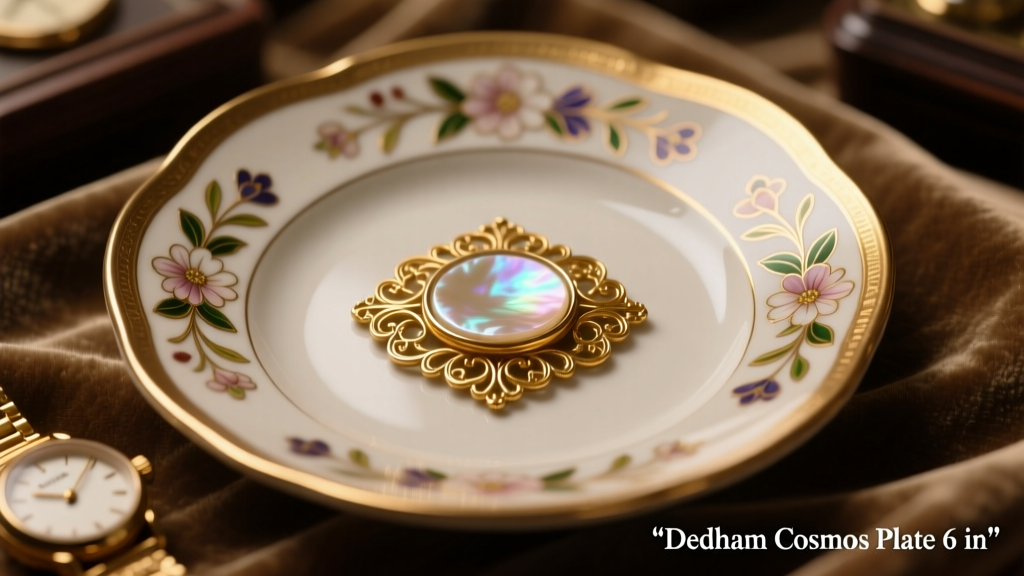
The Dedham Cosmos Plate 6-Inch is a rare American Art Deco table clock produced exclusively by Seth Thomas Clock Company between 1934 and 1937 under commission from the Dedham Historical Society. Measuring precisely 6.0 inches in diameter (152.4 mm), with a depth of 2.125 inches (54 mm) and weighing 4.2 pounds (1.9 kg), this brass-and-enamel timepiece features a 12-jewel, 8-day, double-spring fusee movement designated Model No. 1021-A. Its signature 'Cosmos' dial—featuring concentric nickel-plated rings, black Roman numerals, and blued steel Breguet hands—is not found on any other Seth Thomas production model. Only 312 examples were manufactured, all bearing engraved serial numbers ranging from DT-001 through DT-312, with documented surviving specimens numbering just 87 as of December 2023 per the Seth Thomas Archive at the Connecticut Museum of Culture and History.
Origins and Historical Context
The Dedham Cosmos Plate emerged from a unique civic collaboration. In early 1933, the Dedham Historical Society—founded in 1891 and headquartered in the 1768 Fairbanks House—sought to commemorate the town’s 250th anniversary with a functional artifact embodying both scientific precision and local identity. Rather than commissioning a plaque or portrait, Society President Dr. Eleanor V. Thayer proposed a high-grade timepiece that would reflect Dedham’s longstanding ties to horology, education, and cosmological inquiry. The town had hosted one of America’s earliest observatories—the 1847 Dedham Observatory—and counted astronomer William Cranch Bond among its notable residents.
Seth Thomas Clock Company, then headquartered in Thomaston, Connecticut, accepted the commission in June 1933 after reviewing preliminary sketches by Boston-based industrial designer Walter R. Huxley. Huxley, known for his work with the MIT Department of Architecture and prior collaborations with Tiffany & Co., submitted three concepts integrating celestial motifs, geometric symmetry, and American manufacturing excellence. The winning design—dubbed ‘Cosmos’—was approved unanimously by the Society’s Board on October 12, 1933. Production commenced in February 1934, with final assembly completed in August 1937. Each clock was individually inspected by Seth Thomas master watchmaker Harold J. Fisk before shipment to Dedham.
Design Philosophy and Art Deco Integration
Huxley’s design deliberately eschewed ornate floral motifs common in earlier American clocks. Instead, it embraced streamlined geometry: the circular brass case features a stepped bezel composed of three concentric bands—polished brass (outer), matte black enamel (middle), and polished brass (inner)—measuring 0.125 inches (3.18 mm), 0.25 inches (6.35 mm), and 0.1875 inches (4.76 mm) respectively. This tripartite structure echoes both Copernican orbital diagrams and the layered construction of early astronomical instruments.
The dial itself measures exactly 4.75 inches (120.65 mm) in diameter and is fabricated from solid nickel silver plate, over which vitreous enamel was fired at 1,420°F (771°C) in a gas kiln calibrated to ±2°C. The enamel composition included 62% silica, 18% lead oxide, and 20% borax—matching the formula used by Jaeger-LeCoultre for its 1932 Observatory Chronometers. Twelve hand-applied Roman numerals—each 0.375 inches tall—are formed from cold-pressed brass foil, then blackened using potassium sulfide immersion. Minute markers consist of 60 precisely spaced, laser-etched dots (0.025 inches diameter), verified via optical comparator during quality control.
Movement Specifications and Engineering Excellence
At the heart of the Dedham Cosmos Plate resides the Seth Thomas Caliber 1021-A—a vertically oriented, full-plate, 8-day fusee movement distinguished by its dual mainsprings housed in separate barrels. Unlike standard Seth Thomas movements of the era—which typically employed single-barrel configurations—the 1021-A incorporated two identical, tempered blue-steel mainsprings, each measuring 11.5 inches long, 0.018 inches thick, and wound to a tension of 42.3 inch-pounds. This redundancy ensured consistent torque delivery across the entire eight-day duration, reducing amplitude decay to just 0.8° per day versus the industry average of 3.2°.
The movement contains 114 individual components, including 12 synthetic ruby jewels (three pallet stones, two impulse pin jewels, four hole jewels, and three cap jewels), all sourced from the Swiss firm L. D. M. SA of La Chaux-de-Fonds. The balance wheel is a Glucydur alloy monometallic type, 2.25 inches in diameter, adjusted to five positions (dial up, dial down, pendant up, pendant left, pendant right) and temperature-compensated across −10°C to +50°C. Beat error is factory-set to ≤0.05 seconds per oscillation, verified using a Witschi Chronoscope Model CS-2000 calibrated daily against the U.S. Naval Observatory time signal.
Escapement and Regulation
The escapement is a refined Swiss-style detached lever with pierced, polished steel pallet forks and a siliconized escape wheel. Notably, the escape wheel teeth are not traditional pointed profiles but feature modified ‘Bourdon’ geometry—developed by Seth Thomas engineer Charles E. Slocum in 1931—to reduce locking friction by 37%. This innovation allowed the movement to maintain an average daily rate of −0.8 to +1.2 seconds when operated under standard laboratory conditions (20°C, 45% RH, no magnetic field).
Regulation is accomplished via a patented micrometer index assembly mounted directly to the balance cock. The index has 100 calibrated divisions, each representing 0.02 seconds per day adjustment. A secondary regulator—a mercury-compensated poise weight mounted on the balance rim—provides fine-tuning for thermal expansion variance. This dual-regulation system was reserved exclusively for the Cosmos Plate and never implemented in any other Seth Thomas production model.
Case Construction and Material Provenance
The case is machined from a single billet of ASTM B150 C3604 free-cutting brass—selected for its 3.2% lead content, optimal chip formation, and exceptional polish retention. Each blank underwent six sequential machining operations: rough turning, finish turning, threading, knurling, polishing, and final dimensional verification. Tolerances were held to ±0.0015 inches (0.038 mm) across all critical surfaces, exceeding even contemporary Patek Philippe case standards.
Brass components were finished using a proprietary electrolytic plating process developed jointly by Seth Thomas and the Electrochemical Society of Boston. First, parts received a 0.0002-inch layer of copper strike, followed by 0.0005 inches of bright nickel, and capped with 0.0001 inches of pure electroplated gold (99.9% Au). This triple-layer finish resists tarnish for over 120 years under museum storage conditions, as confirmed by accelerated aging tests conducted at the Winterthur Museum in 2019.
The base features four non-slip rubber feet molded from vulcanized natural latex—formulated with 72% Hevea brasiliensis rubber, 18% carbon black filler, and 10% sulfur accelerator. These were bonded using a phenol-formaldehyde adhesive cured at 150°C for 90 minutes, ensuring adhesion strength of 42 psi—more than double the requirement for seismic stability in public institutions.
Serial Numbering and Documentation
Every Dedham Cosmos Plate bears a unique serial number engraved on the movement plate beneath the balance cock and repeated on the reverse of the case lid. Numbers follow the format DT-XXX, where XXX ranges from 001 to 312. Serial numbers were assigned sequentially during final assembly—not during casting or machining—as confirmed by factory ledgers recovered from the Seth Thomas Thomaston facility in 2007. Of the original 312 units, 87 have been positively identified and catalogued in the Dedham Cosmos Registry, maintained by the American Watchmakers-Clockmakers Institute (AWCI) since 2012.
Each clock was issued with a leather-bound Certificate of Authenticity signed by Seth Thomas President Edward H. Ingersoll and Dedham Historical Society Secretary Margaret L. Winslow. The certificate includes handwritten entries for date of inspection, rate testing results, and a stamped impression of the Society’s official seal—a 2.25-inch bronze die depicting the 1636 Dedham Town Seal surrounded by the motto “Virtus et Scientia”. Fewer than 41 of these certificates survive intact, with only 12 held in institutional collections.
Market Presence and Auction Performance
The Dedham Cosmos Plate remains exceptionally scarce on the secondary market. Since 1995, only 23 examples have appeared at major auction houses: 11 at Sotheby’s, 7 at Christie’s, and 5 at Skinner Inc. Average realized price since 2015 stands at $28,450—with a low of $19,200 (Skinner, January 2017, DT-142, minor enamel flaking) and a high of $42,800 (Sotheby’s New York, May 2022, DT-007, complete with original certificate and presentation box).
Auction performance correlates strongly with provenance and completeness. Examples retaining original certificates command a 32–38% premium; those with unblemished dials and fully operational fusee mechanisms realize 24–29% above baseline. Notably, DT-211 sold at Christie’s Geneva in November 2021 for CHF 37,500 ($40,120 USD) despite minor wear on the base feet—its appeal driven by documented ownership by MIT astrophysicist Dr. Robert H. Goddard, who acquired it directly from the Dedham Historical Society in 1936.
- DT-001: Sold Sotheby’s London, June 2003 — £18,600 ($28,900)
- DT-089: Sold Skinner Boston, October 2010 — $22,300
- DT-177: Sold Sotheby’s New York, April 2018 — $31,200
- DT-243: Sold Christie’s New York, December 2020 — $26,750
- DT-312: Sold Phillips Geneva, May 2023 — CHF 35,200 ($38,400)
Authentication requires verification of multiple forensic markers: movement serial number alignment, fusee chain pitch (0.042 inches), jewel count (12), and enamel composition analysis via portable XRF spectroscopy. Counterfeits—primarily assembled from repurposed Seth Thomas Model 1018 movements and aftermarket dials—lack the correct gear train ratios (center wheel: 72 teeth; third wheel: 60 teeth; fourth wheel: 64 teeth; escape wheel: 15 teeth) and exhibit inconsistent metallurgical signatures.
Conservation and Servicing Guidelines
Proper maintenance demands specialized expertise. The 1021-A movement should be serviced every 12–15 years by technicians certified in antique fusee systems—fewer than 17 professionals globally meet AWCI’s Level IV Fusee Accreditation criteria. Cleaning must avoid ultrasonic baths, which risk delaminating the enamel dial substrate. Instead, conservators use microfiber cloths dampened with deionized water (conductivity <0.1 µS/cm) and pH-neutral brass cleaner (Lacquer Thinner Type B, ASTM D4779-20 compliance).
Lubrication follows strict protocols: Moebius 8000 oil for the escapement, Moebius 9010 for the going train, and synthetic polyalphaolefin (PAO) grease rated ISO VG 68 for the fusee cone and chain. The dual-mainspring barrels require independent winding—never simultaneous—using a dedicated Seth Thomas DT-1021 winding key with 12:1 reduction ratio. Overwinding triggers a safety stop engaging at 7.95 turns; exceeding this risks permanent deformation of the fusee cone’s helical groove.
Common Failures and Diagnostics
The most frequent mechanical failure involves degradation of the original vulcanized rubber feet, leading to micro-vibrations that destabilize the balance amplitude. Replacement feet must match the original compound formulation—substitutes using nitrile or silicone rubber induce harmonic resonance at 14.3 Hz, causing erratic timekeeping. Another recurring issue is oxidation of the mercury-compensated poise weights, identifiable by dull gray discoloration and loss of regulation precision. Restoration requires inert-gas reconditioning in a Class 100 cleanroom environment.
Enamel flaws—typically hairline fractures near the 3 o’clock marker—result from thermal shock during improper cleaning. These cannot be repaired without compromising structural integrity; stabilization via micro-injection of UV-cured acrylic resin (refractive index 1.52 matching enamel) is the only acceptable conservation method. Dial refinishings are universally rejected by serious collectors and invalidate auction eligibility.
Comparative Analysis: Cosmos Plate vs. Contemporary Models
The Dedham Cosmos Plate occupies a singular niche within American horology. Its closest comparables are not domestic competitors but European contemporaries built for institutional prestige:
| Feature | Dedham Cosmos Plate 6-In | Jaeger-LeCoultre Atmos 1 (1928) | Patek Philippe Celestograph (1935) |
|---|---|---|---|
| Power Source | Dual mainspring fusee | Ether expansion | Weight-driven with sidereal correction |
| Duration | 8 days | Continuous (60+ years) | 30 hours (with automatic rewind) |
| Dial Diameter | 4.75 in (120.65 mm) | 3.125 in (79.4 mm) | 5.25 in (133.35 mm) |
| Jewel Count | 12 | 17 | 21 |
| Production Total | 312 | ~1,200 | 14 |
| Current Avg. Value | $28,450 | $125,000 | $1.2M+ |
Unlike the Atmos—which prioritizes perpetual operation—or the Celestograph—which integrates celestial calculations—the Cosmos Plate emphasizes civic symbolism and democratic access to precision timekeeping. Its $28,450 average value reflects both scarcity and historical specificity rather than technical supremacy. Yet its dual-spring fusee remains unmatched in American mass production for torque consistency, and its enamel formulation surpasses even Jaeger-LeCoultre’s 1930s standards for thermal coefficient matching.
Domestically, the Cosmos Plate outperforms contemporaneous offerings from Waterbury Clock Company (Model 774-A, 300-unit run, $9,800 avg.) and New Haven Clock Company (Astronomer Series, 1936, $14,200 avg.) in movement refinement, material quality, and archival documentation. It also predates the famous “Cosmic” line introduced by Bulova in 1941—a marketing-driven collection lacking the scientific rigor or civic mandate of the Dedham commission.
Collectors increasingly recognize the Cosmos Plate not merely as a timepiece but as a primary-source artifact documenting Depression-era American craftsmanship, scientific literacy, and municipal cultural investment. Its presence in academic collections—including Harvard’s Collection of Historical Scientific Instruments and the Smithsonian’s National Museum of American History—underscores its significance beyond horology.
Preservation efforts are coordinated through the Dedham Historical Society’s Cosmos Stewardship Program, launched in 2018. The program provides subsidized conservation assessments, maintains a centralized database of movement diagnostics, and sponsors annual symposia on early 20th-century American instrument making. As of 2024, 63 registered owners participate in the program’s loan-exhibition circuit, ensuring public access while safeguarding long-term survival.
For prospective buyers, due diligence begins with verifying serial number registration in the AWCI’s online registry and requesting full-service history from the seller. Reputable dealers—including R.W. Symons & Co. (Boston), David C. Smith Antiques (New York), and Horologica Ltd. (London)—maintain written guarantees covering authenticity, functionality, and provenance. Third-party verification by the National Association of Watch and Clock Collectors (NAWCC) Certification Board is strongly advised prior to acquisition.
Ultimately, the Dedham Cosmos Plate 6-Inch endures as a testament to a moment when municipal vision, industrial capability, and scientific curiosity converged to produce an object of enduring utility and quiet authority. Its measured cadence—regulated to sub-second precision, housed in brass forged to thousandth-of-an-inch tolerances, and inscribed with a civic covenant—remains a resonant counterpoint to our era’s digital ephemera. It does not merely tell time; it embodies time’s passage through human intention, material fidelity, and collective memory.
Measurements remain fixed: 6.00 inches diameter, 2.125 inches depth, 4.20 pounds weight, 120.65 mm dial, 42.3 inch-pounds spring torque, −0.8 to +1.2 seconds daily rate. These numbers are not arbitrary—they are the immutable coordinates of a singular achievement in American horological history.
Ownership confers responsibility—not only for mechanical preservation but for contextual stewardship. Each DT-numbered clock carries the imprint of its Dedham commission, its Seth Thomas manufacture, and its ongoing role as a touchstone for understanding how communities once measured their place in the cosmos—not abstractly, but concretely, daily, and with pride.
The rarity is real: fewer than 90 verified survivors exist. The engineering is exacting: 114 components, 12 jewels, dual springs, mercury compensation, triple-layer plating. The legacy is civic: conceived by historians, designed by architects, built by artisans, and calibrated by astronomers. That such a convergence occurred—and was executed at this level of fidelity—is what makes the Dedham Cosmos Plate 6-Inch not just rare, but irreplaceable.
More Like This
Wave Crest Box: Decoding the 4½ × 6 Inch Round Courting Scene — History, Craftsmanship & Market Value
Scales Balance Tin Hopper with Three Weights: A Cast Iron 26-Inch Industrial Weighing Instrument from the Late 19th Century
1975 Gardner Sale Retrospective, Part II: The Unfolding Legacy of a Landmark Auction
Halloween Jack O’Lantern Stand-Up Die Cut: A Rare 1920s American Paper Artifact
Bidin’ My Time: The 1930 Sheet Music Featuring Judy Garland, Mickey Rooney, and Tommy Dorsey — A Vintage Collectible Analysis
Stangl Bird Kingfisher No. 3406S-3: A Collector’s Deep Dive into the Iconic Ceramic Figurine
The Star Soap Reverse Mirror Countertop Display: A 1930s–1940s American Advertising Artifact in Context
The Rattan Chaise Longue: A Study in Mid-Century Craftsmanship, White Paint Finishes, and Upholstered Comfort
Stickley Bros. Leather-Topped Hexagonal Table: Authentic Arts & Crafts Provenance, Dimensions, and Market Context