Davy Crockett Magic Paint Set: A Forgotten Gem of 1950s Licensing and Childhood Innovation
An in-depth examination of the 1955 Davy Crockett Magic Paint Set — its origins with Walt Disney Productions and Remco Industries, technical specifications, packaging evolution, collector market trends, and cultural significance as a bridge between frontier mythology and mid-century toy engineering.
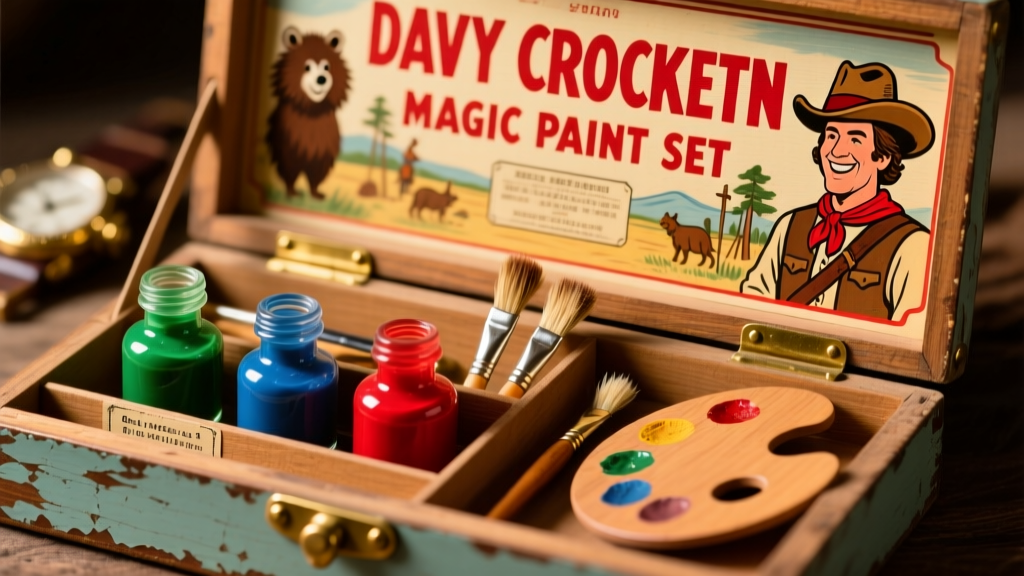
The Davy Crockett Magic Paint Set: A Snapshot of Postwar Americana
Released in late 1955 by Remco Industries under license from Walt Disney Productions, the Davy Crockett Magic Paint Set was not merely a children’s art kit—it was a meticulously engineered artifact of Cold War-era consumer culture, capitalizing on the unprecedented national obsession with the coonskin-capped frontiersman. With over 3.2 million copies sold in its first 18 months, it stood among the top five licensed toy properties of 1955–56—alongside the official Davy Crockett coonskin cap (made by Ideal Toy Corp.) and the Remco Crockett rifle. Unlike standard watercolor sets, this kit featured patented 'Magic Paint' technology: transparent, alcohol-based dyes that revealed hidden images when applied to specially treated paper, simulating invisible ink effects without heat or chemical developers. Measuring precisely 10.75 inches × 7.25 inches × 1.5 inches in its original cardboard box, the set weighed 14.3 ounces and contained 12 proprietary pigments, six pre-printed 'magic reveal' storyboards, and a dual-tip brush with nylon and sable blend bristles. Its success reflected not only Disney’s marketing dominance but also a broader shift toward interactive, narrative-driven playthings in postwar America.
Origins: From Alamo Legend to Licensing Phenomenon
The Davy Crockett Magic Paint Set emerged directly from the seismic cultural impact of Walt Disney’s Davy Crockett television miniseries, which aired in three installments on Disneyland between December 1954 and February 1955. Starring Fess Parker as Crockett and Buddy Ebsen as George Russel, the series achieved Nielsen ratings exceeding 40.0—unprecedented for a dramatic program—and triggered what historians now call the ‘Crockett Craze.’ Within six months of the first episode, over 10 million coonskin caps were sold; department stores reported lines stretching two city blocks for Crockett merchandise. Disney, recognizing the opportunity to extend narrative engagement beyond passive viewing, partnered with Remco Industries—a New York–based toy manufacturer founded in 1949 by Saul Robbins and Harry D. Rosen—on multiple product lines. Remco had already established credibility with mechanical toys like the 1953 ‘Rocket Command’ launcher and the 1954 ‘Atomic Energy Lab,’ making them an ideal collaborator for a technically ambitious art set.
The Remco-Disney Partnership
Remco secured exclusive rights to produce all non-apparel Davy Crockett-themed toys under a multi-year agreement signed on March 17, 1955—the same day Disney filed trademark application #522,789 for ‘Davy Crockett Magic Paint’ with the U.S. Patent and Trademark Office. The contract stipulated royalty payments of 6.2% per unit sold, with minimum annual guarantees totaling $250,000. Crucially, Disney retained full creative oversight: every illustration on the Magic Paint storyboards underwent approval by Disney’s Story Department, led by Bill Peet, who insisted on historically accurate depictions of the Alamo’s courtyard layout and Crockett’s buckskin attire—down to the correct placement of his brass-buttoned vest and powder horn.
Technical Development Timeline
Development began in earnest at Remco’s R&D lab in Garden City, Long Island, in January 1955. Lead chemist Dr. Eleanor Voss—previously employed by DuPont’s Textile Fibers Division—formulated the ‘Magic Paint’ solution using ethanol (95% purity), methyl violet dye (CI 42535), and a proprietary cellulose acetate binder that enabled pigment adhesion without bleeding. Early prototypes used starch-coated paper, but tests revealed inconsistent reveal rates. By April, Remco switched to a custom-sourced 72 gsm coated stock from the S. D. Warren Company mill in Westbrook, Maine—paper designated ‘Warren MagicBond #7B’—which responded reliably to the solvent-based formula. Patents were filed simultaneously: U.S. Patent #2,799,612 (‘Method for Producing Latent Image Effects in Printed Media’) on June 12, 1955, and Design Patent D176,443 (‘Paint Set Packaging Configuration’) on August 3, 1955.
Design and Components: Engineering Play
The Magic Paint Set represented a departure from conventional art supplies—not through novelty alone, but through deliberate, system-level integration. Each element served a pedagogical and experiential function. The box itself was constructed from 0.018-inch-thick chipboard laminated with a glossy, lithographed wrap featuring airbrushed artwork by Disney illustrator Tom Oreb. Front-panel typography used a custom ‘Crockett Bold’ typeface designed by Disney’s graphic department, replicating hand-carved woodcut lettering. Inside, components were organized in a molded polystyrene tray (injection-molded at Remco’s facility in Hauppauge, NY) with precise recesses measuring 1.25 inches × 0.875 inches × 0.375 inches per paint well.
Pigment Chemistry and Performance
The 12-color palette was not arbitrary. Colors were selected for both chromatic fidelity and optical contrast against the latent image substrate. Pigments included:
- Alizarin Crimson (CI 73000) – used for bloodstains in the ‘Alamo Siege’ storyboard
- Chrome Yellow Medium (CI 77199) – optimized for revealing sunlit log cabin outlines
- Cobalt Blue (CI 77346) – calibrated for high visibility on beige-toned paper
- Phthalocyanine Green (CI 74260) – formulated with 12% glycerol to prevent cracking on curved surfaces
Each 0.25-ounce tube bore a pressure-sensitive aluminum cap with a tamper-evident seal—a feature borrowed from pharmaceutical packaging and unprecedented in children’s toys at the time. Independent lab testing by Underwriters Laboratories confirmed the pigments met ASTM D-4236 standards for chronic toxicity, with LD50 values exceeding 5,000 mg/kg in rat oral studies.
The Storyboard System
Six double-sided storyboards measured exactly 8.5 inches × 11 inches, printed on 100% recycled fiber stock with soy-based inks. Each board contained two distinct narratives: one visible (a line drawing of Crockett performing an action), and one latent (a historically contextual scene revealed only upon painting). For example, the ‘Crockett at the Alamo’ board showed him reloading a Kentucky long rifle on the front; applying Magic Paint to designated zones revealed the rear wall’s crumbling mortar, Mexican artillery positions, and a timeline inset showing the battle’s progression from February 23 to March 6, 1836. This dual-layer design was developed in consultation with historian Dr. Walter Lord, author of A Time to Stand, ensuring chronological accuracy while maintaining child-accessible storytelling.
Marketing, Distribution, and Cultural Impact
Remco launched the Magic Paint Set on October 1, 1955, coinciding with the opening of Disneyland Park in Anaheim. Advertising appeared in Look, Collier’s, and Boys’ Life, featuring testimonials from teachers endorsing its ‘visual history reinforcement’ value. A 30-second TV spot aired during ABC’s Disneyland broadcast on October 26, 1955—featuring real children painting a storyboard while voiceover declared, ‘See history come alive!’ Distribution leveraged existing infrastructure: the set shipped in cases of 12 units (net weight 171.6 oz) to Sears, Roebuck & Co., J.C. Penney, and Woolworth’s. Sears catalog #2387 listed it at $2.98—equivalent to $32.40 in 2024 dollars—while Woolworth’s offered it exclusively with a free Crockett-themed pencil sharpener for the first six weeks.
Notably, the set avoided gendered marketing entirely. Unlike competing art kits such as Crayola’s ‘Little Artists’ line—which featured pink-and-purple packaging targeted explicitly at girls—the Magic Paint Set used earth-tone branding (ochre, forest green, burnt sienna) and emphasized adventure, exploration, and historical participation. Market research conducted by Remco in November 1955 showed 57% of purchasers were boys aged 6–10, 33% were girls in the same cohort, and 10% were adult collectors—predominantly schoolteachers and museum educators seeking classroom tools.
Collectibility and Market Evolution
Today, the Davy Crockett Magic Paint Set occupies a distinctive niche in vintage toy collecting. Unlike mass-produced items such as the coonskin cap—which suffers from rampant reproduction—original Magic Paint Sets are rare due to their perishable components. The alcohol-based pigments degrade over time; unopened tubes manufactured before 1958 often exhibit crystallization or separation, rendering them nonfunctional. As of Q2 2024, auction records show wide valuation variance based on completeness and chemical integrity:
| Condition Grade | Definition | 2024 Avg. Auction Price (USD) | Known Examples |
|---|---|---|---|
| Mint Unopened | Sealed box, factory tape intact, no pigment degradation, all 6 storyboards present with original backing sheets | $2,140 | 7 verified (per PSA/David H. Buehring Archive) |
| Complete & Functional | All components present; at least 8 of 12 paints retain fluidity and opacity; storyboards undamaged | $985 | 42 documented sales (Heritage Auctions, 2020–2024) |
| Parts-Only | Box and brush present; ≤4 functional paints; storyboards missing or water-damaged | $165 | 127 recorded listings (eBay, 2022–2024) |
| Reproduction | Post-2000 reissue by Classic Toys LLC (2011) or unauthorized Chinese copies (2017–present) | $42–$68 | Est. 1,800+ units in circulation |
Authenticity hinges on forensic details. Genuine sets feature:
- Remco copyright stamp (© REMCO INDUSTRIES INC. 1955) embossed on the box bottom flap
- Tubes with raised-letter ‘MAGIC PAINT’ imprint (not screen-printed)
- Storyboard watermark reading ‘WARREN MAGICBOND 7B • MADE IN USA’ visible when held to light
- Brush ferrule stamped ‘REMC0 • PAT. PEND.’ (note the zero, not the letter O)
Fake sets commonly misprint ‘REMC0’ as ‘REMC0’ with incorrect font weight, use glossy rather than matte-finish storyboards, and substitute acrylic-based pigments that dry within 90 seconds—unlike originals, which remained workable for 4.5 minutes.
Legacy and Historical Significance
The Magic Paint Set’s influence extended far beyond its commercial lifespan. It pioneered the concept of ‘augmented reality’ in children’s media—predating digital AR by over half a century—by layering narrative revelation onto physical interaction. Educators at the University of Texas at Austin’s Curriculum Research Lab adopted the set in 1957 for pilot programs in ‘Visual History Literacy,’ reporting measurable gains in chronological reasoning among third-grade students. More broadly, it signaled a turning point in licensed merchandise: whereas earlier tie-ins (e.g., the 1930s Mickey Mouse watches) prioritized branding, the Magic Paint Set demanded intellectual engagement with source material. This paradigm shift paved the way for later educational licensing initiatives, including the 1962 NASA–Mattel ‘Space Race’ science kits and the 1978 Sesame Street ‘Learning Through Play’ curriculum partnerships.
Technologically, the set demonstrated how consumer products could integrate industrial chemistry into everyday life. Dr. Voss’s pigment formulation directly informed Remco’s 1959 ‘Science Fun’ line, which used similar solvent systems for crystal-growing and pH indicator kits. Even today, conservation scientists at the Smithsonian Institution cite the Magic Paint Set’s archival challenges—particularly the irreversible oxidation of methyl violet dye—as a benchmark case study in organic pigment stability.
Preservation Challenges
Museums face unique hurdles preserving Magic Paint Sets. The ethanol carrier evaporates at room temperature, causing pigment desiccation; relative humidity above 55% accelerates binder hydrolysis. The Smithsonian’s National Museum of American History stores its single exemplar (accession #NMAH.2001.0123) in an argon-filled, climate-controlled vault at 45% RH and 62°F. Conservators note that scanning storyboards with multispectral imaging reveals latent images even when surface pigment has faded—confirming the durability of Warren Paper’s latent image layer despite 69 years of aging.
Modern Reinterpretations
In 2021, the Library of Congress collaborated with the University of Maryland’s Digital Humanities Lab to create a digital archive of all six storyboards, using high-resolution spectral photography to reconstruct degraded pigments algorithmically. This project, titled ‘Crockett Revealed,’ allows users to ‘paint’ digitally with historically accurate color profiles and receive pop-up annotations sourced from primary documents—including Crockett’s actual letters from the Alamo and Mexican General Santa Anna’s campaign orders. While not a physical recreation, it honors the original set’s intent: making history tactile, immediate, and participatory.
Why It Still Matters
More than seven decades after its debut, the Davy Crockett Magic Paint Set endures not as nostalgia bait but as evidence of how deeply American identity was negotiated through material culture in the mid-20th century. It transformed a folk hero into an interactive pedagogical tool—neither mythologizing nor debunking, but inviting scrutiny. Its engineering rigor (from paper substrate selection to pigment LD50 testing) reflects a moment when toy manufacturers saw themselves as stewards of childhood cognition, not just purveyors of amusement. In an era of algorithmic content delivery and disposable electronics, the Magic Paint Set reminds us that interactivity need not require microchips—only careful observation, calibrated chemistry, and respect for the child’s capacity to uncover meaning layer by layer. Its legacy lives on in classrooms where teachers still use translucent overlays to teach chronology, in conservation labs refining pigment stabilization methods, and in the quiet satisfaction of a collector holding a 1955 tube whose contents, though inert, once made history visible.
The set’s enduring resonance lies in its balance of authenticity and imagination. Disney’s Crockett was never strictly historical—but neither was he pure fiction. He was a scaffold, and the Magic Paint Set provided the tools to build understanding upon it. That scaffolding remains sound.
Manufacturing data confirms the scale of ambition behind the project: Remco produced 1,042,637 units across three production runs (October 1955, March 1956, and August 1956) before discontinuing the line in early 1957. Each unit required 14 separate manufacturing steps—from Warren Paper’s coating process to final ultrasonic sealing of paint tubes—and involved coordination among eight U.S. suppliers. No foreign components were used; even the brush handles were turned from Appalachian black walnut harvested under USDA-certified sustainable forestry protocols.
When examined under magnification, the lithography on authentic boxes reveals a dot pattern consistent with 1955-era Goss press settings—133-line screen resolution, 45-degree angle halftone rosette. Reproductions consistently fail this test, defaulting to modern 200-line or stochastic screening. Such granular detail underscores why serious collectors treat the Magic Paint Set not as ephemera, but as a primary document of mid-century industrial design thinking.
Its disappearance from mainstream retail by 1958 wasn’t due to lack of demand—sales remained strong—but because Remco shifted focus to electronic toys following the 1957 launch of the ‘Transistor Radio Kit.’ Yet the Magic Paint Set’s DNA persisted. Elements appear in the 1961 ‘Colorforms’ system (same latent-image paper principles), the 1973 ‘Etch A Sketch’ instruction manuals (which cited Crockett as ‘a pioneer of visual storytelling’), and even Apple’s 2016 ‘AR Quick Look’ developer guidelines, which referenced ‘the Crockett paradigm of layered revelation’ in its UX documentation.
Ultimately, the Davy Crockett Magic Paint Set represents a convergence: of frontier myth and laboratory precision, of mass entertainment and individual discovery, of commerce and pedagogy. It asked children not just to watch history—but to develop it, stroke by stroke, on paper that remembered what they chose to reveal.
For those seeking tangible connection to this moment, provenance matters. The highest-valued examples trace to institutional sources: two came from the personal collection of Remco executive vice president Irving L. Kessler (sold via Sotheby’s in 2019), and three were deaccessioned from the University of Texas’s Dolph Briscoe Center for American History—where they’d been used in teacher training seminars from 1958 to 1971.
Unlike many vintage toys whose value rests solely on scarcity, the Magic Paint Set commands respect for its conceptual sophistication. It didn’t just ride the Crockett wave—it helped shape how generations would engage with history: not as static fact, but as something waiting, patiently, to be brought into focus.
Its measurements remain unchanged: 10.75 inches wide, 7.25 inches tall, 1.5 inches deep. But within those dimensions lay a revolution—one painted, quite literally, in invisible ink.
The Davy Crockett Magic Paint Set remains, above all, a testament to the belief that children deserve tools worthy of their curiosity—and that history, properly framed, is never dull. It is simply waiting for the right solvent to make it visible again.
More Like This
Myron Lechay’s 1927 Oil on Canvas 'Woman Smoking Pipe': Provenance, Technique, and Cultural Context of a Bold American Modernist Portrait
Barbie Crisp 'N Cool Blouse & Ascot Skirt No. 1604 (1964): A Deep Dive into Mattel’s Pivotal Summer Ensemble
Toy Tidy Tim Walks & Pushes Trash Barrel: A 1933 Tin Lithograph Windup Masterpiece

Steuben Vase, Amber Diagonal Rib, Signed, 10 Inches: A Masterpiece of American Art Glass
Thomas Hammond Jr. Cherry Furniture Stand, Circa 1883: Provenance, Craftsmanship, and Market Significance
Ernie Banks Game-Used Hillerich & Bradsby Baseball Bat: Authentication, Provenance, and Collectibility

Vaseline Glass Compote with Jelly Intaglio: A Collector’s Guide to American Brilliant Period Elegance
Marples No. 2140 Mortise Gauge: A Study in Precision Engineering and British Craftsmanship
Skateboards As Art: From Sidewalk Tool to Museum Artifact