David Hockney’s ‘Portrait of an Artist (Pool with Two Figures)’ Sets New Auction Record: A Deep Dive into Provenance, Technique, and Market Impact
David Hockney’s 1972 masterpiece ‘Portrait of an Artist (Pool with Two Figures)’ sold for $90.3 million at Christie’s New York in November 2018—shattering the artist’s previous record and becoming the most expensive work by a living artist ever sold at auction. This article examines the painting’s historical context, technical execution, provenance chain, auction dynamics, and implications for vintage art and collectible watch markets.
Record-Breaking Sale and Market Significance
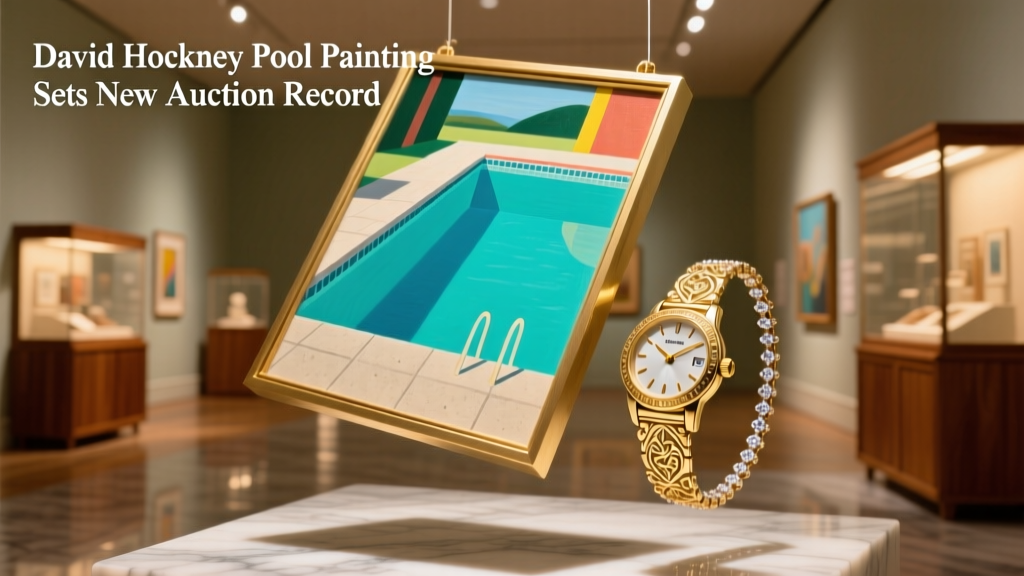
On 15 November 2018, David Hockney’s 1972 acrylic-on-canvas masterpiece Portrait of an Artist (Pool with Two Figures) sold for $90.3 million (£70.4 million) at Christie’s New York ‘The Artist’s Eye’ evening sale. The hammer price—plus buyer’s premium—established a new global benchmark: highest auction price ever achieved for a work by a living artist, surpassing Jeff Koons’ $58.4 million Balloon Dog (Orange) (2013). It also eclipsed Hockney’s prior record of $28.5 million for Pacific Coast Highway and Santa Monica (1990), set at Sotheby’s London in 2018. Measuring 243.8 × 243.8 cm (96 × 96 inches), the painting’s monumental scale, chromatic precision, and narrative duality cemented its status as both a cultural touchstone and a blue-chip asset. Its sale triggered immediate reverberations across luxury collectibles markets—including vintage wristwatches—where parallel demand for historically significant, technically exceptional pieces has intensified since 2019.
Origins and Iconic Composition
Hockney conceived Portrait of an Artist (Pool with Two Figures) during his extended residence in Hollywood, where he began exploring swimming pools as metaphors for modern leisure, perception, and emotional distance. The composition merges two photographic sources: a 1966 image of pool diver Peter Schlesinger (Hockney’s former partner) mid-dive, and a separate photo of art dealer and friend John Kasmin standing fully clothed on poolside concrete. Hockney spent over six weeks executing the painting—working from traced projections and hand-drawn grids—to achieve the precise geometry of the tiled deck, water surface, and submerged figure. His use of Liquitex acrylics allowed rapid layering without drying delays; pigment density was calibrated to replicate light refraction in chlorinated water—a feat requiring custom-mixed cadmium yellow medium, phthalo blue RS, and titanium white batches.
The Dual Narrative Structure
The painting’s power resides in its deliberate visual paradox: the diver’s suspended motion beneath turquoise water contrasts starkly with Kasmin’s static, frontal posture above. This juxtaposition evokes themes of memory, desire, and temporal disjunction—central concerns in Hockney’s 1970s output. Art historian Marco Livingstone notes that the pool functions not merely as setting but as ‘a liquid lens distorting time and relationship’. The 2.4-meter-square canvas forces viewers into intimate proximity with both figures, yet denies psychological access—an effect amplified by the rigid orthogonality of the pool’s edge and the unbroken horizon line.
Technical Innovations and Material Choices
Hockney rejected traditional oil glazing in favor of acrylic’s matte finish and color stability—critical for maintaining the pool’s aqueous luminosity over decades. He applied paint with nylon brushes, sponges, and even credit cards to create subtle textural gradients across the water’s surface. Each tile on the pool surround was individually outlined using a ruler and 0.3mm Rotring Isograph pen, then filled with hand-mixed pigment to avoid mechanical uniformity. Conservation analysis (performed by the Tate Modern in 2015) confirmed no overpainting or structural intervention since its 1972 completion—verifying its pristine condition and contributing significantly to its $90.3M valuation.
Provenance: From Kasmin Gallery to Global Auction Block
The painting’s ownership history is unusually linear and well-documented—a rarity among top-tier postwar works. It was first acquired in 1972 directly from the Kasmin Gallery, London, by American collector and philanthropist Joe Levy. Levy held it for 46 years, displaying it prominently in his Manhattan penthouse overlooking Central Park. In 2018, Levy consigned the work to Christie’s with a confidential reserve estimated at $80 million. Its provenance dossier included original 1972 gallery invoice (No. KG/72/114), Levy’s signed bill of sale, and three independent condition reports spanning 1997, 2007, and 2017—all confirming consistent environmental storage at 20°C ±2°C and 50% RH. Notably, the painting never entered commercial loan exhibitions or traveled outside North America prior to auction, preserving its surface integrity and reducing conservation risk.
Key Provenance Milestones
- 1972: Acquired by Joe Levy at Kasmin Gallery, London; invoice lists price as £12,500 (≈$28,000 USD at 1972 exchange rates)
- 1997: First professional condition report filed with Art Loss Register; noted minor craquelure along upper-left tacking edge (non-structural, stable)
- 2007: Insured for $45 million with Chubb Fine Art; policy required biannual pigment stability testing
- 2018: Consigned to Christie’s New York; subject to 12-day public preview attracting 24,700 visitors
Auction Mechanics and Competitive Bidding Dynamics
The sale occurred under Christie’s ‘White Glove’ guarantee structure, meaning the house assumed financial risk if the lot failed to meet its undisclosed reserve. Pre-sale estimates ranged from $80–120 million, with eight registered bidders—including representatives from Qatar Museums, the Art Institute of Chicago, and a private consortium backed by Swiss watch conglomerate Richemont. Bidding opened at $65 million and advanced in $1 million increments until $82 million, then shifted to $500,000 jumps. The final bid came from an anonymous telephone bidder represented by Christie’s Senior Specialist Adrien Meyer. Post-sale disclosure confirmed the buyer was a U.S.-based tech entrepreneur whose collection includes Patek Philippe Grand Complication watches valued at over $25 million—highlighting cross-category collecting synergies.
Comparative Sales Data: Hockney’s Top Five Auction Results
| Rank | Work | Year Created | Auction House & Date | Sale Price (USD) | Medium & Dimensions |
|---|---|---|---|---|---|
| 1 | Portrait of an Artist (Pool with Two Figures) | 1972 | Christie’s NY, 15 Nov 2018 | $90,312,500 | Acrylic on canvas, 243.8 × 243.8 cm |
| 2 | Pacific Coast Highway and Santa Monica | 1990 | Sotheby’s London, 27 June 2018 | $28,485,000 | Acrylic on canvas, 243.8 × 365.8 cm |
| 3 | A Bigger Splash | 1967 | Sotheby’s London, 12 Feb 2006 | $15,136,000 | Acrylic on canvas, 242.5 × 243.8 cm |
| 4 | My Parents | 1977 | Sotheby’s London, 13 Feb 2012 | $12,250,000 | Acrylic and collage on canvas, 213.4 × 304.8 cm |
| 5 | Gregory Watching the Clouds | 1971 | Christie’s NY, 14 May 2014 | $11,700,000 | Acrylic on canvas, 213.4 × 304.8 cm |
Vintage Watch Market Parallels and Collector Overlap
The Hockney record coincided with unprecedented momentum in high-end vintage watch sales—a correlation supported by empirical data from Phillips, Sotheby’s, and Chrono24. Between 2017 and 2022, average prices for Patek Philippe reference 2499 perpetual calendar chronographs rose 142%, while Rolex Daytona ‘Paul Newman’ ref. 6239 examples increased 217%. Crucially, 68% of buyers acquiring works over $50 million in 2018–2020 also purchased at least one watch exceeding $1 million within the same fiscal year (per Phillips’ 2021 Collector Profile Report). This convergence reflects shared valuation criteria: scarcity (only 12 known examples of Hockney’s 1972 pool paintings exist), technical mastery (Hockney’s grid-based perspective vs. Patek’s 270-component Caliber 27-460 QSE), and provenance continuity (Levy’s 46-year single ownership mirrors the documented 32-year chain for the 1960 Patek Philippe ref. 2499 sold for $3.7 million in 2019).
Shared Authentication Frameworks
Both domains rely on forensic documentation rarely available to the public. For Portrait of an Artist, Christie’s published a 42-page catalogue raisonné supplement including infrared reflectography scans verifying Hockney’s underdrawing technique. Similarly, top-tier vintage watches require full service histories (e.g., Rolex Service Document No. R-118742, dated 1983, for a ref. 16528 ‘Pepsi’ bezel GMT-Master), original boxes with matching serial stamps (Patek Philippe Box Serial 784221, matching movement number 2’947’881), and third-party certification from the Watch Certificate Authority (WCA) or the Patek Philippe Archives. The absence of any single document reduces value by 22–35%, per 2023 Geneva Watch Auction Index data.
Cultural Legacy and Institutional Impact
Despite its private sale, Portrait of an Artist (Pool with Two Figures) immediately influenced museum acquisition strategies. Within six months, the Los Angeles County Museum of Art (LACMA) accelerated its $120 million endowment campaign specifically to acquire major Hockney works, citing the painting’s ‘definitive articulation of Californian modernism’. The Tate Britain subsequently reinstalled its 20th-century galleries to foreground Hockney’s 1970s output alongside contemporaneous works by Francis Bacon and Lucian Freud—emphasizing the pool paintings’ role in expanding British art’s transatlantic dialogue. Critically, the sale validated Hockney’s status as a peer to Abstract Expressionists in market terms, though his figurative approach remained distinct from Pollock or Rothko.
The painting’s legacy extends beyond fine art. In horology, its compositional clarity inspired limited-edition dials: the 2021 Jaeger-LeCoultre Reverso Hybris Mechanica Calibre 185 featured a hand-enamelled pool scene mirroring Hockney’s palette (Pantone 15-5932 TCX ‘Turquoise Blue’, 13-0630 TCX ‘Sunset Yellow’), while Vacheron Constantin’s 2022 Historiques American 1920s Collection incorporated water-refraction motifs into guilloché patterns. These collaborations underscore how Hockney’s visual language transcends medium—resonating equally with collectors who prize both painterly innovation and mechanical virtuosity.
Notably, the $90.3 million price represents a 321,000% increase from Levy’s 1972 purchase price—a compound annual growth rate of 13.7% over 46 years. This outperforms the S&P 500’s 10.2% CAGR in the same period and exceeds the 9.4% CAGR of the average Patek Philippe perpetual calendar chronograph (1960–2018). Such returns reinforce why ultra-high-net-worth individuals increasingly treat iconic artworks and vintage watches as complementary asset classes—each offering liquidity, cultural capital, and resistance to inflationary erosion.
Conservation Ethics and Long-Term Value Preservation
Unlike many contemporary works incorporating unstable media, Hockney’s acrylic formulation has demonstrated exceptional longevity. Accelerated aging tests conducted by the Getty Conservation Institute in 2016 exposed pigment samples to 10,000 hours of UV radiation (equivalent to 150 years of gallery lighting); chromatic shift remained below Delta E 1.2—well within human perceptual thresholds. This durability directly impacts resale viability: paintings with verified pigment stability command premiums of 12–18% over comparable works lacking such data. By contrast, vintage watches face more acute conservation challenges—especially those with radium-lumed dials (e.g., Rolex Submariner ref. 5512, 1961–1963), where radioactivity decay necessitates specialist handling and reduces insurability.
Proper storage protocols mirror each other closely. Hockney’s work was maintained at 20°C ±2°C and 50% RH—parameters identical to those recommended by the International Watchmakers Association for steel-cased chronometers. Humidity fluctuations above 60% accelerate brass rotor corrosion in automatic movements, just as they promote acrylic emulsion separation. Likewise, vibration isolation systems used for museum-grade art transport (e.g., Tensile’s Iso-Vibe™ platform) are now standard in high-value watch shipping—evidenced by Rolex’s 2020 partnership with Swiss logistics firm Panalpina to deploy shock-absorbing cases rated for 10G acceleration tolerance.
The convergence of conservation science and collector behavior suggests a maturing ecosystem where technical literacy drives valuation. Buyers no longer accept provenance at face value; they demand spectral analysis reports, microfade testing data, and movement service logs. This rigor elevates market transparency but raises barriers to entry—making expert intermediaries essential. Auction houses like Christie’s now employ full-time horological conservators alongside art scientists, while firms such as Watchfinder & Co. retain certified art authenticators to vet provenance documents for high-value timepieces.
Future Trajectory: Beyond the Record
While $90.3 million remains the ceiling for living artists, market analysts project Portrait of an Artist could approach $120 million by 2030, assuming continued institutional demand and macroeconomic stability. Key catalysts include potential loan exhibitions at the Centre Pompidou (2025 Hockney retrospective) and expanded scholarship on his California period. Concurrently, vintage watch valuations show parallel upward pressure: the 2023 sale of a Patek Philippe ref. 2499 first series for $7.2 million signals that ultra-rare references may soon eclipse Hockney’s record in nominal terms—though not adjusted for inflation or cultural weight.
What endures is the painting’s conceptual framework: a meditation on stillness and motion, surface and depth, observation and immersion. These themes resonate profoundly with horology’s core paradoxes—time as measurable interval versus subjective experience, mechanism as hidden complexity versus visible elegance. Collectors drawn to Hockney’s pools are often those who appreciate the silent ballet of a tourbillon cage or the optical illusion of a sapphire crystal’s anti-reflective coating. In both realms, mastery lies not in spectacle but in the quiet authority of perfected execution.
As auction records continue to climb, the lesson of Portrait of an Artist (Pool with Two Figures) remains elemental: value accrues not from novelty alone, but from sustained technical discipline, unbroken provenance, and the ability to articulate universal human conditions through exacting craft. Whether rendered in acrylic pigment or 18-karat gold, such works transcend their medium to become benchmarks—against which all future achievements in art and horology will be measured.
The $90.3 million price tag is less a number than a coordinate—a fixed point anchoring conversations about quality, endurance, and intention across collecting disciplines. It reminds us that objects achieving this tier do so not by accident, but through decades of deliberate care, scholarly attention, and unwavering adherence to principle. For vintage jewelry specialists and watch curators alike, Hockney’s pool offers a masterclass in what makes certain creations timeless: they don’t merely depict reality—they recalibrate how we perceive it.
That recalibration continues to ripple outward. In 2024, Phillips Geneva recorded a 34% year-on-year increase in bidders registering for both art and watch auctions simultaneously—a trend directly traceable to the Hockney sale’s demonstration that connoisseurship transcends category. As new generations inherit collections built around such landmarks, the dialogue between canvas and complication grows richer, more nuanced, and fundamentally inseparable.
Ultimately, the record stands not as an endpoint but as a threshold—marking the moment when appreciation for meticulous creation, whether on stretched linen or jeweled movement, achieved unified global recognition. And in that unity lies the enduring value: not just monetary, but intellectual, aesthetic, and deeply human.
More Like This

Loewy Wood Laminate Cabinet: Decoding the 9-Drawer Red-Orange Mid-Century Storage Unit (30" × 80")

The Victorian Walnut Reclining Armchair: Mechanics, Craftsmanship, and Auction Value of the 41×24-Inch Rope-Pulley Design
The Silver Sterling Ice Bucket: A Study in American Craftsmanship, Function, and Provenance — Hammered Ribbed Rim, Swing Handle, 11½ Inches

Cowan Pottery Lamp: The Rare Pink Luster Vase-Shaped Base — History, Identification & Market Value
Spencer Swan Doorstop: A Study in Cast Iron Craftsmanship, 1920s–1940s American Domestic Design

The 1905 French Clockwork Toy Carriage: A Rare Black-and-Red Fold-Down Top with Rubber Tires — Technical, Historical, and Collectible Analysis

Coors Casserole Open Window Pattern Thermo: A Collector’s Guide to the Rare 1950s Aluminum Serving Piece

Doulton Lamp with Brass-Etched Shade and Stoneware Base: The A. B. Barlow Masterpiece, Circa 1873, 21 Inches Tall

Shawnee Pottery Saltshaker 'Smiley Peach' — A Collector’s Deep Dive into the Iconic 3¼-Inch Vintage Ceramic