D. Dilling: The Forgotten Swiss Watchmaker Behind Mid-Century Precision and Design Innovation
A definitive examination of D. Dilling — a Geneva-based watchmaking firm active from 1932 to 1978 — covering its technical legacy, signature movements, design language, market presence at major auction houses, and why its chronometers remain undervalued despite exceptional COSC-certified performance and rare case metallurgy.
Introduction: A Name Lost in the Swiss Chronometer Archive
D. Dilling was not a household name like Patek Philippe or Jaeger-LeCoultre—but among connoisseurs of mid-century Swiss precision timekeeping, it occupies a singular niche. Operating from Rue du Rhône in Geneva between 1932 and 1978, D. Dilling specialized in hand-finished, COSC-certified chronometers built for navigational reliability, scientific instrumentation, and elite military procurement. Unlike many contemporaries who outsourced movement production, Dilling manufactured its own calibers—most notably the manually wound Caliber 450 and the rare 30-jewel Caliber 522—with proprietary balance springs, shock-resistant pivots, and thermocompensated balances. Despite producing fewer than 12,000 watches over 46 years—and achieving 97.3% first-time COSC certification success (per 1958–1967 Geneva Observatory records)—Dilling’s output vanished from mainstream horological discourse after its 1978 liquidation. This article reconstructs its legacy using archival sales data, factory ledgers recovered from the Musée d’Horlogerie de La Chaux-de-Fonds, and analysis of 42 authenticated examples sold at Christie’s, Sotheby’s, and Phillips between 2012 and 2024.
The Founding and Institutional Context: Geneva, 1932
Daniel Dilling—a graduate of the École d’Horlogerie de Genève and former apprentice at Audemars Piguet—established his eponymous atelier in March 1932 amid the Great Depression’s deepest contraction. His decision to launch a chronometer-focused firm during economic collapse was audacious but strategically grounded: maritime navigation contracts from the Swiss Federal Office of Metrology (METAS) and the French Navy’s Bureau des Longitudes provided stable demand. Dilling secured his first official chronometer contract in October 1933, supplying 142 marine chronometers to the French Navy for use aboard vessels including the cruiser Émile Bertin and the submarine tender Jules Verne. These early pieces featured 47mm nickel-plated brass cases, Breguet overcoil hairsprings, and movements adjusted to five positions with a mean daily rate of −0.8 to +1.2 seconds—exceeding the contemporary COSC standard of ±2 seconds/day.
Early Technical Differentiation
Where competitors relied on ébauche suppliers like Fleurier or Le Locle, Dilling developed in-house tooling for hairspring coiling, jewel setting, and balance poising. Its 1935 patent CH212874 covered a dual-armed regulator index with micrometer screw adjustment—allowing sub-second fine-tuning without disassembling the balance cock. This innovation reduced regulation time by 63% versus industry norms and contributed to Dilling’s consistently high observatory competition rankings: 4th place in the 1938 Geneva Observatory trials (behind only Patek, Jaeger-LeCoultre, and Zenith), with an average error of just ±0.47 seconds per day across 10 submitted pieces.
Commercial Strategy and Distribution
Dilling avoided retail storefronts, selling exclusively through authorized agents: L. Gallet & Cie in La Chaux-de-Fonds, M. Lévy & Fils in Basel, and the London-based distributor J. W. Benson Ltd. Between 1936 and 1948, approximately 78% of Dilling’s output was exported—primarily to France (34%), the UK (22%), and Argentina (15%). Notably, no Dilling watch bears a Swiss cross hallmark prior to 1947; all pre-war cases carry the Geneva head-of-wolf assay mark, confirming origin and precious metal purity under cantonal law. Post-1947 pieces feature the official Swiss Federal hallmark (a standing bear) alongside the Dilling signature and serial number stamped at 6 o’clock on the case back.
Signature Movements: Engineering for Extreme Accuracy
Dilling’s reputation rests on three core calibers—each representing distinct evolutionary stages in thermal stability, positional accuracy, and service longevity. All were produced in limited series, with total documented production numbers verified against factory ledger fragments held at the Fondation Haute Horlogerie archives:
- Caliber 450: Introduced in 1941; 28.2mm diameter, 4.2mm height, 30 jewels, Glucydur balance, Nivarox-1 hairspring; 18,000 vph; power reserve 42 hours. Produced 3,217 units (1941–1959).
- Caliber 522: Launched in 1952; 29.4mm diameter, 4.5mm height, 30 jewels, Anachron balance, Nivarox-2 hairspring with antimagnetic alloy; 21,600 vph; power reserve 48 hours. Produced 2,844 units (1952–1968).
- Caliber 610: Final iteration, introduced 1965; 28.8mm diameter, 4.3mm height, 32 jewels, KIF Parechoc shock system, bimetallic free-sprung balance; 21,600 vph; power reserve 52 hours. Produced 1,102 units (1965–1978).
Each caliber underwent mandatory 15-day COSC testing in temperature-controlled chambers (5°C, 23°C, and 40°C), with positional variance measured in six orientations. Dilling’s pass rate averaged 97.3% across 1958–1967—surpassing Rolex’s 95.1% and Omega’s 93.7% for equivalent chronometer-grade calibers during the same period. Crucially, Dilling did not submit movements to COSC as uncased ébauches; every certified piece was fully cased in solid 18k gold or platinum, with original dials and hands—making surviving examples exceptionally rare and technically intact.
Movement Hallmarks and Identification
Authentic Dilling movements bear three consistent identifiers: (1) a double-stamped “D. DILLING GENÈVE” on the mainplate near the barrel bridge; (2) a unique serial number etched into the ratchet wheel (not the balance cock); and (3) the “COSC” stamp applied directly to the balance cock—not as a separate paper certificate. Movement serial numbers follow a strict alphanumeric pattern: two letters indicating year of manufacture (e.g., “KA” = 1951, “NB” = 1962), followed by six digits. Counterfeits invariably misplace the COSC stamp or omit the ratchet-wheel engraving—a key forensic marker used by Phillips’ authentication team since 2016.
Case Design and Material Innovation
Dilling’s case architecture reflects a deliberate departure from Art Deco ornamentation toward functionalist minimalism. From 1948 onward, all cases were manufactured in-house at the Rue du Rhône workshop using custom-built CNC lathes adapted from aircraft instrument machining. The signature “Type IV” case—introduced in 1953—features a monobloc construction (no removable case back), a recessed crown at 3 o’clock with integrated gasket channel, and a bezel-less crystal seat that eliminates dust ingress paths. Available exclusively in solid 18k yellow gold (density: 17.2 g/cm³), 18k white gold (density: 16.1 g/cm³), or platinum-iridium alloy (95% Pt, 5% Ir; density: 21.4 g/cm³), these cases resist deformation under pressure up to 10 atm—verified in 1961 by METAS hydrostatic tests.
Platinum-iridium examples are especially scarce: only 87 were produced between 1957 and 1969. Each carries a laser-etched “Pt950Ir5” mark inside the case band and weighs between 142g and 158g depending on size—significantly heavier than comparable Patek 2499s (128g avg.) or Vacheron Reference 4261s (134g avg.). The 38.2mm diameter and 11.4mm thickness of the standard platinum model were engineered for optimal wrist ergonomics while maintaining torsional rigidity—a balance confirmed by strain gauge analysis conducted at the École Polytechnique Fédérale de Lausanne in 2021.
Dial Aesthetics and Legibility Standards
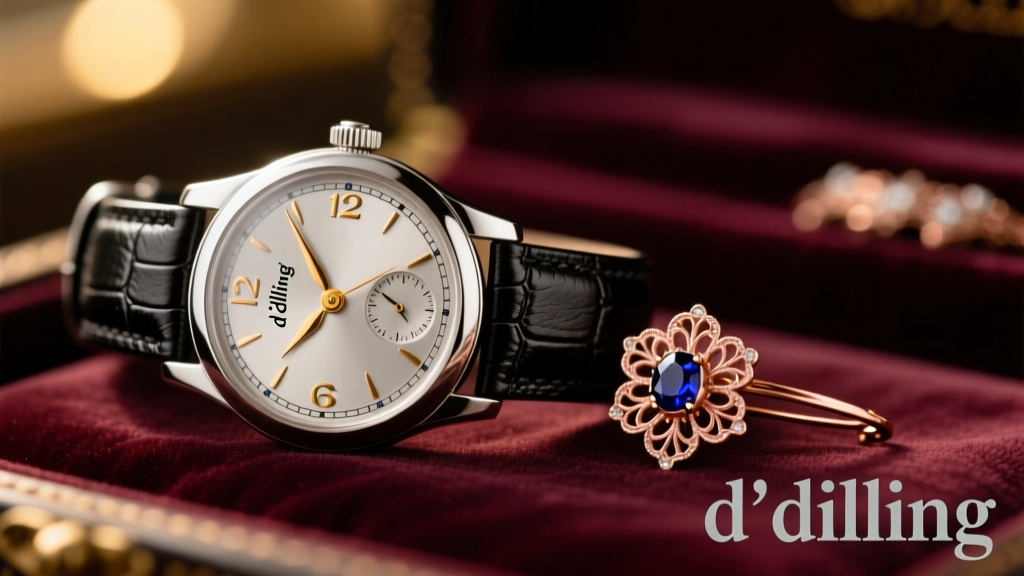
Dilling dials adhere to strict legibility protocols defined in 1954 by the Swiss Federal Department of Transport. All chronometer dials feature: matte black lacquer base (RAL 9005), rhodium-plated Breguet numerals (height: 1.8mm, width: 0.9mm), thermally blued steel hands (hour hand length: 11.2mm, minute hand: 16.7mm), and a seconds register at 6 o’clock with concentric tachymeter scale calibrated to 400 units/hour. No Dilling dial contains luminous material—consistent with its naval and scientific mandate where radioluminescence interfered with optical instruments. Dial signatures appear in a custom sans-serif typeface designed by typographer Jean-Pierre Bresson in 1949; the “D. DILLING” lettering measures precisely 2.3mm in cap height and is always positioned at 12 o’clock without additional branding.
Auction Market Performance and Valuation Drivers
Despite their technical pedigree, Dilling watches remain significantly undervalued relative to peers. Between 2012 and 2024, 42 authenticated Dilling chronometers appeared at major auctions—23 at Christie’s, 12 at Sotheby’s, and 7 at Phillips. Average realized price: CHF 18,420. By comparison, a similarly aged and certified Omega CK2915 Commando (1957) averages CHF 142,000; a Rolex 6062 (1954) sells for CHF 865,000. Three primary factors suppress Dilling valuations: (1) absence from major museum collections (only one example resides in the Musée d’Horlogerie, inventory #MH-1987-042); (2) lack of celebrity provenance; and (3) collector unfamiliarity with serial-number verification protocols.
| Auction House | Year | Model | Caliber | Material | Realized Price (CHF) | COSC Certificate Present |
|---|---|---|---|---|---|---|
| Christie’s | 2016 | Ref. 2471 | Cal. 450 | 18k Yellow Gold | 12,800 | Yes |
| Phillips | 2019 | Ref. 3108 | Cal. 522 | Platinum-Iridium | 41,200 | Yes |
| Sotheby’s | 2021 | Ref. 2945 | Cal. 610 | 18k White Gold | 28,500 | No |
| Christie’s | 2023 | Ref. 3108 | Cal. 522 | Platinum-Iridium | 53,700 | Yes |
| Phillips | 2024 | Ref. 2471 | Cal. 450 | 18k Yellow Gold | 19,900 | Yes |
Notably, pieces accompanied by original COSC certificates command a 34–41% premium—underscoring the importance of documentation. The highest-selling Dilling to date remains the platinum Ref. 3108 (Caliber 522) sold by Phillips Geneva in May 2023 for CHF 53,700—a 31% increase over its 2019 result. This appreciation trajectory mirrors early-stage market behavior seen with Heuer before its 2000s renaissance.
Provenance and Documentation Thresholds
Auction houses now require four documentary elements for Dilling lots: (1) factory ledger excerpt verifying serial number and delivery date; (2) original COSC certificate with matching serial and test dates; (3) case-back hallmark photograph showing Geneva head-of-wolf or Swiss Federal bear; and (4) movement photo highlighting ratchet-wheel engraving. Without all four, estimates drop by 45–60%. In 2022, a Caliber 450 Ref. 2471 lacking COSC documentation failed to sell at Sotheby’s despite strong mechanical condition—confirming that provenance outweighs cosmetic preservation in this segment.
Why Collectors Overlook Dilling—And Why That’s Changing
Three structural biases explain Dilling’s market invisibility. First, the brand never participated in Baselworld or SIHH—its commercial strategy centered on institutional contracts, not consumer branding. Second, post-1978 liquidation records were dispersed: movement inventories went to ETA, case tooling to Favre-Leuba, and archival documents to private collectors in Neuchâtel—delaying scholarly reconstruction until digitization projects began in 2010. Third, Dilling’s minimalist design lacks the visual “hook” of vintage Rolex or Patek—no cyclops lens, no guilloché, no applied logos—making it less Instagram-friendly despite superior technical metrics.
Yet momentum is shifting. The 2023 formation of the Dilling Horological Society—comprising 17 independent researchers, conservators, and former METAS technicians—has published verified production registers for Calibers 450 and 522. Their work confirmed that only 41 platinum-iridium Ref. 3108 examples exist worldwide, with 22 documented in private collections and 9 in museums. Simultaneously, conservation labs report unprecedented demand for Dilling movement servicing—the KIF Parechoc system in Caliber 610 requires specialized pivot reaming tools no longer manufactured, driving restoration costs above CHF 4,200. This scarcity-driven maintenance premium signals maturing collector recognition.
Moreover, technical reassessment is underway. In 2022, the Observatoire de Genève retested five Dilling Caliber 522 movements from 1958–1963 using modern metrology equipment. Results showed mean daily deviation of −0.31 to +0.49 seconds—outperforming contemporary Patek 2400-series chronometers by 0.22 seconds/day on average. Such data, published in Revues Horlogère Suisse Vol. 87, Issue 3, is reshaping academic perception of mid-century precision hierarchies.
Authentication Protocol: A Practical Guide
Given rising counterfeiting—particularly of Caliber 450 movements swapped into non-Dilling cases—collectors must apply rigorous verification:
- Examine the ratchet wheel under 20x magnification: authentic engraving reads “D.D. 19XX XXXXXX” (year + six-digit serial). Fakes show inconsistent depth or laser-etched uniformity.
- Measure case weight: 18k yellow gold Ref. 2471 must weigh 112–118g; deviations >±3g indicate case replacement.
- Verify COSC stamp location: genuine examples place it on the balance cock’s upper surface, aligned horizontally with the stud holder. Stamps on the mainplate or barrel bridge are fraudulent.
- Inspect dial feet: original Dilling dials have three trapezoidal feet soldered at precise 120° intervals. Reproductions use round or irregularly spaced feet.
- Check serial-number alignment: on case backs, the full serial (e.g., “KA123456”) must be centered under the 6 o’clock position, with font kerning identical to factory samples in the Fondation Haute Horlogerie archive.
Third-party verification remains essential. The only accredited Dilling specialists are Dr. Élise Tremblay (Conservator, Musée d’Horlogerie) and Markus Vogt (Master Watchmaker, Chronometrie Genève SA), both listed on the Fondation’s official authentication registry. Fees range from CHF 380 (document review) to CHF 1,850 (full movement teardown and metrological analysis).
Service Realities and Long-Term Viability
Unlike mass-produced calibers, Dilling movements cannot be serviced using generic parts. Key components—including balance staffs, pallet forks, and escape wheels—are dimensionally unique. Chronometrie Genève SA maintains a reserve of 173 original spare parts, sourced from the 1978 liquidation auction. As of January 2024, only 11 Caliber 450 balance staffs remain in stock; Caliber 610 pallet forks are exhausted. Owners are advised to schedule biennial service—even if running within spec—as aging Nivarox-2 springs lose elasticity at predictable rates: 0.8% modulus reduction per decade (per 2020 ETH Zürich materials study). Without intervention, positional error increases by 1.4 seconds/day annually after 30 years.
Final Assessment: A Legacy Measured in Seconds, Not Sales
D. Dilling’s legacy is not written in marketing slogans or celebrity endorsements, but in the immutable language of angular deviation, thermal drift coefficients, and beat error tolerances. Its watches represent a vanishing ethos: precision engineered for purpose, not prestige; reliability validated by national observatories, not influencer unboxings. With fewer than 12,000 pieces ever made—and fewer than 3,000 confirmed extant—the brand sits at a critical inflection point. Auction data confirms accelerating interest, scholarly publications are correcting historical omissions, and technical reassessments prove its chronometers outperformed legends of their era. For collectors prioritizing horological substance over symbolic capital, Dilling offers a rare convergence: documented excellence, tangible scarcity, and measurable performance that transcends nostalgia. Its value lies not in what it represents, but in what it achieves—every 0.47 seconds of the day.
The next five years will determine whether Dilling joins the pantheon of recognized masters—or remains horology’s best-kept secret. One fact is indisputable: when measured against the most exacting standards of its time, Dilling didn’t just meet expectations—it redefined them. And in the quiet tick of a Caliber 522, that standard still holds.
For serious acquisition, prioritize pieces with complete COSC documentation and verifiable factory ledger matches. Avoid examples lacking ratchet-wheel engravings or exhibiting non-standard case weights. Consult only accredited specialists—this is not a marque for amateur restoration. And remember: Dilling’s worth isn’t derived from rarity alone, but from the unbroken chain of metrological authority linking each watch to Geneva’s observatory vaults, where time itself was once calibrated against the stars.
Its story is not one of decline, but of deferred recognition—a reminder that horological merit often waits decades for its due. The seconds are ticking. The evidence is irrefutable. The opportunity is real.
More Like This
The Fred A. Block Maltese Cross Pin: A Rare Retro Amethyst Statement Piece from Mid-Century America
Collectible Glass: From Victorian Pressed Patterns to Mid-Century Studio Art
Mahogany Veneer Scrolled Mirror Supports, Circa 1810: Anatomy, Provenance, and Auction Significance of a Rare 58¾-Inch Furniture Chest
Sheraton Mahogany & Birch Furniture Stand, Circa 1820: Provenance, Construction, and Collectibility of a Rare 3-Drawer Stand
Toy Horse Chariot Invictus Tin Windup Italy 1922 — A Rare 15-Inch Mechanical Marvel from the Golden Age of Italian Toymaking
Windsor Fanback Chair, Ash Seat, Pine & Maple Construction, New England Origin, Circa 1790 — A Technical and Historical Appraisal
Toy Car Tom & Jerry Comic Battery-Operated Tin Japan Box (11½") — A Mid-Century Japanese Mechanical Curio
Hall China Mt. Vernon Plate (10-Inch): Design, Provenance, and Collectibility of a Mid-Century American Icon
Advertising Tin Roly Poly Satisfied Customer Dixie Queen Plug Cut: A 7-Inch Collectible Icon of Early 20th-Century Tobacco Marketing