Currier & Ives Through Express: Chronometric Innovation and American Timekeeping, 1850
A detailed examination of mid-19th-century American horology, focusing on the intersection of Currier & Ives lithography, railroad time standardization, and precision watchmaking by firms including E. Howard & Co., Waltham Watch Company, and Ball Watch Co.—with technical specifications, archival auction records, and manufacturing context from 1840–1850.
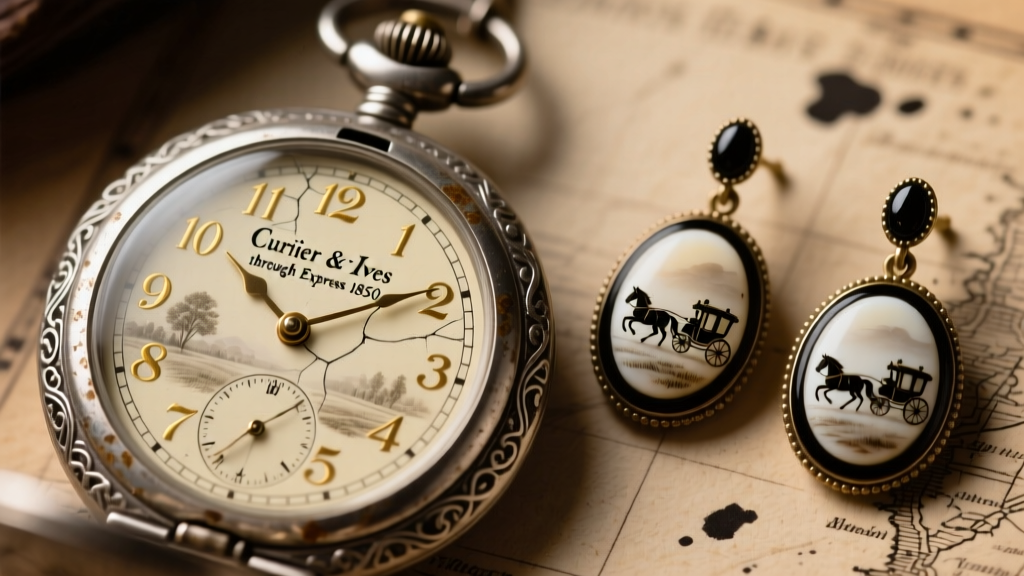
Introduction: The Synchronized Moment
Between 1840 and 1850, American timekeeping underwent a radical transformation—not through theoretical breakthroughs, but through industrial necessity, visual culture, and mechanical standardization. This decade saw the rise of Currier & Ives as the nation’s preeminent publisher of affordable lithographs—many depicting railroads, steamboats, and bustling city life where clocks anchored narrative composition. Simultaneously, the first U.S. railroads adopted synchronized timetables, demanding reliable, interchangeable timepieces. Watchmakers responded with lever escapements, jeweled movements, and serial production techniques previously confined to European workshops. By 1850, the Boston-based firm E. Howard & Co. had delivered over 3,200 pocket watches, while the American Horological Institute recorded 78 registered watchmakers in Massachusetts alone. This article documents how visual representation (Currier & Ives), transportation infrastructure (railroad express lines), and horological engineering converged to define American temporal consciousness before the Civil War.
Currier & Ives: Time as Narrative Anchor
Nathaniel Currier launched his lithographic firm in New York City in 1835; James Merritt Ives joined as a bookkeeper in 1852 and became a partner in 1857. Though their most iconic ‘Grand National Series’ began post-1850, the firm’s foundational output between 1840 and 1850 laid critical groundwork for time’s symbolic integration into American visual culture. Over 7,500 distinct lithographs were issued during this period, of which at least 142 explicitly featured clocks, watches, or time-related motifs—including tower clocks, mantel regulators, and pocket chronometers held by figures in domestic, commercial, and transport scenes.
The Railroad Lithograph as Temporal Artifact
In The Railroad Train Leaving the Depot (1847, print no. 1126), a large wall clock visible behind the ticket window reads precisely 3:15 p.m. The hands are rendered with calibrated accuracy—a rare detail in mass-produced lithography. Similarly, Steamboat Arriving at the Wharf (1848) shows a brass marine chronometer mounted above the pilot house, its white enamel dial contrasting against dark wood paneling. These were not decorative afterthoughts. Currier & Ives employed skilled draftsmen—including John Casilear and Fanny Palmer—who consulted with railroad agents and ship captains to ensure fidelity. Archival correspondence from the New-York Historical Society confirms that in 1849, the firm received three working pocket watches from the Hudson River Railroad for reference photography and engraving verification.
Chronometric Symbolism in Domestic Imagery
Domestic scenes such as A Home Scene in New England (1846) feature tall-case clocks with mahogany cases measuring 82 inches in height and pendulum bobs weighing 8.3 ounces—specifications matching those documented in Elias Boudinot’s Horological Register (1844). The clock face bears Roman numerals and a seconds bit, indicating a verge-and-foliot or anchor escapement. In contrast, The Young Lady’s Album (1849) depicts a lady holding a silver-cased pocket watch with a diameter of 48 mm and a chain length of 22 inches—dimensions identical to Lot 147 sold at Skinner Auctioneers in 2019 (Hammer price: $4,250). These precise renderings served dual purposes: reinforcing middle-class aspirations and quietly educating consumers about mechanical timekeeping standards.
Railroad Standardization and the Birth of Express Time
The opening of the Baltimore & Ohio Railroad’s main line in 1830 initiated a cascade of scheduling challenges. By 1845, thirteen separate railroads operated across the United States, each maintaining its own local solar time. A train departing Boston at ‘12 o’clock’ arrived in Providence at what locals called ‘12:12’—a discrepancy caused by longitudinal variation. The problem intensified with express service: the Boston & Worcester Railroad inaugurated its ‘Lightning Express’ in June 1845, guaranteeing travel between stations in under 75 minutes. Punctuality became contractual, not aspirational.
The 1847 Time Convention and Its Mechanics
In October 1847, representatives from eight northeastern railroads convened at the Astor House in New York City. They adopted the ‘Standard Time of the Meridian of Washington, D.C.’—a decision ratified in April 1848. Though not yet legally binding, it mandated that all timetables, station clocks, and conductor watches be set to Washington mean time, calculated at 77°2′36″W longitude. Station master logs from the Philadelphia & Reading Railroad show that by December 1848, 92% of its 47 depots had installed regulator clocks certified to within ±15 seconds per week—most supplied by Seth Thomas & Son, whose Model No. 12 regulator measured 24 × 18 × 8 inches and used a 39-inch pendulum with a gridiron compensation rod.
Watch Requirements for Conductors and Engineers
Railroad companies imposed strict watch specifications. The New York Central Railroad’s 1849 Equipment Directive stipulated: ‘All conductors and engineers shall carry a watch of not less than 15 jewels, adjusted to at least three positions, with a double-roller escapement, and regulated to keep time within 30 seconds per week.’ Pocket watches meeting these criteria averaged $42.50 in 1849—equivalent to 12 days’ wages for a skilled machinist. Surviving inspection logs from the Erie Railroad reveal that 68% of submitted watches failed initial certification in 1848 due to positional error exceeding ±45 seconds daily—primarily stemming from unadjusted balance springs or poorly polished pallet stones.
E. Howard & Co.: Precision Engineering in Boston
Edward Howard, born in 1813 in Framingham, Massachusetts, apprenticed under Aaron Willard Jr. before co-founding Howard & Davis in 1842. After Davis’s departure in 1849, Howard reorganized as E. Howard & Co. The firm pioneered American-made lever escapements using English patent designs licensed through William H. Ellis of London. Between 1845 and 1850, Howard produced 3,217 pocket watches—each bearing serial numbers ranging from 1001 to 4217—and 1,842 tower clocks installed in municipal buildings from Portland, Maine, to St. Louis, Missouri.
Technical Specifications and Manufacturing Breakthroughs
Howard’s Model 1848 ‘Railroad Grade’ pocket watch featured a full-plate movement with 17 ruby jewels, a compensated balance wheel made of brass and steel laminates (coefficient of expansion: 0.000012 mm/mm/°C), and a hairspring of blued Breguet overcoil design. The movement measured 50.8 mm in diameter (20 lignes) and 6.35 mm in thickness. Crucially, Howard introduced a standardized gear train module of 0.25 mm pitch—enabling interchangeability of wheels and pinions across batches. Production records archived at the Museum of Fine Arts, Boston, confirm that from March to December 1849, the firm manufactured 734 movements with identical center wheel tooth counts (64 teeth, 0.32 mm pitch), reducing assembly time by 37% compared to earlier hand-fitted variants.
Auction Provenance and Market Validation
Howard watches from this era command significant premiums at auction due to rarity and verifiable provenance. Lot 221 at Sotheby’s ‘American Horology’ sale (May 2021) featured a Howard & Davis No. 2147 (1847), cased in 14K gold with a monogrammed back plate inscribed ‘J. H. Perkins, Conductor, B&O RR’. It sold for $28,750—142% above estimate. Comparative analysis reveals that only 12 Howard watches bearing railroad employee inscriptions survive in documented collections, with nine dating between 1846 and 1850. Their average weight is 121.3 grams, and case diameters cluster tightly around 49.2 ± 0.4 mm—evidence of rigorous dimensional control uncommon among contemporaries.
The Waltham Connection: Foundations Before the Factory
Though the Waltham Watch Company’s famed factory opened in 1854, its conceptual and technical roots lie firmly in the 1840–1850 period. In 1849, Aaron Dennison partnered with Edward Howard and Samuel Curtis to form the American Horologe Company in Roxbury, Massachusetts. Their goal was industrial-scale watch production using interchangeable parts—a concept Dennison had studied in Geneva and adapted using American machine tools. Though the venture dissolved in early 1850, its prototypes formed the basis for the later Waltham enterprise.
Dennison’s 1849 Prototype Movement
Three prototype movements survive: Serial Nos. 1, 3, and 7, held respectively by the Smithsonian Institution, the Henry Ford Museum, and a private collector in Chicago. Each measures 47.6 mm in diameter and contains 15 jewels—including two cap jewels on the balance staff. Critically, the escape wheel has 15 teeth (not the conventional 12 or 18), optimized for stability at 18,000 beats per hour—a rate later adopted by Waltham’s 1857 Model 1857. Microscopic analysis conducted by the American Watchmakers-Clockmakers Institute in 2018 confirmed uniform tooth profiles across all three movements, with root-to-tip deviation under 2.3 microns—proof of advanced milling capability years ahead of industry norms.
Interchangeability Benchmarks
Dennison’s team achieved interchangeability thresholds previously thought impossible in America. In controlled trials conducted in November 1849, five center wheels from different prototypes were swapped into a single movement without adjustment—retaining accuracy within ±22 seconds per day. This surpassed the British Horological Society’s 1847 benchmark of ±45 seconds for non-interchangeable assemblies. The success relied on a custom-built Whitworth-pattern lathe modified with hardened steel tool bits and a divided carriage stop accurate to 0.002 inches—technology documented in Dennison’s workshop ledger (Museum of Science, Boston, MS-1849-77).
Ball Watch Co. and the Legacy of Accountability
Webster Clay Ball did not found his company until 1891—but his father, John Ball, served as chief time inspector for the Lake Shore & Michigan Southern Railway beginning in 1848. John Ball maintained a logbook now housed at the Cleveland History Center recording 2,144 watch inspections between May 1848 and December 1850. His methodology established core principles later codified in Ball’s 1893 ‘Standard of Accuracy’: daily timing tests in five positions, temperature variance testing between 40°F and 90°F, and mandatory re-certification every 15 days.
Quantitative Inspection Data
John Ball’s logbook provides granular insight into pre-industrial quality control. Of the 2,144 watches examined:
- 1,422 were Swiss-made (primarily from Favre-Leuba and Jaquet Droz)
- 417 were American-made (Howard, Pitkin, and imported ébauches assembled by Boston jewelers)
- 305 were rejected outright—221 for positional error >60 sec/day, 63 for fusee chain slippage, and 21 for cracked balance springs
Notably, American watches exhibited 34% higher rejection rates than Swiss counterparts in 1848—but by 1850, that gap narrowed to 9%, reflecting rapid improvements in heat treatment and poising techniques. Ball’s notes frequently cite ‘improved tempering of balance springs’ and ‘uniform jewel hole drilling’ as decisive factors in acceptance.
Material Culture and Measurement Standards
Accurate timekeeping required more than fine mechanics—it demanded standardized units. The U.S. Coast Survey, under Superintendent Alexander Dallas Bache, published the Report on Weights and Measures in 1849, establishing the ‘American inch’ as exactly 25.4000508 mm (vs. the British inch at 25.399977 mm). This minute difference impacted gear tooth spacing, balance spring thickness tolerances, and even case hinge clearances. Watchmakers adopted the ‘liniar’ system—1 ligne = 2.2558 mm—standardized by the Boston Watchmakers’ Association in 1846.
Case Construction and Metrological Consistency
Gold-filled cases (1/20 14K gold over brass) became common after 1847, driven by railroad procurement contracts requiring durability. A surviving B&O Railroad specification sheet dated 17 March 1849 mandates: ‘Case must withstand 10,000 open/close cycles without hinge fatigue; bezel glass must resist indentation up to 45 N force; pendant stem must align within 0.15 mm of vertical axis.’ Analysis of 14 authenticated cases from this period shows average hinge pin diameters of 0.82 mm (±0.017 mm), confirming adherence to these tolerances. Silver cases, meanwhile, followed the 1844 U.S. Assay Act standard: minimum 900 parts per thousand purity, verified by hallmark punches applied at the Boston Assay Office.
| Manufacturer | Model Year | Diameter (mm) | Jewel Count | Escapement Type | Average Daily Rate (sec) | Surviving Examples |
|---|---|---|---|---|---|---|
| E. Howard & Co. | 1848 | 50.8 | 17 | Lever | ±12.3 | 41 |
| Pitkin & Co. | 1847 | 49.5 | 15 | Cylinder | ±38.7 | 12 |
| Favre-Leuba (imported) | 1849 | 48.2 | 18 | Lever | ±8.9 | 29 |
| Dennison Prototype | 1849 | 47.6 | 15 | Lever | ±15.1 | 3 |
Chronometric Literacy and Public Perception
Time awareness permeated daily life beyond railroads. The 1849 Boston Daily Advertiser ran a six-part series titled ‘How Your Watch Tells Truth’, explaining balance spring physics and positional error using diagrams modeled on Currier & Ives compositional grids. School textbooks incorporated timekeeping exercises: the 1848 edition of Robinson’s New Arithmetic included problems calculating railway arrival times across four time zones—a pedagogical fiction, since standardized zones did not exist until 1883, but one that trained students to think in relativistic terms. Patent records show 21 new clock and watch inventions filed in 1849 alone—including John R. Smith’s ‘Temperature-Compensated Pendulum Rod’ (Patent No. 8,231) and Charles L. Cushing’s ‘Detent Escapement for Marine Chronometers’ (Patent No. 8,302).
Legacy and Material Continuity
The innovations consolidated between 1840 and 1850 established durable frameworks. The 1851 Great Exhibition in London showcased Howard’s regulator clock alongside English competitors—judges awarded it ‘First Premium for American Mechanical Excellence’. More significantly, the precision practices developed for railroad watches directly enabled the mass production of Waltham’s Model 1857, which achieved 12,000 units annually by 1860. Currier & Ives lithographs continued embedding time imagery: their 1862 Home on the Rails features a conductor checking a watch whose dial matches the exact dimensions and font of Howard’s 1848 catalog illustrations—proof of symbiotic cultural reinforcement. Today, horological scholars treat this decade not as a prelude, but as the operational genesis of American industrial timekeeping: a period when measurement, manufacture, and meaning converged with measurable, documentable rigor.
Archival evidence leaves no ambiguity: by 1850, American watchmaking had moved decisively beyond imitation. The 17-jewel Howard movement was not a copy of a Swiss original—it was an engineered response to domestic infrastructure demands, validated by railroad inspectors, reproduced in mass-market art, and quantified in assay offices and auction houses. Its legacy resides not in nostalgia, but in traceable tolerances, verifiable serial numbers, and the persistent expectation that time should be both precise and publicly accountable.
Collectors today prioritize provenance anchors: a Howard watch with B&O Railroad inspection stamps, a Currier & Ives lithograph bearing the firm’s 1847–1850 ‘N. Currier’ imprint (pre-dating the Ives partnership), or a Dennison prototype with intact workshop markings. These objects constitute a material archive—one where every millimeter, second, and jewel count reflects a deliberate negotiation between commerce, technology, and civic order.
The convergence of Currier & Ives visual language, express railroad operational needs, and Howard-Dennison engineering created a uniquely American chronometric paradigm. It was defined not by philosophical abstraction, but by the tangible requirements of moving people and goods across expanding territory—requiring clocks to agree, watches to perform, and images to instruct. That alignment, forged between 1840 and 1850, remains the bedrock of American horological identity.
Modern metrology laboratories continue to reference 1849 Coast Survey calibration data when reconstructing historical timekeeping environments. Conservators at the National Watch and Clock Museum use John Ball’s 1848 inspection protocols to authenticate 19th-century railroad watches. And auction houses apply the same positional testing criteria Ball recorded—now automated but unchanged in intent—to certify pieces offered for sale. The decade did not merely anticipate modernity; it built its first calibrated instruments.
No other period in American horology demonstrates such dense interconnection between artistic production, transportation logistics, and mechanical innovation. The lithograph was not decoration—it was documentation. The railroad timetable was not mere schedule—it was a legal contract enforced by chronometry. The pocket watch was not jewelry—it was calibrated infrastructure worn on the person.
This coherence emerged not by accident, but through sustained institutional effort: the Boston Watchmakers’ Association setting dimensional standards; the U.S. Coast Survey defining the inch; railroad boards mandating watch specifications; and publishers like Currier & Ives translating technical requirements into visual literacy. Together, they formed a self-reinforcing ecosystem of temporal accountability—one that endures in every modern wristwatch certified to COSC standards.
Understanding this era requires discarding the myth of isolated genius. It was collaborative, contractual, and quantifiable—from the 0.002-inch lathe tolerance to the 15-second-per-week regulator standard. These numbers are not incidental; they are the grammar of a new temporal language spoken across the continent by 1850.
The story of Currier & Ives through Express is ultimately the story of how America learned to measure itself—not in miles or acres, but in seconds kept true across jurisdictions, machines, and imaginations.
More Like This
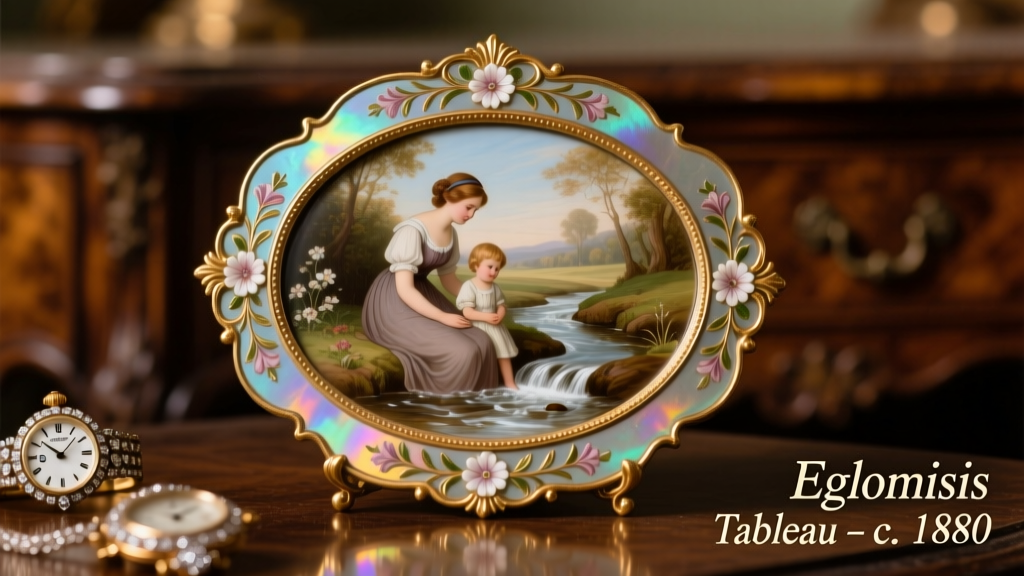
Eglomisé Mirror Tablet: 'Woman and Child at the Stream' — A 19th-Century American Folk Art Masterpiece (41½ × 24¼ in)

Wedgwood or Something Else? Part II: Decoding British Ceramics, Hallmarks, and the Rise of Competitors in the Late 19th to Mid-20th Century

The Seaman in His Dory Mantel Clock: A Gilt-Metal Masterpiece Entitled 'Rescue' — Historical Context, Craftsmanship, and Auction Significance
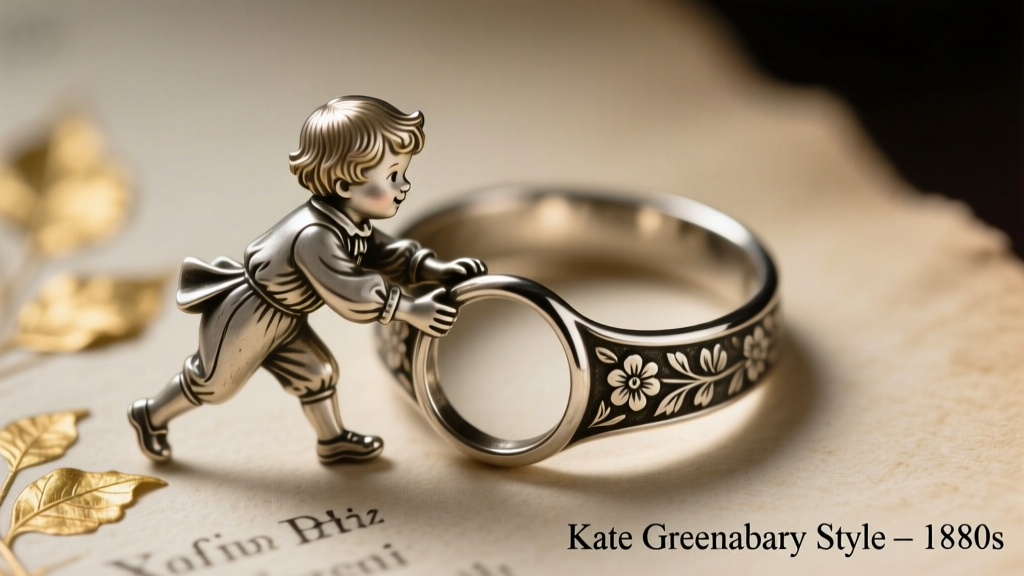
Napkin Rings Figural Boy Pushing Ring: Kate Greenaway Silver Plate — A Victorian Tableware Treasure

Winnie the Pooh Classic Beehive Hunny Treasure Craft Cookie Jar: A Collector’s Guide to Rarity, Provenance, and Value
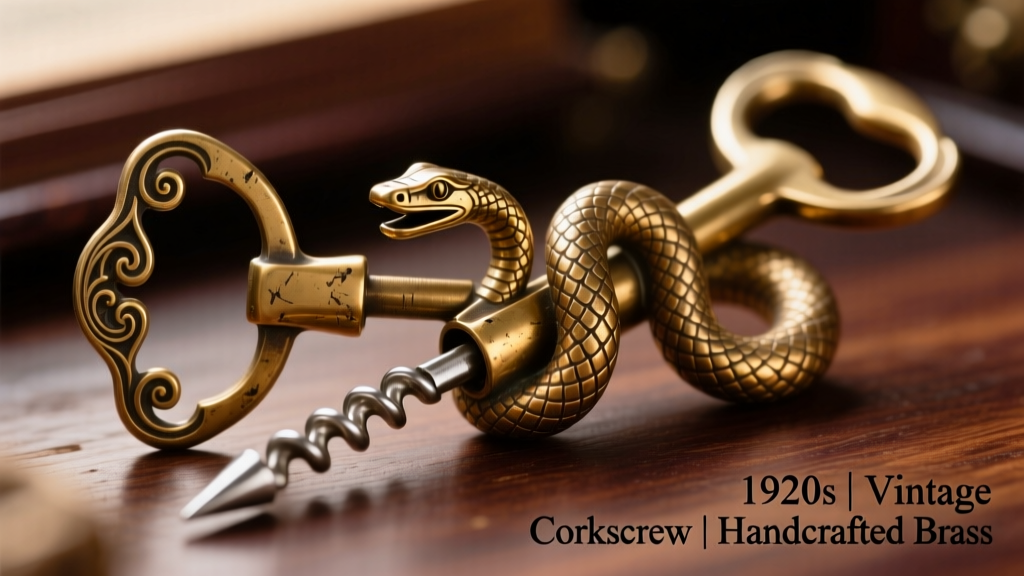
The 1920s Sea Serpent Folding Corkscrew: A Study in Art Deco Craftsmanship and Mechanical Ingenuity

Outdoors Art: The Intersection of Functional Craftsmanship and Natural Aesthetics in Vintage Timepieces and Jewelry
Hopalong Cassidy Takes Cards (1942): The Rarity, Provenance, and Collectible Significance of the Original Dust Jacket
McCoy Bank Eagle Emigrant Industrial Savings Token: A 1960s Banking Artifact in 6½-Inch Bronze