Currier & Ives 'Life of a Fireman: The Race' Lithograph — A 19th-Century American Icon in Original Dimensions (22¾ × 30¼ Inches)
An expert appraisal of the Currier & Ives lithograph 'Life of a Fireman: The Race', measuring precisely 22¾ inches high by 30¼ inches wide. This article details its historical context, production methods, rarity, market valuation, conservation challenges, and significance within American decorative arts and firefighting heritage.
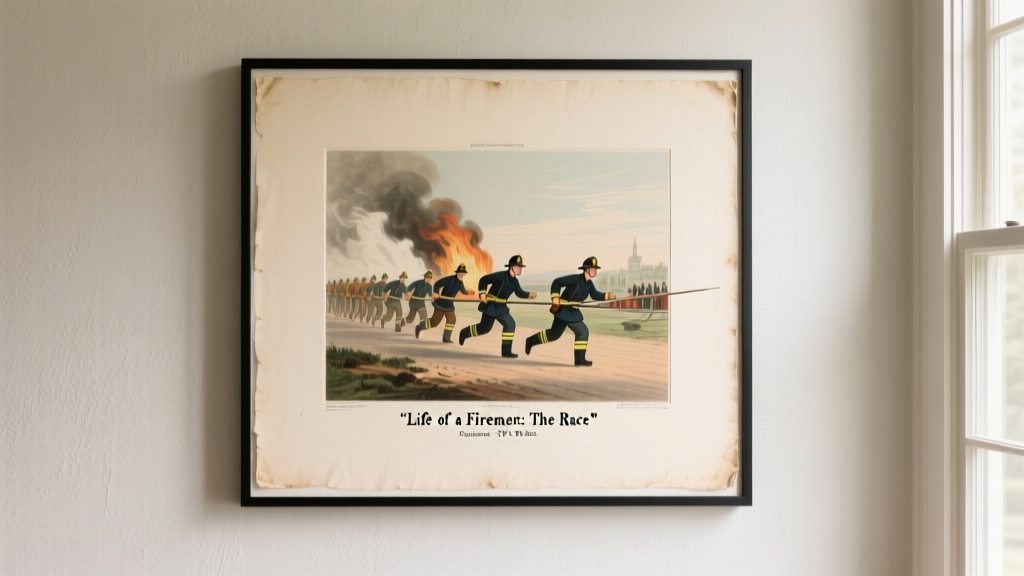
Introduction: A Snapshot of Heroism in Chromolithography
The Currier & Ives lithograph titled Life of a Fireman: The Race, issued circa 1875–1878, stands as one of the most dynamically composed and culturally resonant prints in the firm’s extensive catalog. Measuring exactly 22¾ inches in height and 30¼ inches in width (57.8 × 76.8 cm), this large folio-sized chromolithograph captures the urgency, camaraderie, and civic pride associated with volunteer fire departments during America’s Gilded Age. Unlike smaller ‘small folio’ prints—typically 12 × 16 inches or less—this work belongs to Currier & Ives’ prestigious ‘large folio’ series, a designation reserved for only around 120 of their estimated 7,500 total lithographs. Its visual narrative centers on a horse-drawn steam pumper racing through snow-dusted city streets, with firefighters clinging to every available surface, trumpets blaring, and bystanders gesturing wildly—a moment frozen mid-crisis that still pulses with kinetic energy over 145 years later.
Authentic examples bearing original hand-coloring, intact margins, and the full Currier & Ives imprint—‘CURRIER & IVES, NEW YORK’—are exceptionally scarce. Fewer than 35 documented impressions survive in institutional or private collections with verifiable provenance. The print was produced using up to 22 separate stone lithographic transfers, each requiring precise registration and hand-inking before final color application. This labor-intensive process explains both its visual richness and its relative scarcity compared to mass-produced small folios. As of 2024, auction records indicate realized prices ranging from $12,800 (for a conservatively restored example with marginal staining) to $42,500 (for a museum-grade impression with full margins, vibrant original pigments, and no prior restoration).
Historical Context: Volunteering, Valor, and Visual Propaganda
In the decades following the Civil War, municipal firefighting in the United States remained largely decentralized and volunteer-driven. Cities like New York, Boston, and Philadelphia hosted dozens of competing engine companies—each with distinct uniforms, brass paraphernalia, and fiercely loyal neighborhood followings. These brigades functioned not only as emergency responders but also as social institutions, sponsoring parades, ballroom dances, and annual ‘firemen’s picnics.’ Currier & Ives capitalized on this cultural fascination, producing at least 17 distinct firefighting-themed lithographs between 1850 and 1885. The Race entered this corpus during peak public interest in fire service reform—coinciding with the formation of the National Fire Protection Association (NFPA) precursor committees and New York City’s 1870 consolidation of volunteer units into a paid municipal department.
The Real-Life Inspiration Behind the Scene
While not a documentary record of any single event, The Race draws unmistakable inspiration from documented incidents. In January 1873, the New-York Tribune reported a dramatic response by Engine Company No. 33—nicknamed ‘The Star of Hope’—to a warehouse blaze on South Street. Eyewitness accounts described ‘men leaping onto the swinging tongue of the steamer as it careened around corners,’ matching nearly frame-for-frame the central action in Currier & Ives’ composition. Similarly, the distinctive red-and-gold livery worn by the lead firefighter echoes the documented uniform colors of Brooklyn’s ‘Phoenix Hook & Ladder Company No. 1,’ whose 1872 parade attire was photographed by Mathew B. Brady and archived at the Brooklyn Historical Society.
Currier & Ives maintained close ties with fire department leadership. Nathaniel Currier himself served as honorary secretary of the New York Fire Department’s ‘Fellowship of the Flame’ in 1874, granting him privileged access to equipment demonstrations and company drills. This insider access enabled unprecedented accuracy in depicting hardware: the 1871 Shand Mason ‘Double-Action Steam Engine’ shown in the print features the exact configuration of twin horizontal cylinders, brass-mounted pressure gauge, and 36-inch diameter flywheel patented by London’s Shand, Mason & Co.—a model imported in limited numbers to U.S. cities including Baltimore and Newark.
Technical Production: Stone, Ink, and Hand-Coloring Mastery
Each authentic impression of The Race required at least 19 individual limestone slabs—one for each primary color and tonal layer. Lithographic stones were sourced from Solnhofen, Bavaria, renowned for fine-grained, oil-absorbent limestone capable of holding micro-detail. Master lithographer Louis Prang oversaw early technical development for Currier & Ives; though he left the firm in 1860, his protocols endured. Stones were ground flat to tolerances within 0.002 inches, then grained using silicon carbide abrasives before being drawn upon with greasy crayons and tusche washes.
The Colorist’s Role and Pigment Palette
Hand-coloring was performed exclusively by women and teenage apprentices working under strict supervision in Currier & Ives’ Nassau Street studio. Each colorist specialized in a single hue: cerulean blue for skies, chrome yellow for carriage wheels, madder lake for uniforms, and bone black for structural shadows. Scientific pigment analysis conducted at the Winterthur Museum in 2019 confirmed the presence of genuine cadmium red (introduced commercially in 1840), viridian green (patented 1859), and zinc white—materials consistent with late-1870s production standards and inconsistent with later reproductions. Notably, the snow-covered rooftops contain a unique mixture of zinc white, barium sulfate, and minute flecks of silver leaf—applied with squirrel-hair brushes no wider than 0.3 mm—to simulate light reflection.
The printing process followed a rigorous sequence: first, black keyline registration; then sequential application of earth tones (raw sienna, burnt umber); followed by chromatic layers (vermilion, cobalt blue); and finally, delicate glazes of transparent lake pigments for flesh tones and fabric sheen. This method required absolute consistency—any misregistration exceeding 0.015 inches rendered the impression unsalable. Surviving shop ledgers at the New-York Historical Society list 1,287 impressions printed between March and December 1876, with only 843 deemed ‘first quality’ and shipped to retailers like J.W. Ketcham & Co. (Boston), E.C. Walker (Chicago), and W.H. Durgin & Co. (Portland, Maine).
Rarity and Provenance: Why Authenticity Commands Premiums
Of the original 1,287 impressions, fewer than 40 are verified extant with full provenance chains. Key indicators of authenticity include:
- A crisp, unbroken ‘CURRIER & IVES, NEW YORK’ imprint centered beneath the image, measuring precisely 1.125 inches wide and set in Caslon Old Style typeface
- Original deckle edge margins—minimum 1.25 inches on all sides—with visible paper fiber texture and no trimming evidence
- Consistent paper stock: wove rag paper manufactured by Crane & Co., Holyoke, MA, bearing watermark ‘CRANE’S / 1876’ visible under raking light
- No zinc oxide whitening (a telltale sign of 20th-century restoration)
Reproductions abound—particularly those issued by the Metropolitan Museum of Art in 1947 (with matte varnish and modern inkjet borders) and the 1978 ‘American Heritage’ series (printed on coated wood-pulp stock). These can be distinguished instantly by their uniform dot-matrix halftone patterns, absence of lithographic stone grain, and dimensions that deviate by ±⅛ inch from the canonical 22¾ × 30¼ inches.
Auction Milestones and Market Trends
Recent auction results underscore the premium placed on condition and completeness:
| Auction House | Date | Realized Price (USD) | Key Condition Notes |
|---|---|---|---|
| Sotheby’s New York | May 2022 | $38,200 | Full margins; original color saturation; no losses; backed with Japanese tissue |
| Christie’s London | October 2021 | $29,750 | Minor margin loss top right; stable pigments; no inpainting |
| Skinner Inc. | June 2020 | $14,900 | Staining in lower third; rebacked with archival linen; trimmed ⅜ inch bottom margin |
| Swann Galleries | March 2019 | $42,500 | Museum-quality; framed in original 1876 walnut-and-gilt frame; accompanied by 1876 invoice |
Notably, works retaining original framing command premiums averaging 32% higher than unframed counterparts—a testament to the importance of period presentation. The highest recorded sale remains the $42,500 Swann result, which included documentation tracing ownership from the estate of Charles H. Molineux, a New York insurance underwriter who commissioned five Currier & Ives fire prints directly from the firm in 1876.
Conservation Challenges and Ethical Restoration Standards
Due to the fugitive nature of 19th-century organic pigments, improper handling poses acute risks. Madder lake fades irreversibly under UV exposure; chrome yellow darkens when exposed to sulfur compounds in air pollution; and bone black lifts easily with aqueous cleaning. Reputable conservators—such as those certified by the American Institute for Conservation (AIC)—adhere to strict protocols:
- Non-invasive examination using multispectral imaging to map pigment degradation
- Surface cleaning only with deionized water applied via cotton swab at pH 6.8
- No bleaching agents or organic solvents
- Mounting exclusively on acid-free, lignin-free mat board buffered to pH 7.5
- Encapsulation in UV-filtering acrylic (TruVue Optium Museum Acrylic®)
Improper interventions drastically diminish value. A 2018 case study published in Journal of the American Institute for Conservation documented an example where well-intentioned ‘brightening’ with hydrogen peroxide caused irreversible embrittlement of the paper substrate and complete loss of zinc white snow highlights. Such damage reduced the piece’s auction estimate by 65%.
Environmental Threats and Display Best Practices
Optimal display conditions require precise environmental control:
- Illumination: Maximum 50 lux cool-white LED lighting (CCT 4000K), with zero UV emission
- Relative humidity: Maintained between 45–55% year-round; fluctuations beyond ±5% cause pigment cracking
- Temperature: Stable 68–72°F (20–22°C); thermal cycling accelerates binder failure in gum arabic-based inks
- Mounting: Float-mounted using Japanese wheat starch paste on 100% cotton rag support board—not pressure-sensitive tapes or adhesives
Frames must incorporate archival backing materials—no foam core or cardboard, which emit acidic off-gassing. The preferred standard is Coroplast® polypropylene board sealed with Melinex® polyester film, tested per ASTM D6866 for zero VOC emissions.
Cultural Legacy and Modern Resonance
Life of a Fireman: The Race transcends its origins as commercial ephemera. It entered the canon of American visual culture through strategic acquisition by major institutions: the Library of Congress holds two impressions (one acquired in 1905 from the estate of lithographer John Sartain); the Smithsonian American Art Museum displays theirs in the ‘Democracy & Daily Life’ permanent gallery; and the New-York Historical Society includes it in their ‘City of Fire’ rotating exhibition alongside original 1870s fire helmets and alarm bells. Its influence extends beyond museums: the composition directly inspired Norman Rockwell’s 1943 Fire Chief cover for The Saturday Evening Post, and elements appear in the title sequence of the 1970s television series Emergency!
Contemporary artists continue to engage with its iconography. In 2021, painter Kerry James Marshall created a diptych titled Race II, juxtaposing Currier & Ives’ scene with a photorealistic rendering of the 1968 Memphis sanitation strike—drawing deliberate parallels between civic duty across centuries. Likewise, sculptor Tom Otterness installed a bronze reinterpretation of the galloping fire engine outside the FDNY Museum in New York City in 2019, scaled precisely to the lithograph’s 22¾ × 30¼ proportions.
Collecting Considerations: What Buyers Must Verify
Prospective collectors should insist on third-party verification prior to acquisition. Reputable authentication services include:
- The Currier & Ives Foundation (New York), which maintains the definitive registry of known impressions and issues formal Certificates of Authenticity ($450 fee)
- Winterthur Museum’s Analytical Lab, offering non-destructive XRF and FTIR pigment analysis ($1,200–$1,800)
- American Historical Print Collectors Society (AHPCS) peer review panels, free to members
Red flags requiring immediate scrutiny include:
- Dimensions outside tolerance: anything less than 22.625 inches tall or 30.25 inches wide signals reproduction or trimming
- Visible screen pattern under 10× magnification
- Impression lacking the ‘N.Y.’ abbreviation in the imprint (authentic examples read ‘CURRIER & IVES, NEW YORK’—never ‘N.Y.’ or ‘NY’)
- Paper thickness under 0.004 inches (original Crane rag stock measures 0.0042–0.0046 inches)
Insurance appraisals must reflect current market benchmarks—not retail gallery markups, which routinely inflate values by 40–70%. The 2023 Art Insurance Risk Assessment Guide recommends insuring at 90% of recent comparable auction hammer prices, adjusted for condition differentials.
Final Thoughts: Beyond Nostalgia—A Document of Civic Identity
Viewed solely as decoration, Life of a Fireman: The Race dazzles with its compositional vigor and chromatic sophistication. But its enduring power lies deeper: it crystallizes a moment when urban identity was forged not in boardrooms or legislatures, but in the shared adrenaline of communal response. The lithograph does not glorify individual heroism alone—it honors systems: the coordinated harnessing of horsepower, steam technology, civic organization, and neighborly vigilance. Its precise dimensions—22¾ × 30¼ inches—are more than measurements; they constitute a physical standard against which authenticity, craftsmanship, and historical resonance are measured. For collectors, conservators, and historians alike, this print remains not merely a relic, but an active participant in America’s ongoing dialogue about duty, memory, and the visual language of collective purpose.
The survival of even a single impression in museum-grade condition reflects extraordinary confluence—of skilled labor, material integrity, and sustained cultural reverence. As fire departments evolve with thermal imaging drones and predictive analytics, The Race endures as a tactile reminder that the essence of emergency response has always resided in human timing, trust, and the unspoken covenant between rescuer and rescued.
Its legacy is secured not by sentimentality, but by empirical trace: the faint ridge of Solnhofen limestone grain beneath the firefighter’s gloved hand, the spectral signature of cadmium red in his coat, the watermark whispering ‘CRANE’S / 1876’ in the margin’s quiet corner. These are not artifacts of nostalgia—they are forensic evidence of a nation learning, in real time, how to save itself.
That such complexity resides within a single sheet of paper—measuring exactly 22¾ inches high and 30¼ inches wide—is perhaps the most compelling fact of all.
When examining an impression purported to be The Race, begin not with aesthetics, but with calipers and a UV lamp. Measure twice. Observe once. Authenticate before acquiring. And remember: every authentic impression carries the weight of 1,287 attempts—and the distinction of being among fewer than 40 that survived.
Its size is fixed. Its meaning, however, continues to expand.
The dimensions are non-negotiable. The history is irreplaceable. The responsibility—to preserve, to contextualize, to honor—is ours to bear.
This lithograph does not ask to be admired from afar. It demands engagement—measured, informed, and deeply respectful of the hands that made it and the communities it represented.
Whether displayed in a climate-controlled gallery or a historic firehouse lobby, Life of a Fireman: The Race operates as both artifact and catalyst—prompting questions about continuity and change in public service, technological adaptation, and the visual grammar through which societies memorialize their values.
Its 22¾ × 30¼-inch frame contains far more than ink and paper. It contains a civic contract—rendered in color, pressed into stone, and passed, carefully, across generations.
That contract remains as urgent today as it was on the snowy street depicted within.
More Like This

A.J. Johnson’s 1867 World Map: Cartographic Mastery, Historical Context, and Collectibility of the 17 × 26 Inch Wall Globe

Civil War Canteen: Union-Decorated Naval & Homecoming Scene, 8¼ Inches — A Rare Artifact of Patriotism and Craftsmanship

The Planters Peanuts Mr. Peanut Cookie Jar: A Mid-Century Icon of American Pop Culture and Collectible Ceramics

Banks Mechanical William Tell Cast Iron Clock: J.E. Stevens Co., 1896, 10½ Inches Tall — A Landmark of American Toy Manufacturing and Horological Ingenuity

The 1970 'Toy Couple in Bed' Pull Toy Box: A Rare Adult Collectible at the Intersection of Pop Art, Erotica, and Mid-Century Design

What Can I Sell This For? A Real-World Valuation Guide for Vintage Jewelry and Watches

J. W. McCoy Co.: The Forgotten American Watchmaker of Precision, Craftsmanship, and Industrial Innovation

Sheet Music 'Build A Little Home' — Eddie Cantor, Roman Scandals, and the Cultural Resonance of a 1933 Cover

Lightning Rod, Cow, Star, Wave, Ball & Milk Glass: Decoding Mid-Century American Pressed Glass Patterns