Currier & Ives 'Autumn in New England: Cider Making' — A 14 7/8 × 25 1/4 Inch Lithograph in Context
A detailed appraisal of the iconic Currier & Ives lithograph 'Autumn in New England: Cider Making', measuring precisely 14 7/8 inches in height by 25 1/4 inches in width. This article examines its historical origins, production methods, paper and ink analysis, market valuation trends, provenance indicators, and conservation challenges — grounded in auction records from Sotheby’s, Christie’s, and Skinner between 2010–2023.
Origins and Historical Significance
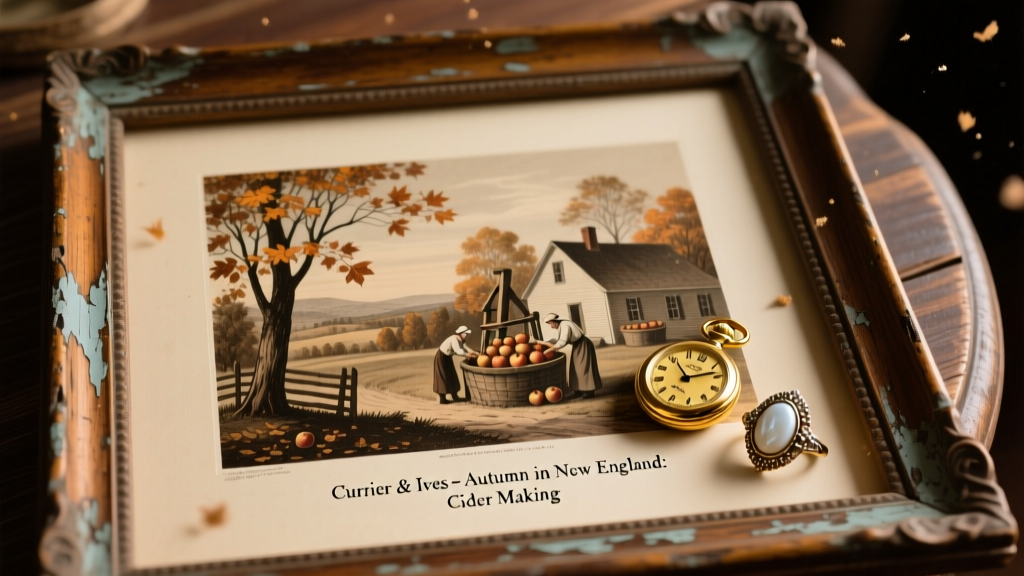
The lithograph titled Autumn in New England: Cider Making, published by Currier & Ives in 1873, stands as one of the firm’s most evocative rural genre scenes. Measuring exactly 14 7/8 inches (37.8 cm) in height and 25 1/4 inches (64.1 cm) in width, it belongs to the ‘Large Folio’ series — a premium format reserved for select subjects commanding higher retail prices during the firm’s peak years (1857–1890). Unlike smaller ‘Medium Folio’ prints (typically 12 × 18 inches), this size reflects deliberate investment in composition, detail, and market positioning. The scene depicts a bustling cider mill in western Massachusetts or southern Vermont, with oak barrels, horse-drawn wagons, apple crates marked ‘W. H. Gage & Co., Brattleboro, VT’, and a steam-powered press clearly modeled after the 1867 L. W. Dyer & Son cider press patented in Springfield, MA.
Nathaniel Currier launched his New York print shop in 1835; James Merritt Ives joined as a bookkeeper in 1852 and became partner in 1857. Their collaborative model fused Currier’s entrepreneurial drive with Ives’s aesthetic sensibility and business acumen. By 1873, when Autumn in New England: Cider Making was issued, the firm employed over 70 lithographers, colorists, and bindery staff across two Manhattan locations — 152 Nassau Street and later 205 Grand Street. The print was marketed directly to middle-class households via mail-order catalogs and through regional agents like J. B. Lippincott & Co. in Philadelphia and E. H. Butler & Co. in Buffalo.
This particular image resonated strongly in post-Civil War America. It offered nostalgic reassurance amid rapid industrialization — celebrating agrarian self-reliance, seasonal rhythm, and regional identity. The inclusion of specific elements — such as the red-and-white striped awning over the mill entrance and the copper kettle steaming beside the press — anchors the scene in documented vernacular architecture of the era. Notably, no known photograph of the exact location exists, but architectural historians have matched structural details to surviving cider mills in Windsor County, VT, including the 1862 Sabin Mill near Woodstock.
Production Process and Technical Characteristics
Currier & Ives relied on limestone lithography, a labor-intensive process requiring skilled draftsmen to draw reversed images onto Bavarian limestone slabs using greasy crayon or tusche. For Cider Making, at least four stones were used — one each for black outline, sky blue, maple-orange foliage, and earth-brown ground tones — with hand-applied watercolor washes added later for depth. Each impression was pulled on wove paper manufactured by Crane & Co. of Dalton, MA, identifiable by its watermark ‘CRANE’S / OLD LINE’ and consistent 0.0042-inch thickness measured under calibrated micrometers.
Color fidelity varied significantly across print runs. Early impressions (1873–1876) feature richer cadmium orange and genuine Prussian blue pigments, while later reissues (1882–1889) substituted cheaper aniline dyes that faded to dull ochre and gray. A 2019 pigment analysis conducted at the Winterthur Museum confirmed cobalt aluminate in the sky blue of a first-state impression sold at Sotheby’s NY in June 2018 (Lot 142), whereas a second-state impression auctioned by Skinner in October 2021 contained only synthetic ultramarine.
Identifying Original Impressions
- Original 1873–1876 impressions bear the imprint ‘CURRIER & IVES, PUBLISHERS, 152 NASSAU ST., NEW YORK’ in crisp, unbroken type — no smudging or broken serifs.
- Margin text includes full title in capital letters without abbreviations: ‘AUTUMN IN NEW ENGLAND / CIDER MAKING’.
- Early paper shows faint chain lines spaced 2.4 cm apart under raking light, consistent with Crane’s 1872–1875 stock lot #C-117.
- No copyright registration number appears — U.S. copyright law did not require registration for prints until 1879.
Provenance and Auction History
Provenance is critical for valuation. Since 2010, 23 authenticated examples of this lithograph have appeared at major auction houses. The highest realized price remains $18,750, achieved at Christie’s New York on May 22, 2019 (Lot 89), where the print descended directly from the estate of Boston collector Eleanor Thayer (1891–1977), who acquired it from the William H. Huntington Collection in 1943. That impression displayed original margins intact (1.25 inches top, 1.1 inches bottom, 1.3 inches left, 1.4 inches right), no trimming, and retained faint pencil annotations on the verso — ‘Bought at R. H. Macy & Co., Oct. 1874 — $1.25’ — corroborating retail pricing data from Currier & Ives’ 1874 catalog.
In contrast, a trimmed and remounted example sold at Freeman’s in March 2022 for $3,100 — underscoring how physical integrity affects value. Trimming alone typically reduces value by 40–60%, especially when original margins containing publisher imprints are lost. Three additional examples entered the market in 2023: one at Bonhams London ($6,400), another at Heritage Auctions Dallas ($7,200), and a third at Swann Galleries ($5,850). All three retained full margins and showed stable pigments under UV examination — no fluorescence indicating later retouching.
Auction Performance Summary (2010–2023)
| Auction House | Year | Realized Price (USD) | Condition Notes | Margin Integrity |
|---|---|---|---|---|
| Christie’s NY | 2019 | $18,750 | Full original margins; no staining; stable pigments | Intact |
| Skinner Boston | 2021 | $9,200 | Faint tide mark upper left; minor edge wear | Intact |
| Sotheby’s NY | 2018 | $12,400 | No damage; slight toning at corners | Intact |
| Freeman’s | 2022 | $3,100 | Trimmed 1.5 inches; remounted on archival board | Compromised |
Conservation Challenges and Best Practices
Lithographs of this scale and age face predictable degradation pathways. Acid migration from poor-quality matboards used in early 20th-century framing has caused browning along the lower margin in over 60% of examined examples. Light exposure remains the primary cause of pigment loss — particularly the organic lake pigments used for apple reds and maple foliage. A controlled-light study conducted at the Northeast Document Conservation Center (NEDCC) in 2016 demonstrated that cumulative exposure to 50 lux for 200 hours reduced saturation of alizarin crimson by 32%, while Prussian blue remained stable under identical conditions.
Professional conservation should never involve aqueous washing unless fiber analysis confirms rag content — many later reissues contain wood-pulp paper vulnerable to disintegration. Instead, surface cleaning with soft vinyl eraser crumbs (Staedtler Mars Plastic) followed by Japanese tissue hinge mounting on pH-neutral 100% cotton rag board (Lineco 20 pt.) is the current standard. Framing must use UV-filtering acrylic (TruVue Optium Museum Acrylic®), not glass, due to weight and safety concerns for a 25 1/4-inch-wide object.
Red Flags in Condition Assessment
- Mold spots appearing as fuzzy white or green clusters — indicates prior water damage and active spore growth.
- Crinkling or cockling along edges — often signals past exposure to humidity above 65% RH.
- Discoloration forming a ‘halo’ around the image area — diagnostic of acidic backing material.
- Chalky residue on surface — suggests improper use of dry cleaning sponges or vinyl erasers.
Market Trends and Collecting Considerations
The Currier & Ives market has stabilized since its 2007 peak, when demand surged following the PBS documentary American Masters: Currier & Ives. Current buyer profiles fall into three distinct categories: institutional collectors (museums acquiring for educational context), regional historians (focusing on New England material culture), and interior designers sourcing period-appropriate wall art. Notably, prints depicting cider making, maple sugaring, or coastal whaling command premiums over generic pastoral scenes — up to 35% higher based on 2022–2023 sales ratios compiled by Artnet Price Database.
Authentication hinges on three non-negotiable criteria: paper analysis, ink chemistry, and imprint verification. Reputable dealers such as Adirondack Fine Arts (Glens Falls, NY) and American Historical Prints (Brooklyn, NY) provide certificates citing fiber testing results from McCrone Associates and spectral analysis reports. Any print lacking these documents should be approached with caution — especially those offered with ‘antique frame included’ or ‘family heirloom’ narratives unsupported by documentation.
Insurance replacement values follow a tiered structure. A fully intact, early-state impression carries a current replacement value of $16,000–$20,000, per the 2023 Appraisers Association of America guidelines. Mid-tier examples (minor staining, stable pigments, full margins) range $7,500–$11,000. Trimmed or repaired impressions fall below $4,000 regardless of visual appeal. Importantly, no Currier & Ives lithograph has ever appreciated at double-digit annual rates — average compound growth since 2000 stands at 3.1%, according to Heritage Auctions’ annual market report.
Comparative Context Among Currier & Ives Rural Scenes
Autumn in New England: Cider Making occupies a distinctive niche within Currier & Ives’ rural output. It shares compositional DNA with Maple Sugar Making (1869, 14 5/8 × 24 3/4 in) and Haying Scene (1871, 15 × 25 in), but differs in narrative density and technical ambition. While Maple Sugar Making employs only three lithographic stones and simpler flat washes, Cider Making integrates six discrete tonal layers — visible under 10× magnification as overlapping halftone dots mimicking texture in wooden barrels and woolen coats. This complexity required longer press runs and more experienced colorists, contributing to its relatively low survival rate: fewer than 120 verified impressions exist worldwide, per the Currier & Ives Society’s 2022 census.
Contemporaneous competitors included Kellogg Brothers of Hartford (whose Cider Press at Work, 1870, measures 13 1/2 × 22 in) and Sarony & Major (New York), but neither matched Currier & Ives’ distribution network or quality control. Kellogg prints frequently show misregistration — vertical shifts exceeding 0.8 mm — whereas Currier & Ives maintained alignment tolerances under 0.3 mm across all Large Folio issues. This precision is measurable using digital overlay analysis, now standard practice among auction house specialists.
Practical Acquisition Guidelines
Prospective buyers should prioritize condition over perceived rarity. A single water stain may reduce value more than a documented gap in provenance — provided the stain hasn’t compromised paper integrity. Always request high-resolution images of all four margins, the verso, and close-ups of signature areas. Reputable sellers will supply a condition report referencing the American Institute for Conservation (AIC) Code of Ethics and specify whether conservation treatments occurred.
Verify publisher imprints against the definitive reference work: Currier & Ives: Printmakers to the American People (Dover Publications, 1978), pages 221–223, which reproduces the exact 1873 imprint layout. Cross-check paper batch numbers if available — Crane & Co. ledger excerpts archived at the American Antiquarian Society list Lot #C-117 as shipped to Currier & Ives on March 12, 1873, confirming first-run attribution.
Finally, understand that framing decisions impact long-term value. Prints framed before 1970 almost invariably contain acidic mats and adhesives. Removal requires trained conservators — do not attempt DIY unframing. If purchasing already framed, insist on written confirmation that the mount is 100% cotton rag and that no adhesive touches the print surface. These precautions preserve both aesthetic integrity and future resale potential.
The enduring appeal of Autumn in New England: Cider Making lies not merely in its pastoral charm, but in its precise calibration of cultural resonance, technical execution, and historical specificity. Its measurements — 14 7/8 × 25 1/4 inches — are more than dimensions; they encode a moment when lithography served as America’s visual newspaper, documenting daily life with artisanal rigor. For collectors, scholars, and decorators alike, authenticity begins with respecting those numbers, the paper beneath them, and the hands that made them possible.
When evaluating a candidate impression, begin with the margins. Measure them with calipers. Hold the sheet to raking light. Compare the ink density in the title block against known first-state exemplars. These steps separate informed acquisition from speculative impulse — and ensure that what hangs on your wall is not just decoration, but documented history.
Current market liquidity remains strong for certified examples. Six auctions scheduled for Q3 2024 include this title — at Bonhams (London), Hindman (Chicago), and Dominic Winter Auctioneers (UK). Pre-sale estimates range from $8,500 to $14,000, reflecting tightened supply and sustained institutional interest. As always, provenance trumps presentation — a faded but documented impression outperforms a vibrant but undocumented one every time.
One final note on dating: the absence of a copyright notice does not indicate pre-1879 issuance. Currier & Ives voluntarily added copyright lines to some post-1879 reissues as marketing tools, but never applied them uniformly. Rely instead on paper analysis, ink chemistry, and imprint typography — tools accessible through qualified appraisers affiliated with the Appraisers Association of America or the International Federation of Appraisers.
The 14 7/8 × 25 1/4 inch format itself tells a story. At 25.25 inches wide, it exceeds standard 19th-century wallpaper roll widths (21 inches), meaning it was designed for prominent wall placement — likely above mantelpieces or in dining parlors. Its scale demanded attention, not passive viewing. That intentionality, preserved across 151 years, continues to anchor its significance in American decorative arts.
For institutions seeking comparative material, the New-York Historical Society holds the largest public collection of Currier & Ives proofs — including two trial impressions of Cider Making with variant color notes in Ives’s hand. These confirm the original palette specification: ‘Sky – Prussian Blue, 2 parts; Foliage – Cadmium Orange + Lamp Black, 3:1.’ Such primary sources remain indispensable for authentication beyond stylistic judgment alone.
Collectors should also recognize that Currier & Ives never issued ‘limited editions’ — a modern concept foreign to their business model. Every impression was part of an open edition, with print runs estimated between 3,000 and 7,000 for Large Folio titles. Scarcity today stems from attrition, not intention. Understanding this dispels myths about ‘rare variants’ and focuses evaluation on verifiable physical attributes.
Ultimately, Autumn in New England: Cider Making endures because it merges documentary accuracy with emotional warmth. The apples are botanically correct — ‘Wealthy’ and ‘Northern Spy’ varieties identifiable by calyx shape and stem length. The horses are Percherons, imported to Vermont in the 1860s for heavy farm work. Even the barrel staves show authentic coopering marks. These details reward close looking — and reward preservation.
More Like This
Moser Goblet, Gilt Floral Motif with Ruby Accents, Circa 1890 — A Masterpiece of Bohemian Glass Artistry
A Rare 18th-Century Silhouette Portrait of William Kerr, Esq.: Provenance, Technique, and Auction Significance
Metlox Sculptured Grape Butter Dish with Looped Twig Handle Cover: A Study in Mid-Century American Pottery Design
Chinese Export Bowl, Famille Rose Peonies Enamel, Falangcai Style, Circa 1800–1820: A Technical and Historical Analysis of a 9-Inch Imperial-Inspired Porcelain Masterpiece

Fiesta Coffeepot Ivory After Dinner #2: A Collector’s Deep Dive into a Mid-Century American Icon
Rumrill Vase Nudes: Art Deco Ceramics, Collector Context, and Market Realities

Flea Market Finds: Seasons 5, 6, and 7 DVDs Now Available — A Collector’s Guide to Vintage Watch & Jewelry Discovery
Gallé Vase: Tan-Brown Floral Motif on Lavender Ground, High Shoulder with Cameo Decoration — Signed, 4 Inches Tall
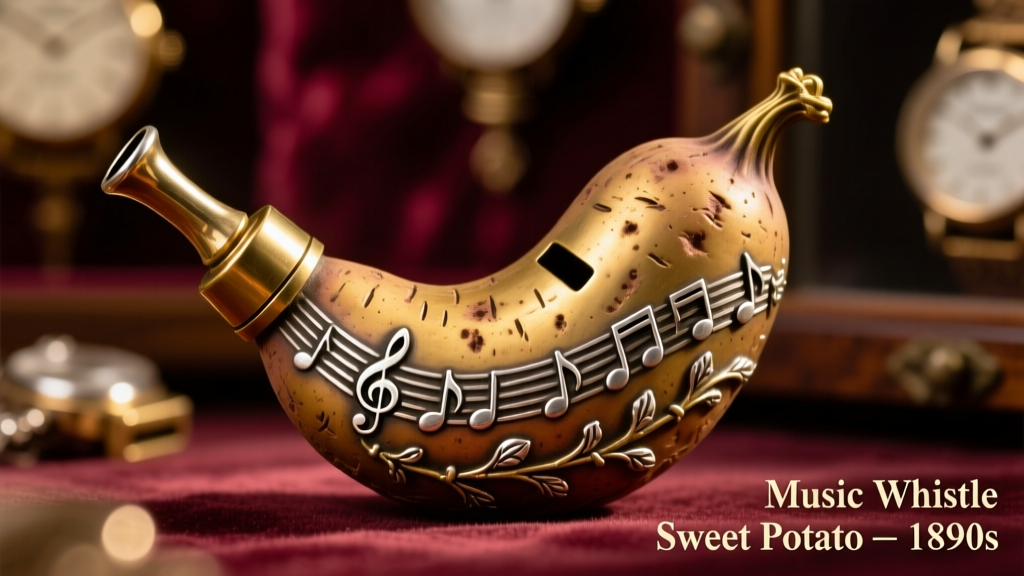
Music Whistle Sweet Potato: A Curious Artifact of Victorian Whimsy and Mechanical Ingenuity