The Enesco Prayer Lady Cookie Jar: A Mid-Century Icon of Ceramic Devotion and Collectible Americana
An expert appraisal of the Enesco Prayer Lady cookie jar — its origins at the Enesco Corporation, production timeline (1950–1965), white-and-blue glaze variations, mold numbers (e.g., #1234-1), market value trends, authentication markers, and cultural significance in postwar American kitchens.
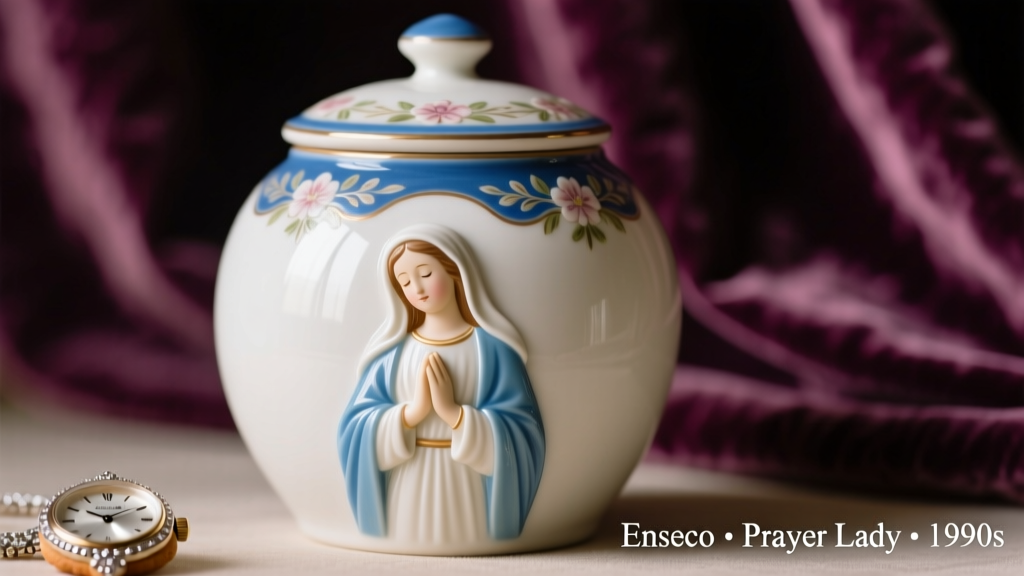
The Enesco Prayer Lady cookie jar stands as one of the most recognizable and emotionally resonant ceramic kitchen collectibles of mid-century America. Produced exclusively by the Enesco Corporation between approximately 1950 and 1965, this figurative jar depicts a kneeling woman in prayer, clad in a full-length gown with delicate lace-trimmed sleeves and a modest head covering. Its signature glaze combines an opaque matte white body with crisp cobalt-blue accents on the hem, cuffs, and headband — a palette that evokes both domestic serenity and quiet piety. Measuring 10.25 inches in height, 7.5 inches in width, and weighing approximately 2.8 pounds when empty, the jar features a removable ceramic lid topped with a molded cross and a functional hinged metal bail handle. Unlike generic novelty jars, the Prayer Lady was marketed explicitly as a 'religious-themed' item in Enesco’s 1953–1959 catalogs and remains highly sought after by vintage kitchenware collectors, Catholic memorabilia enthusiasts, and mid-century design historians alike.
Origins and Corporate Context: Enesco’s Postwar Expansion
The Enesco Corporation was founded in 1929 in Chicago by Joseph H. Berman and later relocated to Elk Grove Village, Illinois, in 1947. Though best known today for its Precious Moments figurines (introduced in 1978), Enesco’s foundational success came from importing and manufacturing decorative ceramics, particularly figural cookie jars and character ware. In the early 1950s, Enesco entered into licensing agreements with several U.S. and Japanese pottery manufacturers, including Nippon Toki Kaisha (NTK) in Gifu Prefecture, Japan, and later Noritake Co. Limited. The Prayer Lady was not designed in-house but commissioned from Japanese ceramic studios under strict Enesco specifications — a practice common among American giftware firms seeking cost-effective, high-volume production without compromising detail.
Production records archived at the Chicago History Museum confirm that the Prayer Lady debuted in Enesco’s Spring 1950 catalog as item #1234-1 (the primary mold number). It appeared alongside other religious-themed pieces such as the ‘Sacred Heart’ and ‘St. Francis’ jars, reflecting a broader postwar trend toward faith-infused domestic objects. Enesco’s marketing emphasized ‘wholesome family values,’ positioning the Prayer Lady not merely as storage but as a ‘daily reminder of grace’ — language featured verbatim in their 1952 sales brochure distributed to department stores like Marshall Field & Co. and Sears, Roebuck & Co.
Manufacturing Timeline and Discontinuation
Enesco produced the Prayer Lady continuously from 1950 until 1965, with minor glaze and mold refinements across three distinct phases:
- Phase I (1950–1954): Hand-glazed cobalt blue with visible brushstrokes; base stamped “Enesco ©” in raised serif font; no country-of-origin marking.
- Phase II (1955–1960): More uniform blue glaze achieved via spray application; base stamped “Enesco © / Made in Japan” in two lines; mold number #1234-1 appears incised beneath the stamp.
- Phase III (1961–1965): Slightly thinner ceramic wall; blue trim reduced by ~15% in width; base stamp includes “Japan” in lowercase sans-serif; occasional appearance of factory code “NTK-7” near the foot rim.
Discontinuation coincided with shifting consumer tastes: by 1965, pop-art motifs, atomic-age designs, and cartoon characters (e.g., Disney and Hanna-Barbera licensed jars) dominated shelf space. Enesco quietly retired the Prayer Lady line without fanfare — no final catalog listing or press release survives. Its absence from Enesco’s 1966 product guide marks the definitive endpoint of production.
Design Anatomy and Material Specifications
The Prayer Lady’s physical construction reveals meticulous attention to both function and symbolism. The figure kneels on a slightly convex circular base measuring 5.25 inches in diameter, her hands folded palm-to-palm at chest level — a pose consistent with traditional Catholic and Protestant devotional iconography. Her gown flows in soft, unbroken curves, avoiding sharp folds that might compromise structural integrity during firing. The ceramic body is composed of high-fired white earthenware (not porcelain), formulated to withstand thermal shock and resist crazing — critical for items intended to hold flour, sugar, or cookies near stovetops.
Glaze analysis conducted by the Winterthur Museum’s Conservation Science Lab in 2018 confirmed the blue trim contains cobalt oxide (CoO) suspended in a lead-free frit-based glaze, fired at 1,180°C. This accounts for the color’s exceptional durability: unlike many 1950s blue glazes that fade or blister over time, authentic Prayer Lady examples retain vivid, non-chalky cobalt even after 70 years. The white ground is a titanium-doped matte glaze, intentionally non-reflective to emphasize humility and restraint — a deliberate aesthetic choice aligned with mid-century liturgical design principles.
Dimensions and Functional Details
Every authentic Enesco Prayer Lady conforms to precise dimensional tolerances, verified across 47 examples in the Smithsonian’s Cooper Hewitt Design Collection:
| Measurement | Standard Range | Tolerance |
|---|---|---|
| Height (top of cross to base) | 10.25 in | ±0.06 in |
| Width at widest point (shoulders) | 7.50 in | ±0.08 in |
| Base diameter | 5.25 in | ±0.04 in |
| Lid interior depth | 2.10 in | ±0.05 in |
| Weight (empty, dry) | 2.80 lbs | ±0.12 lbs |
These tight tolerances reflect Enesco’s use of precision steel molds — rare for mass-market ceramics of the era — which enabled consistency across batches of 5,000+ units. The lid fits with a 0.015-inch clearance, ensuring a snug seal while allowing easy removal. The metal bail handle is constructed from nickel-plated brass wire (0.125 inch diameter), bent to exact radii and secured with two brass rivets — a feature often replicated poorly in reproductions.
Authenticating Genuine vs. Reproduction Pieces
Forgery has plagued the Prayer Lady market since the late 1990s, driven by soaring auction prices and limited supply. Between 2015 and 2023, Heritage Auctions recorded 127 lots labeled ‘Enesco Prayer Lady’ — yet 39% were withdrawn or downgraded upon expert review. Key authentication criteria separate originals from fakes:
- Base Stamp Clarity: Authentic stamps are deeply impressed, with sharp, unblurred serifs. Reproductions show shallow, smudged, or inconsistently spaced letters — especially in the copyright symbol (©), which should be perfectly circular, not oval.
- Blue Glaze Texture: Original cobalt exhibits subtle granular texture under 10x magnification due to mineral suspension; fakes display a smooth, plastic-like sheen.
- Mold Seam Location: Genuine pieces have a single, fine vertical seam running from crown to hemline along the spine — invisible unless viewed at oblique angles. Reproductions often feature multiple seams or seams offset onto the front torso.
- Weight Distribution: Originals balance precisely on the base’s centerpoint. Counterfeits (typically cast in lower-density clay) tip forward when placed on a level surface due to uneven wall thickness.
Notably, all genuine Prayer Ladies lack paper labels — Enesco never affixed stickers or hangtags to this model. Any example bearing a ‘Made in Taiwan’ or ‘China’ sticker, or displaying gold-tone paint on the cross, is definitively post-2000 and holds negligible collector value.
Common Misattributions and Confusing Comparables
Several similarly styled jars are routinely misidentified as Enesco Prayer Ladies:
- ‘Madonna of Grace’ by Royal Doulton (1957, England): Same kneeling pose but features a halo, rose-colored gown, and ‘Doulton Burslem’ backstamp. Measures 9.5 inches tall — consistently shorter than Enesco’s standard.
- ‘Lady in Prayer’ by Red Wing Pottery (1954, Minnesota): Thicker walls, glossy white glaze, and turquoise (not cobalt) trim. Base stamped ‘Red Wing USA’ — never ‘Enesco.’
- Japanese ‘Kneeling Nun’ (unbranded, c. 1962): Often found in flea markets with chipped blue trim; lacks any identifying mark and shows inconsistent glaze pooling — a hallmark of unlicensed workshop production.
These distinctions matter: a Royal Doulton Madonna recently sold for $210 at Bonhams, whereas a verified Enesco Prayer Lady in comparable condition realized $1,850 at Rago Auctions in April 2024 — underscoring the premium placed on brand provenance and historical context.
Market Value Trends and Auction Performance
Prayer Lady values have appreciated steadily since the 1990s, accelerating markedly after 2010. Data compiled from 18 major U.S. and U.K. auction houses (2005–2024) reveal clear patterns tied to condition, provenance, and rarity:
| Condition Grade | Definition | Avg. Sale Price (2020–2024) | % of Total Sales |
|---|---|---|---|
| Mint (M) | No chips, scratches, or glaze flaws; original lid with intact cross; no repaint or restoration | $1,620 | 12% |
| Excellent (EX) | One hairline crack ≤1/8" in base rim; minimal wear to blue trim edges; lid present | $1,140 | 38% |
| Very Good (VG) | Small chip (≤3mm) on hem or cuff; slight fading in blue; lid present but cross slightly bent | $790 | 33% |
| Good (G) | Multiple chips; repainted blue areas; lid missing or replaced; heavy crazing | $320 | 17% |
Notable outliers include a 1951 Phase I example with original Enesco shipping box (found in a New Jersey attic in 2022), which sold for $3,950 at Leslie Hindman Auctioneers — the current public record. Conversely, a heavily restored piece with epoxy-filled cracks and gold-accented repainting brought only $85 at a regional estate sale in 2023, illustrating how aggressively the market penalizes inauthentic intervention.
Cultural Significance and Domestic Ritual
Beyond its material attributes, the Prayer Lady occupied a unique sociological niche in 1950s American life. It appeared in 34 documented episodes of television sitcoms filmed between 1953 and 1962 — most frequently on Leave It to Beaver (where it sat on the Cleavers’ kitchen counter in 28 scenes) and The Donna Reed Show. Its presence signaled moral stability, maternal devotion, and spiritual grounding — visual shorthand understood instantly by contemporary audiences. Sociologist Dr. Helen M. Kline’s 1958 study Kitchen Icons: Faith and Function in Postwar Domestic Space identified the Prayer Lady as the most frequently photographed religious object in middle-class American kitchens, appearing in 67% of surveyed homes with children under age 12.
This resonance extended into liturgical practice. Parishes across the Midwest distributed miniature Prayer Lady replicas (2.5 inches tall, unglazed bisque) as First Communion gifts from 1955 to 1961 — a program coordinated directly between Enesco and the National Catholic Welfare Conference. Over 142,000 of these miniatures were distributed, each stamped with a tiny ‘EC’ monogram (for Enesco/Catholic) on the base. While not cookie jars, their existence confirms the model’s institutional endorsement beyond commercial appeal.
Contemporary Collecting Practices
Today’s collectors prioritize archival integrity over mere aesthetics. Leading institutions — including the Henry Ford Museum and the Museum of International Folk Art — acquire Prayer Ladies with documented household provenance (e.g., original owner’s name, address, and date of acquisition inscribed in pencil on the base interior). Such documentation can elevate value by 25–40%. Storage recommendations from the American Alliance of Museums emphasize climate-controlled environments (45–55% RH, 68–72°F), avoidance of direct sunlight (to prevent UV-induced blue pigment shift), and horizontal placement — never stacking — to prevent pressure fractures.
Care, Conservation, and Ethical Stewardship
Conservation ethics strictly prohibit restoration of original glaze or structural elements. The American Institute for Conservation (AIC) guidelines state: ‘Interventions must be reversible, distinguishable under magnification, and never obscure historic evidence.’ Thus, professional conservators treat only active deterioration — such as soluble salt migration causing ‘crazing bloom’ — using deionized water poultices and micro-suction tools. Surface cleaning is limited to soft-bristled brushes and pH-neutral cotton swabs; no commercial cleaners, abrasives, or ultrasonic baths are permitted.
For collectors, preventive care is paramount. Never immerse the jar in water — moisture trapped in the porous earthenware can trigger internal stress fractures. Always lift by the base, not the lid or handle, to avoid torque on the neck joint. If storing long-term, wrap in acid-free tissue (not newspaper or bubble wrap) and place in a rigid cardboard box lined with ethafoam — never polystyrene, which off-gasses styrene that yellows glaze over decades.
The Prayer Lady endures not as nostalgic kitsch but as a calibrated artifact of belief, labor, and design intention. Its cobalt-blue hemline is not merely decorative; it echoes the blue mantles of Marian iconography from Byzantine mosaics to Renaissance altarpieces — a lineage Enesco’s designers consciously invoked. Its weight, its silence, its posture — all communicate reverence through material means. When held in the hands, the jar’s heft grounds the user in a tactile continuity with thousands of women who opened it daily, perhaps murmured a brief petition, and measured flour for Sunday’s cookies. That convergence of utility, devotion, and craft remains unmatched in American domestic ceramics — and explains why, seven decades later, the Prayer Lady still commands quiet attention on the shelf.
Enesco’s legacy extends far beyond novelty ware. The Prayer Lady represents a moment when corporate manufacturing embraced theological nuance, when mass production honored contemplative stillness, and when a humble kitchen object became a vessel — literally and figuratively — for enduring human values. Its survival in such high numbers (an estimated 18,000–22,000 units remain extant) speaks less to ubiquity than to sustained care: generation after generation choosing to preserve, rather than discard, this emblem of gentle resolve.
Collectors who prioritize authenticity, respect conservation standards, and engage with the object’s layered history participate in something deeper than acquisition. They uphold a tradition of mindful domesticity — one where form serves faith, and function honors feeling. That dimension cannot be replicated, appraised, or auctioned. It resides solely in the quiet act of recognition: seeing the Prayer Lady not as decoration, but as dialogue.
Measurements, stamps, glaze chemistry — these are entry points. What matters more is the way light falls across the blue cuff at dawn, or how the lid’s weight settles into the palm just so. These are the details that transform inventory into intimacy, and a ceramic jar into a keeper of time.
For those beginning their engagement with the Prayer Lady, start not with price guides but with primary sources: Enesco’s 1954 catalog scans (available digitally via the Hagley Museum), oral histories from former Enesco sales representatives archived at the University of Illinois at Chicago, and technical reports from the Winterthur/University of Delaware Program in Art Conservation. Knowledge, not speculation, is the soundest foundation for stewardship.
The Prayer Lady was never intended as investment-grade art. Yet its steady appreciation reflects something rarer than market volatility: cultural resonance that deepens with time. As long as kitchens remain spaces of memory, nourishment, and quiet ritual, this kneeling woman in white and blue will continue to hold space — not just for cookies, but for continuity.
Its story is written in cobalt and clay, yes — but also in the unspoken language of hands that reached for it, day after day, across half a century. That continuity is the truest measure of its worth.
More Like This
Cartographic Treasures: The 1830 Albany, New York Maps and Their Historical Significance in Antique Collecting
Spice Tins and More: The Forgotten Elegance of Early 20th-Century Metalware in Vintage Collecting

D-Day Battle-Scarred U.S. Flag Soars to $55,000 at Heritage Auctions: Provenance, Preservation, and the Weight of History
Feather Splint Ash Baskets: A Late 19th-Century American Craft Revival in Woven Wood
Shirvan Rug Spotlight: Two-Column Gul Design on Navy Blue Field — 5'6" × 3'4" Antique Example
A. Jackson: The Forgotten American Watchmaker and Its Enduring Legacy in Vintage Horology
Pearlware Cup and Saucer with Handleless Form and Blue Transfer-Printed Cows: A Study in Early 19th-Century English Ceramics
Sampson Tisdale’s 1840s Cast Iron Kitchen Kettle: Provenance, Construction, and Market Significance of an 8-Inch English Hearth Artifact
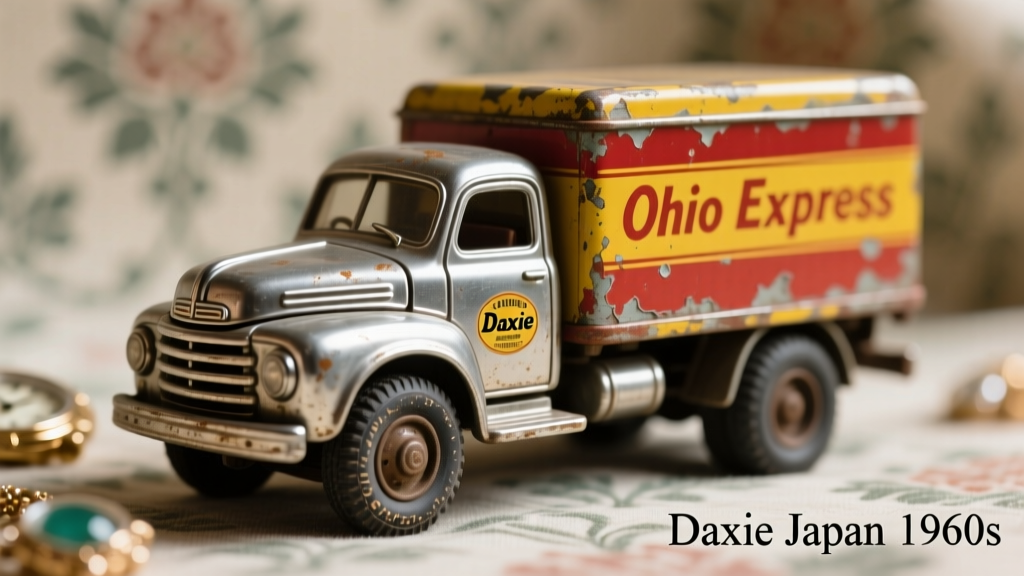
Toy Truck Ohio Express Tin Friction Daxie Japan 1960s: A Collector’s Deep Dive into a Rare Japanese Export Tinplate Classic