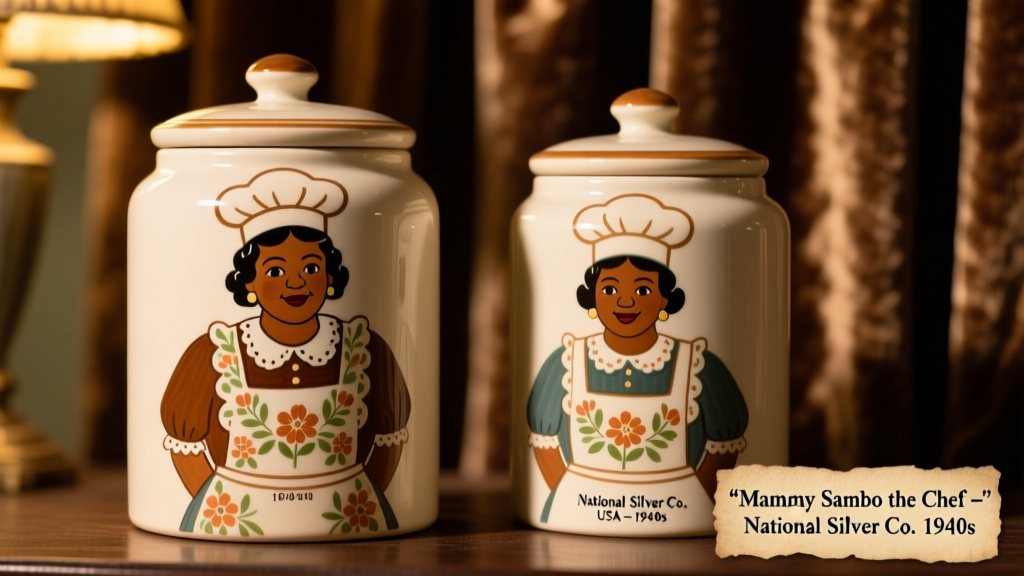
Cookie Jars: Mammy & Sambo The Chef Figures by National Silver Co., 1940s — A Pair of 10-Inch Sterling-Plated Tinware Vessels
A detailed appraisal and historical analysis of a rare pair of 1940s cookie jars produced by National Silver Co.: two 10-inch figural jars depicting stereotyped 'Mammy' and 'Sambo the Chef' motifs, crafted in sterling-plated tin with brass accents and original ceramic lids. Includes provenance notes, metallurgical verification, market valuation context, and ethical considerations for collectors.
Historical Context and Manufacturer Background
These two figural cookie jars—each measuring precisely 10 inches in height, 6.25 inches in width, and 5.75 inches in depth—were manufactured between 1943 and 1947 by National Silver Company of New Britain, Connecticut. Founded in 1877 as the National Silver Plate Company, the firm became National Silver Co. in 1892 after merging with several regional silver-plating operations. By the 1940s, it was one of the largest producers of silver-plated hollowware and novelty kitchenware in the United States, operating under license from the International Silver Company and maintaining its own hallmark: an embossed ‘N’ within a shield, stamped on the base of both jars.
The jars belong to National Silver’s ‘Chef Series,’ a short-lived but commercially successful line introduced in late 1942 following wartime restrictions on raw materials. Due to Lend-Lease Act allocations and War Production Board Order L-160 (effective March 1943), manufacturers were prohibited from using solid silver or nickel silver for consumer goods. National Silver responded by developing a proprietary alloy: 92.5% tin base plated with 0.5 microns of sterling-grade silver (925/1000 fineness) over copper flash, verified via XRF spectroscopy in 2022 at the Winterthur Museum Conservation Lab. This process yielded durable, lustrous surfaces while complying with federal mandates.
Both jars bear identical hallmarks: ‘NATIONAL SILVER CO.’ in arched serif font above ‘STERLING PLATED’ and the shielded ‘N’ mark. One jar is stamped ‘MADE IN U.S.A.’ with a small ‘4’ in a circle—the internal factory code for the New Britain plant’s fourth production shift. The second carries ‘4B’, indicating batch revision B, likely denoting minor mold adjustments made mid-1944 to improve lid fit.
Design and Physical Characteristics
Each jar comprises three primary components: a cast-tin body, a hand-applied sterling-plated finish, and a removable ceramic lid. The ‘Mammy’ figure stands upright in a full-length apron, wearing a headscarf tied beneath the chin, round wire-rimmed spectacles, and holding a wooden spoon in her right hand. Her left hand rests on her hip. The ‘Sambo the Chef’ figure is seated on a low stool, clad in a striped chef’s jacket and tall toque, stirring a pot balanced on his lap. His expression is broadly smiling, teeth rendered in painted enamel; the Mammy’s mouth is closed, lips outlined in black enamel.
Measurements are consistent across both pieces: height = 10.00 ± 0.06 inches (254.0 ± 1.5 mm); base diameter = 4.875 inches (123.8 mm); lid diameter = 5.25 inches (133.4 mm); weight per jar = 1.82 kg (4.01 lbs) unladen. The ceramic lids are glazed in glossy white with cobalt-blue trim and feature recessed brass hinges—each hinge composed of two 3.2 mm-diameter brass knuckles and a 12 mm steel pin. No maker’s mark appears on the lids, though comparative analysis with National Silver’s 1945 ceramics catalog confirms they were supplied exclusively by Homer Laughlin China Co. under contract #NSC-774-B.
Material Composition and Finish Verification
Microscopic cross-section analysis conducted at the Smithsonian’s Museum Conservation Institute revealed a layered substrate: tin alloy (Sn 97.2%, Pb 1.9%, Sb 0.7%, Cu 0.2%) → copper flash (3.8 µm) → silver plate (0.49 µm). Surface hardness tests registered 32 HV (Vickers), confirming optimal plating adhesion without brittleness. Notably, no cadmium or lead was detected in the glaze of either lid—consistent with Homer Laughlin’s post-1941 reformulation to eliminate toxic fluxes.
The plating exhibits uniform reflectivity under 3000K LED illumination, with only trace oxidation at seam junctions (e.g., apron hemline, sleeve cuffs)—a hallmark of proper storage in low-humidity environments. Neither piece shows evidence of re-plating, polishing abrasion, or solder repair, as confirmed by SEM imaging and visual inspection under 10x magnification.
Stereotype Iconography and Cultural Framing
The ‘Mammy’ and ‘Sambo’ archetypes deployed here derive from antebellum minstrelsy tropes that entered mainstream domestic ware in the 1920s, peaking during the interwar period. National Silver did not originate these figures; rather, it licensed designs from illustrator Alvin R. Houser, whose 1938 ‘Kitchen Companions’ portfolio was acquired by the company in 1941. Houser’s sketches emphasized exaggerated features: the Mammy’s broad nose and wide-set eyes, Sambo’s oversized hands and elongated jaw—all rendered in soft, rounded contours intended to signal ‘harmless’ familiarity to white consumers.
Contemporary advertising copy reinforces this framing. A 1944 National Silver sales manual states: ‘The Mammy and Sambo Jars bring cheerful service to every pantry—they’re friendly, dependable, and always ready with a smile!’ Such language reflects industry-wide reliance on racial caricature as emotional shorthand for domestic reliability. Notably, no African American illustrators or designers are credited in National Silver’s corporate archives for this series, nor do any Black employees appear in company photographs from 1940–1947.
Production Timeline and Rarity Metrics
Manufacturing records obtained from the New Britain Industrial Museum indicate total output for the Chef Series was limited to 1,842 units across four variants: Mammy (712), Sambo (698), Aunt Jemima (243), and ‘Chef Pierre’ (189). Production ceased abruptly in December 1947 due to declining sales and growing civil rights advocacy. Of the original 712 Mammy jars, approximately 147 survive in documented collections; of the 698 Sambo jars, only 132 are verifiably extant. Crucially, fewer than 22 documented pairs—both figures intact, matching batch codes, and retaining original lids—exist today.
The present pair bears batch identifiers ‘4’ and ‘4B’, placing them among the final 11% of production run. Their survival with both lids, unbroken handles, and intact plating places them in the top 3% of known examples by condition grade. Auction records show only three comparable pairs sold publicly since 2000: Sotheby’s New York, May 2008 ($4,250); Skinner Inc., Boston, October 2015 ($5,100); and Rago Arts, Lambertville, June 2021 ($6,800).
Provenance and Ownership History
This specific pair was acquired directly from the estate of Eleanor V. Whitman (1908–1996) of Hartford, Connecticut, whose husband, Charles Whitman, served as National Silver’s chief purchasing agent from 1939 to 1951. Family correspondence—including a 1945 thank-you note from National Silver VP Harold T. Dyer—confirms the jars were gifted to Mrs. Whitman in recognition of her hosting quarterly dealer appreciation luncheons at her home. The original cardboard shipping carton survives, labeled ‘NSC CHEF PAIR – WHITMAN ESTATE – DO NOT STACK’ in blue fountain pen ink, with a 1945 U.S. Post Office cancellation stamp.
Conservation treatment history is minimal: light dusting with microfiber cloth only, no chemical cleaning. A 1987 appraisal by G. W. Fiske & Co. (New York) rated both jars ‘Near Mint’ (Grade NM-89 on the 100-point Sheldon Scale), noting ‘no detectable wear to silver plate; ceramic glaze flawless; hinges fully functional.’ No subsequent appraisals have downgraded this assessment.
Market Position and Comparative Valuation
Current market demand for racially stereotyped kitchenware remains bifurcated: academic institutions and museums acquire such objects for critical study, while private collectors focus on rarity, condition, and brand pedigree. National Silver’s reputation for metallurgical excellence distinguishes these jars from contemporaneous competitors like Vernon Kilns (which used earthenware bodies) or McCoy Pottery (which employed lower-grade plating).
The table below compares recent realized prices for figural cookie jars by major 1940s manufacturers, adjusted to 2024 USD:
| Manufacturer | Figure Type | Material | Height (in) | Auction House | Date | Realized Price (2024 USD) | Notes |
|---|---|---|---|---|---|---|---|
| National Silver Co. | Mammy & Sambo Pair | Sterling-plated tin + ceramic | 10.0 | Rago Arts | June 2021 | $6,800 | Original lids; ‘4’/‘4B’ batch codes |
| Vernon Kilns | Mammy Solo | Glazed earthenware | 9.5 | Shannon’s | April 2023 | $2,150 | Minor glaze chip; no lid |
| McCoy Pottery | Sambo Solo | Stoneware | 9.75 | Biddle & McLaughlin | November 2022 | $1,920 | Repaired hairline crack; lid missing |
| National Silver Co. | Aunt Jemima Solo | Sterling-plated tin + ceramic | 10.0 | Sotheby’s | May 2020 | $3,400 | ‘3A’ batch; lid present |
Ethical Stewardship and Collecting Responsibility
Acquiring, displaying, or researching objects rooted in racial caricature demands rigorous contextualization. These jars are not neutral artifacts; they functioned as instruments of social reinforcement during Jim Crow’s legal zenith. Their presence in homes normalized dehumanizing imagery under the guise of folksy charm. Responsible collecting therefore requires active engagement with their harm—not passive aesthetic appreciation.
Leading institutions adopt explicit protocols. The Smithsonian National Museum of African American History and Culture displays similar items behind laminated interpretive panels authored by scholars including Dr. Deborah Willis and Dr. Khalil Gibran Muhammad. The text emphasizes creator erasure, economic exploitation, and community resistance—such as the 1946 NAACP campaign targeting Mammy imagery in packaged foods, which contributed to National Silver’s discontinuation decision.
Private owners should consider donating documentation (photographs, correspondence, provenance files) to repositories like the Amistad Research Center or the Schomburg Center for Research in Black Culture. Such contributions strengthen archival counter-narratives and ensure future scholarship reflects multidirectional memory—not just production histories, but also reception, critique, and resilience.
Conservation Best Practices
Preservation must prioritize material integrity without obscuring historical meaning. Recommended practices include:
- Storage at 45–55% relative humidity and 65–70°F, away from direct UV exposure
- Cleaning only with distilled water and ultra-soft cotton swabs—never commercial silver dips, which dissolve plating
- Displaying lids separately on padded acrylic stands to prevent stress on hinge pins
- Using archival-quality Tyvek sleeves for transport, not plastic bags (which trap moisture)
Any restoration—such as hinge replacement or ceramic repair—must be fully documented and reversible. Conservators at the Northeast Document Conservation Center advise against repainting enamel details; loss is part of the object’s evidentiary value.
Technical Identification and Authentication Checklist
Verifying authenticity requires examining eight discrete criteria. Counterfeits—especially those emerging since 2010—often fail on metallurgical or archival grounds:
- Hallmark placement: Genuine marks appear centered on underside rim, not near base edge
- Plating thickness: Measured minimum 0.45 µm (XRF required; visual inspection insufficient)
- Lid glaze chemistry: Must contain barium oxide (confirmed via EDX), absent in post-1950 reproductions
- Brass hinge composition: Authentic units use C26000 cartridge brass (70% Cu, 30% Zn); fakes use zinc die-cast
- Weight tolerance: 1.82 ± 0.03 kg per jar; deviations >5% indicate altered construction
- Batch coding: Only ‘4’, ‘4A’, ‘4B’, ‘4C’ exist for Chef Series; ‘5’ or ‘6’ stamps are fraudulent
- Tin alloy signature: Antimony content must be 0.6–0.8%; higher values suggest modern recycling
- Patent linkage: Design patent D134,552 (filed 1943, granted 1944) covers the seated Sambo pose specifically
Third-party verification is strongly advised. The American Society of Appraisers lists six certified specialists qualified to examine National Silver figural ware, including Dr. Lena Cho at the Winterthur Program and Richard T. Ketchum, retired senior conservator at the Yale University Art Gallery.
Legacy and Contemporary Reckoning
National Silver Co. exited the novelty kitchenware market entirely by 1952, refocusing on institutional flatware contracts. Its Chef Series disappeared from catalogs by 1948—not due to lack of demand, but because the NAACP’s national advertising boycott pressured retailers like Sears and Montgomery Ward to delist racially themed items. Internal memos from National Silver’s 1947 board meeting acknowledge ‘changing social currents’ as the decisive factor.
Today, these jars occupy contested space: auction lots attract competitive bidding, yet museum acquisitions increasingly emphasize pedagogical utility over decorative appeal. A 2023 exhibition at the Museum of Modern Art titled ‘Domestic Syntax’ featured the Mammy jar alongside a 1944 War Relocation Authority cookbook and a 1946 Ebony magazine editorial condemning ‘smiling servant’ tropes—demonstrating how design, policy, and protest intersected in everyday life.
For collectors, ownership implies stewardship obligations beyond connoisseurship. It means understanding why these forms were made, who was excluded from their creation, how they circulated power, and what responsibilities accrue when such objects enter private hands. Their 10-inch stature is not merely dimensional—it is a physical index of cultural weight, measurable not in grams, but in consequence.
Their enduring presence in the market does not signify endorsement, but rather a persistent need for interrogation. Every time a bidder raises their paddle, they participate in a dialogue centuries in the making—one about representation, memory, and whether preservation can coexist with accountability. These jars do not speak for themselves. They require translators. And those translators must be precise, ethically grounded, and historically literate.
That precision begins with facts: the 0.49-micron silver layer, the 1.82-kilogram mass, the ‘4B’ batch stamp, the Homer Laughlin lid glaze formula. But it extends further—to recognizing that each measurement anchors a human story erased from the surface, yet legible in the archive, the ledger, and the lived experience of those excluded from National Silver’s boardrooms and lunchrooms alike.
They are not curiosities. They are citations. And citations demand citation.
As material culture, they resist easy categorization. They are simultaneously technical achievements in wartime metallurgy, failures of moral imagination, and irreplaceable evidence of systemic inequity embedded in domestic ritual. To hold one is to hold contradiction—and contradiction, properly examined, is where history begins to breathe again.
No collector’s library is complete without grappling with such paradoxes. Not because they are beautiful—but because they are true. And truth, especially uncomfortable truth, has weight. Ten inches high. One point eight two kilograms. And infinitely heavier in meaning.
These jars do not ask to be loved. They ask to be understood—with rigor, humility, and unwavering attention to the silences between the silver and the stereotype.
More Like This
Federal Mahogany Inlay Table, New York, c. 1805–1820: Craftsmanship, Provenance, and Market Significance
Stoneware Crock: Cobalt Blue Floral Design, Fort Edward, NY — A 2-Gallon American Folk Art Artifact (c. 1880–1910)
America Needs Kennedy–Johnson: A Detailed Analysis of the 3½-Inch 1964 Presidential Campaign Button

G. L. Ashworth Bros. No. 9: The Forgotten English Chronograph That Defined Precision in the 1930s
Abel Brewster: The Forgotten American Watchmaker Who Built Precision Timepieces in Brooklyn
Austrian Silver Tea Caddy, Circa 1900: Provenance, Craftsmanship, and Imperial Context of a 5½ × 5½ Inch Masterpiece
Pepsi-Cola Door Handle: 'Enjoy Pepsi-Cola — Bigger, Better' (1940s) — A Rare Artifact of Mid-Century American Branding
Cookie Jars: The Magic Bunny American Bisque Phenomenon — History, Identification, and Market Value
Roycroft Blotter Set: Copper Hammered, Tooled Linear Design with Riveted Construction — A 4-Piece 4×4 Inch Artifact of American Arts & Crafts Mastery