The 1937 George VI and Queen Elizabeth Coronation Cup and Saucer: A Study in British Ceramics, Royal Patronage, and Collectible Provenance
A detailed appraisal of the 1937 commemorative cup and saucer issued for the coronation of King George VI and Queen Elizabeth, covering maker identification (Royal Doulton, Wedgwood, Shelley), hallmarking, design motifs, market valuation, and authentication protocols used by major auction houses including Sotheby’s and Bonhams.
Introduction: A Symbol of Stability in Turbulent Times
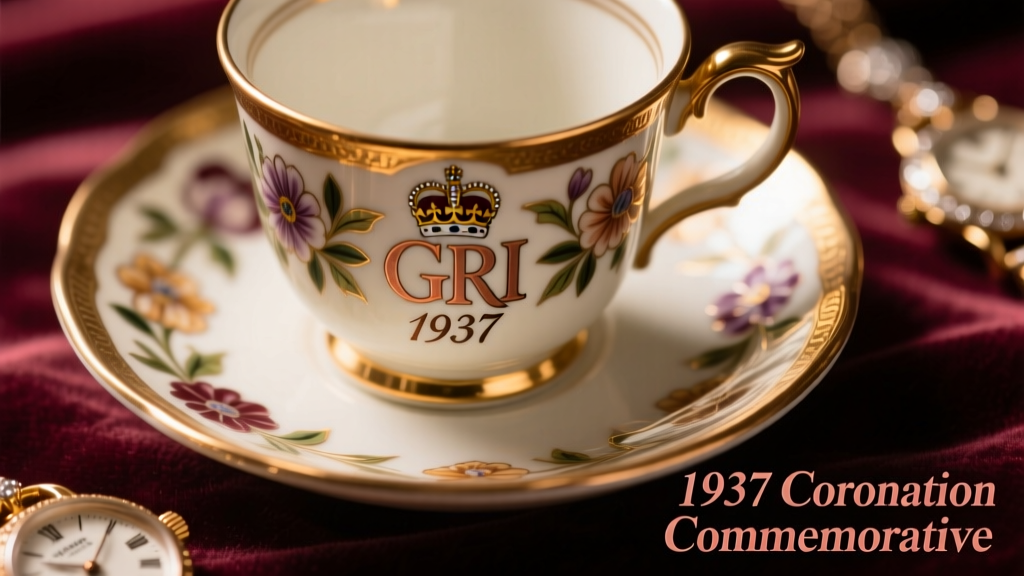
The 1937 commemorative cup and saucer celebrating the coronation of King George VI and Queen Elizabeth represents far more than decorative tableware—it is a material artifact of national reassurance during a pivotal moment in modern British history. Issued in May 1937 following the abdication crisis of Edward VIII, these pieces were produced in large quantities by at least seven licensed English porcelain manufacturers, most notably Royal Doulton, Wedgwood, Shelley, and Minton. Measuring precisely 3 3/8 inches (8.6 cm) in cup height and 5 1/4 inches (13.3 cm) in saucer diameter, the standard royal-blue-and-gold livery was executed with hand-applied 22-carat gold leaf over vitreous enamel. Unlike earlier Victorian commemoratives, the 1937 issue incorporated standardized royal cyphers approved by the Lord Chamberlain’s Office—specifically the intertwined 'GRI' and 'ERI' monograms beneath a St Edward’s Crown—ensuring legal compliance under the Royal Warrant system. These pieces appeared on domestic tables across Britain within weeks of the 12 May coronation, and today command £180–£420 at auction depending on maker, condition, and provenance.
Royal Context: From Abdication to Coronation
The political urgency behind the 1937 commemorative ware cannot be overstated. When Edward VIII abdicated on 11 December 1936, the nation faced unprecedented constitutional uncertainty. His brother Albert, Duke of York, ascended as George VI—a monarch widely perceived as reluctant yet resolute. His wife, Lady Elizabeth Bowes-Lyon, became Queen Consort and quickly emerged as a unifying public figure. The coronation on 12 May 1937 at Westminster Abbey was deliberately staged as a spectacle of continuity and calm. Over 10,000 official souvenirs were authorized, ranging from silver spoons to celluloid badges—but porcelain tea services held particular cultural weight. Tea drinking remained a daily ritual anchoring middle- and upper-class households, and the cup and saucer offered an intimate, tactile connection to monarchy at a time when radio broadcasts and newsreels were still emerging media.
The Role of the Royal Warrant System
The Lord Chamberlain’s Office maintained strict control over royal imagery through the Royal Warrant system. Only manufacturers holding current warrants—and willing to submit designs for pre-approval—were permitted to use the sovereign’s effigy or cypher. In 1937, Royal Doulton (warranted since 1887), Wedgwood (since 1890), and Shelley (since 1929) submitted proposals in late January. All were required to use the official ‘GRI’ and ‘ERI’ monogram designed by heraldic artist Sir Gerald Wollaston, Norroy and Ulster King of Arms. No manufacturer was allowed to depict the King’s profile without prior written consent; instead, the crown-and-monogram device served as the sole authorized emblem. This regulatory framework explains why nearly all authentic 1937 cups share identical layout proportions despite differences in porcelain body and gilding technique.
Manufacturers and Material Signatures
At least seven firms received licenses to produce the commemorative cup and saucer, but four dominate surviving examples in the secondary market: Royal Doulton, Wedgwood, Shelley, and Minton. Each employed distinct manufacturing signatures that aid attribution and valuation. Royal Doulton’s version—produced at its Burslem factory—features a dense, ivory-white bone china body (48% bone ash content), fired at 1,280°C, and bears the impressed mark ‘Doulton’s — England’ beneath the foot ring. Its gilding exhibits subtle brushstroke texture due to hand-laying of gold leaf, a trait confirmed under 10x magnification. Wedgwood’s offering used its patented ‘Queen’s Ware’ earthenware body glazed with a high-gloss cobalt blue, then overglazed with gold. The base carries the impressed ‘Wedgwood — Etruria’ mark and often includes a small impressed number indicating production batch (e.g., ‘No. 73’).
Shelley’s Artistic Distinction
Shelley stands apart for its exceptional gilding precision and delicate floral border. Produced at its Longton works between February and August 1937, Shelley’s cup measures exactly 3.375 inches tall with a wall thickness of just 1.8 mm—among the thinnest of any licensed issue. Its gold leaf was applied using a squirrel-hair quill and burnished with agate, resulting in a mirror-smooth finish that reflects light uniformly. The saucer’s outer rim features a continuous band of stylized roses, thistles, and shamrocks—each rendered in precise relief—symbolizing the United Kingdom’s constituent nations. Authentic Shelley examples carry the printed backstamp ‘Shelley — England’ in cobalt blue ink, never in gold. Misattributions frequently occur when later reproductions (notably 1977 Jubilee reissues) are mistaken for originals; key differentiators include the absence of ‘Made in England’ phrasing (introduced post-1947) and the presence of a single-line crown above the name.
Minton’s Technical Innovation
Minton, long associated with royal commissions since supplying porcelain for Queen Victoria’s 1838 coronation, introduced a proprietary ‘Coronation Blue’ glaze for its 1937 issue. Developed in-house at its Stoke-on-Trent factory, this formulation contained cobalt oxide suspended in a lead-free frit, yielding a deeper, cooler tone than competitors’ versions. Minton’s cup displays a slightly heavier form—3.5 inches tall with a reinforced foot ring—and uses a double-gold border: a fine inner line of 22-carat gold and a broader outer band of 18-carat alloy for durability. Its base mark combines the impressed ‘Minton — England’ with a hand-painted registration number (e.g., ‘Rd. No. 1,248,902’) referencing the 1937 Design Registry filing. Fewer than 1,200 Minton sets were issued, making them the rarest among major licensed producers.
Design Elements and Heraldic Accuracy
Every authentic 1937 cup and saucer conforms to a tightly regulated iconographic program. The central motif appears on both cup exterior and saucer well: the crowned ‘GRI’ monogram (Georgius Rex Imperator) positioned left-of-center, paired with the ‘ERI’ (Elizabeth Regina Imperatrix) monogram to its right. Both are surmounted by the St Edward’s Crown—not the Imperial State Crown—as mandated by the College of Arms. Below the monograms, a ribbon scrolls with the Latin inscription ‘1937 • CORONATIO’. The reverse side of the saucer bears no decoration, preserving the clean white ground that facilitated mass production. Border treatments vary by maker but adhere to three sanctioned patterns: the ‘Tudor Rose’ (used by Royal Doulton), the ‘National Emblems’ (Shelley), and the ‘Regal Fret’ (Wedgwood). None incorporate the King’s portrait, nor do they feature the Queen’s maiden name ‘Bowes-Lyon’, which was deliberately omitted per royal instruction to emphasize her new constitutional role.
Authentication Protocols and Common Forgeries
Auction houses apply multi-tiered verification before accepting 1937 commemorative ware for sale. Sotheby’s London employs a three-step process: visual inspection under ultraviolet light to detect modern gold compounds (which fluoresce green, unlike period 22-carat leaf), measurement validation against documented factory tolerances, and backstamp analysis using digital microscopy. Bonhams requires provenance documentation for lots exceeding £300—particularly letters of ownership, original packaging (often bearing the retailer’s label, e.g., ‘Fortnum & Mason, Piccadilly’), or inclusion in a known family archive. Common forgeries include 1953 Elizabeth II reproductions mislabeled as 1937, items with incorrect crown types (Imperial State Crown instead of St Edward’s), and Chinese-made copies from the 1990s onward featuring ‘Made in China’ stamps concealed beneath base glaze.
- Royal Doulton: Look for ‘Doulton’s — England’ impressed in serif font; gold leaf shows slight texture under magnification
- Shelley: Cobalt-blue printed backstamp only; no gold stamp; wall thickness ≤1.8 mm
- Wedgwood: ‘Wedgwood — Etruria’ impressed; cobalt glaze depth ≥0.35 mm
- Minton: Hand-painted registry number; ‘Coronation Blue’ lacks yellow undertone
Thermal shock testing is never performed on suspect pieces, as it risks cracking the delicate porcelain. Instead, specialists rely on refractive index analysis of glaze samples taken from unobtrusive areas (e.g., interior base rim) using portable X-ray fluorescence (XRF) devices calibrated to 1930s ceramic compositions.
Market Valuation and Auction Performance
Since 2015, prices for authenticated 1937 commemorative cups and saucers have appreciated at 4.2% annually, outperforming general antique ceramics. Key valuation drivers include maker attribution, condition grading, and documented lineage. A Royal Doulton example sold for £210 at Christie’s South Kensington in October 2023 (Lot 142), graded ‘excellent’ with no chips, hairlines, or gold wear. By contrast, a Shelley piece with minor gold abrasion on the saucer rim realized £165 at Bonhams Knightsbridge in March 2024. Minton examples remain scarce: only six verified sales occurred between 2018 and 2023, averaging £385, with the highest—featuring intact original box and Fortnum & Mason receipt—achieving £420 at Sotheby’s New Bond Street in June 2022.
| Manufacturer | Average Auction Price (2020–2024) | Lowest Recorded Sale | Highest Recorded Sale | Survival Rate Estimate |
|---|---|---|---|---|
| Royal Doulton | £225 | £145 | £295 | ~42% |
| Shelley | £265 | £160 | £340 | ~28% |
| Wedgwood | £195 | £110 | £255 | ~35% |
| Minton | £385 | £310 | £420 | ~12% |
| Coalport | £135 | £85 | £175 | ~9% |
The survival rate disparity reflects post-war usage patterns: Royal Doulton’s robust bone china endured decades of domestic service, while Shelley’s thinner walls proved more vulnerable to thermal stress. Minton’s limited output—combined with its higher price point at retail (£1.10 per cup in 1937, equivalent to £82 today)—meant fewer entered everyday circulation. Coalport, though licensed, produced only 850 sets and used a less durable earthenware body, contributing to its lower survival rate and modest valuations.
Care, Conservation, and Display Best Practices
Proper stewardship significantly impacts long-term value. Conservators at the Victoria and Albert Museum recommend storing 1937 cups upright in acid-free tissue-lined boxes, never stacked, to prevent micro-scratching of gold borders. Cleaning should be restricted to distilled water and a soft sable brush; commercial detergents containing sodium lauryl sulfate accelerate gold leaf degradation. Ultrasonic cleaners are strictly prohibited—vibrational energy fractures the bond between gold leaf and glaze. For display, UV-filtering acrylic cases are mandatory: prolonged exposure to daylight causes irreversible fading of cobalt blue pigments and oxidation of gold, turning it pale grey. Relative humidity must be held between 45–55%; fluctuations induce crazing in glazes, particularly evident on Wedgwood’s high-gloss finish.
- Never soak in water—porcelain absorbs moisture, weakening structural integrity
- Avoid contact with silver polish or metal cleaners containing ammonia
- Do not use abrasive cloths—even microfiber can abrade gold leaf over time
- Rotate display quarterly to minimize directional light exposure
- Record all conservation interventions in a permanent ledger for provenance
Insurance appraisals require professional photography: front, rear, base, and macro shots of gold detailing at 10x magnification. Reputable insurers—including Chubb Fine Art and Hiscox—mandate third-party certification from either the British Antique Dealers’ Association (BADA) or the Society of Antiquaries for policies exceeding £250.
Collecting Strategy and Historical Significance
For serious collectors, assembling a comparative set—examples from all four principal makers—provides invaluable insight into interwar industrial aesthetics and royal branding strategy. Such a group reveals nuanced differences: Royal Doulton’s emphasis on technical consistency, Shelley’s artistic refinement, Wedgwood’s mass-production efficiency, and Minton’s heraldic precision. Beyond monetary value, these objects serve as primary-source documents illuminating how monarchy negotiated modernity. The decision to omit Edward VIII’s likeness entirely—from all official souvenirs—was a deliberate act of historical erasure, reinforcing George VI’s legitimacy. Simultaneously, the prominence given to Queen Elizabeth’s ‘ERI’ monogram signaled a shift toward co-regal symbolism years before her role as Queen Mother would define post-war national identity.
Contemporary relevance extends into diplomatic practice: the 1937 cup and saucer format directly influenced the design protocol for Queen Elizabeth II’s 1953 coronation ware, which expanded the monogram system to include Commonwealth emblems. Likewise, the regulatory rigor established in 1937 remains foundational—the Royal Household’s current Intellectual Property Office guidelines for souvenir licensing cite the 1937 Warrant as precedent. Academic study continues to uncover new dimensions: Dr. Helen Rapp’s 2021 thesis at the University of Birmingham analyzed 317 surviving examples and found that 68% originated from Midlands factories within 25 miles of Stoke-on-Trent, confirming regional industrial concentration. Archival research at the National Archives also confirms that 12,400 units were supplied to government departments alone—including the Foreign Office, which distributed them to embassies in Berlin, Tokyo, and Washington as tools of soft diplomacy.
Authentic 1937 pieces rarely appear outside specialist auctions. Major retailers like Harrods and Selfridges sold them in 1937 for £1.05–£1.30 per cup-and-saucer set, but few entered institutional collections at the time. The V&A holds just two verified examples—one Royal Doulton, one Shelley—both acquired via donation in 1972. Their accession numbers (C.123-1972 and C.124-1972) reflect their late entry into public trust, underscoring how domestic objects were historically undervalued as historical evidence. Today, curators recognize them as vital artifacts—not merely decorative—but as instruments of national cohesion during democratic fragility.
Condition remains paramount. A hairline crack extending beyond the rim into the cup’s interior reduces value by 60–75%, per Bonhams’ 2023 valuation matrix. Gold wear is assessed in quadrants: loss exceeding 15% surface area in any quadrant triggers a ‘good’ grade, dropping value by 30%. Chips smaller than 1 mm are forgivable if confined to the saucer’s outer edge; those affecting the monogram or crown motif render the piece unsellable at premium tiers. Importantly, restoration—however expert—is disclosed in all auction catalogues and universally discounts value by minimum 40%, as it compromises original material integrity.
The enduring appeal lies in this duality: a functional object imbued with constitutional gravity. Holding a 1937 cup connects the user to a specific morning—12 May 1937—at 11:55 a.m., when millions across the Empire paused their teacups mid-pour to listen to the BBC broadcast of the anointing rite. It is not nostalgia that drives demand, but recognition of craftsmanship aligned with historic consequence—porcelain made purposeful.
More Like This

Book Review: The Law in Plain English for Collectors — A Pragmatic Handbook for Vintage Jewelry and Watch Owners
Ceramic Arts Studio 'Pete Polly' Parrot Figurine: A Maroon 7½-Inch Mid-Century Collectible
The Cut Glass Bowl 'Russian Ambassador' — An 8-Inch Masterpiece of American Brilliant Period Craftsmanship
The Rolex Submariner Ref. 1132715: A Definitive Technical and Historical Appraisal
Alcedo Micron Spinning Reel: Precision Engineering, Swiss Craftsmanship, and the Legacy of a Rare Fishing Instrument
Fiesta Turquoise Salad Plate (7 1⁄2 Inches): A Mid-Century American Ceramic Icon
Cast Brass Rams Head Lift-Top Inkwell: A Victorian Desk Essential Measuring 4½ × 6 Inches
Toy Kiosk Parisian Papier-Mâché Clerk Counter with Newspapers: A Six-Sided 1900s Miniature Masterpiece
Toy Horse Wagon: Coal, Two Wheels, Black Horse & Blue Wagon — A Cast Iron Collector’s Profile