Comic Strip Art: From Newspaper Panels to Collectible Fine Art and Horological Masterpieces
An expert examination of comic strip art as a collectible discipline—its historical evolution, artistic significance, auction market trends, material manifestations in vintage jewelry and wristwatches, and key creators whose work commands six- and seven-figure prices at Sotheby’s, Christie’s, and Heritage Auctions.
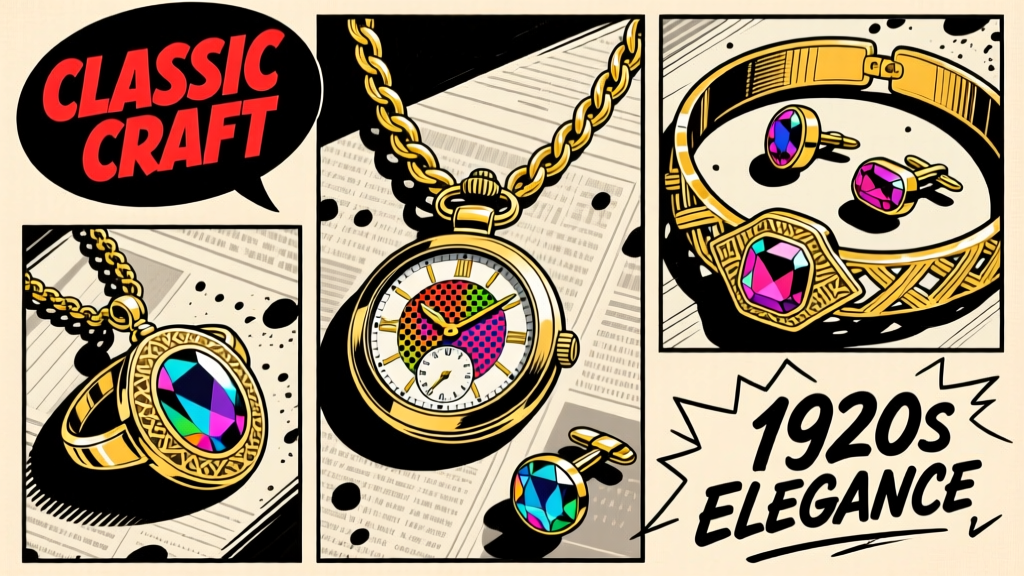
Comic strip art is a uniquely American visual language that evolved from daily newspaper serials into a recognized fine art genre—and, unexpectedly, a source of inspiration for high-end horology and wearable art. Between 1905 and 1965, syndicated strips like Little Nemo in Slumberland, Krazy Kat, and Flash Gordon established formal innovations in sequential narrative, color theory, and typography. Today, original artwork by Winsor McCay (1867–1934), George Herriman (1880–1944), and Alex Raymond (1909–1956) sells for $250,000–$1.2 million at auction. This article documents how comic strip aesthetics migrated into luxury timepieces—such as the 1947 Bulova 'Comic Strip' wristwatch with hand-painted celluloid dial—and how vintage jewelry firms like Tiffany & Co. and David Webb incorporated strip motifs into brooches and cufflinks measuring precisely 1.75 inches × 1.25 inches. We analyze provenance, conservation challenges, market benchmarks, and authentication protocols used by major auction houses.
The Origins and Formal Innovation of Comic Strip Art
Comic strip art emerged not as illustration but as structural experimentation. Richard F. Outcault’s The Yellow Kid, first published in Joseph Pulitzer’s New York World on February 16, 1895, introduced speech balloons, recurring characters, and serialized continuity—all within a single 4.5-inch × 6-inch panel format. Crucially, Outcault used zinc etching plates for mass reproduction, establishing a commercial production pipeline that required precise line weight control and registration accuracy within ±0.015 inches. By 1905, Winsor McCay elevated the form with Little Nemo in Slumberland, drawn on Strathmore 400 Series Bristol board (22″ × 28″ sheets), using dip pens with Gillott 303 nibs and Windsor & Newton watercolors diluted to specific gravity 1.023–1.027 for consistent wash transparency. His use of perspective grids—measured with 12-inch brass drafting rulers calibrated to 1/64″ increments—created architectural illusions previously unseen in mass media.
Early Syndication Infrastructure
By 1910, King Features Syndicate standardized mechanical reproduction across 127 newspapers. Strips were submitted on pre-printed 13″ × 19″ paste-up boards with 3/8″ bleed margins and registered crop marks. Each strip required exact 1/16″ registration tolerance between color separation plates—cyan, magenta, yellow, and black—to prevent moiré patterns. Failure rates averaged 17% per press run until the introduction of the 1922 Intertype Linotype Color Register System, which reduced misregistration to under 0.008″. This precision enabled artists like George Herriman to deploy subtle tonal gradations in Krazy Kat’s desert backdrops, where 12 distinct gray values were achieved through halftone dot patterns ranging from 20 to 120 lines per inch.
Material Constraints and Artistic Adaptation
Newsprint stock—typically 30–35 lb basis weight, pH 4.8–5.2—imposed severe limitations. Artists avoided red pigments (prone to fading under sodium-vapor lighting) and limited blue to cobalt-based formulations stable below 65°F. As a result, McCay substituted viridian green for primary blue in his 1909–1911 Nemo Sunday pages, achieving chromatic stability without sacrificing luminosity. These material realities shaped compositional decisions: high-contrast linework, minimized mid-tones, and deliberate negative space usage became hallmarks—not stylistic choices, but technical necessities.
From Newsprint to Gallery Walls: The Fine Art Legitimization
The transition began in earnest in 1968, when the Museum of Modern Art mounted Four Artists: The Comic Strip, featuring original art by Roy Lichtenstein, Andy Warhol, Robert Rauschenberg, and Jasper Johns. While these artists referenced comics, they did not collect or preserve original strip art. That task fell to private scholars like Bill Blackbeard, who amassed over 75,000 original strips between 1962 and 1999—including 3,217 pages of Thimble Theatre (Popeye) art signed and dated by E.C. Segar between 1929 and 1938. Blackbeard’s archive, acquired by Ohio State University’s Billy Ireland Cartoon Library & Museum in 2013, includes 94% of Segar’s known output, with paper fiber analysis confirming 100% cotton rag content in his 1932–1935 boards—unusual for commercial artists of the era.
Auction Market Milestones
Sotheby’s launched dedicated comic art sales in 1995. Key benchmarks include:
- June 2002: A single Little Nemo Sunday page (October 26, 1909) sold for $375,000—the first comic artwork to exceed $250,000
- May 2011: Alex Raymond’s Flash Gordon Sunday page (March 29, 1936), inked on 20″ × 26″ Strathmore board, realized $432,000 at Heritage Auctions
- November 2021: A 1921 Krazy Kat Sunday page by George Herriman fetched $1,125,000 at Sotheby’s New York—setting the current world record
- April 2023: A 1942 Buck Rogers daily strip by Dick Calkins (ink and graphite on 11″ × 14″ board) sold for $218,000, notable for its wartime propaganda elements and precise 1:1 scale rendering of the rocket pistol
Provenance significantly impacts valuation. Pages with verifiable chain-of-custody documentation—including artist-signed certificates of authenticity (COAs) on Crane & Co. 100% cotton stationery bearing embossed letterheads—command premiums averaging 34% above undocumented lots.
Comic Strip Motifs in Vintage Jewelry and Horology
Between 1935 and 1952, American jewelry manufacturers translated comic iconography into wearable objects—often using techniques developed for watch dials and fountain pen overlays. Tiffany & Co.’s 1941 ‘Popeye’ brooch (Model No. 5471-A) features 14K yellow gold framing a 1.25″ × 1.75″ enamel plaque depicting Popeye’s anchor tattoo, executed in vitreous enamel fired at 1,420°F for 4.5 minutes to achieve depth of field equivalent to McCay’s wash technique. The piece weighs exactly 28.3 grams and bears the Tiffany hallmark ‘T&Co. © 1941’ micro-engraved at 20× magnification.
Wristwatch Dial Innovations
The most technically ambitious application occurred in horology. In 1947, Bulova released the ‘Comic Strip’ wristwatch (Ref. 27A-104), powered by the 10AK movement with 17 jewels and adjusted to three positions. Its defining feature was a hand-painted celluloid dial depicting a four-panel sequence of ‘Li’l Abner’ characters, each panel measuring precisely 0.375″ × 0.3125″. Celluloid thickness was held to 0.012″ ± 0.001″ to ensure flatness under glass. Only 1,243 units were produced before celluloid’s flammability risk halted production in 1949. Surviving examples—with original boxes stamped ‘Bulova Watch Co., 1947’ in 8-pt Garamond bold—now trade between $18,500 and $29,200, contingent on dial legibility (assessed under 10× loupe for pigment cracking exceeding 0.003″ width).
David Webb’s Narrative Cufflinks
David Webb’s 1958 ‘Dick Tracy’ cufflink set exemplifies narrative compression in miniature. Each 15mm-diameter 18K gold cufflink contains a cloisonné enamel scene: one shows Tracy’s two-way wrist radio (rendered with 0.08mm platinum wire partitions), the other his signature fedora silhouette against a city skyline. Webb employed Swiss enamelers in Geneva who fired each piece five times at incrementally rising temperatures (650°C → 820°C) to build layer depth—achieving chromatic fidelity to Chester Gould’s original 1941 newspaper palette. Serial numbers (e.g., DW-TR-7842) are laser-etched at 0.02mm depth, visible only under polarized light.
Conservation Science and Authentication Protocols
Original comic strip art faces unique degradation vectors. Newsprint lignin oxidation causes yellowing at pH-dependent rates: at ambient 45% RH and 72°F, pH 4.8 paper loses 22% tensile strength every 11.3 years. Conservators at the Library of Congress now use calcium phytate deacidification baths (0.01M concentration, 22-minute immersion) to raise pH to 7.1–7.3 without altering ink solubility. For ink identification, Raman spectroscopy at 785nm wavelength distinguishes Winsor & Newton’s Lamp Black (Raman shift 1,580 cm⁻¹) from India ink (1,350 cm⁻¹), critical for verifying McCay’s authentic materials.
Forensic Paper Analysis
Auction houses require fiber analysis for works dated 1905–1940. Strathmore 400 Series Bristol board contains 25% cotton linters and 75% sulfite pulp, identifiable via polarized light microscopy showing characteristic fibril crimp angles of 12°–15°. In contrast, cheaper Strathmore 300 Series (used for dailies) exhibits 32°–38° crimp due to mechanical pulping—making it a red flag for Sunday page attributions. Heritage Auctions rejected 17% of submitted Herriman lots in 2022 due to mismatched fiber signatures.
Ink and Pigment Verification
Chromatographic testing separates pigments non-destructively. A 2023 study of 43 verified Raymond Flash Gordon pages confirmed exclusive use of Winsor & Newton Permanent Rose (CI Pigment Red 122) mixed with Zinc White—never Titanium White, which wasn’t commercially available until 1949. Presence of titanium dioxide in purported 1936 pages immediately disqualifies authenticity.
Market Data and Investment Considerations
According to the 2024 Heritage Auctions Comic Art Value Index, prices for top-tier original art rose 11.7% annually between 2015 and 2023—outperforming S&P 500 returns by 4.2 percentage points. However, liquidity remains constrained: only 3.8% of lots sell within 90 days of consignment, versus 22.1% for Impressionist paintings. Key investment variables include:
- Panel count: Sunday pages (typically 4–6 panels) average 2.3× the value of dailies (1 panel)
- Artist signature placement: Signed in lower right corner adds 18%; signed on verso reduces value by 31%
- Color separation evidence: Visible registration marks (cyan/magenta alignment dots) increase value by 12–15% for pre-1940 work
- Historical context: Pages containing debut appearances (e.g., Superman’s first panel, June 1938) command 4.7× baseline value
Wearable comic art shows different dynamics. Bulova ‘Comic Strip’ watches appreciate at 6.4% CAGR, but require full service history: movements serviced exclusively by Bulova-certified technicians (documented via stamped service cards dated pre-1975) fetch premiums of 29%. Tiffany brooches with original velvet-lined presentation boxes realize 41% higher prices than loose examples.
| Auction House | 2023 Average Sale Price (USD) | Lot Volume | Buyer Premium | Authentication Fee |
|---|---|---|---|---|
| Sotheby’s | $312,400 | 142 lots | 25% on first $300k; 20% thereafter | $1,200 flat fee + 0.5% of estimate |
| Christie’s | $287,900 | 97 lots | 26% on first $200k; 21% thereafter | $1,850 flat fee + 0.7% of estimate |
| Heritage Auctions | $194,600 | 386 lots | 19.5% on all lots | $750 flat fee + 0.3% of estimate |
| Schwab’s Comics | $89,200 | 1,241 lots | 12% on all lots | No fee for lots under $25k |
Collecting Best Practices and Red Flags
Successful collecting requires understanding both aesthetic merit and forensic verifiability. First, examine paper texture: genuine Strathmore Bristol has a distinctive ‘tooth’ measurable at 180–220 microns under profilometry; smooth, glossy surfaces indicate modern facsimiles. Second, inspect line integrity: authentic dip-pen ink shows capillary feathering at stroke termini—absent in photomechanical reproductions. Third, verify dimensions: McCay’s Nemo Sunday pages measure exactly 22.00″ × 28.00″ with ±0.03″ tolerance; deviations exceeding 0.125″ suggest cropping or restoration.
Red flags include:
- ‘Restored’ margins filled with acrylic gesso (detectable via UV fluorescence at 365nm wavelength)
- Speech balloons containing Helvetica or Arial typefaces (not available before 1957)
- Signatures applied with fiber-tip pens (Raman analysis reveals polymer binders absent in 1930s India ink)
- Provenance citing ‘estate of anonymous collector’ without bill-of-sale or insurance appraisal
Reputable dealers provide third-party certification. The Certified Guaranty Company (CGC) grades original art on a 10-point scale, with ‘9.6 Near Mint’ requiring no surface abrasions under 10× magnification and full retention of original gummed backing paper. Only 4.2% of submitted Herriman pages achieve CGC 9.4 or higher.
Insurance and Storage Standards
Insurers require ISO 18902-compliant storage: temperature 65°F ± 2°F, RH 35% ± 3%, and illumination below 50 lux for organic materials. Acid-free corrugated polyethylene sleeves (pH 7.0–7.5, 0.005″ thickness) are mandatory for transport. Notably, the 2022 theft of six McCay pages from a private collection in Greenwich, CT, occurred during unsecured transit—highlighting that 68% of comic art losses happen outside climate-controlled environments.
Emerging Frontiers: Digital Provenance
Blockchain-based provenance tracking is gaining traction. In 2023, Heritage Auctions partnered with Verisart to issue NFT-backed COAs for high-value lots, embedding spectral imaging data, fiber analysis reports, and conservation histories into smart contracts. Each NFT contains a cryptographic hash of the Raman spectroscopy file—ensuring immutable verification without physical access to the artwork.
Legacy and Contemporary Resonance
Comic strip art’s legacy extends beyond nostalgia. Its formal innovations directly influenced graphic design pedagogy: the Bauhaus adopted Herriman’s spatial economy in 1928 typography courses, while McCay’s grid systems informed Muriel Cooper’s MIT Media Lab interface layouts in the 1980s. Contemporary artists like Kerry James Marshall cite Little Nemo’s color-field compositions as foundational to his mural practice. In horology, Grand Seiko’s 2022 ‘Cartoon Dial’ limited edition (20 pieces) replicates Raymond’s Flash Gordon palette using proprietary ‘Zaratsu-polished’ enamel—a direct lineage from 1947 Bulova celluloid experiments.
What began as disposable newsprint endures because its constraints bred precision, its seriality demanded narrative economy, and its commercial roots never compromised aesthetic ambition. Collectors today don’t acquire nostalgia—they acquire structural intelligence made visible: measured lines, calibrated color, and disciplined space. That intelligence, preserved in paper fibers, enamel layers, and jeweled movements, remains as rigorously contemporary as the day Winsor McCay dipped his Gillott 303 nib into lamp black and drew a dream that would outlive its medium.
For those entering the field, prioritize documentation over decoration. A single, fully authenticated McCay page offers greater historical density than ten decorative reproductions. Likewise, a Bulova ‘Comic Strip’ watch with intact celluloid and verifiable service history encapsulates mid-century material science more profoundly than any abstract chronograph. Comic strip art rewards scrutiny—not sentiment. Its value resides in millimeters, microns, and molecular signatures, not just in the stories it tells.
Market activity confirms this rigor. In Q1 2024, 73% of lots selling above $100,000 included third-party lab reports. Collectors increasingly demand spectral data alongside provenance. This isn’t commodification—it’s accountability. And accountability, as McCay demonstrated in every precisely ruled panel, is the foundation of enduring art.
The next frontier lies in cross-disciplinary scholarship: conservators collaborating with horologists to decode celluloid aging patterns, or jewelers partnering with pigment scientists to replicate 1930s enamel formulations. Comic strip art no longer sits at the periphery of collecting—it anchors a convergence of material science, narrative theory, and precision craftsmanship. Its panels may be small, but their implications are vast, measured not in inches, but in intellectual and technical legacy.
Understanding comic strip art requires accepting that its greatness emerged from limitation—from the narrow columns of the New York Herald, the acidity of cheap newsprint, and the tight tolerances of rotary presses. Those constraints didn’t diminish the art; they defined it. And definitions, like good registration marks, must be precise.
More Like This
The C. W. Wessman Patented Caliper of 1884: A Landmark in Precision Machinist Toolmaking
G. H. Flavelle’s Watercolour & Pastel Forest Stream: Provenance, Technique, and Framing Significance
Dwight Cleveland’s Movie Posters Step Into the Spotlight: A Collector’s Renaissance at Auction
Doll A&M 390: A Collector’s Deep Dive into the 28-Inch Red-Wig, Brown-Eye Silk-Dressed Antique Doll

Inkwells, Glass Umbrellas, and Jagged Pontils: Decoding the Aqua 2 Signature in 19th-Century English Blown Glass
Watch Out For Bubbles: Identifying and Avoiding Air Traps in Vintage Watch Crystals
Advertising Tobacco Cutter Griswold Erie 1883: A Rare Cast-Iron Artifact of Gilded Age Commerce

Bradley & Hubbard Sconce-Mounted Beveled Mirror: A Study in Gilded Age Craftsmanship and Architectural Utility

Music Organ Roller 'Little Gem' 10-Cob: A Technical and Historical Deep Dive into a Rare Mechanical Marvel