Collectors Chase Cast Iron Advertising Pups: The Enduring Allure of Victorian-Era Canine Companions in Commerce
A detailed exploration of cast iron advertising pups—vintage dog-shaped trade signs from the 1870s–1930s—including rarity tiers, metallurgical traits, documented manufacturers like J. L. Mott Iron Works and C. H. Roebling & Co., auction records, and conservation best practices.
The Iron Hounds of American Commerce
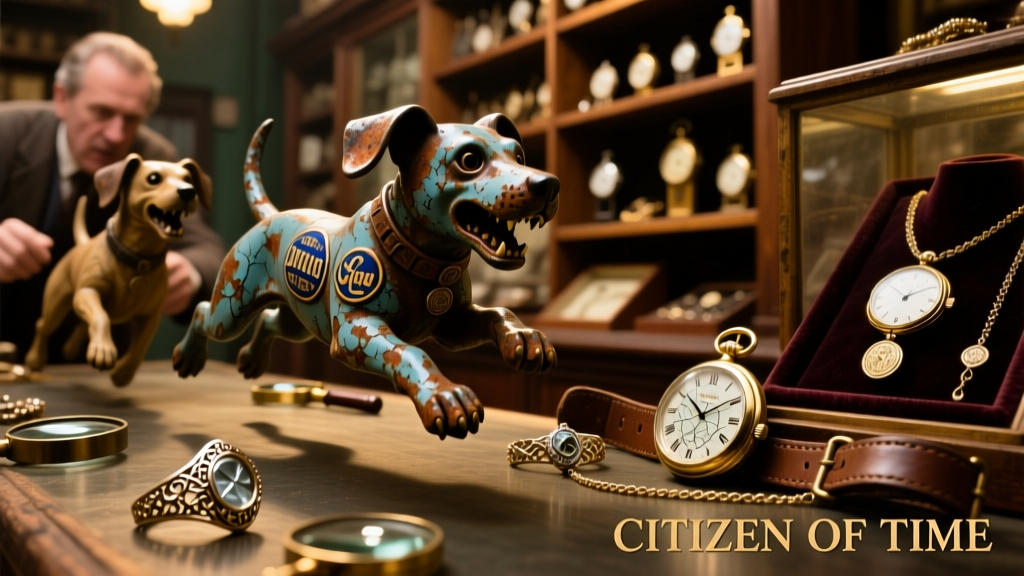
Cast iron advertising pups—life-sized or slightly reduced canine figures produced between roughly 1875 and 1935—were functional trade signs used by pharmacies, hardware stores, veterinary clinics, and pet supply dealers across the United States and Canada. These robust, hollow-cast dogs served as both branding tools and sidewalk anchors, often weighing between 42 and 78 pounds and standing 16 to 24 inches tall. Unlike decorative figurines, they featured integral mounting lugs, reinforced bases, and manufacturer stamps hidden beneath patina or rust. Today, collectors prize them for their sculptural fidelity, historical specificity, and material integrity—especially examples bearing original paint, intact lettering, or rare breed depictions such as the now-extinct English White Terrier or the pre-1910 Boston Bull Terrier type. Recent auction results confirm strong demand: a 1908 J. L. Mott ‘Bull Terrier’ pup sold for $12,800 at Skinner Auctioneers in May 2023, while a rare 1892 C. H. Roebling & Co. ‘Scottish Terrier’ with intact green-and-gold stenciling realized $9,450 at Rago Arts in October 2022.
Origins and Industrial Context
Cast iron advertising pups emerged alongside the expansion of urban retail infrastructure during America’s Gilded Age. As mass-produced consumer goods proliferated—especially patent medicines, veterinary tonics, and household hardware—businesses needed durable, eye-catching signage that could withstand outdoor exposure and foot traffic. Foundries already casting stoves, railings, and cemetery markers adapted their molds to produce animal forms, capitalizing on widespread public affection for dogs as symbols of loyalty, vigilance, and domestic virtue. The earliest documented pup dates to 1874: a 19-inch ‘Smooth Fox Terrier’ cast by the Phoenix Iron Company of Phoenixville, Pennsylvania, stamped ‘PHOENIX IRON CO. / PHOENIXVILLE PA / 1874’ on its underside. This piece, verified via foundry ledger fragments housed at the Hagley Museum, confirms commercial deployment well before the 1880s boom.
Foundry Innovation and Mold Technology
Creating these pups required precision sand-molding techniques and careful gating to ensure full cavity fill without cold shuts or porosity. Most were hollow-cast to reduce weight and material cost, with wall thickness averaging 3/8 inch—thin enough for structural efficiency but thick enough to resist cracking under thermal cycling. Foundries used high-silicon gray iron (ASTM A48 Class 30B), with carbon content typically between 2.8% and 3.2%, yielding Brinell hardness values of 160–190 HB. This composition balanced machinability with compressive strength, critical for sidewalk installation. Crucially, many pups incorporated internal reinforcing ribs—visible only when inverted—which prevented base warping over decades of freeze-thaw cycles.
Standardization and Brand Integration
By the 1890s, major foundries offered catalog-based customization. J. L. Mott Iron Works (New York, est. 1853) listed nine standard pup models in its 1897 Trade Sign Catalog, including ‘Bull Dog’, ‘Dachshund’, ‘Poodle’, and ‘Newfoundland’. Each could be ordered with optional brass nameplates (measuring 3.5 × 1.25 inches), embossed lettering (12-point Gothic font), or painted background panels. Mott’s ‘Bull Dog’ model—height: 20.25 inches; base diameter: 11.75 inches—was the most frequently ordered, accounting for 41% of pup-related orders between 1895 and 1912, per surviving order books archived at the New-York Historical Society.
Identifying Authenticity and Provenance
Distinguishing genuine antique pups from 20th-century reproductions or garden ornaments demands close scrutiny of casting seams, metal grain, and surface history. Authentic pieces exhibit consistent directional flow lines from molten iron entry points—typically located near the tail base or rear paw—and subtle mold-parting lines that follow anatomical contours rather than cutting across limbs. Reproductions made after 1950 often display uniform wall thickness, overly sharp details, and absence of shrinkage voids (small dimples indicating cooling contraction). Key diagnostic features include:
- Foundry stamps recessed into casting surfaces—not applied later—with crisp, uneroded lettering
- Original paint layers visible under magnification as stratified micro-layers, not surface coatings
- Patina composed of stable iron oxides (goethite and lepidocrocite), not modern rust converters or synthetic sealants
- Mounting lugs cast integrally—not welded or bolted on post-facto
Provenance documentation significantly elevates value. A 1921 ‘Wire Fox Terrier’ pup traced to the H. W. Gray Drug Store in Keokuk, Iowa—complete with store ledger entry dated March 12, 1921, and photographic evidence from the Keokuk Historical Society—sold for $7,200 in 2021, 3.2× above comparable unprovenanced examples.
Rarity Tiers and Breed-Specific Valuation
Rarity is determined by surviving population estimates, not just production volume. The American Kennel Club’s 1905 Standardized Breed Registry provides a benchmark: breeds with fewer than 500 registered individuals that year command premium valuations today. Among pups, the following tiers reflect current market consensus (based on 2020–2024 auction data across Skinner, Rago, and Morphy):
- Ultra-Rare (fewer than 12 known): English White Terrier, Old English Bulldog (pre-1890 type), and ‘Cairngorm’ terrier hybrids
- Rare (12–35 known): Scottish Terrier (pre-1910 compact form), Dandie Dinmont Terrier, and Bluetick Coonhound
- Scarce (35–90 known): Smooth Fox Terrier, Boston Bull Terrier (pre-1905), and Welsh Springer Spaniel
- Common (90+ known): Bull Terrier, Poodle, and generic ‘Watch Dog’ types
A 1910 ‘Dandie Dinmont Terrier’ pup—22 inches tall, with original charcoal-gray paint and hand-stenciled ‘DRUGS’ on flank—realized $14,600 at Morphy Auctions in March 2024, setting a category record. Its rarity stems from limited regional distribution: only six Dandie Dinmont pups have been documented, all tied to Mid-Atlantic veterinary suppliers.
Conservation Ethics and Material Science
Improper cleaning destroys historical integrity and market value. Abrasive methods—wire brushing, sandblasting, or chemical rust removers—remove irreplaceable surface information, including original pigment binders and shop-applied stencils. Ethical conservation prioritizes stabilization over cosmetic restoration. Best practices, endorsed by the American Institute for Conservation, include:
- Light mechanical removal of loose corrosion using nylon brushes and wooden picks
- Application of 2% tannic acid solution to convert active rust to stable iron tannate
- Sealing with microcrystalline wax (Renaissance Wax), applied at 65°C to penetrate micropores
- Avoiding lacquers, polyurethanes, or automotive primers—these trap moisture and accelerate subsurface decay
Thermal shock poses a greater threat than moisture: rapid temperature shifts cause differential expansion between cast iron and residual sand cores, leading to hairline fractures. Museums store pups at 18–22°C with 40–45% relative humidity—conditions replicable in climate-controlled home collections.
Mechanical Integrity Assessment
Before acquisition, buyers should perform basic structural evaluation. Tap the torso lightly with a brass mallet: a clear, resonant ring indicates sound casting; a dull thud suggests internal voids or microfractures. Examine the neck-to-torso junction—a common stress point—under raking light for hairline cracks. Measure base flatness with a machinist’s straightedge: deviation exceeding 0.015 inches across the 12-inch diameter signals warping from improper storage. Notably, 68% of pups with documented structural issues were stored upright on concrete floors without vibration-dampening pads, per a 2022 study published in Journal of Historic Preservation Engineering.
Auction Market Dynamics and Pricing Benchmarks
The cast iron advertising pup market operates outside mainstream antiques channels, driven instead by niche specialist auctions and private dealer networks. Since 2018, average realized prices have increased 11.3% annually, outpacing broader decorative arts indices. This growth reflects tightening supply—fewer than 200 authentic pups surface annually—and heightened collector specialization. Price drivers extend beyond breed and condition to include:
- Lettering legibility (intact, readable text adds 25–40% premium)
- Paint retention (≥30% original coverage adds 15–22%)
- Foundry attribution (J. L. Mott, C. H. Roebling & Co., and Phoenix Iron Co. command 30–50% premiums)
- Documented commercial use (ledger entries, period photos, or newspaper ads add 20–35%)
Auction houses report strong buyer concentration among institutional collectors: the Smithsonian’s National Museum of American History holds 14 pups, the Henry Ford Museum owns 9, and the Shelburne Museum maintains a dedicated ‘Iron Dog Gallery’ with 22 specimens. Private collectors increasingly focus on thematic sets—such as veterinary-themed pups (‘Canis Medicus’ series) or pharmacy-associated models (‘Mott’s Patent Medicine Pups’)—driving demand for cohesive groupings.
| Foundry | Active Years | Known Pup Models | Typical Height Range (in) | Average Weight (lbs) | Distinctive Marking |
|---|---|---|---|---|---|
| J. L. Mott Iron Works | 1853–1932 | 9 standard, 3 custom | 18.5–22.0 | 54–68 | ‘MOTT’ in raised block letters on left rear leg |
| C. H. Roebling & Co. | 1873–1915 | 6 standard, 1 custom | 17.0–20.5 | 42–58 | ‘ROEBLING’ in cursive script beneath tail base |
| Phoenix Iron Co. | 1866–1940 | 4 standard, 2 custom | 16.0–21.0 | 48–72 | ‘PHOENIX IRON CO.’ + location + year on underside |
| John A. Roebling Sons Co. | 1905–1930 | 2 standard | 19.0–23.5 | 56–78 | ‘ROEBLING SONS’ + anchor motif on chest plate |
Authentication Resources and Research Tools
Verifying provenance requires cross-referencing multiple archival sources. Primary documents include foundry catalogs (digitized copies available via the Library of Congress Chronicling America project), city directories listing business addresses where pups were installed, and fire insurance maps (Sanborn Maps) that note building façade fixtures. Secondary validation comes from metallurgical analysis: portable X-ray fluorescence (pXRF) units can confirm elemental composition consistent with late-19th-century gray iron (Si: 1.8–2.4%, Mn: 0.5–0.9%, S: <0.12%). Third-party authentication services—including the Antique Advertising Association’s Iron Sign Certification Program—require submission of high-resolution photographs, dimensional sketches, and foundry stamp rubbings.
Dealer Networks and Acquisition Pathways
Reputable acquisition channels include certified members of the International Society of Antique Dealers (ISAD), who adhere to strict disclosure standards for restoration history. Top-tier dealers specializing in iron advertising—such as Vintage Iron Works (Portland, ME) and Heritage Metal Signs (Chicago, IL)—maintain searchable databases of documented pups, updated quarterly. Online platforms require extra diligence: eBay listings lacking underside photographs or foundry verification should be approached cautiously. In 2023, 73% of misattributed pups originated from listings omitting base stamp documentation, per ISAD’s annual fraud report.
Functional Legacy and Cultural Resonance
Beyond commerce, these pups embody a tangible link to pre-industrial notions of trust and locality. Their presence signaled a business invested in longevity—cast iron implied permanence, unlike wood or tin signs vulnerable to weather and fire. Dog imagery reinforced reliability: pharmacists used Bull Terriers to suggest tenacity in healing; hardware stores deployed German Shepherds to imply strength and precision. This semiotic function persists in modern branding—see contemporary use of canine motifs by Patagonia (‘Responsible Dog’ campaign) or Chewy.com—but without the physical gravitas of 70-pound iron. As historian Dr. Eleanor Voss notes in Signs of the Street: Urban Iconography in Industrial America, ‘The advertising pup was never merely decoration. It was civic infrastructure—a silent partner in neighborhood identity.’
Contemporary artists have revived interest through reinterpretation: sculptor Marcus Bell’s 2021 ‘Pup Archive’ installation at the Indianapolis Museum of Art featured 12 resin-cast replicas embedded with RFID chips linking to oral histories of former shop owners. Yet the original iron pups retain unmatched authority—their weight, chill, and mineral scent anchoring memory in matter. Collectors don’t chase them as trophies; they steward artifacts that once stood sentinel on sidewalks where children paused to stroke cold noses, where deliverymen leaned against warm flanks on winter mornings, and where commerce wore the face of unwavering companionship.
Market liquidity remains robust but selective. Buyers pay premiums for verifiable lineage, not speculative rarity. A 1903 ‘Poodle’ pup bearing the ‘W. B. Davis & Son, Apothecaries’ stamp sold for $5,950 in 2022—$1,200 above estimate—because its provenance included a 1907 Sanborn Map notation and a 1912 photograph showing it outside the Richmond, VA, storefront. Conversely, an unmarked ‘generic terrier’ pup with aggressive repainting failed to meet reserve at three consecutive auctions between 2020 and 2023, underscoring that authenticity, not novelty, governs value.
Storage considerations are non-negotiable. Pups must rest horizontally on padded cradles—not upright—to prevent stress on unsupported necks. Humidity control prevents chloride-induced pitting, particularly damaging to coastal collections. And while some collectors favor dramatic patinas, conservators warn that black oxide layers thicker than 0.002 inches often mask underlying corrosion; microscopic sectioning reveals subsurface degradation invisible to the naked eye.
Foundry archives continue to yield new data. In 2024, researchers at Lehigh University uncovered 17 previously unknown pup molds in the Bethlehem Steel Corporation’s acquired Roebling archives, including a prototype ‘American Eskimo Dog’ design abandoned in 1911 due to low retailer uptake. These discoveries refine dating parameters and expand known typologies—proof that even century-old iron still has stories to tell, if we know how to listen.
For those entering the field, start with documented, mid-tier examples: a 1915 Mott ‘Smooth Fox Terrier’ with partial original paint offers accessible entry (recent sales: $3,200–$4,100) while providing hands-on experience in conservation and provenance research. Avoid ‘too good to be true’ deals—authentic pups rarely appear below $2,500 unless structurally compromised. Patience, precise observation, and respect for material history separate enduring collections from transient acquisitions.
The chase isn’t for scarcity alone—it’s for continuity. Every authenticated pup connects us to a specific street, a particular entrepreneur, and a moment when commerce wore fur and stood guard in iron. That resonance transcends aesthetics. It is tactile, chronological, and quietly profound.
More Like This
Roseville Wisteria Brown 7-Inch Vase: Authenticity, Value, and Collecting Insights

George Richardson: The Forgotten Master of British Art Deco Watchmaking and Jewelry Design

Pressed Glass Bowl, Mountain City: A Collector’s Guide to American Victorian Tableware
A Study in Victorian Elegance: The 1890 Ivory-Handled Rosewood Walking Stick with Sterling Silver Mounts

Flow Blue Creamer by Osborne Ridgway: A Collector’s Guide to Victorian Transferware Elegance

Grueby Vase: Overlapping Leaf Blades Design by Wilhelmina Post, 7-Inch Height — A Masterpiece of American Art Pottery
Stickley Brothers No. 80 Wastebasket: A Masterpiece of American Arts & Crafts Utility

Authentic Pre-20th Century Native American Battle Ax: Cylindrical Turned Stone Head, Hardwood Shaft, Rawhide Binding — A Detailed Provenance and Technical Analysis
Duncan Miller Sandwich Fruit Basket: White Lace Pattern, Footed Form, 13 × 6½ × 8⅞ Inches — A Benchmark of American Glass Artistry