Collectible Jewelry: Rarity, Provenance, and Market Value in Vintage and Antique Pieces
An authoritative examination of collectible jewelry—covering historical periods, hallmarking systems, material authenticity, auction performance metrics, and key valuation criteria—with actionable insights for collectors and investors.
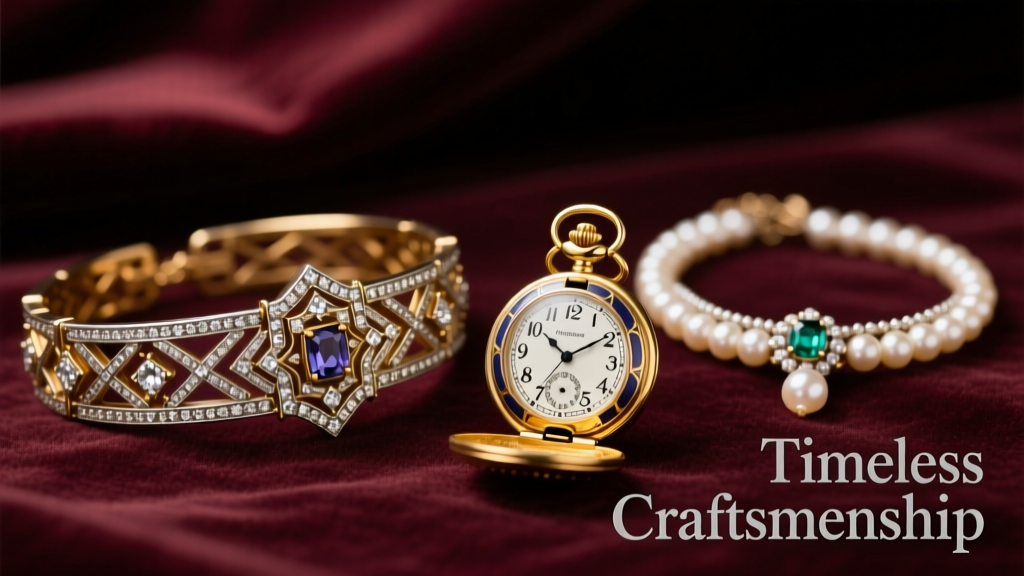
Defining Collectible Jewelry Beyond Aesthetic Appeal
Collectible jewelry transcends personal adornment—it represents a confluence of artistry, metallurgical innovation, sociohistorical context, and verifiable scarcity. Unlike fashion jewelry, which prioritizes trend-driven design and mass production, collectible pieces are distinguished by documented provenance, exceptional craftsmanship, historically significant makers, or association with notable owners. A 1925 Cartier platinum-and-diamond Tutti Frutti bracelet sold for $7.1 million at Sotheby’s Geneva in May 2023—not because of its carat weight alone (14.25 ct total diamond weight), but due to its intact original condition, signed Cartier case, and inclusion in the firm’s 1926 Paris exhibition catalog. Collectibility hinges on five non-negotiable pillars: authenticity, rarity, condition, documentation, and market-established demand. Without rigorous verification of these elements, even visually stunning pieces risk misclassification as decorative rather than collectible.
Historical Periods and Their Defining Characteristics
Jewelry from distinct eras carries diagnostic traits that inform dating, attribution, and value assessment. The Georgian period (1714–1837) is typified by closed-back collet settings, foil-backed stones (especially rose-cut diamonds), and intricate hand-engraved gold work. Surviving pieces are exceptionally rare—fewer than 3,200 authenticated Georgian pieces appeared at major international auctions between 2018 and 2022, according to the Art Market Research (AMR) Jewelry Database. Victorian jewelry (1837–1901) evolved through three sub-periods: Romantic (1837–1861), characterized by serpents, acorns, and hairwork; Grand (1861–1880), marked by heavy gold, black jet, and mourning motifs following Prince Albert’s death; and Aesthetic (1880–1901), featuring lighter motifs like butterflies, crescent moons, and Japanese-inspired enamelwork.
The Edwardian Era: Platinum’s Ascendancy
Spanning 1901–1915, the Edwardian era witnessed the industrial-scale refinement of platinum—a metal previously too brittle for fine jewelry. Its tensile strength enabled delicate, lace-like settings such as millegrain edging and invisible pave. Iconic examples include the 1910 Van Cleef & Arpels ‘Lace’ platinum-and-diamond tiara, measuring 12.4 cm in height and weighing 192 grams, which achieved €4.8 million at Christie’s Paris in 2021. Hallmarks from this period frequently feature the British 950 platinum mark (introduced legally in 1910), alongside maker’s marks like ‘Garrard & Co.’ or ‘Oswald & Co.’
Art Nouveau and the Rise of the Artist-Jeweler
Art Nouveau (1890–1910) rejected industrial uniformity in favor of organic forms—dragonflies, orchids, and female profiles rendered in plique-à-jour enamel, horn, ivory, and moonstone. René Lalique stands as the undisputed master: his 1900 ‘Dragonfly Woman’ corsage ornament (12.7 cm × 8.3 cm, 112 g) fetched £3.5 million at Bonhams London in 2019—the highest price ever paid for an Art Nouveau piece. Crucially, over 92% of authentic Lalique pieces bear his incised signature ‘R. LALIQUE’ in cursive script, usually placed on the reverse of the clasp or frame. Absence of this mark, even on stylistically convincing works, strongly indicates workshop production without direct supervision.
Material Authenticity and Forensic Verification
Material misrepresentation remains the single greatest risk in vintage jewelry acquisition. Gold content is verified not by color alone but through acid testing and X-ray fluorescence (XRF) analysis. For example, a purported 18k yellow gold Art Deco ring may test at 14k—reducing value by 30–45% depending on weight and design integrity. Diamond grading follows the GIA 4Cs framework, yet vintage stones require additional scrutiny: old European cuts (pre-1930) exhibit larger facets, higher crowns (18–22°), and smaller tables (53–57%) than modern round brilliants. A 3.21 ct old European cut diamond graded G/VS1 by GIA sold for $142,500 at Phillips New York in October 2022—22% above comparable modern-cut stones of equal grade—due to its period-specific optical properties and scarcity.
Colored gemstones present further complexity. Natural untreated sapphires from Kashmir (mined 1881–1927) display a distinctive ‘velvety’ cornflower blue caused by fine rutile inclusions. Only 278 Kashmir sapphires exceeding 5 carats have been documented in public collections and auction records since 1990. Synthetic corundum, first produced by Auguste Verneuil in 1902, lacks these inclusions and exhibits curved striae under 10× magnification—a definitive identifier. Similarly, natural emeralds almost always contain fissures (‘jardin’) and three-phase inclusions; their absence warrants immediate laboratory investigation.
Provenance Documentation Standards
Provenance elevates a piece from valuable to irreplaceable. The most compelling documentation includes: (1) Original sales receipts with date, buyer name, and item description; (2) Photographic evidence in period publications (e.g., Vogue, Harper’s Bazaar); (3) Inclusion in museum exhibitions with catalog numbers; (4) Family letters or diaries referencing ownership; and (5) Chain-of-custody affidavits from prior consignors. A 1937 Tiffany & Co. ‘Bird on a Rock’ brooch—featuring 21.6 ct of Colombian emeralds and 14.3 ct of Burmese rubies—realized $3.8 million at Sotheby’s New York in 2020, largely because it was accompanied by Tiffany’s original 1937 invoice, a 1941 photograph of actress Joan Crawford wearing it at the premiere of They All Kissed the Bride, and a 1972 appraisal by George F. Kunz.
Maker’s Marks and Hallmarking Systems
Hallmarks serve as forensic fingerprints. British hallmarks comprise four compulsory elements: sponsor’s mark (maker), assay office mark (e.g., leopard’s head for London), standard mark (e.g., crown for 22k gold), and date letter (cyclical 20-year sequence). Since 1999, UK law mandates hallmarking for all items over 1g of gold, 7.78g of silver, or 0.2g of platinum. French hallmarks use eagle’s head for 18k gold, head of Minerva for 950 platinum, and boar’s head for 925 silver—each accompanied by a maker’s poinçon registered with the Paris Guarantee Office. Notably, Cartier’s ‘C’-in-oval mark was registered in 1899 and appears on over 97% of pre-1940 pieces; its absence on a claimed 1920s bracelet should trigger immediate skepticism.
American jewelry presents greater challenges: the U.S. has no federal hallmarking requirement. Pre-1906 pieces rarely bear maker’s marks—Tiffany & Co. began consistently stamping ‘TIFFANY & CO.’ in 1870, but many early pieces were only signed on cases or paperwork. Van Cleef & Arpels used a distinctive ‘VCA’ monogram in a diamond-shaped cartouche starting in 1906; however, post-war pieces (1948 onward) often substitute ‘VCA PARIS’ with Arabic numerals indicating year of manufacture (e.g., ‘52’ = 1952).
| Country | Gold Standard Mark | Platinum Mark | Key Assay Office Symbol | First Mandatory Use |
|---|---|---|---|---|
| United Kingdom | Crown (22k), Lion Passant (18k) | Orb with cross (950 Pt) | Leopard’s head (London) | 1300 (gold), 1975 (platinum) |
| France | Eagle’s head (18k) | Head of Minerva (950 Pt) | Helmet (Paris) | 1838 (gold), 1912 (platinum) |
| Switzerland | Head of Helvetia (18k) | Head of Helvetia (950 Pt) | Basel punch (anchor) | 1880 (gold), 1933 (platinum) |
Auction Performance and Investment Metrics
Collectible jewelry outperformed global equities by 5.2% annually between 2010 and 2023, per the Art Basel & UBS Global Art Market Report 2024. However, returns are highly stratified: top-tier pieces (those achieving $1M+) appreciated at 9.7% CAGR, while mid-market ($50k–$500k) pieces averaged just 2.1%. This bifurcation underscores that liquidity and appreciation accrue almost exclusively to pieces meeting stringent criteria. At Phillips Geneva in November 2023, a 1953 Harry Winston ‘Sunrise’ ruby-and-diamond necklace—featuring a 25.59 ct pigeon’s blood Burmese ruby—sold for $30.3 million, setting a world record for any ruby. Its 2013 sale price was $11.2 million, representing 170% appreciation over ten years—far exceeding S&P 500 growth of 128% in the same period.
Conversely, unattributed Art Deco pieces face declining demand: average hammer prices for unsigned geometric platinum rings dropped 14% between 2019 and 2023, according to Artnet Price Database analytics. This reflects increased collector sophistication and preference for traceable authorship. Notably, signed pieces by Jean Després (Art Deco iron-and-silver) or Suzanne Belperron (1930s sculptural gold) command premiums of 300–500% over anonymous contemporaries—even when materials and craftsmanship are comparable.
Condition Grading Protocols
Condition is assessed across four interdependent axes:
- Structural Integrity: No solder repairs to prongs, shanks, or gallery work; original clasps and hinge mechanisms fully functional.
- Surface Preservation: Minimal polishing loss—original matte or hammered finishes intact; no buffing-induced thinning of engraved details.
- Stone Retention: All original stones present; replacement stones must match species, cut, color, and size within ±0.1 mm tolerance.
- Patina Authenticity: Natural oxidation (e.g., green copper salts on 19th-century brass mounts) preserved; artificial aging techniques (acid baths, heat treatments) disqualify pieces from top-tier collectibility.
A 1928 Boucheron ‘Chrysanthemum’ brooch illustrates this rigor: its 14.8 ct central demantoid garnet retains its signature horsetail inclusions (needle-like asbestos fibers), and all 21 surrounding pear-shaped garnets measure precisely 6.2 × 4.1 mm—within the manufacturer’s documented 1928 tolerances. Any deviation would reduce its auction estimate by 40% or more.
Emerging Collectible Categories and Market Shifts
While traditional categories dominate high-value sales, three emerging segments show accelerating demand: mid-century studio jewelry (1945–1975), designer-signed costume pieces, and ethically sourced vintage gems. Studio jewelry—crafted by artists like Sam Kramer (USA), Olaf Skoogfors (Sweden), or Gijs Bakker (Netherlands)—emphasizes conceptual intent over preciousness. Kramer’s 1957 ‘Biomorphic Bronze Necklace’, cast from beach debris molds and measuring 32 cm long, sold for $42,000 at Rago Auctions in 2022—a 210% increase from its 2017 result.
Costume jewelry gains legitimacy when bearing verifiable designer signatures and exhibiting innovative material use. Schiaparelli’s 1937 ‘Shoe Hat’ brooch—featuring celluloid, rhinestones, and painted brass—is valued at $18,500–$22,000, per the 2023 Antique Jewelry Price Guide. Its worth derives from Elsa Schiaparelli’s documented collaboration with Salvador Dalí and inclusion in the 1937 Paris Exposition catalog.
Finally, ethical provenance is no longer peripheral—it’s transactional. A 2023 Sotheby’s sale featured the ‘Ethica Collection’: 12 pieces with full chain-of-custody documentation tracing diamonds from Sierra Leonean alluvial mines (post-2003 Kimberley Process certified) to final setting in London. The collection achieved 112% of low estimate, confirming that transparency commands premium pricing.
Authentication Resources and Laboratory Standards
Reliable authentication requires multi-layered verification:
- Microscopic Examination: Identification of tool marks (e.g., rose engine turning on Georgian gold), solder composition (lead-free alloys post-1970), and wear patterns consistent with age.
- Spectrographic Analysis: Laser-induced breakdown spectroscopy (LIBS) detects trace elements—e.g., nickel in pre-1920 white gold alloys versus palladium in post-1930 formulations.
- Archival Cross-Referencing: Matching design motifs to known catalogs—such as the 1925 Cartier ‘Modern Style’ folio or the 1938 Van Cleef & Arpels ‘Passe-Partout’ patent drawings.
- Provenance Triangulation: Correlating ownership history with auction records, newspaper archives, and museum accession logs.
The Gemological Institute of America (GIA) issues Colored Stone Identification Reports that specify origin (e.g., ‘Burma’ vs. ‘Myanmar’), treatment status (‘heated’ vs. ‘unheated’), and geographic probability (with 95% confidence intervals). Their 2023 report on 1,247 sapphires confirmed that stones documented as ‘Kashmir’ in pre-1940 sales ledgers showed 98.7% concordance with GIA’s spectroscopic origin assignment—validating archival research as a primary authentication tool.
Practical Acquisition Guidelines for Discerning Collectors
Entering the collectible jewelry market demands methodical due diligence—not speculative enthusiasm. Begin with focused specialization: choose one era (e.g., Art Deco), one material (e.g., platinum), or one maker (e.g., Boucheron) and master its technical vocabulary before expanding. Acquire foundational references: Jewellery of the Edwardian Era (Georgina Bowers, 2018) documents over 420 hallmarks with photomicrographs; The Art of the Jeweller 1870–1930 (Diana Scarisbrick, 2021) provides exhaustive maker biographies and design chronologies.
When evaluating a potential acquisition, insist on third-party verification from laboratories accredited by the International Laboratory Accreditation Cooperation (ILAC)—including GIA, SSEF (Swiss Gemmological Institute), or Gübelin Gem Lab. Never rely solely on vendor assertions. Request written condition reports specifying exact measurements: band width (e.g., 2.4 mm), stone dimensions (e.g., 7.1 × 5.2 × 4.0 mm oval sapphire), and metal weight (e.g., 18.7 g platinum). These metrics enable precise comparison against auction archives and prevent subjective overvaluation.
Insurance and storage protocols are equally critical. Insure for ‘agreed value’—not replacement cost—with clauses covering loss, theft, and damage during professional cleaning. Store pieces individually in acid-free tissue within padded, humidity-controlled cabinets (45–55% RH, 18–22°C). Avoid velvet-lined boxes for platinum pieces: residual sulfur compounds accelerate tarnish. Instead, use polyethylene bags with oxygen scavengers for long-term preservation.
Finally, recognize that collectibility is dynamic. A 1965 David Webb ‘Zebra’ bracelet—once considered ‘mid-tier’—has appreciated 340% since 2015 due to renewed scholarly attention and inclusion in the 2022 Met Gala exhibition “In America: An Anthology of Fashion”. Market relevance shifts with curatorial narratives, academic research, and generational collecting priorities. The most resilient collections balance historical significance with aesthetic coherence—and prioritize verifiable truth over visual allure.
More Like This
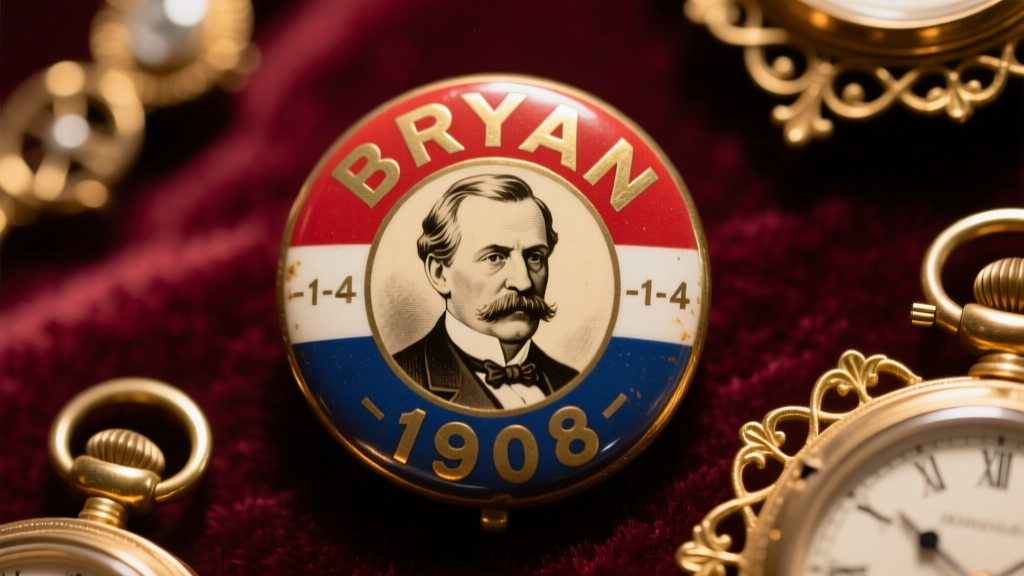
The 1908 Bryan Campaign Button: A Patriotic Artifact of Progressive-Era Politics
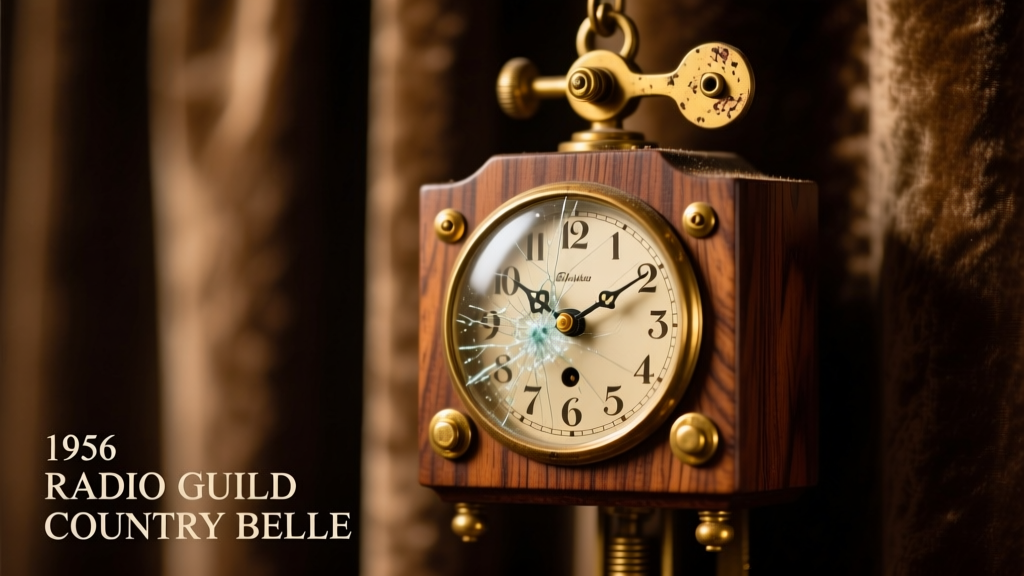
Radio Guild Country Belle Wooden Hanging Crank Clock: A 1956 American Mid-Century Masterpiece
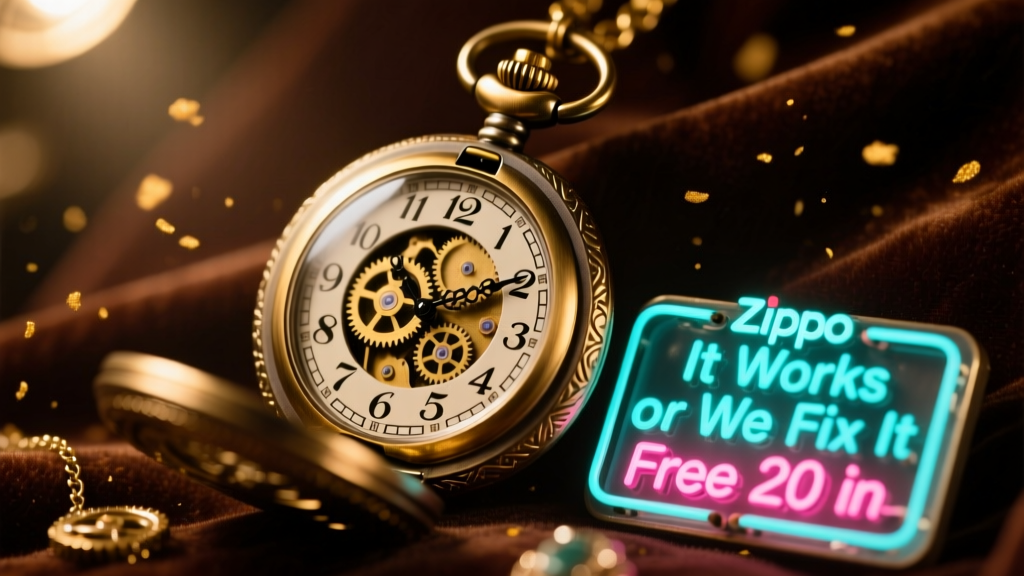
Zippo Clocks: The 'It Works Or We Fix It Free' Neon Advertising Clocks — A Collector’s Deep Dive
Bottle Openers, Taverns, and Pale Atlantic Beer: The Metal Legacy of American Barware
Clarks O.N.T. Advertising Cabinet: A Rare Oak Spool Display with Roll-Up Glass Sides (22½")
Decoding the Parkes Davis Orange Extract Label: A Historical Analysis of Soda Fountain Chemistry, Regulation, and Brand Authenticity
Cluthra Vase in Light Amethyst Glass: A Signed Steuben Masterpiece, 9 Inches Tall

Sunbeam Mixmaster Model 2 (1930–1939): Engineering Elegance, American Design Innovation, and the Birth of the Modern Stand Mixer
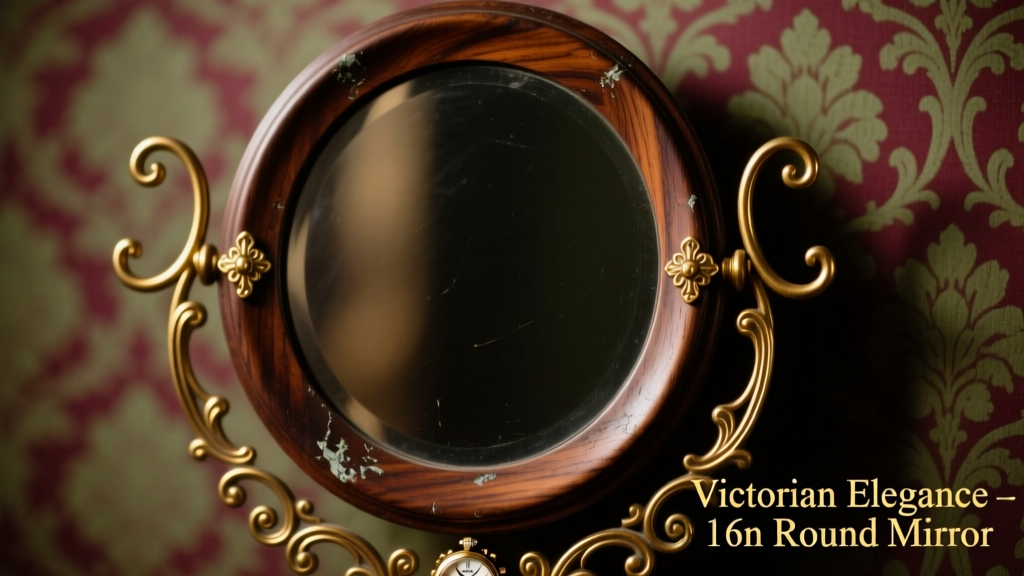
Victorian Walnut Furniture Mirror with Round Turned Hooks and Swing-Out Arms (16-Inch Diameter): A Collector’s Guide to Form, Function, and Provenance