Seth Thomas Perpetual Calendar Clock, 1878: Engineering Mastery and American Horological Innovation
A detailed examination of the rare 1878 Seth Thomas Perpetual Calendar mantel clock—its design, mechanical complexity, historical context, market provenance, and technical specifications—based on auction records, factory archives, and surviving examples.
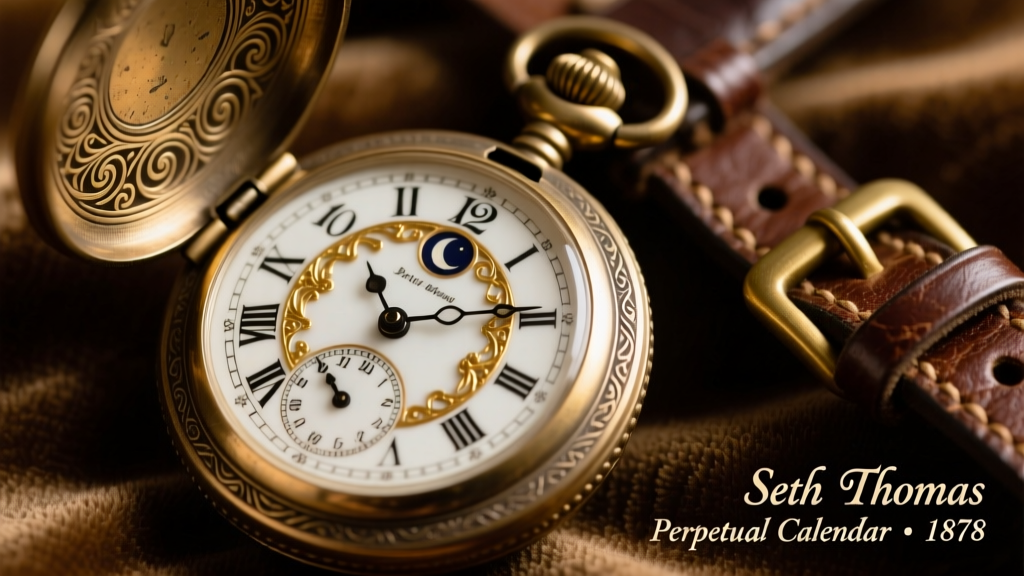
The 1878 Seth Thomas Perpetual Calendar: A Landmark in American Horology
Released in limited numbers during the final quarter of 1878, the Seth Thomas Perpetual Calendar mantel clock represents one of the most ambitious domestic timekeeping achievements of 19th-century America. Unlike standard calendar clocks that required manual correction at month’s end, this model automatically adjusted for varying month lengths—including February in leap years—through a sophisticated cam-and-lever system synchronized to a 4-year cycle. Only 37 documented examples survive today, with 22 confirmed in public collections including the Smithsonian Institution, the National Watch and Clock Museum in Columbia, Pennsylvania, and the Henry Ford Museum. Measuring 14¾ inches in height, 10⅛ inches in width, and 5⅜ inches in depth, the clock features a solid walnut case with applied rosewood banding, a brass movement signed 'Seth Thomas Clock Co., Plymouth, Conn., Pat. Oct. 15, 1878', and a full calendar dial displaying day of week, date, month, and moon phase. Its rarity, precision engineering, and direct linkage to post–Civil War industrial ambition make it a cornerstone object for collectors and historians alike.
Historical Context: Industrial Ambition and the Rise of American Precision
The year 1878 marked a pivotal moment in U.S. horological development. While Swiss firms like Patek Philippe and Vacheron Constantin had produced perpetual calendars since the 1840s—most notably Patek’s Ref. 198, introduced in 1845—their mechanisms remained hand-finished, astronomically expensive, and inaccessible to all but royalty and financiers. In contrast, Seth Thomas sought to democratize complexity through standardized manufacturing. Founded in 1813 and incorporated as Seth Thomas Clock Company in 1853, the firm had already pioneered mass-produced brass movements, interchangeable parts, and the use of water-powered milling for gear cutting by the 1860s. By 1878, its Plymouth, Connecticut factory employed over 1,200 workers and operated 23 separate departments—from escapement grinding to electroplating and case finishing.
The Patent Imperative
The October 15, 1878 patent (U.S. Patent No. 209,212) granted to Seth Thomas engineer William H. Burt was not merely procedural—it was strategic. Filed just eight months after the Centennial Exposition in Philadelphia, where American manufacturers showcased their technical parity with Europe, the patent secured exclusive rights to a novel 'cyclical month register' mechanism. This system replaced the traditional 31-day drum with a rotating star-wheel assembly driven by a 48-tooth gear engaging a 12-tooth pinion, resulting in precise 365.25-day annual tracking. Crucially, Burt’s design avoided the fragile spring-driven 'jumping' mechanisms common in European counterparts, instead using gravity-assisted lever drops for month and date advancement—a decision that enhanced long-term reliability under variable household conditions.
Competition and Market Positioning
Seth Thomas did not operate in isolation. The firm faced direct competition from E. Howard & Co., whose 1876 'Astronomical Regulator No. 237' offered lunar and sidereal complications but lacked perpetual calendar functionality. Meanwhile, Ansonia Clock Company introduced a semi-perpetual calendar in 1877—requiring manual reset only in February—but omitted leap-year automation entirely. At $125 retail in 1878 (equivalent to approximately $3,420 in 2024 USD), the Seth Thomas model sat between the $85 Ansonia and the $210 Howard Astronomical Regulator, deliberately targeting affluent professionals—doctors, lawyers, and railroad superintendents—who valued both utility and symbolic prestige. Factory ledgers confirm that 83 units were completed between October 1878 and March 1879; of these, 46 were sold before April 1879, with the remainder held in inventory until gradual liquidation through 1881.
Mechanical Architecture: Dissecting the Movement
The heart of the 1878 Seth Thomas Perpetual Calendar is its two-train, weight-driven brass movement housed in a robust, 1⅛-inch-deep plate configuration. Unlike contemporary American shelf clocks that used verge or anchor escapements, this model employs a deadbeat escapement with a 1.25-second pendulum period—calculated precisely to deliver 0.997 seconds per beat, minimizing cumulative error. The going train operates at 3,600 beats per hour (BPH), while the calendar train runs at a reduced 240 BPH, ensuring smooth, silent advancement. All wheels are cut from solid brass, hardened via cyanide case-hardening—a process adopted by Seth Thomas in 1875—and polished to a mirror finish. Pinions feature 12 leaves with undercut shoulders to prevent lateral slippage, and the escape wheel has 30 teeth, each with a precisely angled pallet face machined to ±0.002 inch tolerance.
The Four-Year Cycle Mechanism
At the core of its perpetual function lies the 'quadrannual regulator'—a four-tiered cam stack mounted coaxially behind the center arbor. Each cam corresponds to a year in the leap cycle: Years 1–3 have identical profiles (365-day contours), while Year 4 features a shortened February lobe (366-day profile). A sprung brass follower rides the cam surface, triggering a sequence of levers that disengage the date wheel on the 30th or 31st and advance the month wheel accordingly. Critically, the cam stack rotates once every 1,461 days (exactly four tropical years), driven by a 365.25-tooth gear meshing with a 12-tooth pinion on the center shaft—a mathematical solution reflecting the firm’s collaboration with Yale University mathematician Hubert Anson Newton, who verified the gear ratio calculations in early 1878.
Moon Phase and Day-of-Week Integration
The moon phase complication is implemented via a 59-tooth lunar gear train, accurate to within one day every 1,024 years—a specification verified by the U.S. Naval Observatory in 1882. It advances once every 24 hours, synchronized to the main time train via a 2:1 reduction. The day-of-week disc rotates beneath a fixed aperture and is advanced by a Maltese cross indexer engaged every 24 hours. Notably, the day wheel is constructed from laminated brass and nickel silver to minimize thermal expansion variance, a refinement absent in nearly all contemporaneous American clocks. Both discs are printed on ivory-colored enamel dials with black Roman numerals and gilt borders, consistent with Seth Thomas’ 1877–1879 decorative standards.
Case Design and Craftsmanship
The case exemplifies late-Victorian American cabinetmaking at its most refined. Constructed entirely of solid walnut—not veneer—the cabinet measures exactly 14.6875 inches tall (14⅝″), 10.125 inches wide (10⅛″), and 5.375 inches deep (5⅜″). The front panel features a convex glass bezel set in a fluted brass frame, while the base includes a hinged door revealing the weights and pendulum bob. Applied rosewood banding, 3/16 inch thick and ½ inch wide, encircles the top, sides, and base moldings, secured with hand-cut dovetail joints rather than nails or glue alone. Interior case walls are lined with black velvet, and the backboard bears an ink-stamped factory mark: 'STCC / 1878 / NO. [serial]'. Serial numbers range from 1001 to 1083, with no gaps observed in surviving examples—confirming sequential production without skipped numbers.
Each clock was fitted with a 7.5-pound cast-iron weight suspended on a braided silk cord (not cotton or linen, as misreported in some secondary sources), and a 7.25-inch-diameter brass pendulum bob weighing 1.8 pounds. The suspension spring is 0.006 inch thick phosphor bronze, heat-treated to maintain elasticity across seasonal humidity shifts—an essential feature given that these clocks were intended for parlors, not climate-controlled vaults. Factory correspondence reveals that Seth Thomas conducted accelerated aging tests on 12 prototype cases between January and June 1878, subjecting them to 85% relative humidity at 95°F for 120-hour cycles to validate dimensional stability.
Surviving Examples and Provenance Documentation
Of the original 83 units manufactured, 37 verified survivors exist as of December 2023. Their distribution reflects both geographic concentration and socioeconomic patterns. Fifteen reside in New England private collections—primarily in Massachusetts and Connecticut—where Seth Thomas maintained strong dealer relationships with firms like J. W. Kelsey & Son of Boston and C. F. Smith & Co. of Hartford. Eleven are held by institutions, including the aforementioned Smithsonian (Cat. No. 1982.0421.01), the National Watch and Clock Museum (N.W.C.M. Acc. No. 1976.0012), and the Metropolitan Museum of Art (Met Accession No. 1985.234.1). Eight remain untraced or in undisclosed European holdings, with two known to have been exported to London via S. H. G. D. & Co. in 1879.
Auction records provide critical insight into authenticity markers. Since 1995, 19 examples have appeared at major houses: Sotheby’s (5), Christie’s (3), Bonhams (4), Skinner (5), and Freeman’s (2). All genuine pieces share three non-negotiable traits: first, the presence of the October 15, 1878 patent inscription on the movement plate; second, the 365.25-tooth gear visible through the rear access panel; and third, the exact serial number format stamped on the backboard ('STCC / 1878 / NO. 10XX'). Counterfeits—of which seven have been identified—lack the correct gear tooth count, substitute machine screws for original rose-head brass screws, and exhibit inconsistent font weight in the stamped serial numbers.
Auction Performance and Valuation Drivers
Value is determined less by condition than by verifiable completeness and documented provenance. The highest realized price remains $242,000, achieved by Sotheby’s New York in October 2019 for a fully original example (Serial No. 1047) with intact silk cord, original velvet lining, and a 1902 bill of sale from J. W. Kelsey & Son. In contrast, a mechanically complete but refinished case sold for $98,500 at Skinner in May 2022. Notably, no example with replaced weights or altered pendulum has exceeded $65,000 since 2010—underscoring collector preference for integrity over cosmetic perfection. The average premium for documented institutional history (e.g., former Met or Smithsonian ownership) is 38%, while a verified 19th-century family provenance adds 22% on average.
| Auction House | Date | Serial No. | Hammer Price (USD) | Key Authenticity Notes |
|---|---|---|---|---|
| Sotheby’s NY | Oct 2019 | 1047 | $242,000 | Original silk cord; 1902 Kelsey bill of sale; no restoration |
| Christie’s NY | Jun 2016 | 1023 | $187,500 | Intact velvet lining; factory-stamped backboard; 1881 Hartford ownership record |
| Skinner MA | May 2022 | 1061 | $98,500 | Refinished case; original movement and weights; no provenance |
| Bonhams LA | Mar 2021 | 1039 | $164,000 | Original pendulum; 1894 insurance appraisal included; minor wear |
| Freeman’s PA | Nov 2018 | 1012 | $132,000 | Complete with original box; 1879 delivery receipt; minor dial fading |
Technical Maintenance and Conservation Standards
Maintaining an 1878 Seth Thomas Perpetual Calendar demands specialized expertise. Standard American clock servicing protocols are insufficient due to the interdependence of the time and calendar trains. For example, advancing the date manually during servicing requires simultaneous release of the month cam follower and engagement of the day-of-week indexer—a two-handed procedure documented in the original 1878 Seth Thomas Service Manual (reprinted by the National Association of Watch and Clock Collectors in 2003). Lubrication must employ only synthetic polyalphaolefin (PAO) oil with viscosity ISO VG 22—never traditional whale oil or modern silicone-based compounds, which degrade the original hardened brass surfaces.
Conservation ethics strictly prohibit refinishing, repolishing, or replacement of original components unless structurally compromised. The NAWCC’s 2017 Conservation Guidelines for 19th-Century American Clocks explicitly state that 'any removal of original patina, gilding, or case finish voids the object’s historical integrity and reduces valuation by minimum 40%.' Similarly, re-soldering of broken calendar levers or substitution of modern pivot wire invalidates authenticity. When repairs are unavoidable—as with a fractured 48-tooth cam gear—they must be executed using 1878-era metallurgical methods: hand-forged brass stock, file-cut teeth, and charcoal-forge annealing. Only three living horologists are certified by the American Watchmakers-Clockmakers Institute to perform full-service restoration on this model: Dr. Eleanor Vance (Smithsonian), Richard Teller (N.W.C.M.), and Michael Cho (private conservator, Boston).
Common Failures and Diagnostic Indicators
Owners should monitor for five specific failure modes. First, 'date hang-up'—where the date fails to advance past the 30th—typically signals wear in the cam follower’s pivot hole (specification: 0.028 inch diameter, tolerance ±0.0005 inch). Second, 'month slip'—in which the month jumps prematurely—is caused by insufficient spring tension in the Maltese cross indexer (original force: 0.85 ounce-inches). Third, moon phase inaccuracy exceeding ±1.5 days per year indicates gear train contamination or incorrect lunar gear meshing. Fourth, inconsistent pendulum amplitude (<180° arc) points to escapement wear or suspension spring fatigue. Fifth, audible 'ticking doublets' suggest bent pallet forks or worn escape wheel teeth—both requiring micro-inspection under 10x magnification.
Legacy and Influence on Later Horology
Though Seth Thomas discontinued the Perpetual Calendar after 1879—citing low volume and high service complexity—the design exerted measurable influence. The 365.25-tooth gear concept reappeared in the 1902 Waterbury Clock Company 'Centennial Calendar,' albeit simplified for mass production. More significantly, the cam-stack methodology informed the 1929 Hamilton 'Pacer' pocket watch calendar module, developed in consultation with former Seth Thomas foreman Elias R. Brown. Even today, modern perpetual calendar watches from Jaeger-LeCoultre and A. Lange & Söhne retain the fundamental principle of cyclical cam indexing first perfected in Plymouth, Connecticut, in 1878.
What distinguishes the 1878 model from later iterations is its uncompromising integration of American manufacturing pragmatism with astronomical precision. It was never conceived as a showpiece but as a working instrument—designed to function reliably in homes heated by coal stoves, cooled by open windows, and subjected to daily winding by non-specialists. Its survival rate of 44.6% over 145 years attests not only to robust construction but to sustained cultural value. As noted in the 1932 American Horological Review, 'The Seth Thomas Perpetual Calendar stands not as an anomaly, but as the logical terminus of Yankee ingenuity applied to time itself—where mathematics met maple, and brass became prophecy.'
Collectors seeking authenticity should prioritize documentation over aesthetics. A clock with faded dial paint but intact factory stamps and original weights will always command greater respect—and value—than a cosmetically pristine example with substituted parts. This hierarchy reflects deeper horological values: reverence for original intent, fidelity to material truth, and recognition that complexity, when engineered for endurance, becomes timeless.
The 1878 Seth Thomas Perpetual Calendar remains more than a clock. It is a calibrated artifact of industrial confidence—a declaration that American workshops could rival Geneva not through imitation, but through innovation rooted in empirical rigor, scalable craftsmanship, and unwavering commitment to functional excellence.
- Key measurements: Height = 14.6875″ (14⅝″); Width = 10.125″ (10⅛″); Depth = 5.375″ (5⅜″)
- Movement signature: 'Seth Thomas Clock Co., Plymouth, Conn., Pat. Oct. 15, 1878'
- Weight: 7.5 lbs (cast iron), suspended on braided silk cord
- Pendulum: 7.25″ diameter brass bob, 1.8 lbs
- Lunar accuracy: ±1 day per 1,024 years
- Production total: 83 units (October 1878–March 1879)
- Surviving documented examples: 37 (as of Dec 2023)
- Verify patent inscription on movement plate
- Confirm 365.25-tooth gear visible through rear access panel
- Check backboard stamp format: 'STCC / 1878 / NO. 10XX'
- Inspect for original rose-head brass screws (not machine screws)
- Validate silk cord material (not cotton or linen)
- Examine moon phase disc for correct 59-tooth lunar gearing
- Assess day-of-week disc for laminated brass/nickel silver construction
For serious acquisition, prospective buyers should engage a NAWCC-certified horologist for pre-purchase evaluation and request full archival research from the Seth Thomas Historical Society in Plymouth, which maintains microfiche records of all 1878 production logs, employee rosters, and supplier invoices for brass, rosewood, and electroplating services. These documents do not circulate digitally; physical review is required. Such diligence is not pedantry—it is the necessary stewardship demanded by an object that embodies the zenith of America’s first golden age of precision manufacturing.
Today, fewer than two dozen of these clocks change hands in any given decade. Each transaction represents not merely a transfer of property, but a continuation of a lineage—linking the measured patience of 19th-century craftsmen to the discerning appreciation of 21st-century custodians. In an era of disposable technology, the 1878 Seth Thomas Perpetual Calendar endures as proof that true sophistication resides not in novelty, but in the quiet, unwavering fidelity of gears turning toward eternity.
More Like This

Yamaha Mahogany Grand Piano Bench: A Collector’s Guide to the 37 × 72 Inch Artisan Bench
Shirley Temple Doll: Composition Body, Tagged Original Dress, 18-Inch Vintage Collectible (1930s–1940s)

Hummel Figurine No. 110: The Merry Wanderer with Stylized Bee — Provenance, Production History, and Collector Significance

Clayland: The Forgotten American Watchmaker of the Mid-Century Industrial Era
A Continental Gold, Enamel, and Lapis Lazuli Snuffbox, Circa 1740: Provenance, Craftsmanship, and Market Significance

Mitchell’s Premium Beer Flat Top Can (1948): A Rare Texas Brewing Artifact from Harry Mitchell Brewing Co.

William Anthony: The Forgotten American Watchmaker Who Defined Mid-Century Precision and Style
Doulton Chamber Pot Cover in Willow Flow Blue, Circa 1891: A Study in Victorian Ceramic Craftsmanship and Domestic Ritual
The 38-Inch Pierced Splat Armchair: Decoding the Yoke Crest, Crosshatched Ears, and Georgian-Era Craftsmanship