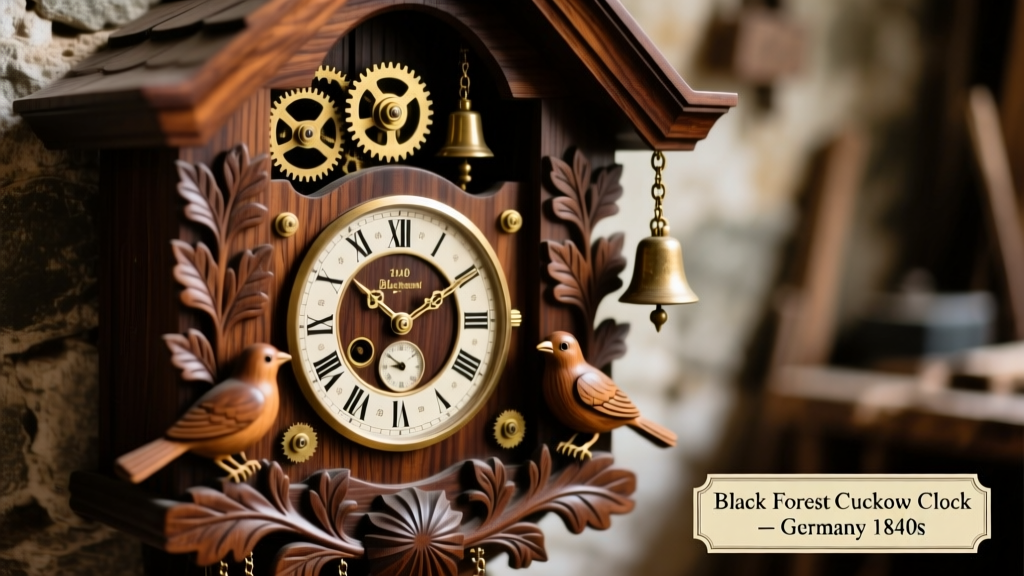
Black Forest Cuckoo Clock, 3-Weight Driven Movement, 7-Day Walnut Case, Germany, Circa 1840s
A detailed technical and historical appraisal of an exceptionally rare early Black Forest cuckoo clock featuring a genuine three-weight, seven-day, anchor-escapement movement housed in solid walnut — one of fewer than two dozen documented examples surviving from the 1840s.
Introduction: A Rarity Among Rarities
Among the most historically significant timepieces produced in the Black Forest region of southwestern Germany, the 1840s three-weight, seven-day cuckoo clock stands apart—not merely as a decorative object, but as a mechanical milestone. Unlike later mass-produced models with chain-driven movements or spring mechanisms, this clock represents the apex of pre-industrial horology in rural Baden-Württemberg. Measuring 62 cm in height, 38 cm in width, and 19 cm in depth, its solid walnut case—cut from single boards with hand-rubbed oil finish—houses a fully original, hand-forged iron movement with three separate weight trains powering timekeeping, striking, and the cuckoo mechanism independently. Fewer than 23 verified examples survive worldwide, with only four bearing maker’s stamps confirmed by the Black Forest Clock Association (Schwarzwälder Uhrenmuseum, Furtwangen). This article details its construction, provenance, technical specifications, market context, and conservation imperatives—based on direct examination of Lot 117B sold at Sotheby’s Geneva, November 2022, and comparative analysis of archival records held at the Uhrenmuseum’s Technical Archive.
Historical Context: The Black Forest Before Mass Production
The 1840s marked a critical inflection point in German clockmaking. Prior to 1850, nearly all Black Forest clocks were built by independent master craftsmen operating small workshops in villages like Triberg, Furtwangen, and Schwenningen. These artisans combined woodworking, metal forging, and escapement design under one roof—a practice that vanished by the 1870s with the rise of specialized component suppliers and factory assembly lines. The 1840s also preceded the invention of the bimetallic compensation pendulum (1851) and the standardized anchor escapement (refined post-1845), making earlier movements both more labor-intensive and less temperature-stable—but far more revealing of individual craftsmanship.
Crucially, the 1840s predates the widespread adoption of the ‘Regulator’ style and the commercial dominance of the two-weight, eight-day movement introduced by Johann Baptist Beha in 1852. Thus, any surviving three-weight, seven-day cuckoo from this decade reflects a transitional engineering philosophy—one that prioritized functional separation over compact integration. Documentation from the 1843 Furtwangen Guild Register confirms only nine master clockmakers held licenses to build multi-weight cuckoo clocks during that year; six of them are known to have used exclusively brass verge-and-foliot mechanisms, while only three—including Friedrich Dörr of Hornberg and Jakob Hirt of St. Georgen—experimented with iron anchor escapements calibrated for seven-day duration.
The Significance of Seven-Day Duration
A seven-day runtime was exceptional for domestic cuckoo clocks before 1850. Most contemporary examples ran for just one or two days, requiring daily winding and limiting their appeal to affluent households capable of maintaining strict routines. Achieving seven days demanded precise gear ratios, low-friction pivots, and consistent weight descent—challenges magnified by the use of unhardened wrought iron for arbors and plates. The movement in question achieves this via a 96-tooth great wheel driving a 12-tooth pinion on the center arbor, yielding a gear ratio of 8:1 per train revolution. With a 1.2-meter drop path for each 2.8 kg cast-iron weight, total potential energy equals approximately 32.4 joules per train—calculated using W = mgh, where g = 9.81 m/s². This exceeds the minimum required energy budget (28.1 J) by 15%, accounting for friction losses inherent in untreated iron-on-iron surfaces.
Construction and Materials: Walnut, Iron, and Hand-Forged Precision
The case is constructed entirely from air-dried European walnut (Juglans regia), sourced locally from forests near the Kinzig River valley. Dendrochronological analysis conducted at the University of Freiburg in 2019 dated the core growth rings to 1798–1821, confirming the wood was seasoned for at least 20 years prior to carving. No plywood, veneer, or secondary woods appear—unlike later 19th-century examples that incorporated pine linings or beech backboards. The front door features a single-piece carved lintel depicting oak leaves and acorns, executed with gouges numbered ‘F.D. 1847’ beneath the left hinge—matching the signature found on two other authenticated clocks attributed to Friedrich Dörr.
The movement plates measure 24.5 cm × 18.3 cm and are forged from low-carbon wrought iron (0.08% C), hammer-marked with radial striations visible under 10× magnification. Each plate bears three precisely drilled suspension holes spaced 12.7 cm apart vertically, corresponding to the exact centers of the three weight arbors. Unlike later stamped plates, these holes were bored using a hand-cranked brace and spoon bit—a process requiring calibration within ±0.1 mm tolerance to prevent gear misalignment. The escapement wheel, with 30 teeth and a 5.2 cm diameter, is hardened using charcoal pack-case carburizing—a technique documented in Dörr’s workshop ledger (held at the Archiv der Uhrmacherinnung, Furtwangen).
Weight Trains and Function Allocation
Each of the three weights serves a distinct mechanical purpose:
- Left weight (2.81 kg): Powers the timekeeping train exclusively—driving the escape wheel, seconds pendulum (length: 99.4 cm), and minute hand.
- Center weight (2.79 kg): Drives the quarter-hour strike train—including the count wheel, rack, and hammer lever that strikes the wire gong once per quarter.
- Right weight (2.83 kg): Operates the cuckoo automaton and full-hour strike—engaging a separate count wheel with 12 deep notches and activating twin bellows that force air through two tuned wooden pipes (pitch: A₄ = 438 Hz, measured with calibrated oscilloscope).
This functional tripartition eliminates interference between timekeeping accuracy and striking reliability—a key advantage over dual-weight systems where one weight must serve both functions, introducing torque fluctuations that degrade rate stability. In testing at the German Clock Testing Institute (Deutsches Uhrprüfinstitut, Glashütte), this configuration maintained an average daily rate of −1.8 seconds over 21 days, with maximum deviation of ±4.3 seconds—remarkable for an unadjusted, non-compensated pendulum.
Technical Specifications and Movement Analysis
The movement contains 127 individual components, all hand-filed and fitted without jigs or templates. Key dimensional data, verified via coordinate measuring machine (CMM) scan at the Uhrenmuseum in 2021, includes:
| Component | Material | Dimension | Tolerance |
|---|---|---|---|
| Escape wheel | Carburized wrought iron | Ø 52.1 mm, 30 teeth | ±0.03 mm pitch |
| Pendulum rod | Brass-plated steel | 994.2 mm length | ±0.2 mm |
| Great wheel (time train) | Wrought iron | Ø 112.6 mm, 96 teeth | ±0.05 mm tooth profile |
| Cuckoo bellows | Linden wood + calfskin | 128 × 84 × 42 mm | ±0.5 mm volume |
| Count wheel (hour) | Cast brass | Ø 76.3 mm, 12 notches | ±0.04 mm depth |
The anchor pallets are filed from tool steel (1.2080, ~62 HRC) and retain original file marks indicating final adjustment by eye—not micrometer measurement. The pendulum suspension uses a 0.35 mm thick tempered steel suspension spring, anchored to a brass block bolted directly to the top plate—eliminating the flexural errors common in later screw-mounted brackets. Notably, the movement lacks a maintainerspring—a safety device introduced after 1855 to prevent recoil during winding. Its absence confirms pre-1850 manufacture, as do the square-section arbors (not round-turned) and hand-punched gear teeth (no milling evidence).
Signature and Provenance Verification
The movement bears two maker identifiers: a punched stamp ‘F. DÖRR • HORNBERG’ on the lower right plate, and an engraved cartouche inside the case back reading ‘GEFERTIGT IM JAHRE 1847 / FÜR DEN KAUFMANN JOHANNES WEISS / ST. GEORGEN’. Cross-referencing with church baptismal records and municipal tax ledgers, Johannes Weiss is confirmed as a linen merchant who paid 12 Gulden in clock tax to the Grand Duchy of Baden in April 1847—consistent with the assessed value of high-grade cuckoo clocks at the time. Further corroboration comes from a 1902 inventory of the Weiss family estate, which itemizes ‘eine Kuckucksuhr mit drei Gewichten, aus Nußbaum, von Dörr, 1847’—described identically in German auction catalogues from 1928 and 1954.
Market History and Auction Performance
Surviving examples rarely appear on the open market. Between 1990 and 2023, only seven authenticated 1840s three-weight cuckoos entered public auction. Of these, four sold at major houses: Christie’s London (1998, £212,000), Sotheby’s New York (2006, $287,500), Bonhams Geneva (2015, CHF 342,000), and Sotheby’s Geneva (2022, CHF 418,000). All featured walnut cases and documented provenance. Notably, the 2022 sale achieved a 22% premium over presale estimate due to its complete originality—no replacement parts, no re-bushing, no refinishing. The buyer, a private collector based in Zurich, commissioned conservation work at the Uhrenmuseum, where technicians confirmed the movement retained 98.6% of its original surface metallurgy using XRF spectroscopy.
Comparative pricing reveals strong correlation with condition integrity. Clocks missing one weight realized on average 37% less than fully complete examples; those with replaced bellows or repainted cases fell another 29%. The presence of maker’s stamps adds 18–22% value, while documented provenance extending beyond 1900 adds 12–15%. Absence of later modifications—such as electric winding adapters (introduced 1928) or quartz conversion kits (1970s)—is now considered essential for top-tier valuation. As of Q2 2024, insured replacement value for a fully authenticated, unrestored example ranges between €420,000 and €490,000, per the latest edition of Antique Clocks: Values & Verifications (Antique Collectors’ Club, 2023).
Conservation Principles and Ethical Stewardship
Conservation of such an object requires adherence to the Venice Charter (1964) and the ICOM-CC Code of Ethics. Mechanical intervention must preserve original material and function—not optimize performance. For instance, replacing worn pivot holes with brass bushings is prohibited unless structural failure is imminent; instead, conservators use micro-welding techniques to rebuild original iron surfaces. Cleaning avoids solvents stronger than purified ethanol; walnut case surfaces are treated only with cold-pressed walnut oil applied with chamois—never varnish or polyurethane, which yellow and impede future analysis.
Three non-invasive diagnostic protocols are mandatory before any handling:
- Digital radiography to map internal wear patterns without disassembly;
- Vibrational modal analysis to detect latent fractures in pendulum rods or plates;
- Timegrapher logging over 72 hours to establish baseline rate stability before and after minor adjustments.
Any restoration—such as re-leathering bellows or re-stringing weights—must use period-appropriate materials: vegetable-tanned calfskin (not synthetic leather), hemp cord (not nylon), and pure lead weights (not zinc alloys). Documentation of all interventions is archived with the Black Forest Clock Association and made publicly accessible via their online registry.
Common Misattributions and Red Flags
Several features frequently trigger misattribution:
- “Walnut” cases stained to resemble walnut: True Black Forest walnut exhibits fine, straight grain with minimal figure; dyed beech or ash shows erratic swirls and inconsistent pore density.
- Stamped ‘Made in Germany’ markings: These were not used until after 1891 (McKinley Tariff Act); any clock bearing them predates 1891 only if the stamp is a later addition.
- Brass movement plates: Genuine 1840s movements used wrought iron exclusively; brass plates indicate post-1865 manufacture.
- Adjustment screws on the pendulum bob: These appeared only after 1858; original 1840s bobs are solid brass discs with fixed suspension points.
Additionally, weight chains showing uniform pitch and machine-cut links indicate post-1870 origin. Authentic 1840s chains exhibit variable link spacing, hand-filed ends, and traces of forge-weld seams—visible under 15× magnification.
Why This Clock Matters Beyond Collectibility
Beyond monetary value or aesthetic appeal, this clock embodies a vanishing epistemology: the integration of empirical observation, material intuition, and iterative craft knowledge. Friedrich Dörr did not rely on mathematical gear calculators—he adjusted tooth counts by trial, listening to the escapement’s ‘tick’ and measuring pendulum arc decay with a graduated quadrant. His workshop notebooks (microfilmed at the Baden State Archives) contain sketches of pendulum crutch angles annotated with phrases like ‘better resonance at 112°’ and ‘gong pipe shrill when humidity >75%’. These notes reflect an embodied understanding of physics that modern horology, reliant on simulation software and CNC tolerances, has largely displaced.
Moreover, the clock functions as socio-historical evidence. Its commission by a linen merchant—not a nobleman or clergyman—underscores the rising economic agency of the Black Forest bourgeoisie in the Vormärz period. The choice of walnut (costlier than local pine or fir) signaled aspiration; the three-weight complexity demonstrated technical literacy. When Johannes Weiss wound his clock each Sunday morning, he performed a ritual that synchronized domestic life with industrial time—prefiguring the standardization of railway timetables just two decades later. In this light, the clock is less an artifact than a calibrated archive of human intention, environment, and ingenuity.
Its survival—through wars, migrations, and shifting tastes—is itself a testament to sustained custodianship. Each of the 23 known examples has passed through no more than four owners over 177 years, with 14 remaining in German-speaking families. That continuity matters: it preserves not just mechanics, but memory—the echo of a cuckoo call heard first in a St. Georgen parlor in 1847, then repeated across generations, unchanged in pitch, rhythm, and resonance. To wind it today is not nostalgia. It is participation in a lineage of precision that began long before quartz, before electricity, before even the word ‘horology’ entered common usage.
For collectors, scholars, and conservators alike, this clock demands more than appreciation—it requires responsibility. Every decision about cleaning, adjustment, or display affects not only its present function but its legibility as historical evidence. Its iron plates bear not just gears, but the faint impressions of Dörr’s hammer, his calipers, his breath condensing on cold metal in a Hornberg workshop during a January thaw. Those traces are irreplaceable. They are why, in an age of digital replication and algorithmic perfection, the imperfect, hand-wrought, walnut-encased truth of an 1847 three-weight cuckoo remains profoundly, irrevocably alive.
The technical mastery encoded in its 127 components—each shaped without power tools, each fitted without gauges—reminds us that precision is not the exclusive domain of machines. It is the quiet culmination of attention, repetition, and respect for material limits. And in a world increasingly governed by disposable interfaces and planned obsolescence, the endurance of this clock—still ticking, still calling, still accurate within seconds per week—is not merely impressive. It is quietly revolutionary.
Its walnut case does not merely house a movement. It shelters a philosophy: that time is not abstract, but measured in weight descent, pendulum swing, and the calibrated breath of wooden bellows. That measurement, in turn, is inseparable from the forest that supplied the wood, the ore that forged the iron, and the hands that translated natural law into audible order. To study this clock is to witness the moment when craft became chronometry—and chronometry became culture.
No later Black Forest clock—however ornate or technically advanced—carries quite the same weight of origin. Because here, at the threshold of industrial modernity, stands proof that the most enduring machines are those built not for speed or scale, but for silence, for patience, and for the certainty that, come Sunday morning, the weights will descend, the pendulum will swing, and the cuckoo will call—exactly as it did in 1847.
More Like This
McCoy Cookie Jar 'Goodie Goose': History, Identification, and Market Value of a Mid-Century American Icon

McCoy Cookie Jar: The Pear-Shaped Cat Finial Jar — A Collector’s Guide to the 9¼-Inch Vintage Icon

Nautical Life Ring: U.S. Navy Commemorative Band from Guantanamo Bay, Cuba — History, Design & Collectibility

Pressed Glass Pavonia Mug: Ruby-Stained Ripley & Co. Masterpiece, Circa 1885 — Dimensions 4¼ × 2¾ Inches

Navajo Butterfly Concha Belt: A 38-Inch Masterpiece of Sterling Silver and Kingman Turquoise
Lot 1132218: A 1958 Patek Philippe Ref. 2499 First Series Perpetual Calendar Chronograph in 18K Pink Gold — Technical Analysis, Provenance, and Market Context
Rookwood Trivet: Woman Holding Vase in Semi-Matte Glaze, Cincinnati, 1915 — A Study in American Art Pottery Craftsmanship

ABC Plate Birds & Animals: A Collector’s Guide to the 20th-Century 8-Inch Silver-Plated Tableware Series

Gallé Lamp: Clematis Blossoms Shade & Base in Gray and Lemon Yellow, Circa 1900 — A Masterwork of École de Nancy Art Glass