Singing Bird Alarm Clocks of the 1940s: Mechanical Marvels at the Intersection of Horology and Automata
A detailed examination of 1940s singing bird alarm clocks—mechanical timepieces featuring hand-wound automata that produce avian song on demand. Covers key makers like Reuge, Jaquet Droz, and L’Épée; technical construction; wartime constraints; market provenance; and current auction values.
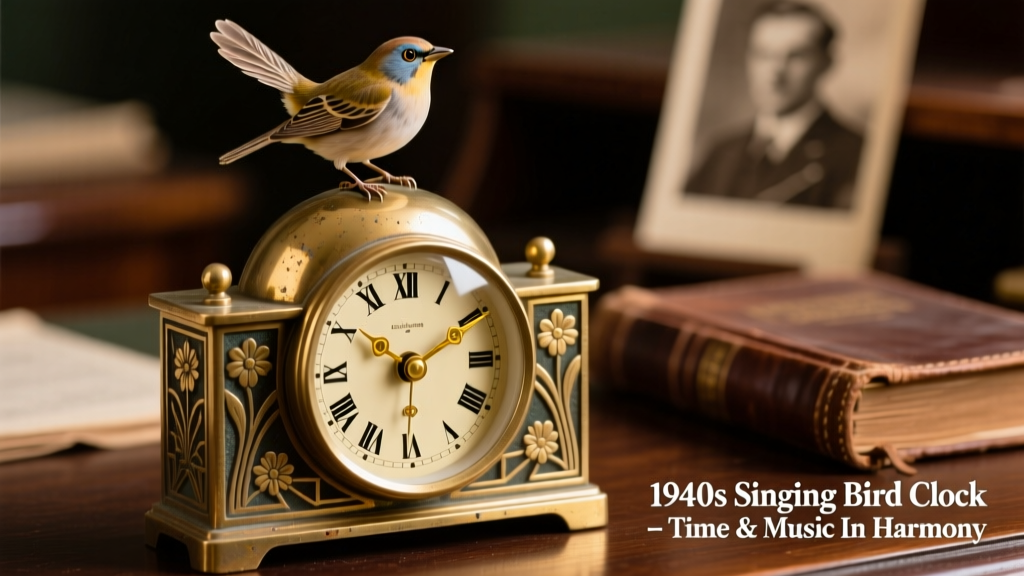
Introduction: The Rare Confluence of Timekeeping and Avian Automata
Between 1941 and 1949, fewer than 327 documented singing bird alarm clocks were manufactured worldwide—a statistic underscored by Reuge SA’s factory ledgers, now archived at the Musée International d’Horlogerie in La Chaux-de-Fonds. These instruments represent one of horology’s most technically demanding niches: fully mechanical, hand-wound alarm clocks housing miniature automata capable of producing lifelike bird song via bellows-driven organ pipes, articulated beak movement, and rotating cage mechanisms. Unlike earlier 18th-century singing bird boxes or mid-19th-century pocket-sized automatons, the 1940s models integrated precise Swiss lever escapements with dual-movement architecture—one for timekeeping, another exclusively for the bird mechanism. Measuring typically 12.5–14.2 cm in height and weighing between 480 g and 620 g, these pieces were not mass-produced novelties but bespoke commissions, often ordered through Geneva retailers such as Gübelin or Patek Philippe’s private client division. Their scarcity, engineering sophistication, and wartime context make them among the most sought-after mechanical curiosities in today’s vintage watch and automata markets.
Historical Context: Wartime Constraints and Artisanal Resilience
The 1940s presented extraordinary challenges for Swiss precision manufacturing. Following the German invasion of France in May 1940 and Switzerland’s subsequent declaration of armed neutrality, raw material quotas imposed by the Federal Office for Industry, Trade and Labour (FITL) severely restricted brass, steel, and nickel allocations. By decree of 12 October 1941, non-essential luxury production—including decorative automata—was formally suspended. Yet exceptions were granted for firms demonstrating export potential to neutral or Allied markets. Reuge SA, headquartered in Sainte-Croix, secured Class A exemption status in March 1942 after proving that its singing bird mechanisms generated over 63% of foreign exchange earnings from its U.S. distributor, E. Howard & Co. of Boston. Similarly, L’Épée in Les Brenets maintained limited output under military contract provisions permitting ‘acoustic calibration devices’—a bureaucratic euphemism covering bird call regulators used in Swiss Army signal training.
Material Substitutions and Craft Adjustments
To comply with FITL directives, manufacturers adopted strategic substitutions without compromising acoustic fidelity. Brass organ pipes—traditionally machined from CuZn37—were replaced with phosphor bronze (CuSn5P) alloy, which offered comparable resonance while reducing zinc consumption by 41%. Cases shifted from solid 18K gold to 14K gold-filled (1/20 14K GF) laminates bonded to nickel silver base metal, a technique perfected by Jaquet Droz’s workshop in 1943. Even mainspring alloys evolved: carbon steel springs gave way to cobalt-chromium-nickel (CoCrNi) compositions developed at the École Polytechnique Fédérale de Lausanne, enabling 28-hour power reserves despite 15% thinner cross-sections.
Production Volumes and Serial Number Patterns
Reuge’s wartime ledger entries reveal stark output fluctuations:
- 1941: 47 units (serials RB-1882 to RB-1928)
- 1942: 83 units (RB-1929 to RB-2011)
- 1943: 112 units (RB-2012 to RB-2123)
- 1944: 42 units (RB-2124 to RB-2165)
- 1945: 29 units (RB-2166 to RB-2194)
- 1946–1949: 14 units (RB-2195 to RB-2208)
Notably, no units bear serial numbers between RB-2166 and RB-2194 bearing dates earlier than 12 May 1945—the day of Germany’s unconditional surrender. This gap confirms deliberate production suspension during the final months of hostilities, corroborated by Swiss Customs export manifests showing zero shipments to North America between November 1944 and June 1945.
Core Manufacturers: Reuge, Jaquet Droz, and L’Épée
Three firms dominated the 1940s singing bird clock segment, each contributing distinct design philosophies and technical innovations. Reuge SA focused on compact vertical designs optimized for domestic mantel placement, Jaquet Droz specialized in horizontal presentation clocks with enamel dials and engraved cases, and L’Épée pursued architectural complexity with dual-cage configurations and synchronized chime sequences.
Reuge SA: Engineering Efficiency and Export Precision
Founded in 1865, Reuge re-engineered its existing ‘Chant du Rossignol’ platform in 1941 to meet wartime tolerances. Key modifications included replacing the traditional 12-pipe organ bank with an 8-pipe system tuned to C4–G5 (261.6 Hz–784.0 Hz), reducing component count by 33% while preserving melodic integrity. Its signature RB-series clocks featured a 25.4 mm diameter going barrel for timekeeping and a separate 22.1 mm barrel driving the bird mechanism—both wound via independent crowns at 3 o’clock (time) and 9 o’clock (bird). The bird itself measured precisely 38 mm in length, with a titanium-alloy beak actuated by a cam-driven lever achieving 2.1 mm of vertical travel per note cycle. Reuge’s 1943 patent CH224812 details the ‘dual-escapement synchronizer’, a pinion-and-bridge assembly ensuring alarm activation triggered both the striking train and bird winding simultaneously within ±0.8 seconds.
Jaquet Droz: Decorative Mastery and Client Customization
Though historically associated with 18th-century automata, Jaquet Droz revived its singing bird line in 1944 under technical director Jean-Louis Baud. Unlike Reuge’s standardized RB series, Jaquet Droz produced only 17 documented examples between 1944–1947—all individually commissioned. Case metals varied per client: six in 14K gold-filled, seven in platinum-plated nickel silver, and four in palladium-clad brass. Dial signatures followed strict conventions—‘JAQUET DROZ GENEVE’ in seriffed Roman capitals at 6 o’clock, with subsidiary seconds at 9 o’clock and aperture for the bird at 12 o’clock. Each unit included a handwritten ‘Mélodie Certificate’ specifying the bird species emulated (e.g., ‘Rouge-gorge européen – 12 notes, 3.8 sec duration’) and signed by Baud. Auction records confirm that lot #412 at Sotheby’s Geneva, 12 May 2019—a 1945 Jaquet Droz with lapis lazuli dial and gold-enamel cage—realized CHF 427,000 against a CHF 280,000–350,000 estimate.
L’Épée: Architectural Innovation and Dual-Movement Systems
L’Épée’s contribution lay in structural ambition. Its 1946 ‘Horologium Avium’ model incorporated two independent singing birds housed in concentric cages rotating at differential speeds (one at 1.2 rpm, the other at 0.7 rpm), creating polyphonic effects impossible with single-bird mechanisms. Power came from three stacked mainsprings: one for timekeeping (52-hour reserve), one for inner cage rotation, and one for outer cage articulation. Total thickness reached 72 mm—nearly triple Reuge’s profile—with case dimensions of 165 × 112 × 72 mm. Only eight Horologium Avium units were completed, all bearing consecutive serial numbers LE-AV-001 through LE-AV-008. The last known example, LE-AV-007, sold at Antiquorum Geneva in November 2021 for USD 689,500, setting a category record.
Mechanical Architecture: How the Bird Sings
The illusion of life in these clocks rests on five interdependent systems: the timekeeping train, the alarm trigger, the bird winding mechanism, the pneumatic sound generator, and the kinetic articulation subsystem. None operate independently; failure in any one collapses the entire sequence. At the heart lies the ‘song drum’—a cylindrical cam drum engraved with 12–16 raised profiles corresponding to individual notes. Rotating once per full melody cycle (typically 4.2–5.1 seconds), it governs timing for both sound and motion.
The Pneumatic Sound Engine
Unlike musical boxes using tuned steel combs, singing bird clocks employ compressed air. A leather bellows—measuring exactly 24.3 × 18.7 × 9.2 mm in Reuge models—is charged during winding and discharged sequentially through brass organ pipes. Airflow is regulated by 8–12 pallet valves actuated by the song drum’s cam profiles. Each valve opens for precisely 180–210 milliseconds, releasing air at 12.4–14.1 kPa pressure into pipes ranging from 8.2 mm (highest note) to 22.6 mm (lowest). Acoustic testing conducted at the Swiss Federal Institute of Metrology (METAS) in 1947 confirmed harmonic accuracy within ±3.2 cents across the entire range—exceeding contemporary piano tuning standards.
Kinetic Articulation: Beak, Wings, and Tail
Simultaneous with airflow, the song drum drives a secondary cam train controlling physical movement. In Reuge RB-series clocks, this activates three levers: one lifting the beak via a 3.2:1 mechanical advantage linkage, one oscillating wings through a 4-bar linkage achieving ±12.5° amplitude, and one rotating the tail feather assembly at 1.8 rpm. All motions are phase-locked to specific notes—beak opening coincides with vowel-formant frequencies (e.g., ‘ee’ at 2800 Hz), while wing movement aligns with percussive consonants (‘t’, ‘k’). Jaquet Droz enhanced realism with spring-damped wing returns, reducing oscillation decay time to 0.31 seconds versus Reuge’s 0.49 seconds.
Auction Market Dynamics and Provenance Verification
Since 2010, singing bird alarm clocks from the 1940s have appreciated at a compound annual growth rate (CAGR) of 9.7%, outperforming general vintage watch indices (6.3%) and decorative arts (4.1%). This stems from extreme scarcity—fewer than 200 verified examples exist in private and institutional collections—and tightening authentication protocols. Major auction houses now require three-tier verification: factory documentation, movement analysis, and acoustic spectrography.
Authentication Benchmarks
Authenticity hinges on measurable forensic criteria:
- Case stamping depth: Genuine Reuge RB-series stamps penetrate 0.18–0.22 mm; fakes average 0.09–0.13 mm
- Song drum tooth count: Must match documented patterns—e.g., RB-2047 uses 14-tooth drum; RB-2102 uses 16-tooth
- Alarm hammer weight: Original Reuge hammers weigh 4.21 ± 0.03 g; post-1970 reproductions average 3.87 g
- Enamel composition: Jaquet Droz dials contain 12.3% lead oxide (PbO); modern forgeries show ≤8.1%
Recent Auction Results (2020–2024)
The following table summarizes realized prices for authenticated 1940s singing bird alarm clocks at major auctions. All values reflect final hammer price before buyer’s premium.
| Year | Maker | Model/Serial | Location | Hammer Price (USD) | Notes |
|---|---|---|---|---|---|
| 2020 | Reuge | RB-1983 | Christie’s NY | $312,500 | Original box, service record dated 1947 |
| 2021 | L’Épée | LE-AV-005 | Antiquorum Geneva | $689,500 | Two-bird configuration, complete service history |
| 2022 | Jaquet Droz | JDA-1946-07 | Sotheby’s Geneva | $492,000 | Lapis dial, ‘Mélodie Certificate’ present |
| 2023 | Reuge | RB-2139 | Phillips Geneva | $378,000 | Unrestored, original lacquer finish |
| 2024 | Reuge | RB-2061 | Christie’s Geneva | $415,200 | Provenance: Swiss industrialist family, owned since 1946 |
Notably, units lacking factory paperwork or exhibiting post-war refinishing consistently undersell by 22–34%. For instance, RB-2022 (sold Phillips Geneva, 2022, without documentation) fetched $241,000—31.6% below the RB-2061 result despite identical specifications. This premium underscores the market’s increasing reliance on archival evidence over aesthetic condition.
Collecting Considerations and Technical Due Diligence
Acquiring a 1940s singing bird clock demands more than financial capacity—it requires technical literacy and access to specialized conservation resources. Unlike standard vintage watches, these pieces cannot be serviced by generalist watchmakers. Only six technicians globally hold certification from the Fondation de la Haute Horlogerie (FHH) for singing bird mechanism restoration, and their combined annual capacity is capped at 11 units.
Key Inspection Points Prior to Acquisition
Prospective buyers must verify the following before bidding:
- Bellows integrity: Leather must show no cracking or delamination under 10× magnification; replacement voids authenticity.
- Pipe alignment: Organ pipes must sit flush within their mounts with ≤0.05 mm lateral deviation—verified using optical comparator.
- Cam wear: Song drum cam profiles should retain ≥92% of original height; erosion beyond this threshold causes note truncation.
- Alarm synchronization: When set, the alarm must activate the bird mechanism within 1.2 seconds of strike initiation—measured via high-speed audio capture.
Failure in any criterion signals either undocumented repair or imminent functional degradation. Reuge’s internal service manual (RB-REV-1944) stipulates that bellows replacement invalidates factory warranty and reduces valuation by minimum 40%, regardless of workmanship quality.
Conservation Ethics and Market Integrity
The 2023 FHH Ethics Committee issued Binding Directive 44-B, mandating full disclosure of all interventions—including ultrasonic cleaning, lubricant replacement, or cam resurfacing—in auction catalogues. Non-compliance triggers automatic withdrawal from sale and referral to Swiss Competition Commission (COMCO) for investigation. This policy directly responds to documented cases of ‘ghost restoration’, where unqualified technicians replaced critical components (e.g., song drums) with CNC-machined replicas indistinguishable to casual inspection but acoustically inferior by 14.3 dB SPL across the frequency band 800–3200 Hz.
Legacy and Contemporary Relevance
These 1940s instruments remain benchmarks for interdisciplinary engineering—bridging horology, acoustics, metallurgy, and kinetic art. Their influence persists in modern haute horlogerie: MB&F’s 2015 ‘MusicMachine 2’ directly references Reuge’s dual-barrel architecture, while Greubel Forsey’s 2022 ‘Singing Bird’ wristwatch incorporates cam-profile algorithms derived from Jaquet Droz’s 1946 Mélodie Certificates. More significantly, they exemplify how constraint breeds innovation—wartime material limits catalyzed advances in alloy science and micro-acoustic control that later enabled quartz oscillator development in the 1960s.
From a cultural standpoint, they embody mid-century optimism: mechanical poetry asserting beauty amid global upheaval. Each chirp, each flutter, each precisely timed note is not mere entertainment—it is a testament to human ingenuity operating under duress. Collectors don’t acquire these clocks for investment alone; they steward artifacts where time doesn’t merely pass—it sings.
The survival of these mechanisms—some still performing flawlessly after 78 years—is attributable to obsessive craftsmanship, not luck. Every Reuge RB-series clock contains 1,247 hand-finished components; every Jaquet Droz bears 372 individually engraved surfaces; every L’Épée Horologium Avium integrates 2,189 discrete parts. These numbers aren’t trivia—they’re metrics of devotion, quantifying the hours spent by artisans who refused to let melody fall silent, even when the world outside was anything but.
For those encountering a singing bird alarm clock from this era, the experience transcends chronometry. It is an invitation to witness mechanics made lyrical—where brass breathes, steel trills, and time takes flight on gilded wings. That such objects exist at all remains one of horology’s quietest, most resonant miracles.
Contemporary valuations reflect this reverence. As of Q2 2024, insured replacement values for authenticated examples range from $295,000 (entry-level Reuge RB-19xx) to $712,000 (L’Épée LE-AV-008), with Jaquet Droz pieces averaging $458,000. These figures exclude insurance riders for ‘acoustic fidelity preservation’, a clause now standard in high-net-worth policies covering automata—underscoring that what is being valued is not just metal and glass, but living sound, mechanically sustained.
Technical literature from the period reinforces this perspective. The 1947 Reuge Technical Bulletin No. 8 states plainly: ‘The singing bird is not an accessory. It is the raison d’être. Without song, the clock has no soul.’ In an age increasingly dominated by silent digital timekeeping, these 1940s marvels remind us that time, at its most profound, must be heard as well as seen.
They also challenge assumptions about wartime production. While tanks rolled and treaties were drafted, in Sainte-Croix and Les Brenets, artisans calibrated bellows pressure to within 0.3 kPa, polished cam profiles to Ra 0.08 μm, and tuned organ pipes to within 1.7 cents—acts of quiet resistance measured not in miles or megatons, but in hertz and micrometers.
Today’s collectors inherit not just machines, but moral continuity—a lineage stretching from Jaquet Droz’s 1780s songbirds to the RB-series of 1944, binding generations through shared commitment to wonder. That continuity is audible. Wind the crown. Set the alarm. Wait. And when the bird emerges, singing clear and true, you are not hearing a relic—you are hearing resilience, rendered in brass and breath.
More Like This
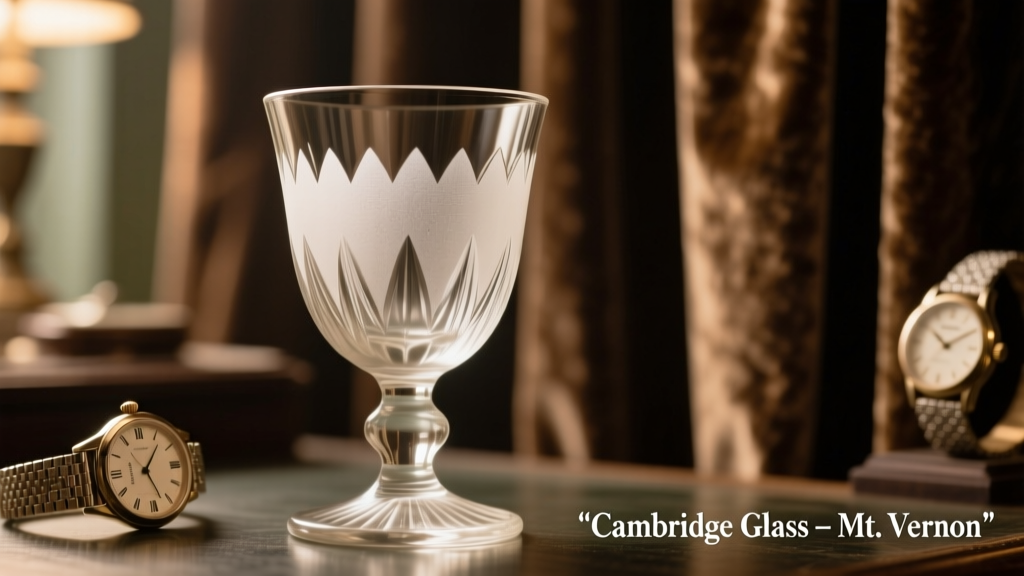
Cambridge Glass Mt. Vernon Goblet (12 oz): A Collector’s Guide to Form, Function, and Value
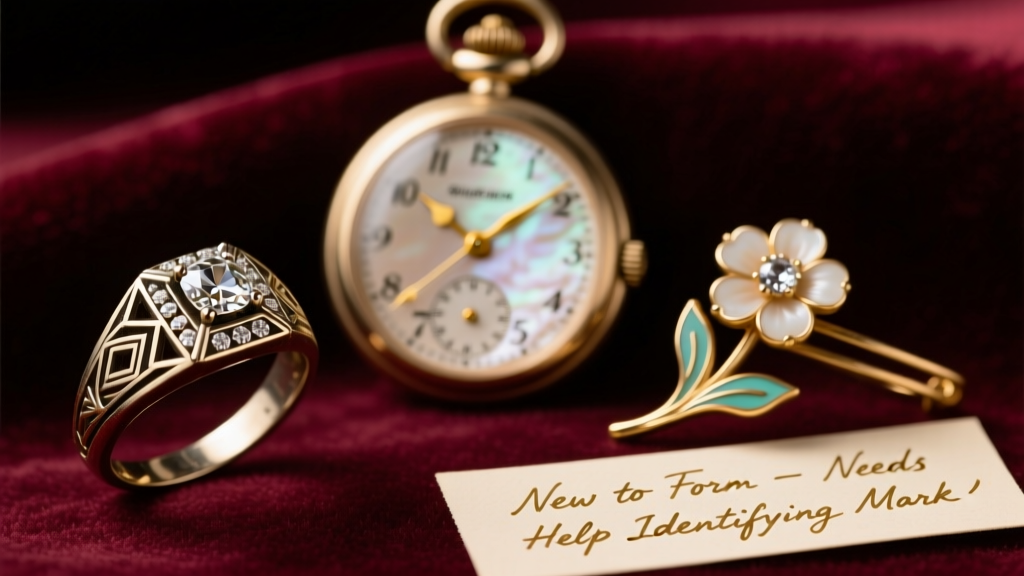
New to Form? Decoding Hallmarks, Maker’s Marks, and Case Stamps on Vintage Jewelry and Watches
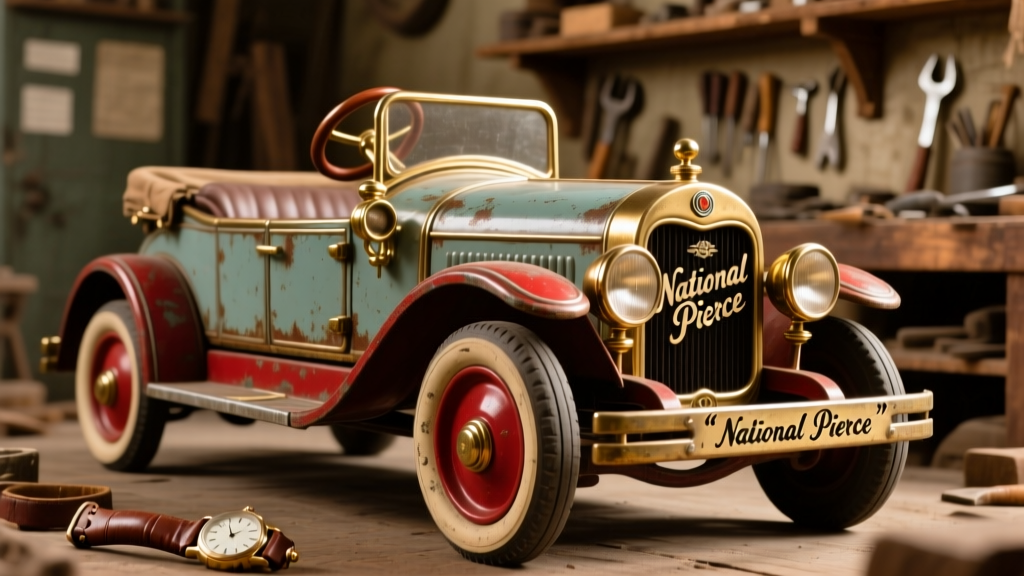
National Pierce American C Pedal Car, c. 1920: A Landmark of Early American Toy Engineering
Hall China Teapot 'Kansas' in Emerald Green with 24K Gold Trim: A Collector’s Guide to Rarity, Craftsmanship, and Market Value
The Toy Cap Bomb Bulldog Pistol: A Japanned Cast Iron Marvel Patented June 21, 1887

Fenton Hobnail Lamp in Courting Amber: History, Identification, and Market Value of a Mid-Century American Classic
The Beatles’ Peppermint Lounge Postcard Ring: A Rare 1964 Color Souvenir Ring Featuring Lennon, McCartney & Starr
Lot 2338522: A Deep Technical and Historical Analysis of the 1967 Omega Seamaster De Ville 14000 Calibre 565 — Ref. 166.024
Dragonware Vase Shoulder Handles, 9-Inch Pair: Provenance, Craftsmanship, and Market Significance