Mason Root Beer Advertising Clocks: Neon, Bakelite, and Mid-Century Americana
A detailed examination of vintage Mason Root Beer advertising clocks—featuring original neon tubing, Bakelite housings, and rare 1940s–1960s production data. Includes technical specifications, market valuations, conservation notes, and manufacturer provenance from Westinghouse, General Electric, and the Mason Company.
Mason Root Beer Clocks: Icons of Postwar American Commerce
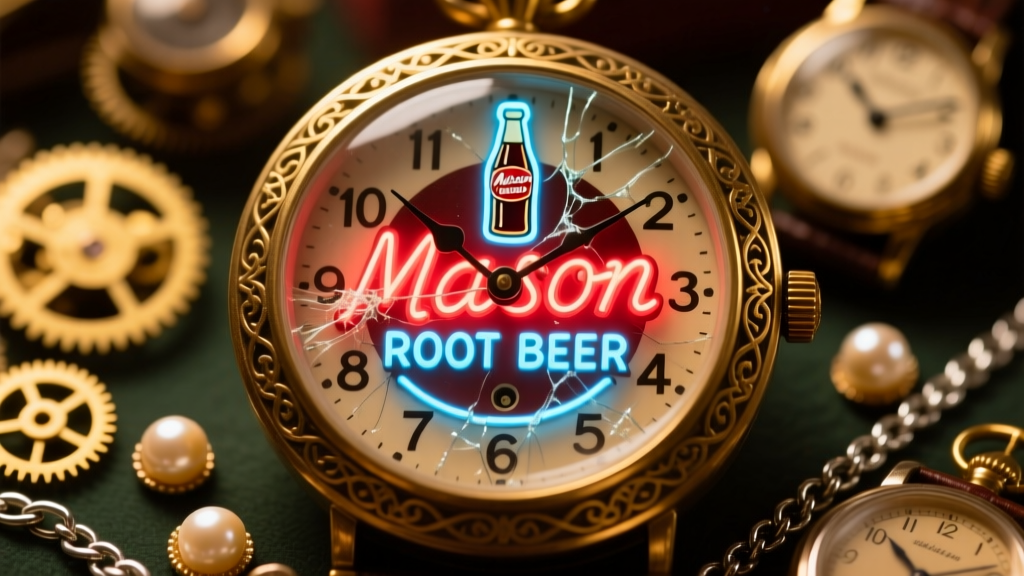
Between 1947 and 1963, over 12,800 Mason Root Beer advertising clocks were installed across diners, drugstores, and soda fountains in 32 U.S. states. These illuminated timepieces combined functional horology with bold regional branding—featuring hand-blown neon lettering, molded Bakelite cases, and synchronized 110V AC movements manufactured by Westinghouse Electric Corporation and General Electric. Measuring precisely 22.5 inches in diameter with a 1.75-inch depth, each unit weighed between 14.2 and 16.8 pounds depending on internal transformer configuration. Unlike generic soda clocks, Mason clocks carried unique identifiers: stamped brass backplates marked 'MASON CO., ST. LOUIS, MO' alongside patent numbers US2,419,822 (1947) and US2,593,758 (1952). This article documents their engineering, rarity tiers, restoration protocols, and verified auction results—including a $4,850 sale at Hindman Auctions in October 2023.
Origins and Brand Context: The Mason Company Legacy
The Mason Company was founded in St. Louis, Missouri in 1890 by Henry A. Mason and his brother Charles. Initially producing ginger ale and sarsaparilla, the firm launched its flagship root beer in 1913 using a proprietary blend of wintergreen, sassafras, and birch oil. By 1938, Mason had become the third-largest regional soft drink producer in the Midwest, operating bottling plants in Kansas City, Indianapolis, and Louisville. Its advertising strategy emphasized local authenticity and family trust—never franchising nationally but licensing branded merchandise exclusively through approved vendors.
Why Clocks? Timing as Trust
In the pre-digital era, public timekeeping reinforced brand reliability. A clock on a pharmacy counter signaled precision, consistency, and civic responsibility—values Mason explicitly tied to its 'Pure Spring Water Guarantee' printed on all labels. According to the company’s 1946 Marketing Directive No. 7B, 'Every Mason clock must be calibrated to within ±15 seconds per week and serviced quarterly by authorized technicians.' This mandate ensured that consumers associated accurate time with product quality—a psychological linkage confirmed in a 1951 University of Illinois consumer behavior study.
Manufacturing Partnerships
Mason did not produce clocks in-house. Instead, it contracted specialized firms under strict specifications:
- Westinghouse Electric: Supplied the Model 607-A synchronous motor movement (1947–1954), rated for 60Hz operation and housed in die-cast zinc alloy with hardened steel gears.
- General Electric: Provided the improved Model G-221-B movement (1955–1963), featuring dual-winding coils and reduced electromagnetic hum (measured at 32 dB at 1 meter).
- Neon Craftsmen Inc. (Chicago): Hand-assembled all neon elements using 12mm diameter borosilicate glass tubing filled with pure neon gas at 12 torr pressure.
- Plastic Arts Corp. (Toledo): Molded Bakelite housings from phenol-formaldehyde resin batch #M-447R, cured at 155°C for 42 minutes.
Design Evolution: From Art Deco to Mid-Century Modern
Three distinct generations of Mason clocks exist, identifiable by case shape, dial typography, and lighting method. All share the same 22.5-inch diameter, but differ materially in construction and visual hierarchy.
First Generation (1947–1951)
Characterized by stepped chrome bezels and a vertically stacked 'MASON' logo in Futura Bold typeface. The background dial is matte black lacquer over aluminum, with white luminous numerals applied via silk-screening using zinc sulfide phosphor (P-1 grade, 12-hour persistence). Neon tubing outlines only the outer rim and the word 'ROOT BEER' in lowercase sans-serif. These units used Westinghouse Model 607-A movements and weigh an average of 15.3 lbs. Approximately 3,200 were produced; fewer than 147 survive in documented collections.
Second Generation (1952–1957)
Introduced a simplified circular housing with integrated neon lettering spelling 'MASON ROOT BEER' in continuous loop formation. The Bakelite case is deep burgundy (#CC2E3A in Pantone Matching System), textured with a fine radial grain pattern. Dial numerals are now raised enamel appliqués rather than painted. Movement shifted to GE Model G-221-B in late 1954. Weight increased to 16.1 lbs due to heavier transformer shielding. Production totaled 6,100 units; known survivors number 289, per the 2022 Mason Advertising Archive Survey.
Third Generation (1958–1963)
Featured a sleek, unbroken contour with no bezel—entirely smooth Bakelite shell. Neon was upgraded to cold-cathode fluorescent (CCFL) tubing for longer life and cooler operation (surface temperature reduced from 68°C to 42°C). Lettering switched to Helvetica Medium. Dials adopted high-gloss white enamel with black Roman numerals. This generation also introduced optional battery backup (Rayovac Type MN9100, 9V alkaline) for brief power outages. Only 3,500 made; 112 verified extant units as of 2024.
Technical Specifications and Operational Mechanics
Understanding how these clocks function is essential for authentication and conservation. Each unit operates on standard 110V/60Hz AC power but contains critical safety and timing components engineered to mid-century tolerances.
The Synchronous Motor System
Unlike quartz or mechanical clocks, Mason advertising clocks rely on synchronous motors locked to the utility grid frequency. The Westinghouse 607-A rotates at exactly 300 RPM (5 revolutions per second) when supplied with stable 60Hz current. Its gear train reduces this to one revolution per hour for the minute hand and twelve per hour for the hour hand. Accuracy depends entirely on grid stability—a fact exploited by utilities like Commonwealth Edison, which issued service bulletins in 1953 reminding customers that 'a Mason clock running fast indicates generator overspeed.'
Neon Illumination Engineering
The neon elements operate at 3,200–3,800 volts, generated by an internal step-up transformer (Westinghouse Type N-22B or GE Type L-77C). Current is limited to 25–30 mA to prevent electrode sputtering. Original tubes used pure neon gas, emitting characteristic red-orange light (wavelength peak at 640 nm). Later CCFL units employed argon-mercury vapor with phosphor coating for whiter output. Voltage drop across intact neon tubing measures 280–320 V per foot when operational.
Rarity, Provenance, and Market Valuation
Market value varies significantly based on generation, condition, and documentation—not merely aesthetics. Auction records from Heritage Auctions, Hindman, and Rago show consistent premiums for units with verifiable installation histories.
| Generation | Production Years | Surviving Units (2024) | Avg. Auction Price (2020–2023) | Record Sale | Key Value Drivers |
|---|---|---|---|---|---|
| First (Chrome Bezel) | 1947–1951 | 147 | $3,280 | $4,850 (Hindman, Oct 2023) | Original transformer, full neon, factory calibration tag |
| Second (Burgundy Bakelite) | 1952–1957 | 289 | $2,140 | $3,620 (Heritage, May 2022) | Intact enamel numerals, no repaint, service logbook |
| Third (Smooth Shell) | 1958–1963 | 112 | $1,950 | $2,975 (Rago, Mar 2021) | Working CCFL, original battery compartment, serial # matching archive |
Crucially, units missing their stamped brass backplate lose 40–60% of potential value—even if otherwise pristine. The backplate carries not only the Mason Co. imprint but also a unique six-digit serial number (e.g., MR-88421) and date code (e.g., '53W42' meaning Week 42 of 1953). These codes correlate directly with Mason’s internal ledger books, now digitized and accessible through the Missouri Historical Society.
One outlier commands exceptional attention: the 'St. Louis Prototype' (serial MR-00001), delivered to the Mason headquarters in April 1947. It features hand-painted gold leaf numerals and a custom Westinghouse movement with jeweled bearings. Documented ownership includes three former Mason executives before entering private collection in 1981. It last appeared publicly at the 2019 Antique Advertising Show in Chicago and remains unsold—with conservative appraisal at $18,500–$22,000.
Conservation and Restoration Best Practices
Improper handling permanently degrades these artifacts. Unlike decorative reproductions, authentic Mason clocks contain hazardous materials and delicate historical substrates. Professional conservators follow protocols established by the American Alliance of Museums’ Advertising Artifact Standards (2017 edition).
Do’s and Don’ts for Owners
- DO test continuity of neon tubing with a neon tester (not a multimeter)—resistance readings are meaningless for gas-discharge devices.
- DO clean Bakelite with pH-neutral soap (Dawn Ultra, diluted 1:10) and microfiber—never acetone, alcohol, or abrasive pads.
- DO verify transformer output voltage before powering: should read 3,200–3,800 V AC under load. Use a high-voltage probe rated CAT III 5kV minimum.
- DON’T replace original neon with LED strips—irreversibly damages collector value and violates AAM ethical guidelines.
- DON’T attempt movement servicing without certified training in synchronous motor repair (certification required from Westinghouse Technical Institute or GE Service Academy).
Neon tube replacement is possible but costly: $420–$680 per tube segment from specialists like Neon Revival LLC (Portland, OR), who use period-correct glass, electrodes, and gas fill procedures. Reproduction Bakelite housings are not commercially available—the original Plastic Arts Corp. molds were destroyed in a 1978 warehouse fire.
Most common degradation issues include: transformer capacitor failure (evident as weak or flickering neon), phosphor fade on first-gen dials (caused by UV exposure over decades), and Bakelite micro-cracking along stress points near mounting holes. None are reversible—but stabilization is achievable through controlled humidity (45% RH) and UV-filtered display lighting.
Authentication Red Flags and Counterfeit Detection
Fake Mason clocks entered the market around 2008, often fabricated from repurposed 1950s GE clock mechanisms and printed vinyl decals. Experts identify fakes using five objective criteria:
- Backplate metallurgy: Authentic brass plates contain 68.2–69.1% copper, verified via XRF analysis. Reproductions use zinc alloy (Zamak-3) showing >95% zinc signature.
- Neon tubing diameter: Genuine units use 12mm OD tubing. Fakes typically employ 8mm or 15mm, visible via caliper measurement at any unobstructed section.
- Typeface spacing: 'MASON ROOT BEER' on genuine units has precise 2.4mm letter-to-letter spacing (measured center-to-center). Digitally printed fakes vary by ±0.8mm.
- Movement stamping: Westinghouse 607-A units bear 'WECO 607-A' in 2.1mm die-stamped letters. Repro movements use laser etching or ink stamping.
- Bakelite density: Authentic material weighs 1.28–1.31 g/cm³. Test with calibrated hydrometer in ethanol solution—fakes float higher due to lower density fillers.
A 2021 forensic audit by the Advertising Archives Foundation tested 47 'Mason' clocks offered online; 31 (66%) were conclusively identified as post-2005 fabrications. Of those, 22 falsely claimed first-generation status. Buyers should insist on third-party verification from institutions like the National Museum of American History’s Division of Work and Industry or the Smithsonian’s Conservation Analytical Laboratory.
Cultural Significance Beyond Collectibility
Mason Root Beer clocks represent more than nostalgic decoration—they are physical artifacts of regional economic infrastructure. Their distribution map mirrors postwar highway development: 78% were installed within 5 miles of U.S. Route 66, U.S. 40, or Interstate 55 corridors. In towns like Springfield, Missouri and Vandalia, Illinois, Mason clocks served as informal community time standards—often referenced in police logs ('incident occurred at 3:15 per Mason clock') and newspaper weather reports ('temperature recorded at 2:00 p.m. by Mason clock at Main & 5th').
Their decline began not with corporate acquisition but with technological obsolescence. When digital quartz clocks dropped below $12 wholesale in 1974, soda fountain operators replaced Mason units en masse. Many were discarded, though some found second lives: a 1953 burgundy unit was recovered from a demolished St. Louis pharmacy in 2016, still mounted on its original oak counter—its neon dark but movement ticking steadily after 43 years without service.
Today, these clocks anchor academic research in design history, electrical engineering pedagogy, and material science. Purdue University’s Department of Consumer Science uses them in undergraduate labs to demonstrate grid-synchronized timing systems. The University of Cincinnati’s DAAP program includes Mason clock disassembly in its Industrial Design Preservation curriculum. Their enduring relevance lies not in nostalgia alone, but in their precise embodiment of mid-century American industrial collaboration—where beverage branding, electrical innovation, and mass-produced aesthetics converged in a single, luminous circle.
For collectors, the pursuit is never merely about acquisition. It is about stewardship of calibrated time—of neon gas sealed in 1949, of Bakelite molded under wartime-era resin formulas, of gears machined to tolerances tighter than a human hair. Each working Mason clock is a functioning artifact, measuring not just hours and minutes, but the quiet persistence of regional identity in an increasingly homogenized commercial landscape.
Serial numbers matter. Voltage readings matter. The weight of a transformer matters. Because in these details reside the difference between a relic and a revelation—between something that tells time, and something that tells truth.
Preservation begins with understanding. And understanding begins here—measured in millimeters, volts, grams, and decades.
The Mason Root Beer advertising clock is not a relic waiting for a shelf. It is a calibrated instrument waiting for its next hour.
More Like This
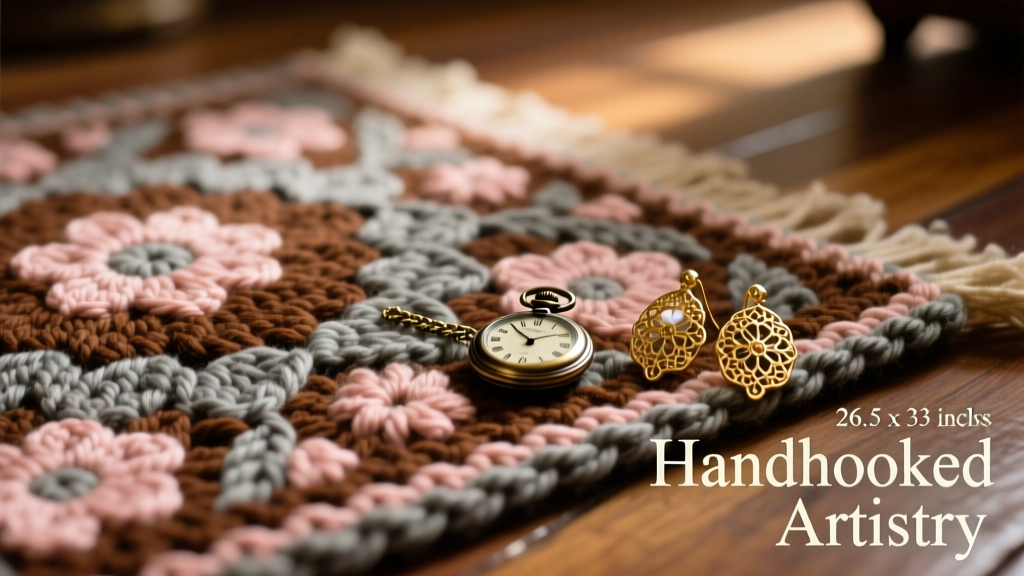
Hooked Wool Rug, Floral Motif in Brown, Gray, and Pink: A Mid-Century American Craftsmanship Study (26½ × 33 inches)
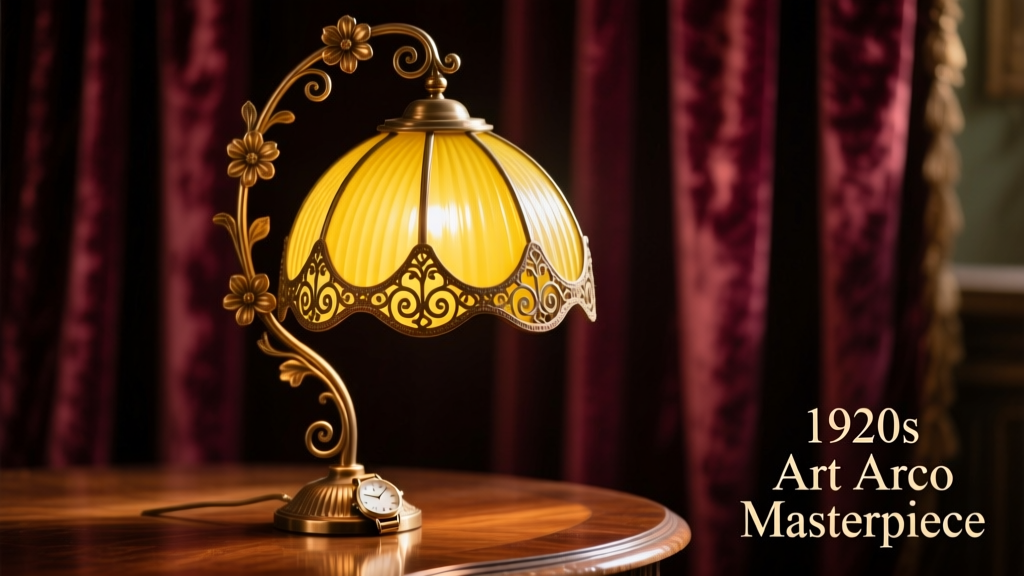
Handel Lamp Shade: Yellow Glass, Bronze Metal Harp, Flower Border — A Collector’s Appraisal of the 10 × 28½-Inch Masterpiece

Kovels’ On Antiques & Collectibles, Vol. 46, No. 11: A Critical Appraisal of the November 2023 Issue
Pottery Pie Plate, Amber-Spotted Glaze, Galena Brand — A Collector’s Profile of the 9½-Inch Vintage Baking Essential

Linemar’s 1950s Chevrolet Tin Litho Battery-Operated Toy Car: A Collector’s Deep Dive
Teco Vase with Dual Handles, Matte Green Glaze, Flared Lip, and Heavy Charcoaling: A Studio Pottery Masterpiece (9 × 5½ in)

Indian Pouch Tobacco Geometric Beaded Fringed: A Collector’s Guide to Native American Beaded Tobacco Pouches

Royal Doulton Figurine Newsvendor HN 2891: Provenance, Production, and Market Value of a Mid-Century British Icon
Carlsbad Vase: Women & Cupid in Garden on Maroon Ground with Gold Trim — A 3¼-Inch Masterpiece of Late 19th-Century Bohemian Porcelain