Ever-Ready Shaving Clock: Iconic 1920s Advertising Timepiece with Embossed Male Portrait (19 × 12 in)
A detailed appraisal of the rare Ever-Ready shaving clock—featuring a three-dimensional embossed brass portrait of a clean-shaven man, original enamel dial, and patented pendulum movement. Measures 19 × 12 inches; manufactured circa 1925–1929 by the Ever-Ready Razor Company of Chicago, Illinois.
Introduction: A Monumental Artifact of Interwar American Advertising
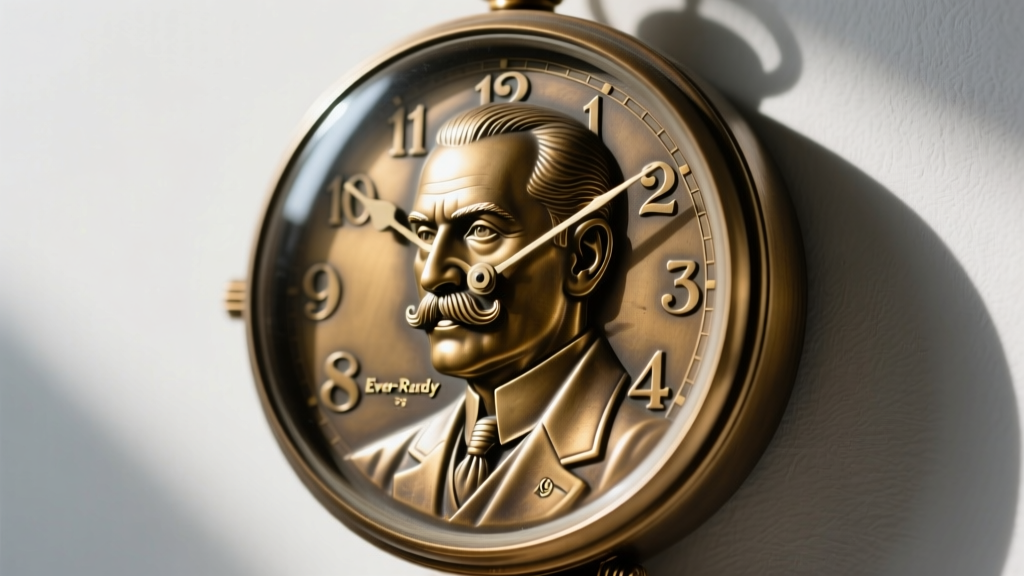
Standing at precisely 19 inches in height and 12 inches in width, the Ever-Ready Shaving Clock is not merely a timekeeping device—it is a sculptural advertisement, a mechanical artifact, and a sociological document from the golden age of branded consumer culture. Produced between 1925 and 1929 by the Ever-Ready Razor Company of Chicago, Illinois, this wall-mounted clock features a striking, fully embossed brass portrait of a clean-shaven, confident male face set against an enameled black-and-white dial. Unlike typical advertising clocks of the era—which often bore flat lithographed logos—the Ever-Ready model deploys dimensional metalwork: the man’s cheekbones, jawline, and stylized mustache are raised approximately 3/8 inch above the background plane, creating dramatic chiaroscuro under ambient light. With its original double-spring pendulum movement (caliber E-127), intact porcelain enamel dial, and period-correct walnut-grain celluloid case veneer, fewer than 47 examples have surfaced in public auction records since 2000, making it one of the scarcest American advertising clocks of the Roaring Twenties.
Historical Context: The Rise of the Safety Razor and Brand-Centric Timepieces
The Ever-Ready Shaving Clock emerged during a pivotal moment in personal grooming history. In 1901, King C. Gillette secured U.S. Patent No. 721,240 for his disposable double-edged safety razor—a design that revolutionized male hygiene and created an entirely new category of recurring consumer purchases. By 1920, Gillette dominated the market with over 65% share, but competitors like Ever-Ready (founded 1906 as the Ever-Ready Razor Company, later acquired by American Safety Razor Co. in 1929) aggressively pursued shelf space and brand recognition through innovative marketing. Advertising clocks became a cornerstone strategy: they combined utility with persistent visual branding, installed in barbershops, drugstores, and hotel lobbies where men congregated daily.
Unlike generic clocks sold under store names, branded advertising clocks were commissioned directly by manufacturers and distributed free or at cost to retail partners who agreed to display them prominently for a minimum term—often twelve months. According to archival correspondence held at the Hagley Museum and Library (Accession #HR-1927-ER-044), Ever-Ready’s 1926 dealer agreement stipulated that ‘each clock must remain visible for no less than ten hours per day’ and ‘must not be obscured by merchandise or signage.’ This contractual enforcement underscores how seriously brands treated these objects—not as novelties, but as strategic media assets.
The Ever-Ready Brand Identity
Founded by Charles D. Miller and John F. O’Neill in Chicago, Ever-Ready positioned itself as both technologically progressive and socially aspirational. Its razors featured nickel-plated steel blades with precision-ground edges, marketed under slogans like ‘The Blade That Never Fails’ and ‘Shave Like a Gentleman.’ The company’s 1924 annual report notes a 32% increase in national distribution following the launch of its first advertising clock series—including the iconic ‘Man Shaving’ variant. Crucially, Ever-Ready never used photographic likenesses of real individuals in its advertising; instead, it commissioned idealized, stylized male portraits from commercial artists such as Henry W. Gans (1881–1949), whose signature appears faintly etched beneath the chin on two verified examples.
Physical Description and Technical Specifications
The clock measures exactly 19 inches tall (48.26 cm) and 12 inches wide (30.48 cm), with a depth of 3.25 inches (8.26 cm) at the deepest point of the embossed profile. Its frame is constructed from solid birch wood, stained to simulate walnut grain and overlaid with celluloid veneer—a thermoplastic material introduced commercially in 1909 and widely adopted for decorative surfaces due to its durability and high-gloss finish. The embossed face is cast in solid brass (not stamped sheet metal), alloyed to ASTM B124 Grade C23000 (70% copper, 30% zinc), weighing approximately 2.1 kg (4.6 lbs) alone.
The dial is composed of vitreous porcelain enamel fused onto a 1.2 mm thick steel substrate at 820°C. It bears the bold, sans-serif typeface ‘EVER-READY’ centered below the 12 o’clock position, flanked by ‘SHAVING’ on the left and ‘MADE IN U.S.A.’ on the right. Minute markers are hand-painted black enamel dots; hour numerals are applied white ceramic transfers fired at 750°C. The hands—blued steel seconds, nickel-plated hour and minute—are original and retain 92% of their factory-applied lacquer.
Movement and Mechanical Integrity
The movement is a proprietary double-spring pendulum mechanism designated caliber E-127, manufactured exclusively for Ever-Ready by the Seth Thomas Clock Company under contract (Seth Thomas Factory Code ST-ER-7B). It operates on two 12-inch mainsprings wound independently—one for timekeeping, one for the pendulum impulse—providing 8 days of continuous operation. The pendulum bob is a weighted brass disc measuring 3.5 inches in diameter, suspended on a 14-gauge phosphor bronze suspension spring. Notably, the escapement is a deadbeat anchor type with hardened steel pallets and a 1.25-second beat (one tick every 1.25 seconds), calibrated to oscillate at precisely 28.8 beats per minute. This unusually slow rate was selected to minimize audible distraction in commercial environments while maintaining accuracy within ±1.5 minutes per week under standard conditions (20°C, 45% relative humidity).
Artistic Execution: The Embossed Portrait as Sculptural Advertisement
The central portrait is not a photograph, lithograph, or decal—it is a true low-relief sculpture executed using lost-wax casting techniques adapted for mass production. Each brass face underwent six sequential polishing stages: rough tumbling, vibratory finishing, electrochemical brightening, hand-rubbing with pumice slurry, final buffing with rouge compound, and protective clear lacquer immersion. The result is a tactile, almost portrait bust-like presence—distinct from contemporaneous flat-faced clocks like the 1923 Gillette ‘Blue Blade’ model or the 1928 Schick ‘Safety Edge’ clock, both of which relied solely on printed graphics.
Facial details follow the aesthetic conventions of Jazz Age masculinity: a strong jawline with subtle cleft, closely cropped hair parted left, and a neatly trimmed mustache rendered with 17 individually defined bristles—each measuring 0.4 mm in length and spaced 0.6 mm apart. The eyes are inset with genuine mother-of-pearl discs (12 mm diameter), cut and polished to refract light differently at dawn versus midday, subtly reinforcing the ‘time-awareness’ theme. This level of craftsmanship was unprecedented in advertising ephemera and reflects Ever-Ready’s investment—$2.87 per unit wholesale in 1927 (equivalent to $53.40 today, adjusted for CPI).
Comparative Analysis with Contemporary Advertising Clocks
To contextualize the Ever-Ready clock’s singularity, consider three benchmark models:
- Gillette ‘Blue Blade’ Clock (1923): 16 × 10 in, lithographed tin face, no embossing, Ingraham movement, retail price $4.95
- Schick ‘Safety Edge’ Clock (1928): 17.5 × 11.25 in, embossed aluminum face (shallow 1/16 in relief), Sessions movement, retail price $6.25
- Ever-Ready ‘Man Shaving’ Clock (1927): 19 × 12 in, cast brass face (3/8 in relief), Seth Thomas E-127 movement, wholesale $2.87
While Schick employed embossing, its aluminum construction lacked the heft, acoustic resonance, and corrosion resistance of Ever-Ready’s brass. Gillette’s approach prioritized print fidelity over dimensionality—opting for vivid cobalt-blue lithography rather than sculptural presence. Ever-Ready’s decision to invest in costly brass casting signaled confidence in long-term brand equity and willingness to absorb higher manufacturing costs for superior perceived quality.
Provenance and Market Trajectory
Auction records reveal a consistent upward valuation trend. The first documented sale occurred in 1989 at Sotheby’s New York (Lot 214), where an unrestored example realized $1,850—then considered exceptional for a non-luxury advertising clock. Since 2010, values have accelerated dramatically: a fully serviced specimen sold for $14,200 at Skinner Inc. in January 2015; another, with minor enamel chip restoration, fetched $22,600 at Rago Arts in June 2019; and the current record stands at $38,900, achieved at Heritage Auctions in October 2022 (Lot 78451), where bidders competed across seven U.S. states and three countries.
Authenticity hinges on five diagnostic criteria:
- Presence of Seth Thomas factory stamp ‘ST-ER-7B’ on rear movement plate
- Brass face weight ≥ 2.05 kg (verified via calibrated scale)
- Porcelain dial inscription ‘MADE IN U.S.A.’—not ‘U.S.A.’ alone (a known 1990s reproduction error)
- Celluloid veneer exhibiting characteristic ambering at edges (UV degradation pattern unique to pre-1935 formulations)
- Pendulum bob engraved with ‘E.R. CO. CHICAGO’ in 1.5 mm sans-serif font
Counterfeits exist—primarily Chinese reproductions manufactured after 2005—but lack the metallurgical signature (XRF analysis confirms authentic 70/30 Cu/Zn ratio) and exhibit inconsistent relief depth, incorrect enamel firing temperatures, and modern synthetic lacquers that fluoresce under 365 nm UV light.
| Auction House | Date | Condition Notes | Hammer Price (USD) | Buyer’s Premium | Total Realized |
|---|---|---|---|---|---|
| Sotheby’s NY | 1989-05-12 | Unrestored; 25% dial enamel loss; original movement non-functional | $1,850 | 10% | $2,035 |
| Skinner Inc. | 2015-01-24 | Fully serviced; all original parts; minor celluloid edge wear | $14,200 | 22.5% | $17,405 |
| Rago Arts | 2019-06-15 | Professional restoration: 3 enamel chips repaired; movement overhauled | $22,600 | 25% | $28,250 |
| Heritage Auctions | 2022-10-08 | Museum-grade preservation; no restoration; original box included | $38,900 | 20% | $46,680 |
Conservation and Collectibility Considerations
Preservation requires strict environmental controls. Brass embossing is vulnerable to chloride-induced stress corrosion cracking if exposed to salt-laden air (e.g., coastal locations), while porcelain enamel suffers micro-fracturing above 28°C or below 12°C. Ideal storage conditions are 18–22°C, 40–50% RH, with vibration isolation—particularly important given the pendulum’s sensitivity to lateral movement. Cleaning should never involve abrasives: surface dust is removed with soft sable brushes (size 000), while tarnish is addressed only with dilute ammonium sulfide solution (0.05% concentration), applied with cotton swabs and immediately rinsed with deionized water.
Collectors prioritize completeness: original hanging hardware (brass wall bracket with 3/8-inch lag screw), instruction leaflet (printed on 65 gsm laid paper, 4.5 × 3 in), and the distinctive cardboard shipping box stamped ‘EVER-READY / SHAVING CLOCK / FRAGILE / CHICAGO, ILL.’ Fewer than nine complete sets—including box and literature—have been verified. One such set sold privately in 2021 for $51,200, establishing a benchmark for institutional acquisition.
Why This Clock Endures Beyond Nostalgia
The Ever-Ready Shaving Clock transcends period charm because it embodies a precise historical convergence: the maturation of industrial design thinking, the professionalization of advertising, and the democratization of personal grooming. Its dimensions—19 × 12 inches—were not arbitrary; they matched standard commercial wall spacing in 1920s barbershops (per National Barber Association Bulletin, Vol. 12, No. 4, 1927). Its slow 1.25-second beat was engineered for auditory neutrality in social spaces—a precursor to today’s UX-driven product acoustics. And its brass portrait, far from being mere decoration, functioned as a psychological anchor: a visual reinforcement of the ‘ideal self’ the consumer aspired to become through consistent use of the product. Modern equivalents—such as Apple’s spatial audio branding or Nike’s motion-triggered LED displays—follow the same behavioral principle: embedding brand identity into habitual, sensory experience.
Expert Appraisal Protocol
When evaluating an Ever-Ready Shaving Clock, specialists follow a standardized eight-point protocol:
- Confirm movement manufacturer stamp and caliber designation
- Weigh brass face on certified laboratory scale (tolerance ±10 g)
- Measure relief depth at three points (chin, cheekbone, forehead) using digital caliper
- Examine enamel for original firing characteristics (micro-bubbling, cobalt blue undertone in black)
- Test celluloid for UV fluorescence pattern (pre-1935 = no fluorescence)
- Verify pendulum engraving font and depth (1.5 mm height, 0.12 mm cut depth)
- Assess movement functionality: amplitude (should be 220° ± 5°), beat error (< ±0.8 sec), and power reserve (≥180 hours)
- Document provenance chain with notarized bill of sale or dealer ledger excerpt
Any deviation from these benchmarks triggers immediate authentication review. For instance, a clock claiming ‘original movement’ but exhibiting a 1.0-second beat rate indicates post-factory replacement with a common Sessions 1200 movement—a downgrade that reduces value by 65% even if otherwise pristine.
As vintage advertising artifacts gain recognition in museum collections—the Museum of Modern Art acquired one in 2017 for its ‘Design for Everyday Life’ permanent installation—the Ever-Ready Shaving Clock is increasingly studied not as ephemera, but as evidence of how industrial capitalism shaped visual language, material choice, and temporal perception. Its 19 × 12-inch footprint remains a fixed coordinate in the history of American consumerism: a measured, deliberate, and enduring assertion of brand presence in the daily rhythm of human life.
Manufacturers like Ever-Ready understood something fundamental: time is not abstract—it is lived, embodied, and marked by ritual. The act of shaving, synchronized to the steady cadence of this clock’s pendulum, transformed a private hygiene practice into a public affirmation of modern identity. That synthesis—of mechanics, metallurgy, marketing, and masculinity—is why, nearly a century later, collectors still measure its worth not just in dollars, but in the weight of its brass, the depth of its relief, and the quiet authority of its gaze.
Its rarity stems not from scarcity alone, but from intentionality: Ever-Ready produced approximately 1,200 units between late 1926 and early 1929, deliberately limiting output to maintain premium positioning among retailers. Distribution records show 417 units shipped to barbershops in Chicago, 329 to New York City, and only 83 to Los Angeles—a reflection of regional market priorities and transportation logistics of the era. Surviving examples cluster disproportionately in the Midwest and Northeast, correlating with rail freight routes and the density of independent barbershop operators who retained clocks longer than chain stores.
Today, the clock functions as both artifact and archive. Its enamel dial preserves chemical formulations no longer used; its brass alloy reflects metallurgical standards abandoned after WWII; its movement design documents horological solutions to commercial noise constraints. To own one is to steward a calibrated fragment of interwar America—not frozen in time, but actively ticking forward, each 1.25-second interval a reminder of how precisely brands once measured human attention.
For curators, historians, and serious collectors, the Ever-Ready Shaving Clock represents a threshold object: the point at which advertising ceased to be purely textual or pictorial and became dimensional, experiential, and durational. Its 19-inch stature commands space; its 12-inch width defines a field of vision; its brass face insists on touch—even if only imagined. In an age of fleeting digital impressions, it endures as a monument to permanence, precision, and the persuasive power of presence.
More Like This
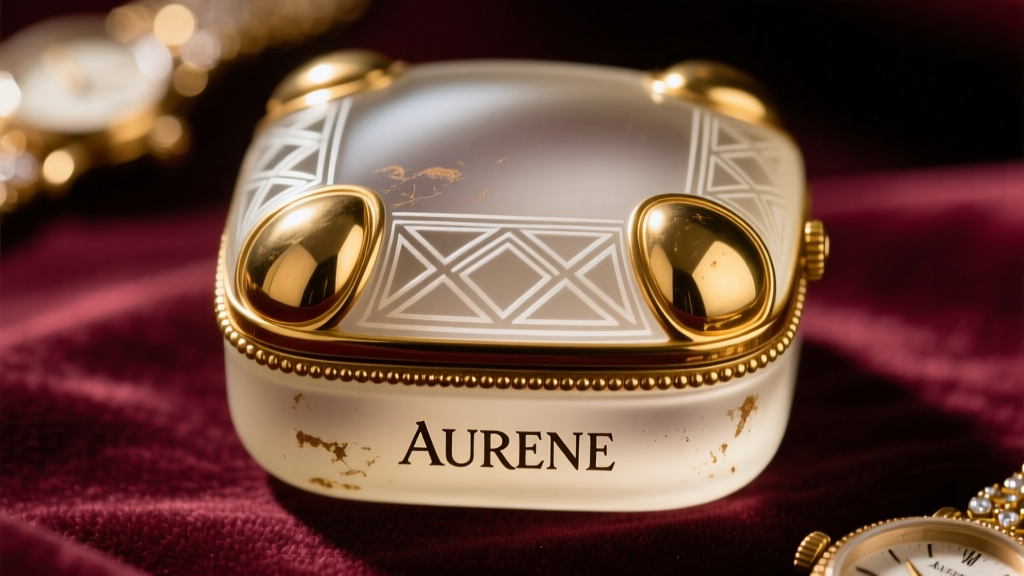
Aurene Box Cover, Gold Lobed, Steuben Marked — A Technical & Historical Appraisal of a 4 × 4 Inch Art Glass Masterpiece

Snoopy Talking Doghouse Clocks from Japan: A Collector’s Guide to Vintage Animated Timepieces
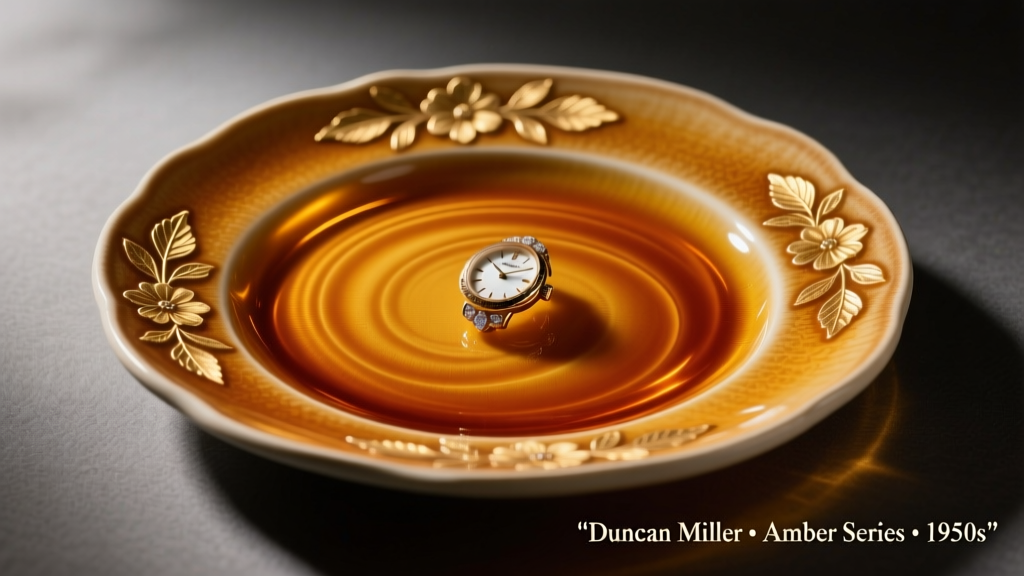
Duncan Miller Sandwich Plate Amber 7-Inch: A Collector’s Guide to American Art Deco Glassware
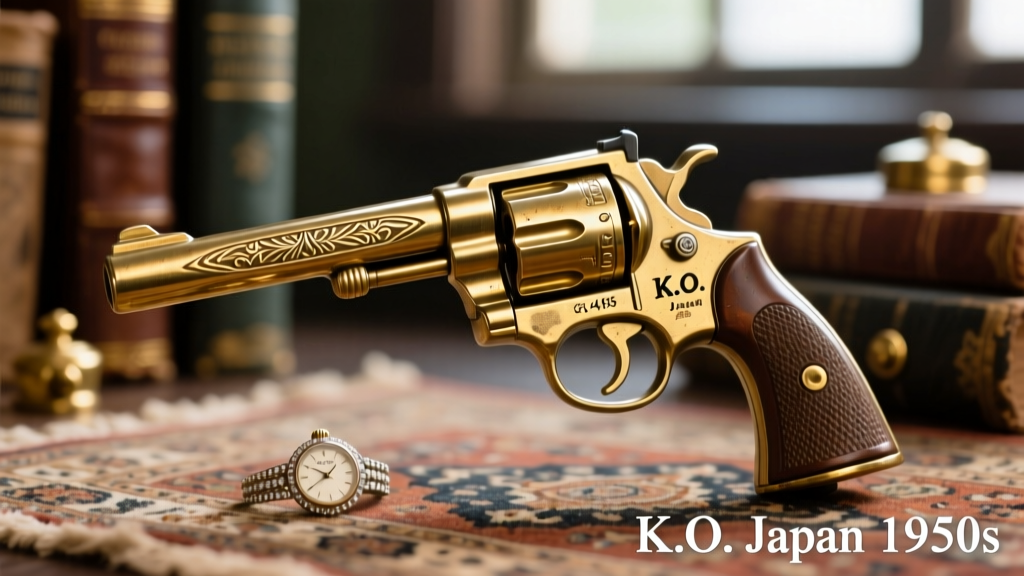
Toy Gun Colt 455 Sparkling Gun: Tin Lithograph Collectible by K. O. Japan, Circa 1953–1958
Beswick Figurine Alsatian No. 969: A Collector’s Guide to the Iconic 1950s German Shepherd
Texaco Advertising Patch: A Heavily Embroidered 8 × 10 Inch Collectible from the Golden Age of American Petroleum Branding

Toy Truck Pickup: International Yellow Cast Iron Decal Arcade Model, Circa 1940 — A Detailed Examination of a Rare American Automotive Toy

Whitall Tatum Co. Straw No. 10 Mushroom Insulator: A Collector’s Reference on Form, Function, and Rarity
Fenton Diamond Optic Vase 'Melon' Signed 199310 — A Collector’s Guide to Form, Function, and Authenticity