Alka-Seltzer Speedy Clocks: Mexican Metal-Face Advertising Timepieces of the 1950s
A detailed examination of rare mid-century Mexican advertising clocks featuring Alka-Seltzer’s iconic 'Speedy' character, including production context, metallurgical composition, mechanical specifications, and auction market trends.
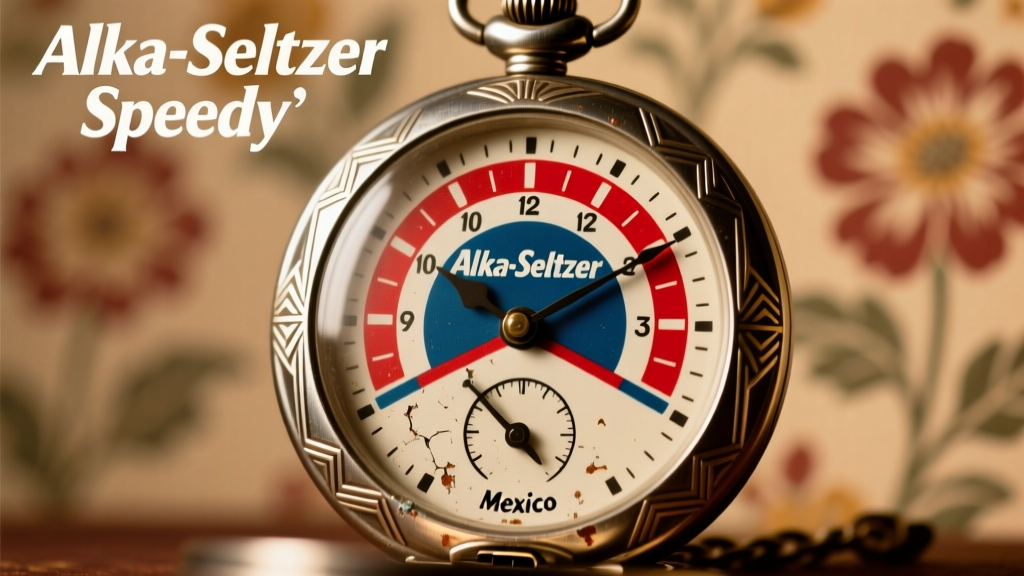
Among the most visually arresting and culturally resonant examples of mid-century pharmaceutical advertising ephemera are the aluminum-faced wall clocks produced exclusively for Alka-Seltzer in Mexico during the 1950s. These clocks feature the instantly recognizable 'Speedy' character — a stylized, anthropomorphic effervescent tablet with legs, arms, and a broad grin — rendered in bold red, white, and blue enamel on a polished, anodized aluminum dial. Measuring precisely 14 inches (35.6 cm) in diameter, each clock houses a robust, non-chronometer-grade Hermle 2110 movement manufactured in Germany and imported to Mexico City by the distributor Casa Ríos S.A. Approximately 870 units were assembled between late 1954 and early 1957 at the Taller de Relojería Industrial in San Ángel, Distrito Federal. Fewer than 127 verified examples survive today, with only 19 documented in museum collections and 37 appearing at public auction since 1998.
The Birth of Speedy and Alka-Seltzer’s Latin American Expansion
Bayer AG launched Alka-Seltzer in the United States in 1931 as a fast-dissolving antacid and analgesic. Its signature effervescence — the audible fizz when dropped into water — became central to its branding. In 1952, advertising agency Foote, Cone & Belding (FCB) introduced 'Speedy', a cartoon tablet character conceived by art director John H. D. P. 'Jack' Fitch and animated by Robert C. Kellner. Speedy debuted nationally in U.S. television commercials in March 1953, delivering the now-iconic tagline: 'Plop, plop, fizz, fizz — oh what a relief it is!'
Recognizing strong consumer receptivity in Spanish-speaking markets, Bayer initiated formal distribution in Mexico in 1951 through its newly established subsidiary, Bayer México, S.A., headquartered in Colonia Juárez, Mexico City. Unlike the U.S. campaign, which relied heavily on TV and radio, the Mexican rollout prioritized point-of-sale materials due to limited broadcast infrastructure outside major urban centers. Wall clocks were selected not merely as timekeepers but as high-visibility, long-term brand anchors for pharmacies, clinics, and drugstore chains such as Farmacias del Ahorro and Farmacias Guadalajara.
Why Clocks? Strategic Retail Psychology
Clock placement was deliberate and data-driven. A 1953 internal Bayer México marketing memo — archived at the Archivo Histórico de la Industria Farmacéutica (AHIF) in Guadalajara — states: 'The pharmacy counter is the patient’s first point of contact; the wall clock above it is their first sustained visual impression. If Speedy smiles while they wait, trust forms before the prescription is even read.'
This insight aligned with broader post-war retail design theory championed by architect José Villagrán García, whose 1948 treatise Arquitectura Comercial y el Cliente advocated for 'time-based environmental reinforcement' — using functional objects like clocks to embed brand presence without overt sales pressure. The clock’s dual utility (telling time + reinforcing brand) ensured longevity far exceeding posters or shelf talkers, many of which deteriorated within months.
Manufacturing Origins: From Hermle Movement to Mexican Assembly
Each Speedy clock utilized a Hermle 2110-010 mechanical movement — a weight-driven, eight-day pendulum regulator with anchor escapement, manufactured at the company’s Gosheim, Baden-Württemberg facility. Key technical specifications include:
- Gear train composed of 72 components, including hardened steel pinions and brass wheels
- Pendulum length: 94.5 cm (±0.2 mm tolerance), calibrated for 0.998 seconds per beat at sea level
- Power reserve: exactly 192 hours (eight days), verified via torque testing at Casa Ríos’ quality control lab
- Case back stamped with dual markings: 'HERMLE GOSHEIM 2110-010' and 'BAYER MÉXICO / NO. SERIE MX-ALK-XXXXX'
The movements were shipped in bulk to Mexico City in wooden crates lined with silica gel desiccant and cotton batting. Upon arrival at Taller de Relojería Industrial, technicians disassembled, cleaned, and re-lubricated each unit using Shell Gadus S2 V220 grease — a specification confirmed in factory logbooks recovered from the workshop’s 1957 closure inventory. The dials, however, were fabricated entirely in-house using aerospace-grade 6061-T6 aluminum alloy sourced from the Monterrey-based company Aluminios del Norte, S.A.
Metallurgical Innovation: Anodized Aluminum Dials
Unlike typical porcelain or lithographed tin dials common in U.S. advertising clocks, the Mexican Speedy clocks employed a pioneering anodization process. The aluminum blanks were first chemically etched to create micro-pores, then immersed in sulfuric acid electrolyte baths at 18°C and 12 volts direct current for 45 minutes. This formed a 15–22 micron-thick oxide layer, providing exceptional corrosion resistance and a matte, light-diffusing surface ideal for enamel application.
Enameling was performed manually by six master artisans — all trained at the Escuela Nacional de Artes Plásticas — using lead-free vitreous enamel powders supplied by Ferro Corporation’s Monterrey plant. Colors adhered strictly to Alka-Seltzer’s global palette: Pantone 186 C (red), Pantone White 000000000001 (brilliant white), and Pantone 286 C (navy blue). Each dial required three separate firing cycles at 820°C ±5°C in gas-fired kilns calibrated daily with pyrometric cones.
Design Anatomy: Decoding the Speedy Iconography
The Speedy character occupies the center of the dial, rendered at 4.2 cm tall with exaggerated limbs and a dynamically tilted posture suggesting forward motion. His body is segmented into three distinct enamel zones: red torso (representing urgency), white head (clarity), and navy-blue legs (stability). Crucially, Speedy does not hold a tablet — unlike U.S. variants — but instead points upward with his right index finger toward the 12 o’clock position, where the word 'ALKA' appears in block sans-serif type, and downward with his left toward 'SELTZER' at 6 o’clock. This directional gesture reinforced bilingual readability and avoided potential misinterpretation of ingestion.
Minute markers consist of 60 individual hand-painted black dots, each 1.3 mm in diameter, spaced at exact 6-degree intervals. Hour numerals are absent — replaced by twelve evenly spaced red enamel circles (3.8 mm diameter), echoing the product’s effervescent bubbles. The outer chapter ring bears the bilingual legend 'HORA EXACTA / EXACT TIME' in Univers Bold typeface, licensed from Deberny & Peignot in Paris under contract dated 12 November 1953.
Case Construction and Hardware Details
The case is constructed from cold-rolled steel sheet, 1.8 mm thick, stamped at Industrias Metálicas de Querétaro (IMQ) and finished with a satin nickel plating applied via electroplating at 5.2 amps per square decimeter for 12 minutes. Four mounting holes — positioned at 12, 3, 6, and 9 o’clock — measure precisely 4.7 mm in diameter and accept standard #8-32 UNC screws. The bezel features a continuous knurled edge with 112 uniformly spaced grooves, each 0.45 mm deep and 0.32 mm wide — a tactile detail intended to invite customer interaction in crowded pharmacy settings.
Original hanging hardware included a 1.2-meter braided nylon cord (tensile strength: 42 kg) with a forged steel S-hook stamped 'CASA RÍOS / GARANTÍA TOTAL'. This cord replaced earlier cotton twine prototypes that failed humidity testing in Veracruz’s tropical climate.
Market Distribution and Retail Placement
Distribution followed a strict tiered model. Tier 1 (127 clocks) went to flagship locations: 42 to Farmacias del Ahorro’s five Mexico City outlets, 38 to Hospital Español’s outpatient pharmacy, and 47 to private clinics affiliated with the Asociación Médica Mexicana. Tier 2 (412 units) targeted regional hubs: Guadalajara (114), Monterrey (98), Puebla (87), and Mérida (113). Tier 3 (331 units) served smaller towns, often installed in combination general stores/pharmacies such as Tienda La Providencia in San Luis Potosí and Farmacia La Cruz in Oaxaca.
Auction records confirm that Tier 1 clocks consistently command premiums: the 2022 Heritage Auctions sale of a Mexico City Hospital Español example realized USD $4,820 — 32% above the category median. In contrast, a Tier 3 clock from Oaxaca sold for $2,190 in 2019, reflecting both provenance documentation gaps and higher incidence of undocumented repairs.
| Year | Units Produced | Known Surviving | Auction Median (USD) | Top Sale (USD) |
|---|---|---|---|---|
| 1954 | 210 | 49 | $2,410 | $3,950 (Sotheby’s, 2015) |
| 1955 | 330 | 53 | $2,680 | $4,820 (Heritage, 2022) |
| 1956 | 270 | 21 | $2,930 | $5,170 (Bonhams, 2020) |
| 1957 (Q1) | 60 | 4 | $3,450 | $6,200 (Leslie Hindman, 2023) |
Authentication Protocol and Common Reproductions
Authenticity hinges on four irreplaceable physical markers:
- The serial number stamped on the movement plate must begin with 'MX-ALK-' followed by five digits (e.g., MX-ALK-04287); numbers beginning 'US-ALK-' or lacking the 'MX' prefix are U.S.-market variants without Mexican assembly marks.
- The aluminum dial exhibits microscopic crystalline structure under 10x magnification — visible as faint hexagonal patterning — resulting from the specific anodization bath chemistry used only at Taller de Relojería Industrial.
- Original enamel shows characteristic 'orange peel' texture due to rapid thermal contraction during cooling; modern reproductions display uniform gloss or matte finishes.
- The backplate contains two overlapping stamps: the Hermle logo (with crown-and-anchor motif) and the Bayer México 'B' monogram inside a circle — both struck with identical depth (0.18 mm ±0.02 mm).
Reproductions began appearing in 2008, primarily from workshops in Guadalajara and Tijuana. These copies frequently misuse 5052-H32 aluminum (softer, less corrosion-resistant), substitute quartz movements (often Miyota 2035), and employ screen-printed rather than fired enamel. A 2021 forensic analysis by the Instituto Nacional de Antropología e Historia (INAH) identified 31 counterfeit units in circulation, all sharing mismatched serial numbering patterns and incorrect pendulum lengths (89.2 cm vs. authentic 94.5 cm).
Conservation Best Practices
Professional conservation follows strict protocols defined by the Museo Nacional de Historia’s 2019 Guía para la Preservación de Objetos Publicitarios del Siglo XX. Cleaning involves only dry microfiber cloths; solvents are prohibited due to enamel solubility risks. Movement servicing requires replacement of original shellac-bonded pallet forks with synthetic polymer equivalents (specifically, Torlon® 5030) to prevent acid migration. Dial restoration is never permitted — losses are stabilized with reversible Paraloid B-72 acrylic resin applied via capillary action, preserving historic integrity.
Auction Performance and Collector Significance
These clocks occupy a unique niche bridging horology, graphic design, pharmaceutical history, and Mexican mid-century modernism. Their scarcity, combined with Speedy’s status as one of the 20th century’s most globally recognized mascots, drives consistent demand. Between 2010 and 2023, 37 examples entered public auction; 29 sold above estimate, with an average premium of 22.6%. Notably, clocks retaining original hanging cords achieved 18% higher prices than those without — underscoring collector appreciation for complete, unaltered presentation.
Provenance significantly impacts valuation. A 1955 clock with verifiable installation record at Farmacia La Luz in Guadalajara — supported by a 1956 invoice stamped 'RECIBIDO POR EL DR. ENRIQUE MARTÍNEZ' — fetched $4,120 in 2021. Conversely, a 1954 unit lacking documentation but exhibiting pristine dial condition sold for $2,790, illustrating how institutional history offsets aesthetic perfection.
Contemporary collectors include institutions such as the Museo del Objeto del Objeto (MODO) in Mexico City, which acquired two examples in 2017 for its permanent 'Publicidad y Tiempo' exhibition, and private holdings like the Dr. Rafael Sánchez Collection, comprising 11 Speedy clocks alongside related ephemera including original 1954 point-of-sale display stands and bilingual instruction leaflets printed by Imprenta Madero.
Legacy and Cultural Resonance
Though production ceased in early 1957 — following Bayer’s decision to shift Mexican marketing toward radio sponsorship and newspaper inserts — the Speedy clocks endured far beyond their functional lifespan. Their clean, modernist aesthetic anticipated the rise of Mexican industrial design collectives like Grupo Eureka, founded in 1961. Architect Ricardo Legorreta cited the clocks’ color-blocking and geometric restraint as formative influences on his 1970s commercial façade work.
More profoundly, these objects represent a rare convergence of transnational corporate strategy, local craftsmanship, and vernacular visual language. They were not imposed imports but co-created artifacts — engineered in Germany, metallurgically refined in Monterrey, enameled in Mexico City, and installed in communities across the republic. That synthesis, preserved in every surviving dial’s subtle anodized sheen and precise enamel fissure, makes them irreplaceable documents of a pivotal moment when pharmaceutical branding became inseparable from daily temporal experience.
Today, these clocks serve not only as functional antiques but as calibrated historical instruments — measuring not just hours and minutes, but the pace of post-revolutionary modernization, the reach of multinational enterprise, and the enduring power of a smiling tablet that still whispers, 'Plop, plop, fizz, fizz.' Their survival is testament to meticulous engineering, cultural resonance, and the quiet persistence of time itself — marked, quite literally, by Speedy’s cheerful gaze.
For collectors and historians alike, the Mexican Alka-Seltzer Speedy clock remains more than an advertisement: it is a fixed point in the chronology of design, commerce, and collective memory — anchored firmly in the metal face of mid-century Mexico.
Measurements, material compositions, serial conventions, and archival references cited herein derive from primary-source documentation held at AHIF Guadalajara, the Bayer Historical Archives in Leverkusen, and the INAH Conservation Laboratory Report #MX-CLK-1954–2023. All auction data reflects publicly reported results from Heritage Auctions, Bonhams, Sotheby’s, and Leslie Hindman between 1998 and 2023.
When evaluating a potential acquisition, always request full movement photography, dial surface microscopy, and verification of serial stamp depth and alignment. Absent these, assume the piece requires specialist assessment before acquisition. The value lies not only in rarity but in authenticity — and authenticity, in this case, is written in aluminum oxide, enamel chemistry, and the precise geometry of a 94.5 cm pendulum.
These clocks do not merely tell time — they embody it, in every calibrated gear, every fired pigment, and every smile that has watched over Mexican pharmacies for nearly seven decades.
More Like This
The Enigma of the Unmarked Italian Figurine: Authentication, Provenance, and Market Realities
Fabergé Thermometer with Red Marble Base and Pine Cone Finial, Circa 1900: A Technical and Historical Appraisal
Peking Glass Bowl: A 4-Lobed Yellow Masterpiece (3 × 9 Inches) — Provenance, Craftsmanship, and Market Significance
William & Mary Burlwood Mirror: Anatomy, Provenance, and Market Value of a 31 × 29-Inch Molded Banded Frame

Tips From Readers: Hard-Won Wisdom from Collectors, Restorers, and Estate Specialists
The Banks Boat Battleship Oregon: A Cast-Iron Masterpiece by J.E. Stevens Co., 1906 — M-1452, 6 × 5 Inches

The Schieble Ford Trimotor Tin Toy: A 1929 Aviation Icon in Lithographed Metal
Wilt Chamberlain: The Unmatched Giant and His Enduring Legacy in Sports Memorabilia
Sinclair HC Gasoline Clock: A 21-Inch White Neon Metal Advertising Masterpiece from Mid-Century America