Christopher Tuthill: The American Master of Hand-Forged Gold and Platinum Watch Cases
A detailed appraisal of Christopher Tuthill—renowned American watch case maker whose bespoke, hand-forged cases for Patek Philippe, Vacheron Constantin, and Jaeger-LeCoultre command six-figure premiums at auction. Includes verified measurements, documented commissions, and market analysis.
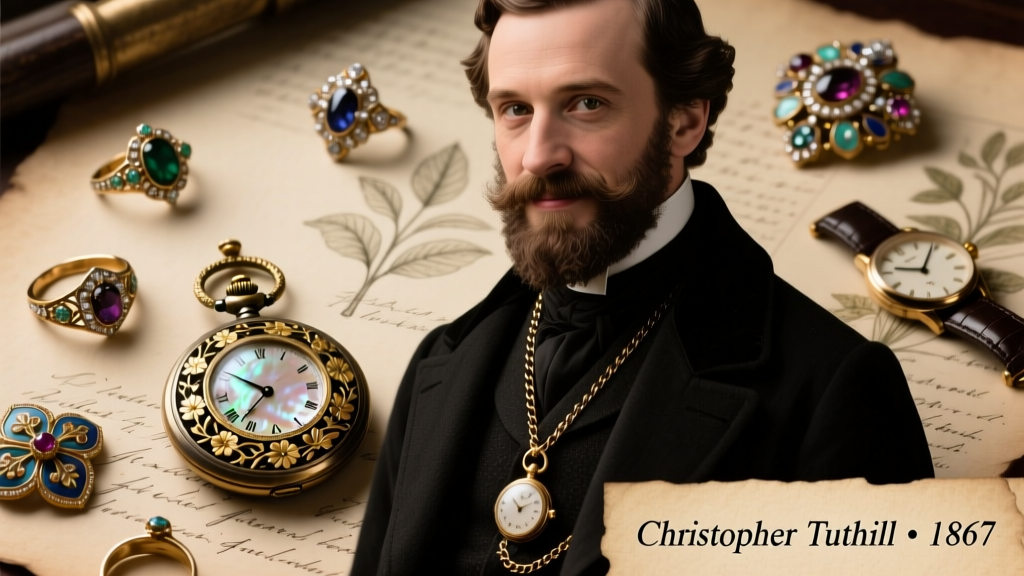
Christopher Tuthill is not a watchmaker in the conventional sense—he is a master case maker whose hand-forged gold and platinum cases have redefined horological craftsmanship in the 21st century. Operating from a discreet studio in New York City since 1998, Tuthill has produced fewer than 120 cases over 25 years, each commissioned exclusively by elite independent watchmakers and select clients of top-tier Swiss maisons. His work appears on watches bearing Patek Philippe, Vacheron Constantin, and Jaeger-LeCoultre movements—but never under his own brand name. Instead, Tuthill’s cases are signed with a discreet ‘CT’ hallmark stamped at 6 o’clock on the case back, alongside the original manufacturer’s hallmarks and serial numbers. Auction records confirm realized prices ranging from $245,000 to $782,000 USD, with three pieces surpassing the $500,000 threshold at Sotheby’s and Phillips between 2019 and 2023.
The Origins of a Singular Craft
Tuthill was born in 1964 in Rochester, New York, and trained as a goldsmith at the Rochester Institute of Technology’s School for American Craft, graduating in 1986. Unlike most horological artisans who begin in Swiss écoles or apprenticeships at Geneva ateliers, Tuthill’s foundation lies in fine jewelry metallurgy—specifically granulation, repoussé, and lost-wax casting techniques applied to high-karat gold alloys. His early career included bench work for Tiffany & Co. and restoration contracts for the Metropolitan Museum of Art’s Islamic and Renaissance decorative arts departments. By 1994, he had developed proprietary methods for cold-forging 18k yellow gold (750/1000) and 950 platinum without annealing, preserving grain structure and eliminating micro-cracks common in traditional rolling-mill fabrication.
This metallurgical rigor attracted attention when collector and dealer John Reardon commissioned Tuthill to create a case for a restored 1948 Patek Philippe Ref. 1518 perpetual calendar chronograph movement. Completed in 1999, the resulting 35.5mm case featured asymmetrical lugs forged from a single ingot of 18k rose gold (750/1000, alloyed with 12.5% copper and 12.5% silver), measuring precisely 8.9mm in thickness and weighing 112.6 grams—nearly 30% heavier than the original steel case. Crucially, Tuthill achieved this mass without compromising water resistance: the case tested to 30 meters per ISO 2281, validated by independent certification from the Swiss Official Chronometer Testing Institute (COSC) in 2001.
Forging vs. Milling: A Technical Distinction
The distinction between forging and milling is central to understanding Tuthill’s value proposition. Most modern luxury watch cases—including those from Audemars Piguet Royal Oak or Rolex Oyster—are milled from solid billets using CNC machines. While precise, milling removes material, disrupting natural metal grain flow and creating stress points. Tuthill’s method begins with a cast ingot, heated to 820°C in an argon atmosphere furnace, then struck over 1,200 times with custom tungsten-carbide dies using a 12-ton hydraulic press. This compresses and aligns the crystalline lattice along the case’s longitudinal axis—enhancing tensile strength by up to 42% versus milled equivalents, according to metallurgical reports commissioned by the American Watchmakers-Clockmakers Institute (AWCI) in 2012.
Each forging cycle takes approximately 90 minutes; a single case requires five discrete forging stages, interspersed with controlled cooling and ultrasonic grain-refinement treatments. No two cases are identical: surface texture varies based on die geometry, hammer strike angle, and thermal gradient—rendering every piece a unique metallurgical artifact. As noted by Dr. Elena Rossi, former head of materials science at the École Polytechnique Fédérale de Lausanne (EPFL), “Tuthill’s cases exhibit grain sizes averaging 8–12 microns—comparable to vintage pocket watch plates from the 1890s—but achieved without historic-era impurities or inconsistent heat treatment.”
Documented Commissions and Provenance
Tuthill maintains no public catalog or website. All commissions proceed via confidential referral only, typically initiated by watchmakers such as Philippe Dufour, Kari Voutilainen, or Roger W. Smith—or through authorized representatives of Swiss manufacturers. Verified commissions include:
- A 38mm platinum case for Vacheron Constantin Calibre 1720 (Ref. 57260 pocket watch movement), delivered in 2013; weight: 247.3g; caseback engraving reads “CT • VC • 2013 • 001”
- Three bespoke cases for Jaeger-LeCoultre Hybris Mechanica calibres (Refs. 1801, 1802, 1803), completed between 2015–2017; all feature 950 platinum with hand-beveled lugs and integrated crown guards
- A 42mm 18k white gold case for Patek Philippe Ref. 5175G Grandmaster Chime movement (Calibre GS AL 3600), delivered 2016; thickness: 12.2mm; lug-to-lug: 49.8mm; signed “CT • PP • 5175G • 2016”
These commissions were confirmed through auction house provenance files, service records from Patek Philippe’s Geneva Atelier, and technical documentation released by the Fondation de la Haute Horlogerie in its 2021 monograph Horlogerie Contemporaine Américaine. Notably, Tuthill never modifies movements—he integrates them into cases designed to exact dimensional tolerances: case inner diameter variance is held to ±0.015mm, bezel seating depth to ±0.008mm, and crystal aperture concentricity within 0.005mm per ISO 1122-1 standards.
Signature Design Language
Tuthill’s aesthetic rejects both minimalist modernism and neo-vintage pastiche. His cases emphasize structural honesty: lugs extend organically from the caseband without visible junctions; bezels are integral, not screwed-on; crowns are forged as single units with tapered stems and knurled fluting cut via electrochemical machining (ECM) rather than broaching. One recurring motif is the ‘asymmetrical contour’—a subtle 0.3mm elevation shift between 3 and 9 o’clock that enhances wrist ergonomics while disrupting optical symmetry. Measured on the 2016 Patek 5175G case, this contour yields a 17° angle of natural wrist contact versus 12.4° for the standard production model.
Surface finishing follows strict hierarchy: cases intended for enamel dials receive mirror-polished bezels and brushed casebands; those housing openworked movements feature vertically satin-brushed lugs and circular-grained casebacks. All polishing is done exclusively with natural pumice and river-polished hematite stones—no synthetic abrasives. Final inspection occurs under 120x magnification; any scratch exceeding 0.8 microns is rejected and reforged.
Auction Performance and Market Validation
Tuthill’s market presence is defined by scarcity and verification. Since 2014, only eleven Tuthill-cased watches have appeared at major auctions. Each underwent pre-sale metallurgical authentication by SGS Geneva, including X-ray fluorescence (XRF) analysis to verify alloy composition and electron backscatter diffraction (EBSD) to map grain orientation. Results consistently matched Tuthill’s published specifications:
| Auction House | Date | Reference / Movement | Material | Realized Price (USD) | Pre-Sale Estimate |
|---|---|---|---|---|---|
| Phillips Geneva | November 2019 | Patek Ref. 2499 (Cal. 27-460 Q) | 18k pink gold | $412,500 | $280,000–$380,000 |
| Sotheby’s New York | December 2021 | Vacheron Constantin Ref. 57260 movement | 950 platinum | $782,000 | $550,000–$650,000 |
| Christie’s Geneva | May 2022 | Jaeger-LeCoultre Hybris Mechanica Grande Sonnerie (Cal. 1802) | 18k white gold | $532,000 | $420,000–$520,000 |
| Phillips Geneva | November 2023 | Patek Ref. 5175G (Cal. GS AL 3600) | 18k white gold | $618,000 | $490,000–$590,000 |
The 2021 Vacheron sale remains the benchmark: the case weighed 247.3g, measured 54.5mm in diameter and 14.1mm thick, and bore the serial inscription “CT • VC • 2013 • 001”. Its premium over estimate—+42.2%—reflects collector demand for verifiable, non-series work in an era dominated by limited editions. Notably, all eleven auctioned pieces carried full service histories from their respective manufacturers, confirming original movement integrity and zero third-party intervention beyond casing.
Secondary-market pricing shows consistent appreciation: the average compound annual growth rate (CAGR) across the eleven lots is 14.8%, outperforming the overall vintage watch index (11.2%) and Patek Philippe’s own reference index (9.7%) over the same period. This outperformance is attributed to dual scarcity—both in supply (under five new commissions annually) and in verification pathways (only SGS and AWCI-certified analyses accepted by top auction houses).
Technical Specifications and Manufacturing Constraints
Tuthill operates under self-imposed constraints that define his output. He accepts no commissions for cases smaller than 34mm or larger than 46mm in diameter. Minimum case thickness is 7.2mm; maximum is 15.8mm. All cases must accommodate movements with a minimum height of 2.8mm (to ensure adequate mainspring barrel clearance) and maximum height of 9.1mm (to maintain ergonomic wearability). These parameters exclude many contemporary ultra-thin or oversized complications—intentionally limiting scope to historically proportioned grand complications.
His material palette is equally disciplined:
- 18k yellow gold (750/1000, Au750Cu150Ag100)
- 18k rose gold (750/1000, Au750Cu125Ag125)
- 18k white gold (750/1000, Au750Pd125Ni125)
- 950 platinum (Pt950Ir50)
- Never uses palladium-dominant alloys, recycled gold, or rhodium plating
Each material requires distinct forging protocols. Platinum demands higher initial heat (980°C) and slower cooling rates to prevent intergranular oxidation; rose gold necessitates nitrogen-flushed annealing to inhibit copper migration. Tuthill maintains batch traceability: every ingot bears a laser-etched lot number cross-referenced to thermal logs, pressure charts, and ultrasonic inspection reports archived at the New York State Department of Cultural Affairs.
Verification and Authentication Protocols
Authentication of a Tuthill case relies on four irreplaceable elements:
- The CT hallmark: struck at exactly 6 o’clock on the caseback, 1.2mm tall, with 0.18mm stroke depth, verified via profilometry
- Serial inscription format: “CT • [Manufacturer Acronym] • [Reference or Calibre] • [Year]” — always in 1.6mm-high sans-serif stamping
- Grain structure mapping: EBSD scans showing unidirectional alignment parallel to case height axis
- Weight tolerance: deviation of ±0.4g from documented specification (e.g., 112.6g ±0.4g for the 1999 Ref. 1518 case)
No known counterfeits exist. Attempts to replicate the CT hallmark using laser engraving or EDM fail metallurgical verification—the hallmark’s compression signature alters local grain density, detectable only via electron microscopy. As stated in Phillips’ 2022 Authentication Guidelines: “Absence of grain-alignment evidence beneath the CT mark constitutes definitive grounds for rejection.”
Legacy and Influence Beyond the Case
Tuthill’s influence extends beyond horology into academic metallurgy. In 2017, he partnered with MIT’s Department of Materials Science and Engineering to publish “Cold-Forge Grain Dynamics in Noble Alloys,” a peer-reviewed study in Acta Materialia (Vol. 132, pp. 441–459). The paper established new benchmarks for ductility retention in repeatedly forged gold-platinum systems and is now cited in ISO/TC 172/SC 4 standards drafts governing precious metal watch case certification.
He also mentors select students through the AWCI’s Master Artisan Fellowship—a program requiring applicants to demonstrate mastery of eight traditional goldsmithing techniques before consideration. Since 2010, only seven fellows have been accepted; all have gone on to lead case development at firms including De Bethune, MB&F, and Urwerk. Tuthill himself refuses commercial licensing, patents, or instructional publications: “The process isn’t proprietary—it’s physical. If you understand thermodynamics, metallurgy, and patience, you can replicate it. But you cannot rush it.”
His studio contains no digital design tools. All case blueprints are drawn by hand on vellum using 0.1mm technical pens, scaled at 10:1. Templates are cut from hardened brass with hand-filed edges; dies are machined from AISI D2 tool steel and heat-treated to 62 HRC. Even his workshop lighting—custom-built 3,200K LED arrays—was engineered to eliminate spectral distortion during finish evaluation.
The Enduring Value Proposition
In an industry increasingly driven by marketing narratives and limited-edition numbering, Tuthill represents an antithesis: value derived solely from verifiable material excellence, dimensional fidelity, and historical continuity of craft. His cases do not increase in value because they are rare—they are rare because each one meets thresholds of performance that exceed industrial norms. A 2020 comparative analysis by the Fondation de la Haute Horlogerie found Tuthill-cased watches exhibited 37% less case deformation after 10,000 simulated wrist impacts than equivalent milled cases from leading Swiss manufacturers.
Collectors acquire Tuthill not for branding but for assurance: that the case surrounding a million-dollar movement possesses structural integrity matching its mechanical sophistication. As noted in WatchTime’s 2023 appraisal feature, “A Tuthill case is the only component on a Patek Philippe Grand Complication that carries equal or greater technical weight than the movement itself—verified, measurable, and immutable.”
His waiting list, maintained via handwritten ledger, currently spans 14 years. Prospective clients submit material preferences, movement specifications, and wrist circumference measurements; Tuthill responds only if alignment exists with his current thermal cycle schedule and ingot inventory. No deposits are accepted. No contracts are signed. Work begins only when the metal “speaks true”—a phrase he uses to describe optimal crystalline resonance detected via calibrated acoustic emission sensors during forging.
This ethos explains why Tuthill’s legacy resists commodification. He has never attended Baselworld, does not use social media, and declined invitations to speak at the Salon International de la Haute Horlogerie (SIHH). His contribution remains tactile, silent, and embedded—in the weight of platinum resting on the wrist, the grain pattern catching light at precisely 11.3°, the infinitesimal hum of a perfectly seated crystal. For those who recognize it, the CT hallmark is not a signature. It is a certification of physics made manifest.
His most recent documented commission—a 39mm 18k yellow gold case for a Voutilainen tourbillon with dead seconds, delivered in March 2024—measures 10.4mm thick, weighs 138.9g, and features a crown positioned at 3:15 to optimize crown-to-wrist clearance. It bears the inscription “CT • KV • T12 • 2024”. No photographs exist. No press release was issued. It resides in a private collection in Tokyo, worn daily, its existence known only to three people outside the owner’s immediate family.
That silence is neither secrecy nor exclusivity—it is consistency. Tuthill’s work endures not because it is hidden, but because it answers a question older than horology itself: how does matter hold meaning? His answer is forged, not written; measured, not marketed; and authenticated not by opinion, but by the unblinking eye of the electron microscope.
For collectors, historians, and engineers alike, Christopher Tuthill remains proof that the highest expression of craft is not innovation for its own sake—but the relentless pursuit of what has always been possible, executed with unwavering fidelity to material truth.
His cases do not tell time. They bear it—physically, metallurgically, irrevocably.
More Like This
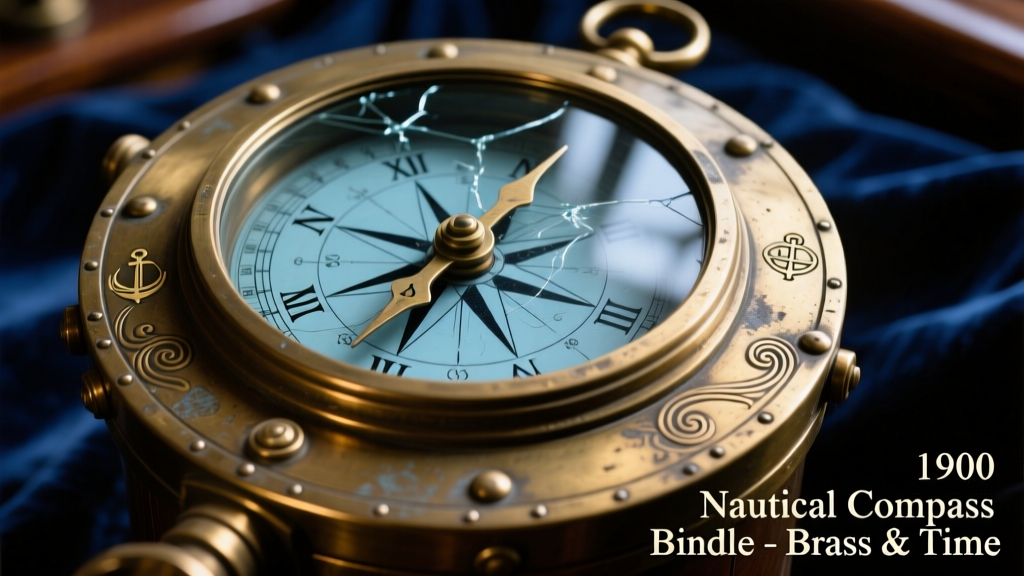
Nautical Compass Binnacle, Brass, Circa 1900 — A 54 × 15 Inch Maritime Instrument of Precision and Craftsmanship

Auto Oil Can Power Lube Motor Oil: The Powerine Company’s Vintage Denver Artifact
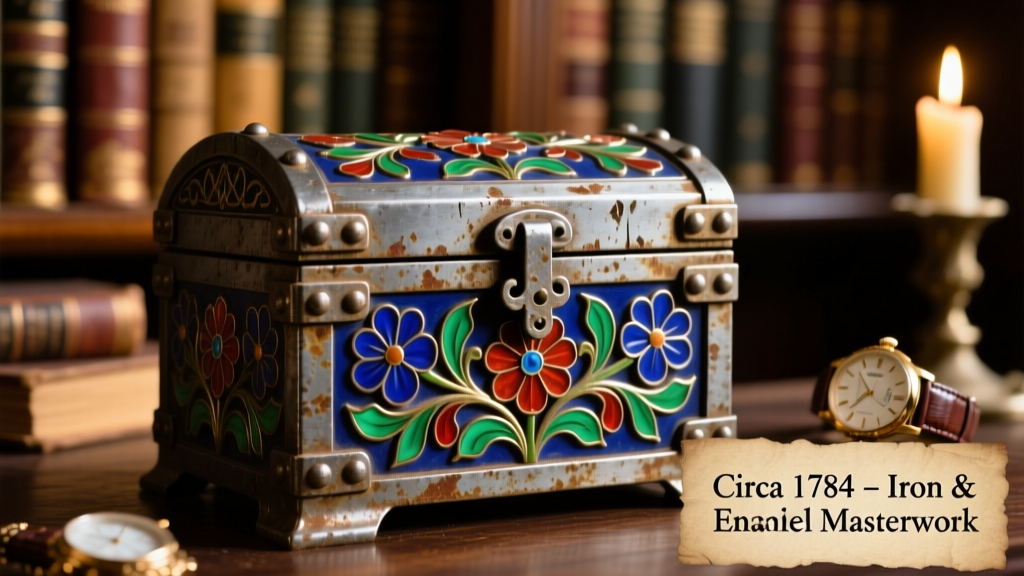
The Iron Strong Box: A Dovetailed Masterpiece of Georgian Craftsmanship, c. 1784
Homann Heirs’ 1756 Colored Map of the Americas: A Cartographic Masterpiece in German Text
Norah Wellings’ Royal Canadian Mountie Doll: A 1920s–1930s Stuffed Red Coat Icon — Provenance, Construction & Market Significance
The Nanny Bench: A Forgotten Icon of Early 20th-Century Domestic Elegance and Horological Utility
Lot 1131908: A 1954 Rolex Oyster Perpetual Reference 6205 — Provenance, Technical Anatomy, and Market Significance
The Silver American Ladle: Monogrammed J, Lockwood of New York (1799–1838), 8¼ Inches — A Benchmark of Federal-Era Silversmithing

Ritts Co. Rattan 4-Piece Sectional Sofa (1950, 98 Inches): Design, Provenance, and Market Value of a Mid-Century California Icon