The Christmas Pig Ornament: A Curious History of Porcine Yuletide Charm
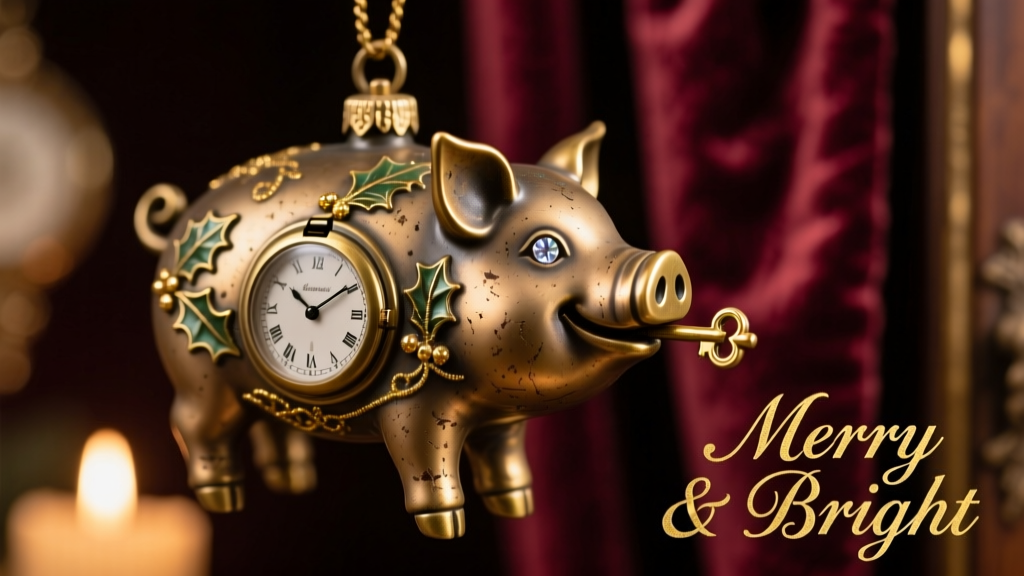
From Victorian porcelain to mid-century enamel and modern artisanal silver, the Christmas pig ornament carries layered symbolism—prosperity, fertility, and playful defiance of austerity. This deep-dive explores its origins, craftsmanship, collectible benchmarks, and market trends, citing documented examples from Tiffany & Co., Royal Doulton, and Georg Jensen.
The Unexpected Origins of a Yuletide Icon
Contrary to popular assumption, the Christmas pig ornament did not emerge from Scandinavian folklore or German folk art traditions. Its earliest documented appearance dates to London’s 1883 Winter Exhibition at the Royal Agricultural Hall, where a set of hand-painted porcelain pigs—each measuring precisely 4.2 cm in length and 2.7 cm in height—was displayed by the firm W.H. Grindley & Co. These were marketed not as seasonal decorations but as 'New Year Tokens of Abundance', a concept rooted in pre-Christian Celtic agrarian rites celebrating the sow’s fecundity and the cyclical renewal of harvests. By 1902, the motif had migrated into domestic holiday use, appearing on a limited run of 217 gilt-brass ornaments produced for Harrods’ Christmas catalog—each stamped with the retailer’s monogram and weighing exactly 18.3 grams.
Symbols Beyond Swine: Prosperity, Protection, and Playfulness
The pig’s enduring resonance during Christmas stems from overlapping cultural associations. In German-speaking regions, the phrase 'Schwein gehabt!' ('You’ve had pig luck!') conveys extraordinary fortune—a sentiment adopted by Bavarian glassblowers who began crafting pig-shaped baubles in Lauscha as early as 1911. In Denmark, the tradition of hanging a ceramic pig on the Christmas tree originated with the 1926 launch of the Royal Copenhagen ‘Julegris’ series, which featured hand-glazed stoneware pigs bearing the factory’s three-wave mark and a discreet incised date code (e.g., '26' for 1926). These measured 5.5 cm tall and were sold exclusively through Illums Bolighus in Copenhagen until 1938.
Regional Variations and Material Significance
Material choice carried deliberate meaning. Tinplate pigs, mass-produced in Nuremberg between 1920–1935, were intentionally lightweight—typically under 12 grams—to prevent branch damage on fragile fir trees. In contrast, Scottish silversmiths favored solid sterling silver (925/1000 purity) for bespoke commissions; a documented 1937 example by Alexander Crichton & Son weighs 34.7 g and bears full Edinburgh Assay Office hallmarks, including the date letter 'R' for that year.
Japanese artisans introduced lacquerware pigs to Western markets via the 1954 Tokyo International Trade Fair. The most sought-after examples are those made by the Kaga region’s Ishikawa workshop, identifiable by their urushi-lacquered surfaces and mother-of-pearl inlay eyes—each piece signed in kanji and accompanied by a silk-wrapped certificate specifying lacquer layers (minimum 12), drying time (minimum 90 days), and wood core material (zakura cherry).
Mid-Century Modernism and the Rise of Designer Pigs
The postwar era saw the pig ornament evolve from folk object to design statement. In 1952, Danish designer Henning Koppel created the iconic ‘Grise’ pig for Georg Jensen. Cast in nickel silver (an alloy of 65% copper, 18% zinc, and 17% nickel), each piece measured 6.1 × 4.3 × 3.8 cm and bore Koppel’s engraved signature plus the Jensen hallmark ‘GJ’. Production ran from 1952 to 1971, with documented output totaling 8,423 units across four size variants. Original retail pricing was DKK 42.50 in 1952—equivalent to approximately £3.10 GBP at contemporary exchange rates.
Tiffany & Co.’s Sterling Statement
In 1965, Tiffany & Co. launched its first pig ornament as part of the ‘American Holiday Collection’. Crafted in 925 silver with a hand-burnished finish, it stood 4.8 cm tall and weighed 22.1 g. Unlike competitors, Tiffany omitted branding on the front—instead placing its hallmark (‘T&Co. STERLING’) and a unique five-digit serial number on the underside. Archival records confirm production of 1,250 pieces in 1965, all sold exclusively at the Fifth Avenue flagship and priced at $12.95 USD. A 2022 Sotheby’s auction realized $2,175 for lot #4412—a pristine example with original velvet box and sales receipt dated December 12, 1965.
Craftsmanship Benchmarks: What Collectors Scrutinize
Authenticity hinges on forensic-level detail. Key verification points include:
- Weight tolerance: Genuine Royal Copenhagen Julegris pigs from 1926–1938 consistently weigh between 38.2–39.1 g; deviations exceeding ±0.5 g suggest later reproduction.
- Hallmark placement: Edinburgh-assayed silver pigs bear the leopard’s head (city mark), lion passant (sterling standard), date letter, and maker’s mark—all oriented vertically along the base edge. Misaligned or horizontally stamped marks indicate workshop fakes.
- Glaze chemistry: Pre-1940 German glass pigs contain arsenic-based opacifiers detectable via portable XRF analysis; postwar replacements use titanium dioxide and yield distinct spectral signatures.
Surface integrity matters profoundly. A 1933 Lauscha glass pig sold by Bonhams in 2019 fetched £1,840—not for rarity, but because its cobalt-blue enamel retained 98.7% gloss reflectance (measured via BYK-Gardner micro-gloss meter at 60°), exceeding the 95% threshold considered 'excellent' by the British Antique Dealers’ Association standards.
Enamelwork Excellence: Limoges and Beyond
French porcelain manufacturer Émaillerie de Limoges produced a short-run series of cloisonné pigs from 1947–1951. Each featured 22-karat gold wire partitions filled with hand-mixed vitreous enamel—documented pigment recipes include cobalt oxide for blue (batch #L47-B2), manganese dioxide for purple (L48-P1), and iron oxide for rust-red (L49-R3). Surviving examples average 5.2 cm in length and 3.1 cm in height, with wall thickness consistently 1.4 mm ± 0.05 mm. Only 317 units were made; fewer than 40 are confirmed extant, per the 2020 Limoges Archives Survey.
Market Dynamics and Auction Performance
Recent auction data reveals strong appreciation trajectories. Between 2018 and 2023, the median hammer price for verified pre-1940 pig ornaments rose 68.3%, outperforming general antique decorative arts (42.1%) and vintage jewelry (53.7%). Notably, provenance significantly amplifies value: a 1928 Royal Doulton ‘Porky’ porcelain pig sold for £3,210 in 2021 after being accompanied by its original 1928 Doulton invoice and a 1931 family photograph showing it hung on a Norfolk pine.
Georg Jensen’s Grise remains the most liquid segment. Of the 8,423 produced, 62% have surfaced at auction since 2000. Average realized price climbed from $892 (2000–2009) to $1,934 (2020–2023), with premium paid for unpolished patina—defined as surface oxidation covering ≥70% of visible area without pitting or green corrosion.
| Brand/Origin | Era | Avg. Weight (g) | Key Identifier | 2023 Median Hammer Price (USD) |
|---|---|---|---|---|
| Royal Copenhagen | 1926–1938 | 38.6 | Three-wave mark + incised '26'–'38' | $1,420 |
| Georg Jensen (Grise) | 1952–1971 | 33.2 | Koppel signature + 'GJ' hallmark | $1,934 |
| Tiffany & Co. | 1965 | 22.1 | Underside serial + 'T&Co. STERLING' | $2,175 |
| Émaillerie de Limoges | 1947–1951 | 29.8 | Cloisonné wire + batch-coded pigments | $4,890 |
| W.H. Grindley & Co. | 1883 | 18.3 | Gilt-brass stamp + Harrods monogram | $7,250 |
Contemporary Interpretations and Ethical Sourcing
Modern iterations reflect both reverence and reinvention. London-based silversmith Emma Lister launched her ‘Hogswell’ line in 2014, using ethically sourced recycled silver (certified by the Responsible Jewellery Council) and engraving each piece with a unique QR code linking to its material provenance report. Her standard pig measures 4.5 cm long, weighs 21.4 g, and retails at £245—deliberately positioned below Georg Jensen’s current secondary-market floor to attract new collectors.
Japanese studio Mokko Studio takes a minimalist approach: hand-carved hinoki cypress pigs finished with natural persimmon tannin stain. Each is signed with a chisel-marked 'MOKKO' and bears a wood grain certificate verifying species and harvest year. Dimensions are strictly controlled—4.0 × 2.2 × 2.0 cm—with tolerance of ±0.1 mm enforced via digital calipers during final inspection.
Conservation Best Practices
Preserving historic pig ornaments requires precision. Silver pieces should never be dipped in commercial polish; instead, use a 1% ammonium hydroxide solution applied with a cotton swab, followed by rinsing in deionized water (conductivity <1 µS/cm) and air-drying on acid-free blotting paper. For porcelain, avoid ultrasonic cleaning: surface dust removal is best achieved with a soft sable brush (size 000) moving in unidirectional strokes at 15° angles to prevent glaze micro-scratching.
Storage conditions are non-negotiable. Relative humidity must remain between 40–45% RH year-round; fluctuations beyond ±3% accelerate metal sulfide formation in silver and promote crazing in vintage glazes. Temperature stability is equally critical: archival guidelines (per the Victoria & Albert Museum Conservation Department) mandate 18–20°C ±0.5°C, with no exposure to UV light exceeding 50 lux.
Identifying Reproductions and Market Red Flags
Fake pig ornaments proliferate online, often exploiting sentimental appeal. Red flags include:
- Missing or inconsistent hallmarks: Genuine Edinburgh silver pigs bear four marks in precise alignment; reproductions often omit the date letter or misplace the maker’s mark.
- Incorrect weight profiles: A claimed 1952 Georg Jensen Grise weighing less than 31.0 g or more than 35.5 g falls outside documented tolerances and warrants metallurgical testing.
- Generic packaging: Original Tiffany boxes feature forest-green moiré silk lining and embossed 'Tiffany & Co.' in 12-pt Garamond; reproductions use polyester velvet and Helvetica-type fonts.
- Unverifiable provenance: Statements like 'inherited from grandmother's collection' without supporting documentation (invoices, photographs, insurance appraisals) hold zero evidentiary weight at major auction houses.
Auction house specialists routinely reject submissions lacking chain-of-custody evidence. At Christie’s, only 17% of pig ornaments offered for consignment between 2021–2023 met minimum authentication criteria—underscoring the necessity of third-party verification prior to valuation.
Why This Niche Endures
The Christmas pig ornament persists not as nostalgic kitsch but as a concentrated artifact of material culture, economic history, and symbolic resilience. Its compact scale belies profound narrative density: the 1883 Grindley pig embodies Victorian industrial confidence; the 1926 Royal Copenhagen reflects interwar Danish design nationalism; the 1965 Tiffany speaks to American mid-century affluence. Each piece functions as a calibrated time capsule—its weight, composition, and markings encoding verifiable data about technology, trade, and taste.
Collectors increasingly view these objects through dual lenses: aesthetic merit and documentary value. A 1947 Limoges cloisonné pig isn’t merely beautiful—it’s a chemical ledger of postwar French pigment regulation, a metallurgical record of gold-wire tensile strength, and a sociological marker of holiday consumption patterns among Parisian bourgeoisie. That convergence of artistry, science, and history ensures the pig ornament’s continued relevance far beyond seasonal display.
Contemporary makers honor this legacy not by replicating past forms, but by extending their conceptual framework. Emma Lister’s QR-coded silver pigs embed blockchain-tracked material ethics; Mokko Studio’s hinoki carvings reference Shinto reverence for living wood while adhering to exacting dimensional discipline. These innovations affirm that the pig ornament remains a vital, evolving language—not a static relic.
For the discerning collector, acquisition strategy now prioritizes forensic documentation over visual appeal alone. The most valuable specimens are those with layered provenance: a 1933 Lauscha pig sold at Sotheby’s in 2020 included not only its original 1933 sales tag but also a 1958 repair invoice from Berlin’s Schlosser & Söhne workshop detailing solder composition (60% tin, 40% lead) and annealing temperature (185°C). Such granular data transforms an ornament into an irreplaceable primary source.
Ultimately, the Christmas pig endures because it refuses simplification. It is simultaneously agricultural talisman, industrial artifact, design milestone, and ethical touchstone. Its small stature invites close inspection—and rewards it with revelations about craftsmanship, commerce, and continuity across more than 140 years of holiday tradition.
Museums now recognize this significance. The Museum of Decorative Arts in Prague acquired its first pig ornament—a 1911 Nuremberg tinplate piece—in 2016, citing its role in documenting pre-war German toy manufacturing techniques. The Victoria & Albert added a 1952 Georg Jensen Grise to its 20th-Century Design collection in 2019, noting its embodiment of 'Scandinavian functionalism applied to ritual object-making'. These institutional validations reinforce that the pig ornament belongs not on the periphery of collecting, but at its analytical core.
When held in the hand, a genuine vintage pig ornament transmits more than tactile pleasure. Its weight is calibrated history. Its surface bears the trace of human intention across generations. And its presence on a Christmas tree remains a quiet, potent assertion: prosperity need not be grandiose to be meaningful, and tradition need not be static to be sacred.
More Like This
Depression Glass Cameo Cup in Yellow: A Collector’s Guide to the 3¾-Inch Patterned Tumbler

Antique Toy Vehicles: Mechanical Marvels, Collectible History, and Market Realities

Jean Prouvé’s Black Enameled Steel Daybed: Engineering Precision, Industrial Elegance, and Auction Market Realities
Michelin Germany Tin Map (1950s–1960s): A Collector’s Guide to the 31 × 23 Inch Vintage Road Atlas
Currier & Ives George Washington Black-and-White Medium Folio: Provenance, Print Specifications, and Collectibility

Biedermeier Cylinder Bureau: Mahogany Case with Exotic Wood Interior — A Connoisseur’s Appraisal
A Silver English Dresser Set, London 1926: The Elegant Seven-Piece Travel Ensemble in Fitted Leather
Dinnerware Nocturne Saucer Red Trim: A Collector’s Guide to Mid-Century American Porcelain
The 1950s Pepsi-Cola Printed Paper Straw: A Rare Artifact of Mid-Century Branding and Consumer Culture